An opening note of acknowledgement and gratitude
This book was born of a personal search and a prolonged dialogue. It does not come from a university chair or from the authority of a Buddhist teacher. Its purpose is more humble: to bring some of the teachings of Buddhism closer to people who wish to understand suffering better and to learn to live with greater clarity.
The idea, the structure, the choice of themes and the general direction are mine. During the process I used an artificial intelligence to organise materials, develop drafts and explore ways of explaining complex concepts in accessible language. Afterwards I reviewed, corrected and steered the text in accordance with my experience, my reading and the kind of book I wished to offer. Responsibility for the final version, its decisions and its limits is mine.
These pages are intended for those who barely know Buddhism, for those who approach it from another religious tradition, and also for those who hold no settled faith. They do not claim to replace the original sources, the guidance of qualified teachers, a community of practice, or professional help when it is needed. They aspire to be a doorway and an initial companion.
There are pains that life brings without asking permission: a loss, an illness, anxiety, loneliness, or fear of the future. And there is a suffering that we add ourselves when we resist, cling, or react before we understand. This book is born to help us tell them apart.
Buddhism for Walking the Path brings Buddhism closer to those of us who live in the West, not as an obligation to abandon our beliefs, but as a philosophy of life and a practice of clarity. Its central tool is meditation, through which we learn to calm the mind, to be less reactive in our responses, and not to turn pain into added suffering.
To come to know it, the book draws on the explanations of Buddhist teachers and monks who have spent more than two thousand years studying the human mind and its reactivity. It also explains the three roots of suffering —ignorance, attachment and aversion— and the eight rightnesses of the Noble Eightfold Path, Buddhism’s ethical proposal for leading a life that is kinder to ourselves and to others.
The book turns to recognisable human experiences, especially grief understood in a broad sense: the loss of a loved one, of a job that sustained our identity, of family life when we first leave home, of health, or of a stable image of ourselves. Loneliness, illness, anxiety, family conflict, fear of the future, and a difficult relationship with one’s own body will also appear. No single example can represent every life. I trust that each reader will know how to carry the heart of the teachings over to their own particular situation without forcing parallels.
I want to express my gratitude to my religious education teacher in secondary school, who planted in me a first curiosity about Buddhism. I am also grateful for the testimony of Tina Turner, whose life showed that a spiritual practice can become a real support in the face of fear and suffering.
The books of Pema Chödrön have been a decisive influence. In them I found an honest way of approaching pain without fleeing and of making friends with one’s own mind. The teachings of Thich Nhat Hanh, especially those devoted to mindfulness, compassion and the transformation of anger, clarified many questions and gave a practical direction to this search.
I thank God for having allowed me to come close to Buddhism without experiencing it as a betrayal of my Catholic faith. For me it has been a help in cultivating silence, attention, compassion and responsibility. Not everyone around me has understood this interest; that lack of support, however, has not diminished the value of what I have learned.
I do not write to convince anyone to abandon their beliefs. I write to hold out a hand. If these pages help one person to understand their pain, to treat themselves with less harshness, or to look at life with a little more clarity, the work will have been worthwhile.
One last thing before we begin. This is a book for entering into the philosophy of Buddhism and learning to look at one’s own mind, and meditation is essential to that learning. But if you have come this far with a more urgent question, if what you need today is to know how to begin to meditate, a quick guide to meditating awaits you at the end of the book. It does not replace any of the teachings that follow; it is a brief manual of initiation, just enough for you to sit down this very day. Later, when you have the breath for it, return to these pages: in them are all the practices and all the ideas that, joined to meditation, can teach you to see the course of your own life with greater clarity.
For those who begin midway along the path
This book is not addressed to perfect people, nor to those who believe they have every question resolved. It is intended for whoever begins in the middle of real life: after a loss, during a spell of anxiety, in the midst of loneliness, facing an illness, or simply on discovering that the usual way of living no longer brings any rest.
We often seek peace by imagining that the world must settle back into place as it was. We wish to recover the one who died, to return to the job that gave us an identity, to go back to the family home as though we had never left, to secure the future, to keep the body from changing, or to get others to confirm our worth. Life offers no such contract. Everything that is born is transformed; bonds change, health is vulnerable, and no identity remains intact.
Buddhism begins by looking at that reality head-on. It does not aim to make us cold, to deny love, or to ask for passive obedience in the face of harm. It proposes distinguishing between the pain that is part of existence and the suffering we add when we cling, reject what has happened, or turn a wound into a total definition of ourselves.
Buddhism has spent more than two thousand years observing how the human mind works. For me, that long journey confirms it as a practice grounded in experience: a path for learning to govern one’s own mind. Its wisdom helps the “reactive mind” of the twenty-first-century human being to recover self-control, and to that end it uses meditation as a tool. Moreover, the rectitudes that the Noble Eightfold Path defines lead those who decide to bring them into their lives to walk it in a more conscious, honest and kind way, both with themselves and with those around them. That is why I encourage the reader to read on and to discover that “Nirvana” is not “the Buddhists’ heaven”, but a state anyone can reach in this very life: that of being at peace with oneself and with others.
Ever since I grew interested in Buddhism, I set out on a long course of reading Buddhist monks and masters, experts in the mastery of their own minds. Yet I found it very hard to absorb all that material: it was steeped in a certain “Eastern mysticism” that made it difficult for me to understand. Only after years of reading did I finally come to grasp it clearly. That is the reason that led me to write this book: to distil, into Western language, the Buddhist teachings for those who wish to live them as a philosophy of life, and not as a religion.
A death hurts because there was love. Losing a job can throw one’s identity into disarray. Leaving home for the first time can hurt because it also means leaving behind a form of family. An unexpected change in health or in life can disorganise the imagined future. Loneliness, illness, failure or financial fear each have their own ways of wounding. The practice does not consist in declaring that nothing matters, but in learning to accompany what matters without multiplying the inner violence.
Throughout the book the word ego will appear. It will not be used only as a synonym for arrogance. It will denote the tendency to construct a stable image of “I” and to defend it continually: wanting to control, to be right, to receive validation, to be liked, to hold on, or to avoid any sign of fragility. That tendency is not a monster we must hate. It often springs from fear. Seeing it clearly allows it to stop directing us blindly.
We will also observe the mind. We will learn to tell a fact apart from the story we build about it, an emotion from the conduct we choose, and love from the desire to possess. We will enter little by little into meditation, ethics, impermanence, compassion, emptiness and interdependence. In the end we will come closer to bodhichita, tonglen and lojong, practices aimed at opening the heart beyond an exclusive concern for oneself.
Buddhism can be lived as a complete religion, as a discipline of transformation, or as a source of learning compatible, with discernment, with other convictions. This book will respect those possibilities without reducing a profound tradition to a set of pleasant phrases or relaxation techniques.
No life without sorrow is promised. Nor does meditation guarantee permanent calm. Its function is to help us be present, recognise our habits and respond with less confusion. Sometimes waking up is uncomfortable: it forces us to admit that we were calling attachment love, hardness strength, or the fear of setting limits patience. That discomfort can be the beginning of a more honest freedom.
I want to confess something with humility before going on. Very often, the occasions when I most needed to meditate have been, precisely, the ones when I could not. When the pain really bore down, when a piece of news left me with no ground beneath me, when rage or fear filled everything, sitting down to breathe seemed impossible to me, and even out of place. The last thing one wants, when burning inside, is to stay still with what is burning.
And yet, I have gradually come to understand that this is exactly where it matters most. Not because meditating puts out the fire —it does not— but because it gives us back an instant of awareness before reacting. There are days when you do not feel like it, when no impulse advises you to do it, when it seems to be of no use at all. Those are, almost always, the days when you need it most. You do not have to do it well: it is enough to come back, even for a minute, even trembling. This book is also written out of those times when I could not, and came back all the same.
Perhaps it will help if I first tell how I myself learned to meditate, because I did not arrive all at once: I arrived in stages, and this book follows that same order.
I began with the simplest thing there is: bringing the mind to the present moment and returning to the breath each time it wandered off. It is the practice that the mindfulness movements revived in the nineteen-seventies and took into hospitals, clinics and schools, although Buddhism had been teaching it for centuries under another name: attention to the breath, anapanasati, the basis of what is called calm meditation. There is no mystery to it. One sits, feels the air coming in and going out and, on discovering that the mind has wandered, returns. That is all.
It seems little and it changes much. What I learned there was not to be calm, but to stop being so reactive: not to respond out of anger, not to decide in the heat of the moment, not to strike back when I felt attacked. Between what happens and what I do there appeared, for the first time, a small space. Another life fits in that space. If you begin here, you will find it in detail in chapters 17, 18 and 19, and in chapter 23, which is the one that serves for the days when everything is burning.
When that practice was settled, the next one came, somewhat more demanding. It consists in naming. A thought appears —the scene of a loss that still hurts— and with it an emotion: sadness. So far, the experience. But the mind does not stop: it at once manufactures a story. “I will never be happy”. And that sentence, spoken within and in one’s own voice, sounds like a verdict.
It is not. It is a tale. Learning to see this has been, perhaps, the most useful thing the practice has given me. In Buddhism this way of looking is called clear seeing, vipassana, and its best-known tool is precisely that: putting a name to what appears. When the story comes undone, the fact is left in view, and then one can indeed write a sentence closer to what is real: “I am going through a loss; I need to take care of myself today and not turn this pain into a verdict on my whole life”. The first sentence condemns; the second can be worked on. This is developed in chapters 24, 25 and 26, and the exercise of separating fact, emotion and story already appears in chapter 3, almost at the beginning.
The third I have been putting together only recently, and it happens within the meditation itself. A thought arrives and I name it for what it is: “this is a thought”. I look beneath it for the emotion: “it is sadness”. I locate it in the body, because it is always somewhere: the heart, the throat, the stomach, the head. I name the fact without adornment: “something that gave me an identity has changed”. And I undo the story that came stuck to it: “I am no one now”, “I will never again be at home in my own life”.
Nor did I invent that route. It is the order of the four foundations of mindfulness, the satipatthana of the ancient texts: the body, the sensations, the mind and what the mind produces. I came to it out of necessity, without knowing it had a name. It is spread throughout the book: the three pauses of chapter 17, the body as anchor in chapter 20, the emotion in chapter 25 and the four questions in chapter 26.
There is no need to begin with the third; no one begins with the third. One begins by sitting down for five minutes and returning to the breath when the mind wanders off. The rest comes with the months, almost without one noticing. That is why this book can also be read as a meditation manual for someone starting from scratch: you do not need to know anything, nor to believe anything, nor to have ever sat down before.
Each chapter develops a main idea, relates it to everyday life and proposes a simple practice when that proves useful. There is no need to believe it all in advance. It is enough to observe what happens when we cling, how the mind speaks when it fears losing, and what changes when we breathe before reacting.
The path does not begin in a distant monastery. It can begin in a quiet kitchen, in a doctor’s surgery, during a family argument, on switching off the phone, or on acknowledging that we need help. It begins there, where we stop pretending and take the next step with a little more awareness.
We are all looking for rest
There is a weariness that sleep cannot mend.
You can go to bed early, close your eyes, switch off your phone, keep your body still for hours and, even so, wake up with the feeling that something inside you is still restless. It is not just physical fatigue. It is a deeper weariness: that of holding too many worries, trying to control the uncontrollable, putting on a show of strength when inside there is fear, guilt, sadness or emptiness.
That exhaustion often appears after a great loss.
When someone we love dies, life becomes strange. The streets are still where they were, the house keeps its furniture, other people go on talking about ordinary things, but something essential has disappeared. A chair is left empty. A voice stops calling. A gesture suddenly comes back to memory and it hurts. Then we discover that absence, too, has a presence: it fills rooms, dates, songs, photographs and silences.
It can also arise when we lose an identity that sustained us. A job can disappear, and with it the question “who am I now?” falls into disorder. An illness can force us to say goodbye to the sense of security with which we inhabited our body. Leaving home for the first time can open up a longed-for freedom and, at the same time, a grief for the everyday family left behind.
Sometimes grief is not understood from the outside because there is no funeral, no visible farewell. No one sees us mourn a profession, a childhood home, an old form of family or the image of health we took for granted. The mind then fills with questions: “why does it affect me so much?”, “shouldn’t I be grateful?”, “what if I never get to be myself again?”, “how do you live when a part of your identity is gone?”. In that confusion, the heart is split between gratitude, fear, nostalgia and the need to begin.
Loneliness, too, can produce that weariness which sleep cannot mend. Sometimes it does not come from a recent loss or from a visible loss. It is born of feeling, for a long time, without true company, without a gaze that recognises us, without a place where we can rest without playing a part. One can be alone living on one’s own, but also within a family, within a shared home or an apparently normal social life.
When loneliness drags on, the mind begins to tell very harsh stories: “I don’t matter”, “no one chooses me”, “there is something wrong with me”, “it will always be this way”. The basic pain is the need for connection. The added suffering appears when we turn that human need into a verdict on our worth.
In all those moments we tend to say: “I want to be at peace”.
And yet we do not always know what being at peace really means.
We often imagine that peace will come when life gives us back what we have lost. When the person who died could sit again at our table. When the job gave our name back to us. When the family home became once more the refuge it always was. When loneliness stopped visiting us at night. When the future stopped unsettling us. When the illness disappeared. When the children were always safe. When no one criticised us. When everything fitted together.
But life does not work that way.
Existence changes, joins, separates, gives and withdraws. It lets us love, though it does not grant us possession for ever. It gives us bodies, relationships, homes, projects and names, but none of them comes with a guarantee of permanence.
Buddhism begins by looking at this head-on.
It does not aim to make us cold or indifferent. Nor does it ask us to stop loving or to passively accept what destroys us. On the contrary: it invites us to love with greater clarity, to live with more presence and to suffer with less confusion. It teaches that pain is part of life, but it also shows that a part of our suffering is born of the way we resist reality.
This difference will be one of the first lights on the path.
La mente busca refugio
Every human being seeks refuge.
We need to feel safe in something: a family, a friendship, a home, a profession, a bank account, a religion, an image of ourselves, a routine, an explanation of the world. That search is not wrong. Bonds, meaning and a certain stability are deeply human needs.
The problem appears when we turn those refuges into absolutes.
Company can bring relief, but it cannot save us from every emptiness. A loved one can give us love, but cannot defeat death. A profession offers identity and structure, yet it does not guarantee personal worth either. Youth, health or success seem solid for a while, until they reveal their fragility.
When we demand permanence from what by its nature changes, sooner or later we feel betrayed.
But perhaps life has not betrayed us. Perhaps it has only shown us something we did not want to see: nothing conditioned can be a final refuge.
This teaching may seem harsh at first. Well understood, however, it does not destroy our love for life; it makes it more precious.
Knowing that a person can die may help us listen to them better today. Recognising that a stage can end teaches us to love with less possession and more truth. Understanding that some bonds need limits gives us permission not to confuse giving with self-abandonment. Seeing that the body changes invites us to care for it without idolising it. Discovering that emotions pass allows us not to obey every storm as though it were an order.
Buddhism does not take away our love for the world. It teaches us to stop demanding from the world what the world cannot give: absolute permanence, total control and security without cracks.
El primer error: creer que descansar significa controlar
Many people come to spirituality looking for control.
They want to master their anxiety, silence their thoughts, put their grief in order, cool their desire, tame their sadness or neutralise their fear. Even meditation sometimes becomes another project of the ego: “I am going to control my mind so as not to feel bad”.
But deep rest is not born of control. It arises from a wiser relationship with what happens.
Let us imagine someone who has just lost their mother. Each morning they wake and, for a few seconds, forget that she has died. Then they remember, and reality falls on them like a stone. Their impulse may be to flee: to fill the day with tasks, to avoid photographs, not to speak of it, to harden themselves. The opposite could also happen: to stay trapped in the memories, to replay the final moments, to punish themselves for what they said or did not say.
At both extremes there is suffering. At one, because it rejects the pain. At the other, because it identifies completely with it.
The Buddhist path would propose something different: to pause for a moment, to breathe and to recognise, with simplicity:
“This is pain”. “This is love in the form of absence”. “It is happening now in my body and in my mind”. “I can stay with this moment without destroying myself”. “I do not need to turn it into an endless story”.
It is not easy. But it is profoundly human.
Let us think now of someone who has just lost a job that sustained much of their identity. Perhaps it was not perfect, but it gave them a schedule, recognition, belonging and a simple social answer. The mind seeks to control the impossible: it wants guarantees that everything will fit together again, it longs for an explanation with no grey areas, it imagines a transition without fear and it hopes to close a wound without passing through it.
And yet many healthy decisions also hurt.
To rest, in that case, does not mean to stop feeling. It means to stop interrogating ourselves with cruelty. It means to recognise: “I have lost something important; I can suffer this loss without turning it into a verdict on my worth”.
La pregunta que inicia el camino
Buddhism begins with a very concrete question:
Why do we suffer?
The answer does not stay on the surface. It does not simply say that we suffer because bad things happen. Of course they happen. People we love die. Stages come to an end. Illnesses appear. We grow old. We fail. We make mistakes. Others let us down, and we let others down too.
The Buddhist gaze goes deeper and asks:
What does the mind do with what happens? In what way does it turn pain into identity? How does it turn love into possession? What mechanisms make fear into a need for control? When does a thought become a prison? Why can a loss turn into a war against life? At what point does enduring stop being love and become self-abandonment?
Then an even more important question appears:
Is there another way to live through this?
The Buddhist path answers that there is.
It does not promise a painless, magical, quick or invulnerable life. It offers something more sober and more profound: a way of seeing, practising and responding with less confusion.
We can feel without drowning. It is possible to love without possessing. We can remember without destroying ourselves. We can also lose without becoming ruins. One can set limits without hardening the heart. The mind learns to come back when it is trained with patience. The body can breathe within the pain. And the heart, even after closing, can open again.
Un pequeño ejercicio para empezar
Before you read on, pause for a moment.
You do not need to sit like a monk. Nor do you need to close your eyes if you do not want to. It is enough to stop for a moment.
Feel your body. Notice the weight of your hands, the temperature of your face, the contact of your feet with the floor or of your body with the chair. Let your breath come and go without correcting it.
Now ask yourself gently:
What am I looking for when I say that I want to be at peace?
Do not answer too quickly.
Perhaps you are looking for something to be as it was before. Perhaps you wish a death had not happened. Perhaps you are trying to stop feeling guilt. Perhaps you want to control the future, to receive an explanation, to recover a stage of life or to find the strength to accept that it has already changed. Perhaps, deep down, you simply want to rest from yourself.
Look at whatever appears without turning it into a verdict.
Then you can say inwardly:
“This is what there is now”. “I can be here for a moment”. “I do not have to solve my whole life in this instant”. “I only need to come back to this breath”.
That is enough to begin.
Para recordar
Deep rest does not depend on controlling life, but on relating to it in a less violent way. Human refuges are valuable, but none can offer absolute permanence. The path begins when we recognise what we are looking for when we ask for peace, and when we stop demanding that everything change before we can breathe.
Pain is not the same as suffering
There are wounds that belong to life.
No one passes through this world without knowing some form of loss, fear, disappointment or farewell. However much we try to live prudently, to love carefully and to organise the future intelligently, something always arrives that was not in our plans. A phone call changes a morning. A single sentence wounds a friendship. A diagnosis alters the horizon. A death leaves the house full of objects that no longer know to whom they belong.
Buddhism does not begin by denying this. It does not ask us to look the other way or to repeat phrases of serenity while the heart is trembling. Its starting point is more honest: to live involves pain.
But it immediately introduces a decisive distinction.
Pain and suffering are not exactly the same thing.
Pain is a natural response to what wounds us. Suffering, by contrast, tends to grow when the mind resists, clings, interprets, demands or turns the experience into a closed story about ourselves and about life.
This difference may seem small, but it changes the whole path.
Pain needs care. Added suffering needs understanding.
It is not about eliminating human sensitivity. Nor about turning ourselves into cold, indifferent people who are unable to weep. Buddhism does not seek to tear out our heart, but to teach us not to drive a second arrow into ourselves when the first has already wounded us.
The first arrow and the second arrow
An ancient Buddhist teaching speaks of two arrows.
The first arrow is inevitable pain: illness, death, loss, ageing, uprootedness, failure, uncertainty. No one is completely safe from it.
The second arrow is the one we fire at ourselves when we add mental resistance: “this should not be happening”, “I cannot bear it”, “my life no longer has any meaning”, “it is all my fault”, “I will never be well again”, “if this has happened, it means I am worthless”.
The first arrow hurts. The second one chains us.
Let us think of the death of a loved one. The first arrow is the absence: that person is no longer here. We will not be able to hear their voice as before, to embrace them, to ask their advice or to share the everyday gestures that were part of our life. That pain is real. It would be cruel to ask anyone not to feel it.
The second arrow appears when the mind turns the loss into a sentence: “I cannot go on”, “if I begin to feel better, I will be betraying their memory”, “life has nothing left to offer me”, “I should have done more”, “I will never forgive myself”.
None of this means that the love is false. It means that the mind, in its attempt to find meaning, can increase suffering until it becomes unbearable.
Something similar happens when we lose an important identity. The first pain is concrete: a routine disappears, a role comes to an end, the body changes, a house ceases to be our everyday home, or the imagined future falls apart. That grief deserves respect.
Then comes the second arrow: “I am no longer useful”, “nobody needs me”, “I have lost the best years of my life”, “if that identity is gone, I am nobody”. The loss ceases to be a painful experience and becomes a verdict on our personal worth.
It also happens when illness changes our life. The first arrow is hard: symptoms, treatments, exhaustion, limitations, uncertainty. The body can tremble even when we are doing everything possible to care for it.
The second arrow says something else: “I am weak”, “my body has betrayed me”, “I am a burden”, “perhaps I deserve this suffering”, “I am no longer worth what I was”. Then the physical pain or the limitation becomes covered in guilt, and the mind confuses vulnerability with failure.
Loneliness, too, has its first and its second arrow. The first can be very simple and very human: today I have no company, I miss a presence, I need to be listened to, I would like to share my life with someone. The second arrow appears when the mind adds: “if I am alone it is because I am worthless”, “no one will ever need me”, “my life has been left outside the world of others”.
That second arrow hurts a great deal because it turns a circumstance or a history of lack into an identity. Buddhism does not ask us to deny loneliness. It invites us to look at it without letting it turn into a final sentence against ourselves.
Buddhism does not remove the first arrow. No serious spiritual path promises that.
Its teaching consists in learning to recognise the second.
Clean pain
There is a kind of pain that does not need to be corrected.
When someone we love dies, weeping can be a way of honouring them. The chest tightens, the throat closes, memories come in waves. Sadness has its own rhythm, and each person moves through it in a different way. There is no exact timetable for grief, nor a perfect way of missing someone.
That pain can be clean when we do not turn it into a war against ourselves.
Clean pain is to say: “I miss you”. Added suffering is to say: “I should not go on living with any joy”.
Clean pain is to weep before a photograph. Added suffering is to blame oneself for not having foreseen the death.
Clean pain is to feel the emptiness of a chair. Added suffering is to believe that the whole of life is left empty for ever.
The same distinction holds before the changes we do not choose.
When a chapter of life breaks apart, clean pain acknowledges: “this matters to me”, “I have lost something valuable”, “my heart needs time”. It does not dramatise, but neither does it harden. It allows sadness to be there without turning it into an identity.
Added suffering, by contrast, begins to build an inner tribunal: “I was naive”, “I do not deserve love”, “it was all a lie”, “I should never have trusted”. The mind does not only mourn the loss; it also uses the loss to pass judgement on our whole life.
In loneliness, clean pain can sound like this: “it hurts not to have company right now”, “I miss a presence”, “I need human contact”, “I need time to rebuild my network of relationships”. It is an honest pain, even a noble one, because it acknowledges a human need.
Confusion appears when we add punishment: “if I am alone, it must be because I am worthless”, “if no one calls, I do not matter”, “if I need company, I am weak”. There the second arrow turns a legitimate need for connection into a condemnation of ourselves.
Not all pain is asking to return to what was. Sometimes it asks for care, patience and firmness.
The mind wants to argue with reality
A great part of suffering is born of an inner argument with what is already happening.
The death happened, but the mind insists: “it should not have happened”. The work that gave us an identity was lost, but the mind repeats: “it ought to have been otherwise”. The illness arrived, and a part of us demands: “I should be able to bear it without fear”. The body grows old, while thought rebels: “this cannot be happening to me”.
That argument does not change the facts. It only exhausts the heart.
To accept does not mean to approve. This difference is essential. To accept that someone has died does not mean that we think it is right. To acknowledge that a job has ended is not the same as denying its importance. To admit an illness does not imply surrendering to it. To see reality is not to resign ourselves passively, but to stop adding fog.
Buddhist acceptance is a form of clarity.
It says: “this is happening”. From there we can weep, act, ask for help, leave, forgive, set boundaries or keep silent. But we no longer spend all our energy denying the obvious.
A person who has lost their father may spend years arguing with death. Every birthday, every Christmas, every anniversary reopens the phrase: “he should not have gone”. Love mixes with protest, and protest prevents rest. A moment will come, perhaps very slowly, when they can say: “I wish he were here, but he is not; I can love him from within this new form of absence”.
That change does not erase the pain. It makes it more liveable.
Whoever loses an identity also needs a similar acceptance. Perhaps they would like things to have been different, for the body to respond as it once did, for the work to continue, for the family they came from to go on being the home it always was. For a time, the mind may keep negotiating with the past. And yet clarity begins when one acknowledges: “this has changed; I do not need to hate what was, but I do need to live from what now is”.
There a form of peace appears that does not depend on everything being pleasant.
The practice of not adding
At this point on the path we can introduce a very simple practice: not adding.
Not adding means observing pain without immediately covering it with a story.
If sadness appears, we acknowledge: “sadness”. On noticing fear, we say inwardly: “fear”. When guilt arises, we look at it as “guilt”, not as absolute truth. If the thought “I am worthless” comes, we recognise it as a thought, not as a verdict.
The practice does not consist in repeating words mechanically. Its purpose is to create a small space between the experience and our identification with it.
A grieving person can sit for a few minutes and notice: pressure in the chest, tears, tiredness, images of the one who died. Instead of adding “I cannot cope with this”, they might say: “this is pain; right now it feels like this”. The phrase does not resolve the grief, but it avoids turning the emotion into a condemnation.
After a loss, someone may feel anxiety on seeing a photograph, a street or an old object. The practice would be to breathe and to acknowledge: “this is attachment”, “this is memory”, “this is the wish to recover what was”. There is no need to obey it or to reject it violently.
Whoever is going through a painful situation may feel guilt when remembering the good times. Instead of concluding “then I have no right to suffer”, they can look with greater precision: “this is tenderness”, “this is grief”, “this is fear”, “this is the part of me that still seeks what is familiar”. Lucidity protects better than harshness.
Not adding does not mean feeling less. Rather, it allows us to feel with less confusion.
An exercise to tell pain and added suffering apart
Find a quiet moment. It does not need to be long. Five minutes are enough.
Sit with your back comfortable. Let your breathing find its own rhythm. Do not try to calm yourself by force.
Bring to mind a situation that hurts you, but do not choose the most overwhelming one if you do not feel ready now. It may be a loss, an illness, a chapter you had to leave behind, or any wound that is still alive.
First ask yourself:
What is the basic pain here?
Perhaps the answer is: “I miss someone”, “I feel alone”, “I am afraid”, “I have lost a life I used to imagine”, “it hurts that I left”, “I feel sadness for what could not be”.
Allow that answer to be simple.
Then put another question:
What story am I adding to this pain?
Phrases may appear such as: “I will never be well”, “I am worthless”, “it was all my fault”, “I should have held on”, “if I move forward, I will forget”, “if it hurts, it means I was wrong”.
Do not fight against those phrases. Nor believe them straight away. Observe them like mental clouds.
Next, return to the body. Feel your breathing. Notice whether there is pressure, heat, cold, tension, emptiness or tiredness. For a few seconds, let the experience be physical and direct.
You can end by saying:
“This hurts”. “I do not need to add a condemnation”. “I can care for this pain without becoming it”. “I can listen to my suffering without obeying all its stories”.
Practising in this way, little by little, opens up space.
To remember
Pain deserves care; the second arrow needs understanding. A loss, a disappointment or a difficult decision can wound us without becoming a verdict on our worth. The practice consists in recognising which part belongs to the fact and which part the mind adds through guilt, resistance or absolute predictions.
The mind that makes storms
Sometimes we suffer not only because of what happens, but because of everything the mind builds around what happened.
An event can be small and yet grow within us until it fills everything. A sentence spoken coldly becomes proof of rejection. Someone else’s silence turns into abandonment. A mistake revives old insecurities. A loss opens the door to thoughts that seem like final truths: “I won’t be able to cope with this”, “everything is over”, “my life will no longer be a life”.
The human mind has an immense capacity for creating worlds.
It can remember, imagine, anticipate, interpret, compare, fear, desire and judge. Thanks to it we learn, plan, love, create and make meaning. But that same mind, when it is untrained, can also become a factory of storms.
It does not need much to begin.
A word. An absence. A glance. An unexpected notification. A memory that appears without warning. A photograph found in a drawer. A song heard at the least opportune moment.
From there, the mind can build an entire story.
And if we believe that story without examining it, we are swept away.
The fact and the story
It is worth distinguishing between two things: the fact and the story.
The fact is what has happened.
The story is what the mind adds, interprets and repeats.
Someone we love has died. That is the fact. The person is no longer here physically. There is absence, grief, sadness, a new reality we must learn to inhabit.
The story may say: “I will never be well again”, “life has lost all meaning”, “if I laugh, I will be betraying their memory”, “I should have done more”, “I will not be able to bear this absence”.
An important chapter comes to an end. That is the fact. Life changes shape. There is sadness, bewilderment, perhaps loneliness, perhaps relief mixed with pain.
The story may claim: “I am not enough”, “I have failed”, “no one will value me”, “everything I lived was a lie”, “my life begins to lose its worth because that person is no longer here”.
An illness or a loss changes our plans. That is the fact. We have recognised that we need to take care of ourselves in a different way, to ask for help, to rest more or to reorganise our life.
There can also be a fact of loneliness: “today I am alone”, “I do not have enough of a network”, “I find it hard to feel accompanied”, “it has been a long time since I had an intimate bond”. The story, by contrast, may say: “I am not worthy of love”, “no one is interested in my life”, “I will always be left out”, “others have something that I do not”.
Separating the fact from the story does not immediately resolve loneliness, but it stops the mind from turning a relational wound into a closed identity.
The story can punish us: “I am weak”, “I should be able to cope with everything”, “maybe I am exaggerating”, “I am a burden”, “needing boundaries shows a lack of strength”.
Buddhism does not ask us to deny the facts. On the contrary, it invites us to see them with more precision. What it questions is the automatic story that turns a real pain into a closed identity.
It is not about saying: “it’s nothing”. It is something. It matters. It hurts. It affects us.
The practice consists in asking: “which part belongs to the fact and which part belongs to the interpretation?”.
That question is humble and powerful.
The mind does not always lie, but neither does it always tell the truth
It would be a mistake to think that all thoughts are false. The mind can offer us valuable information. If a situation is consuming us, the thought “this is not doing me any good” can be a sign of lucidity. When someone dies, remembering what that person meant to us can help us honour their life. After a loss, reviewing honestly what happened can teach us a great deal.
The problem appears when we confuse thought with absolute truth.
A thought is a mental event. It arises, remains for a time and changes. It can be useful or useless, compassionate or cruel, clear or distorted. Some thoughts are born of wisdom; others come from fear. There are ideas that protect life, while others merely repeat old wounds.
The wounded mind tends to exaggerate.
It turns an ending into a total failure. It transforms an absence into a sentence. It takes a passing emotion and presents it as destiny. It feels fear and calls it intuition. It feels attachment and calls it love. It feels guilt and calls it responsibility.
That is why we need to learn to look.
Not in order to distrust everything we think, but so as not to obey every thought as if it were a master.
When the mind says “I will not be able to live without this person”, we can acknowledge the pain beneath it, but also observe that this sentence is not a prophecy. It expresses despair, not necessarily truth.
If “no one cares about me” appears, perhaps we are listening to the fear of not mattering, not an objective reading of the future.
Faced with the sentence “if I leave this chapter behind I am betraying my loved ones”, it is worth breathing and looking carefully: perhaps it is not ethics speaking, but attachment, guilt or the fear of disappointing.
A thought needs to be heard. It does not always need to be believed.
The storm begins when we fuse with the story
The mind fabricates storms when we fuse with what it thinks.
To fuse means not distinguishing between “I am having a thought” and “this is reality”. In that state, we no longer see a mental sentence; we live inside it.
“I am alone” turns into “I will be alone forever”. “This loss hurts me” becomes “my life is broken”. “I miss the one who died” turns into “I must not feel joy again”. “My identity has changed” is buried under “I no longer know who I am”.
When this happens, the mind stops being a tool and becomes a closed room.
A person in grief can spend hours reliving an unfinished conversation. Perhaps they recall something they did not say, a visit they put off, a call they could have made. The initial pain was missing someone. The mental storm adds judgement, guilt, fantasies of control and an impossible question: “what would have happened if...?”.
Someone going through a period of loneliness may look at their phone again and again. Each silence is filled with meaning. If no one calls, the mind concludes that we do not matter. If a notification arrives, it tries to read it as proof of something. The reality may be simple: we are hurt, alone or disoriented, and the heart is looking for something to hold on to. But the story turns every gesture into evidence.
When someone needs to change a dynamic that exhausts them, the storm can take on a moral tone. “I ought to be more patient”, “I should be able to cope with everything”, “maybe I have to endure it”. Compassion is confused with limitless sacrifice. The mind uses noble ideas to justify abandoning oneself.
There Buddhism makes a firm invitation: return to the present.
Not the present as a pretty phrase, but the real present: body, breath, sensation, raw emotion, concrete fact. The mind is telling a story. The body is living an experience. Learning to distinguish the two planes opens space.
The body knows before the story does
Very often the mental story arrives after a bodily sensation.
First the chest tightens. Then the sentence appears: “I can’t cope with this”. An emptiness arises in the stomach. Then the mind says: “I have been left alone”. The shoulders tense. At once comes the thought: “I have to defend myself”. The throat closes. Later the guilt appears: “I should be able to cope with everything”.
Buddhism, especially in meditative practice, teaches us to return to direct experience. That means feeling what is happening before losing ourselves in the explanation.
There is no need to analyse everything. Sometimes it is enough to notice: heat, pressure, trembling, tension, tiredness, tears, a knot in the throat, a weight on the chest.
When someone we love dies, the body carries the grief. There are days when sadness appears as tiredness. On others, as oppression. Sometimes it shows itself in loss of appetite, interrupted sleep or a feeling of unreality. Listening to the body allows us to accompany the pain without immediately turning it into a theory about life.
In loneliness, the body can miss habits, contact and routines. The mind interprets this as proof that something is missing forever, but there can also be attachment, habit and fear of emptiness. Feeling it directly helps us not to make hasty decisions.
After changing a routine that was harming us, the body may take time to feel safe. Even though the mind knows the change was necessary, the emotional system may miss what is familiar. That nostalgia does not always mean the decision was wrong. Sometimes it only shows that a part of us is learning to live in a different way.
The body does not lie in the same way the story does. But it too needs to be understood with patience. Its signals are not always commands; often they are memories, alarms, grief or needs for care.
The mind that remembers and the mind that repeats
Remembering is not the problem.
Memory is part of love. Whoever has lost a loved one needs to remember. Memories preserve gestures, words, places, lessons. Sometimes they bring tears; at other times, gratitude. We should not expel them.
The difficulty appears when remembering turns into repeating.
Remembering opens the heart. Repeating without awareness shuts it in.
The mind that remembers can say: “how beautiful it was to have shared this”. The mind that repeats insists: “I cannot accept that it has ended”. One honours; the other clings.
In a loss, remembering can help us integrate what we lived: recognising the good, learning from the difficult, bidding farewell to a chapter. Compulsive repetition, however, returns again and again to the same scenes in search of a way out that is no longer there.
Faced with a change of life, memory can be especially ambiguous. It is common to remember the good moments with great intensity and to minimise the tiredness, the loneliness or the painful episodes. The mind selects. Attachment edits. The fear of losing security embellishes the past. That is why it is worth remembering in full: not only the relief, but also the wound; not only what was pleasant, but also the pattern that kept repeating.
To look at it completely does not mean to hate. It means not to betray oneself.
Buddhist practice does not destroy memory. It gives it back its clarity.
Not feeding the storm
A mental storm feeds on repetition, identification and lack of presence.
Each time we repeat the same story without seeing it as a story, the groove grows deeper. The emotion grows. The body tenses. The ego finds new proof. The mind looks for more memories, more arguments, more images.
Interrupting the storm does not mean repressing it.
We can do something more subtle: recognise it.
“This is a story of guilt”. “This is fear of not mattering”. “This is attachment seeking security”. “This is grief speaking”. “This is the ego trying to regain control”. “This is a partial memory of a chapter”.
Naming it gently helps us wake up inside the storm.
Afterwards we return to something direct: the breath, the feet on the floor, the touch of the hands, a nearby sound, the sensation of the seated body. Not because the body is a magic solution, but because it brings us back to the present. And the present is usually more habitable than the films of the mind.
A person mourning someone who has died can say: “right now I am remembering their absence”. Then they feel the breath. They do not need to resolve the whole of their grief.
Someone looking at the phone in search of a reassuring sign can recognise: “this is a wish to be rescued”. Then they put the phone down, feel the body and wait a few minutes before acting.
Whoever wishes to repeat a habit that harms them can pause and ask themselves: “am I looking for immediate relief from fear?”. That pause can protect a life.
An exercise: separating fact, emotion and story
Look for a situation that is active in your life. It can be a loss, a loss, the decision to distance yourself from someone or any conflict that stirs you.
Take paper and write three sections.
1. The fact
Describe what happened in the simplest and most objective way possible.
For example:
“My father died six months ago”. “I lost the job that organised my identity”. “I have left home for the first time and I miss my family”. “No one has written to me today”. “The illness has forced me to change my plans”.
Avoid adding interpretations. Stay with what is verifiable.
2. The emotion
Now write down what you feel.
Sadness, fear, guilt, anger, relief, nostalgia, loneliness, confusion, tenderness, anxiety. Contradictory emotions can coexist. You do not have to put them in order.
Add, if you can, where they appear in the body.
“Pressure in the chest”. “A knot in the stomach”. “Tiredness in the shoulders”. “Heat in the face”. “Emptiness in the throat”.
3. The story
Finally, note down what the mind is saying.
“I will never be well”. “I am worthless”. “I should have done more”. “If changing hurts me, it means I am making a mistake”. “I should have endured it”. “No one will value me”. “If I stop suffering, I will forget”.
Read it slowly.
Then ask yourself:
Does this story help me see clearly or does it increase my suffering? Is it completely true or does it only express fear? Which part belongs to love and which part belongs to attachment? Where is awareness speaking and where is the wounded ego speaking?
Do not force a perfect answer. The practice consists in looking.
To close, breathe three times and say inwardly:
“I can recognise the fact”. “I can feel the emotion”. “I can observe the story without becoming it”.
To remember
The mind interprets, anticipates and completes what it does not know. That capacity is useful, but it can also turn a limited fact into a total story. Separating fact, emotion and account opens space. A thought can contain information without representing the whole truth.
Siddhartha: the man who dared to look
Before speaking of the Buddha as a teacher, it is worth remembering him as a human being.
That is one of the most beautiful doorways into Buddhism: to understand that his path does not begin with a distant god dictating truths from the heavens, but with a man who dared to look at what almost all of us try to turn away from.
Siddhartha Gautama was born into a world different from ours, in an ancient culture, surrounded by symbols, beliefs and customs that may seem remote to us today. And yet the question that set him in motion remains utterly current:
how are we to live knowing that everything we love changes, ages, is lost or dies?
This question does not belong to monks alone. It does not live only in monasteries or in sacred texts. It appears in a hospital room, in a house after a funeral, in the silence that follows a loss, in the instant when someone realises that a stage of life can no longer continue in the same way.
Siddhartha’s life interests us because he did not flee from that question.
At first, according to tradition, they tried to protect him from it.
A sheltered life
Siddhartha was born into a noble family. His father wished for him a life of power, success and security. Like so many parents, he wanted to spare him suffering. According to the traditional accounts, he surrounded him with comforts and sought to keep him away from anything that might trouble his spirit: illness, old age, death and misery.
That image carries an enormous symbolic force.
In a way, we all try to build a similar palace. Perhaps not with princely riches, but with routines, projects, affections, ideas and hopes that make us feel safe. We arrange our life as though it could be kept under control. We tell ourselves that we need not yet think about death, that love will last if we do the right thing, that health will be there, that the people who matter will not disappear, that the bonds that hold us up will not break.
Siddhartha’s palace exists within us too.
It is made of denial, comfort, distraction and fear. It is not always a place of luxury; sometimes it is a screen switched on so as not to feel, a diary full so as not to think, a routine kept up out of fear of loneliness, or an image of strength that keeps us from admitting that we are suffering.
Someone who has just lost a loved one may suddenly discover that their palace was fragile. Until then, death was an idea, something that happened to others, a sad but distant word. After the funeral, everything changes. Impermanence ceases to be a concept and sits down at the family table.
Something similar happens when a way of life is lost. The imagined future worked like an inner house: routines, projects, schedules, conversations, a way of belonging. When that form comes apart, we do not only lose a circumstance; an architecture of meaning collapses as well.
In a job that drains us, the palace can be even more deceptive. We keep telling ourselves that everything will get better, that conditions will change, that enduring is compulsory, that looking for another option would be failure. The walls are made of hope and fear. From the outside, cracks may be visible; from the inside, we go on decorating them so as not to have to leave.
Siddhartha’s awakening begins when that palace is no longer enough.
Leaving the palace
Tradition tells that one day Siddhartha left the sheltered space in which he lived and saw what had been hidden from him. There is no need to read this scene only as a historical episode. We can also understand it as an image of the moment when life forces us to see.
There are days when all of us leave the palace.
We leave when someone we love dies and we understand that no person, however dear, can be held on to forever. The mind may rebel, but something in us has already seen. Life is vulnerable. Love does not spare us the farewell. The body is fragile. Physical presence can come to an end.
We also leave when an identity breaks and we discover that the longing for permanence does not guarantee permanence. A job, a family home, a familiar state of health or a stage of life may have been the centre of our life and, even so, change. What was promised can change. Feeling can be transformed. Everything human, however intense, lives within time.
Another way of leaving the palace happens when we admit that an apparently stable life is extinguishing us. Perhaps we had spent months or years avoiding that clarity. We justified exhaustion, we played down symptoms, we mistook endurance for strength, we called patience what was in fact fear. Until one day something inside says: “I cannot go on like this without losing myself”.
That instant can be painful, but also profoundly lucid.
Siddhartha left the palace because reality began to call him more strongly than comfort did.
In the spiritual life, that call does not always sound sweet. Sometimes it comes as grief. At other times, as anxiety. It may appear in the form of weariness, disgust, failure, illness or loneliness. Not seldom it presents itself as an uncomfortable question we can no longer silence:
am I living awake, or am I merely trying not to suffer?
The wound that becomes a question
Suffering can close us or open us.
When someone we love dies, a part of us may harden. Perhaps resentment appears towards life, towards God, towards fate, towards others who carry on with their own affairs. It is understandable. Grief can make us harsh for a time.
But there is another possibility too: that loss may make us deeper. We can begin to ask ourselves how to love better those who are still alive, what it means to accompany someone, what worth the unspoken words have, what place gratitude holds when we can no longer touch the one we love.
A deep loss can also close us. The wounded mind may conclude that to trust is dangerous, that it is better not to ask for support, or that nothing new is worth attempting. That defence means to avoid pain, though it often ends up narrowing life.
And yet, if we look at it with awareness, a stage that has ended can teach us a great deal. It shows us where there was attachment, where there was dependence, what we expect of life, how we react to uncertainty, and what part of our care was made of fear.
When we break off a dynamic that was harming us, the experience can open an even more delicate inquiry. Why did I stay so long where it hurt me? What part of me believed that setting limits was failing? How can I cultivate compassion without abandoning my dignity?
These questions do not look for someone to blame. They look to awaken.
Siddhartha did not see old age, illness and death in order to sink into contempt for life. He saw them and understood that he had to inquire more deeply. That is the difference between despair and path.
Despair says: “everything hurts, nothing makes sense”. The path asks: “if pain exists, how can I understand it and live with more truth?”.
The great renunciation
Tradition says that Siddhartha left the palace, left behind a life of privilege and began his spiritual search.
This scene may strike us as difficult from a modern Western viewpoint. We might wonder about his family, about his responsibilities, or about the gesture of leaving everything behind. There is no need to simplify that discomfort. The great spiritual stories often contain elements that deserve to be read with respect, but also with maturity.
Beyond the literal account, the great renunciation holds a very powerful inner meaning.
To renounce does not always mean to change place outwardly. Very often it means to stop obeying an illusion.
Siddhartha renounced the idea that comfort is enough. He let go of the fantasy that life can be kept protected from old age, illness and death. He abandoned an identity built on privilege in order to seek a truth that did not depend on the palace.
In our own life, renunciation can take very different forms.
After the death of a loved one, we may need to renounce the impossible demand that nothing should have changed. We do not renounce love, but the war against the irreversible.
After a loss, we may have to let go of the idea that our worth depends on a particular identity. We do not abandon the capacity to love; we let fall an image sustained by the gaze of others.
When a situation is harming us, to renounce can mean something especially brave: to stop calling the repetition of a wound hope. It is not about hating. Nor about erasing what was lived. Renunciation, here, consists of letting go of the fantasy that duty justifies losing one’s own dignity.
There are renunciations that look like loss from the outside and like rescue from within.
The extreme search
After leaving the palace, Siddhartha explored intense spiritual practices. According to tradition, he learned from teachers, practised severe disciplines and took austerity to extremes that almost destroyed his body.
This moment, too, teaches us a great deal.
When we suffer, we often go to extremes. If a loss breaks us, we may harden completely or sink without limit. After a loss, we may swing between idealising the past and hating it. In a painful situation, we may go from putting up with everything to closing the heart absolutely.
The mind confuses intensity with truth.
Siddhartha discovered that punishing oneself does not lead to liberation. The blind comfort of the palace was not the path, but neither was violence against himself. Neither indulgence nor mortification gave him the answer.
From this an essential teaching will arise: the middle way.
It is not about living asleep in pleasure, nor about destroying ourselves in the name of spirituality. The path requires discipline, but not aggression. It asks for honesty, not cruelty. It invites us to look at suffering, not to turn it into an identity.
This teaching is crucial for our book.
A person in grief does not need to sink in order to prove love. Nor must they force themselves to be well before their time. The middle way allows them to weep, to rest, to remember, to receive help and to go on living without feeling guilty for it.
Whoever goes through a loss need not deny what has happened nor dramatise it until it becomes a destiny. They can acknowledge sadness without turning it into a sentence.
Someone who sets a difficult limit likewise does not have to swing between harshness and surrender. They can stand firm without becoming cruel. It is possible to feel tenderness and, at the same time, to protect oneself. It is possible to wish others well without abandoning one’s own life.
The middle way
The middle way is one of Siddhartha’s great intuitions.
After knowing both luxury and extreme austerity, he understood that neither of those poles set him wholly free. The spiritual life did not consist in satisfying every desire nor in crushing every need. A way of lucidity, balance and presence had to be found.
This path is not lukewarmness. It does not mean living by halves or avoiding difficult decisions. On the contrary: sometimes balance demands enormous courage.
In grief, the middle way avoids two extremes. One consists of denying the pain: “it’s nothing, I have to be strong”. The other clings to the wound: “if I stop suffering, I betray”. Between the two there is a wiser way of loving: to allow sadness without turning it into a prison.
In a significant loss, extremes appear as well. We can idealise what we lived and forget its difficulties. Or devalue everything so as not to feel. The middle way lets us acknowledge both the good and the painful, be grateful for what was real and accept that it ended.
When a situation in life overwhelms us, the middle way is even more demanding. It does not ask us to endure indefinitely nor to react out of hatred. It invites us to see clearly. If there is illness, exhaustion, intense loneliness, accumulated grief or a loss of dignity, asking for help and setting limits can be the most lucid way of not adding further suffering. That response can be made with firmness and without revenge.
The middle way does not always feel comfortable. Very often it feels sober.
But in that sobriety there is freedom.
The awakening
Siddhartha awoke and became the Buddha, the awakened one.
To awaken does not mean that life stopped changing. Nor does it imply that the body no longer aged or that death vanished from the world. Awakening does not erase reality; it removes the ignorance with which we look at it.
The Buddha saw that everything conditioned is impermanent. He understood that suffering arises from attachment, aversion and ignorance. He discovered that a possible freedom exists when we stop clinging to what changes as though it could give us absolute security.
This teaching is not understood all at once. We shall make our way through it chapter by chapter.
For now it is enough to see one thing: the Buddha did not awaken by withdrawing from the human condition, but by passing through it with lucidity.
That is why his life can speak to us today.
To the one who mourns a death, it recalls that pain can be looked at without adding despair. To the one who suffers a loss, it shows that a loss need not become an identity. To the one living through illness, loneliness or exhaustion, it teaches that awakening also means ceasing to collaborate with what darkens life.
Awakening begins when we see.
And to see is, at times, the bravest act of all.
An exercise: leaving your own palace
Find a moment of silence and write down the answers to these questions. Do not try to answer perfectly. Honesty is enough.
What is my palace? It may be an illusion of control, a personal image, a comfort, an excuse or a way of not looking.
What reality am I avoiding seeing? Perhaps a loss I do not accept, a stage that has ended, a dynamic that harms me, an emotion I do not want to feel, or a decision I have long been putting off.
What story do I tell myself so as not to look it in the face? “It’s not that bad yet”. “I won’t know how to live without this”. “If I accept death, I’ll forget”. “If I rest, I let others down”. “If I’m no longer who I was, I’m worthless”. “I’ll look at it later on”.
What would it be to take a small step towards the truth? It need not be a great, immediate decision. It can be talking to someone, asking for help, sitting down to meditate for five minutes, writing what you feel, stopping checking your phone, admitting that you need to change something, or allowing yourself to weep without justifying it.
End by breathing three times and saying inwardly:
“I can look a little longer”. “I don’t need to see it all today”. “The truth can hurt, but it can also set me free”.
To remember
Siddhartha’s life shows a search that abandons both blind comfort and extreme punishment. His path is born of looking at human fragility and turning it into a question. The essential renunciation does not always consist of leaving a place, but of letting go of an illusion that already prevents us from seeing.
The four sights
Sometimes a life changes because we see something that was already in front of us, but which until then we had not wanted to look at.
It is not always a luminous revelation. It can be a simple scene, even a harsh one: an elderly person walking slowly, a hospital bed, a lifeless body, someone who has decided to seek a truth deeper than comfort. The Buddhist tradition tells that Siddhartha Gautama, before becoming the Buddha, was transformed by four encounters of that kind.
They are known as the four sights.
He saw an old man. He met a sick man. He beheld a dead man. Finally, he discovered a spiritual seeker.
These sights are not merely episodes from an ancient biography. They are also symbols of what all of us, sooner or later, encounter on our own path. Old age, illness, death and the search for meaning do not belong to the past. They are here, in our families, in our bodies, in our relationships and in our sleepless nights.
Siddhartha did not awaken because he lived far from suffering. He awoke because, when suffering showed itself to him, he never again fell fully asleep.
That is the beginning of all serious spiritual life.
First sight: old age
The first sight was old age.
Siddhartha saw an elderly person and understood that the body does not remain young. What seemed strong grows weak. What was agile becomes slow. The skin changes. The memory falters. The hands tremble. Energy diminishes. The body, which for years seemed to obey us, begins to show that it never fully belonged to us.
For a modern Western person, this teaching can be uncomfortable. We live surrounded by messages that promise prolonged youth, constant performance, controlled beauty, available bodies and ever-ascending life stories. Old age is hidden, made up or set aside. And yet, sooner or later, it appears.
We see it in our parents when they begin to repeat questions. In someone who once walked quickly and now needs support. In an old photograph where we recognise a face that no longer exists in the same way. It also shows itself in our own body: a knee that aches, a wrinkle, a new tiredness, a slower recovery.
Old age teaches us impermanence.
Not as an elegant idea, but as an embodied truth.
The ego tends to resist this sight. It wants to preserve a fixed image: “I am strong”, “I can handle anything”, “I am still the person I was”. But life does not ask permission to change. The body is transformed even though our identity tries to stay still.
In grieving the death of a loved one, old age sometimes appears in retrospect. We remember how that person was gradually changing: their weaker voice, their slower gestures, their need for help. Perhaps at the time it hurt us to see it. After the death, those changes take on another meaning. We understand that life had long been teaching us to say goodbye, even though we did not want to learn.
In matters of identity, old age also holds a symbolic teaching. It is not only bodies that grow old; certain ways of living grow old too. There are jobs, family roles, habits and dreams that change, lose their freshness, reveal cracks, pass through weariness. Some may mature. Others wither. Seeing this honestly keeps us from clinging to the image of what was, when the present reality is already something else.
When a situation causes harm, this sight is especially important. We may be clinging to an old version of life: our former health, a stage of energy, the identity we thought we had. But perhaps what exists now is different. The practice consists in looking at reality as it is today, not only as it was or as we would like it to be again.
Old age teaches that everything changes. Wisdom begins when we stop asking what is changeable to remain identical.
Second sight: illness
The second sight was illness.
Siddhartha saw a sick person and understood that the body is vulnerable. It is not enough to wish for health in order to keep it. It is not enough to be prudent, strong or disciplined. Illness can come. Physical pain can disturb the mind. A fever, an injury, a depression, an intense anxiety or a serious diagnosis can suddenly change the way we see life.
Illness shatters the illusion of control.
One may have organised one’s calendar, one’s projects, one’s finances, one’s family and one’s professional identity. Then the body arrives and says: “not now”. And everything comes to a halt.
That halt can give rise to anger. Also fear. Sometimes shame appears at needing help. On other occasions a deep sadness arises on realising that we are not as self-sufficient as we imagined.
Buddhism does not see illness as a punishment. Nor does it romanticise it. Being ill can be hard, unjust and exhausting. The teaching does not consist in saying that physical suffering is good, but in recognising that vulnerability is part of human existence.
The ego feels threatened by illness because it reminds the ego that it is not as much in command as it believes. It wants a docile, available, useful and presentable body. When that body fails, the ego may respond with denial, anger or self-accusation.
“This should not be happening to me”. “I cannot afford to be unwell”. “I am a burden”. “My life has shrunk”. “I am no longer who I was”.
Buddhist practice invites us to look at those phrases carefully. The body can be ill without our dignity falling ill. We can need help without losing our worth. Fragility is not a personal failing; it is a shared condition.
When a loved one dies after an illness, this sight takes on a particular force. Whoever accompanies a long illness knows that they face not only the final death, but many small prior losses: the autonomy that slips away, the conversations that change, the energy that disappears, the family roles that are reversed. Loving someone who is ill teaches us compassion, but it also confronts us with powerlessness.
In some losses, illness can appear as a metaphor for a vital dynamic. There are situations that make us ill. Not because everything is monstrous, but because the dynamic becomes harmful: dependence, manipulation, contempt, fear, control, humiliation, repeated indifference. Sometimes we keep trying to cure something that can no longer be cared for in the same way.
Recognising a painful situation can be similar to accepting a diagnosis: “this is not right”, “this is weakening me”, “this needs treatment, support or distance”. Clarity hurts, but it also keeps us from going on calling love or duty what is consuming us.
Illness teaches vulnerability. Whoever accepts their vulnerability can begin to live with less arrogance and more tenderness.
Third sight: death
The third sight was death.
Siddhartha saw a lifeless body and understood that every being that is born is destined to die. It was not a remote possibility nor a misfortune reserved for others. Death was inscribed in existence itself.
This sight is the hardest.
We can speak of impermanence in a philosophical way, but the death of someone we love takes away any intellectual distance. Then the teaching enters through the flesh. We no longer think about “mortality”; we feel that a particular person will never again come through the door.
The death of a loved one places us before a truth that the mind rejects: love does not stop death. We can love intensely and still lose. We can care and still say goodbye. No human bond, however deep, lies outside change.
This does not make love useless. On the contrary, it makes it sacred.
Precisely because life is fragile, a conversation matters. A phone call matters. The way we say goodnight to someone before sleep matters. Patience has value. Words left unsaid weigh heavily. Gratitude should not wait too long.
The ego rebels against death because it destroys its fantasy of permanence. It wants guarantees. It needs to imagine that certain things will not change. When death comes, the ego may take refuge in denial, in guilt or in anger.
“I should have done more”. “I cannot accept this”. “Life has robbed me”. “If I stop suffering, I will be forgetting”. “I do not want to live in a world where this person is not”.
These phrases deserve compassion. They are born of a deep pain. But they also need to be seen as expressions of grief, not as final truths.
Accepting death does not mean that it stops hurting. It means ceasing to argue with the fact that it happened. Love will have to find another form. The physical presence is no longer there, but the inner relationship can be transformed into memory, gratitude, learning and tenderness.
In a loss of identity there is also a symbolic death. A form of “I” or of “we” dies. A version of the future comes to an end. Habits, words, plans and shared places are extinguished. The body may experience it as a real loss, even though no one has physically died.
When we leave behind a way of life, something also dies: the hope that it might become what we wished for. That death is very hard to accept. Sometimes we miss not only what existed, but the imagined possibility: “what it could have been if it had changed”, “what I dreamed of”, “what it promised”, “what I saw in its best moments”.
Buddhism invites us to distinguish between reality and the possibility we cling to.
Mourning what could not be is also part of grief.
Death teaches finitude. Finitude, if we look at it with courage, teaches us not to postpone love or truth.
Fourth sight: the spiritual seeker
The fourth sight was different.
After seeing old age, illness and death, Siddhartha met a spiritual seeker. Someone who did not simply live distracted, resigned or in despair. A person who had decided to look at suffering and to seek a deeper freedom.
This sight was decisive because it offered a possibility.
Without it, the first three sights could lead only to fear. We will grow old, we will fall ill, we will die: a conclusion like that, with no path, can sink us. But the fourth sight says something more: there is a way of living with wisdom within that reality.
The spiritual seeker represents the part of us that does not settle for suffering automatically.
That part asks: “Can I live in another way?” “Is there a freedom that does not depend on controlling everything?” “Is it possible to love without possessing?” “Can I pass through grief without becoming bitter?” “How do I leave a painful situation without closing my heart?” “What do I do with my fear, my attachment, my ego and my need for security?”
The seeker is not someone who already has all the answers. It is someone who has stopped fleeing from the important questions.
In the death of a loved one, the seeker appears when, in the midst of pain, a person wonders how to honour that life without abandoning their own. Perhaps they begin to meditate, to pray, to write, to accompany others better, to live with more presence. The wound does not disappear, but it becomes a door.
After a loss, the seeker is born when we stop looking only for immediate relief and begin to examine our patterns. Why did I cling so tightly? What did I expect that stage to resolve in me? What can I learn about the way I care for others? How do I rebuild my dignity without hardening?
In a painful situation, the seeker manifests as a mixture of trembling and clarity. They may ask for help, recover friendships, seek therapy, practise silence, learn limits, study their attachment and cultivate compassion without returning to what extinguishes them.
The fourth sight does not eliminate the first three. It illuminates them.
Old age, illness and death still exist. But they are no longer only threats. They become teachers.
Seeing without sinking
To look at old age, illness and death does not mean becoming obsessed with them.
This point is important. The Buddhist teaching does not intend for us to live in sadness, nor for us to turn impermanence into a gloomy idea. Looking at reality is not the same as sinking into it. On the contrary, when we stop denying it, we can live with more lightness.
Knowing that people die can make us more attentive. Understanding that the body falls ill can make us more humble. Accepting that stages and bonds change can help us to care without so much possessiveness. Recognising that a painful situation is not transformed by wish alone can save us from years of suffering.
Denial seems to protect, but in reality it makes us more fragile. When we do not want to look, life strikes us harder. By contrast, whoever contemplates impermanence serenely begins to develop a different kind of strength.
Not the strength of one who controls. Rather that of one who knows how to accompany change.
Seeing without sinking requires compassion. One must look little by little, not violently. If we are in recent grief, it may not be wise to force ourselves into great philosophical reflections. If we are passing through a painful situation, perhaps the priority is to recover safety, rest and support. Wisdom does not consist in forcing clarity before its time.
The path is walked with truth, but also with care.
The question born of the four sights
After seeing old age, illness, death and spiritual search, Siddhartha could no longer live as before.
Not because he despised life, but because he saw it with more depth. He had understood that no external comfort was enough if the mind remained trapped in ignorance, attachment and fear.
The question born of the four sights could be put like this:
If everything changes, how can I live without clinging in a way that destroys me?
This question will be one of the pillars of the book.
If someone I love can die, how do I love today? When an identity changes, how do I pass through grief without losing my dignity? If illness or loneliness throw me off balance, how do I ask for help without hatred and without self-deception? Given that my body is vulnerable, how do I care for it without identifying completely with it? If my thoughts change, why believe that each one tells the definitive truth? Since the ego seeks security in what is unstable, where can the heart truly rest?
Buddhism does not answer with a single sentence. It offers a whole path.
A path of vision, ethics, meditation and compassion.
The four sights open the door. The teachings that come afterwards will help us to cross it.
An exercise: recognising my four sights
Find some paper and write four sections.
1. My sight of old age
When have I seen the passing of time up close? What changes in my body, in my family or in my life that I find hard to accept? To what image of myself am I still clinging?
2. My sight of illness
What has the vulnerability of the body or of the mind taught me? How do I react when I cannot function as I would wish? Can I need help without feeling that I lose my worth?
3. My sight of death
What loss has changed me? What do I find hard to accept about that absence? How might I honour the one who died without abandoning my own life?
4. My sight of the seeker
What part of me wants to awaken? What practice, teaching, person or question is calling me? What small gesture of seeking can I make this week?
Then add a fifth question:
What relationship, situation or story is asking me to see it with more truth?
It may be a loss, a grief, a painful situation, a fear or an illusion of control.
Do not answer in order to judge yourself. Write in order to see.
Finish with three calm breaths and a simple sentence:
“I can look at life with more honesty and more tenderness”.
To remember
Old age, illness and death reveal that existence is vulnerable; the spiritual seeker shows that this truth does not necessarily lead to despair. Looking at these sights with care can make us more present, humble and responsible with the time we share.
Beneath the tree of awakening
There are moments in life when running away no longer works.
For a while we can distract ourselves, fill our days with tasks, look for explanations, try to please, tend to our image, work too much, train the body until it is exhausted, or pretend that everything is under control. We can also take refuge in the phone, in food, in constant activity, or in the need for others to see us as strong, attractive and self-assured.
But there comes a point when something inside us knows that this is not enough.
The sadness is still there. The fear returns. The guilt does not go away. The painful situation keeps asking to be tended to. The absence of the person who died still breathes in the house. The loss of a chapter still hurts, even when we try to convince ourselves that it no longer matters.
Siddhartha also knew that impossibility of going on running away.
He had lived protected in the palace. Then he went out and saw old age, sickness and death. Later he sought answers in extreme practices, in the harshest austerities, in efforts that pushed his body to its limit. But he did not find liberation there either.
Neither the comfort of the palace nor the punishment of the body gave him the answer.
So he did something simple and enormous: he sat down.
Tradition tells us that Siddhartha sat beneath the bodhi tree with a profound determination. It was not about escaping the world, but about understanding it. He was not looking for a belief to console himself, but for a clear vision of the root of suffering.
That tree became the symbol of awakening.
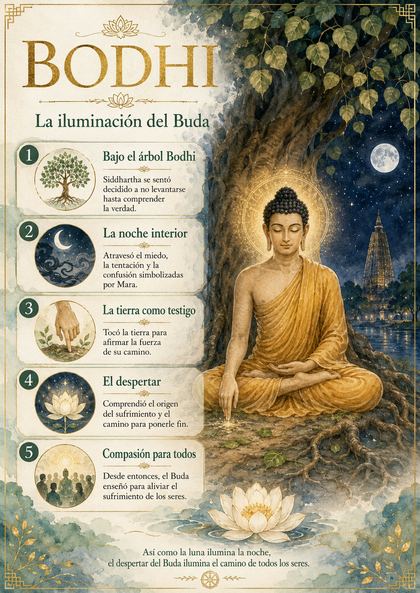
Not because it had magical powers, but because it was there that Siddhartha stopped running.
Sitting before life
Sitting beneath the tree means coming to a halt before reality.
It is not a passive gesture. Sometimes staying still takes more courage than moving. It is easy to fill life with noise so as not to hear what we feel. It is far harder to stop and look.
When someone we love dies, we can spend a long time avoiding the pain. We sort out papers, answer calls, comfort others, tidy the house, put belongings away, or busy ourselves with everything practical. Some of those things are necessary. The problem appears when the activity becomes a way of fleeing.
A night comes when there is nothing urgent left to do. The house falls silent. The absence sits down in front of us. That can be our bodhi tree: the moment when we stop escaping and recognise, with a broken heart, “this person is no longer here”.
Something similar happens in a significant loss. For days or weeks we may look for signs, explanations, unfinished conversations. We go through photos. We ask friends. We imagine returns. We rehearse sentences. We want to close the pain with an answer.
But awakening begins when we stop and say: “life has changed; something has ended; now I must feel this without turning it into a pursuit”.
When a situation harms us and we need to change it, sitting beneath the tree can be even harder. There is not always perfect clarity. Sometimes there is fear, guilt, dependence, tenderness and exhaustion all at once. We sit before an uncomfortable truth: “if I do not tend to this, I keep losing myself”.
That recognition can hurt enormously. But it can also save us.
The bodhi tree does not always look sacred
We often imagine awakening as a beautiful, silent, luminous scene. Yet, in real life, our awakening trees can look very different.
It may be a bed where we cannot manage to sleep. A kitchen at three in the morning. A parked car after we have wept. A hospital waiting room. The moment we receive news that changes our plans. A conversation in which we finally say: “I need help”. The instant we put the phone out of reach so as not to act out of anxiety.
The place does not have to look spiritual. What matters is the attitude: to stop lying to ourselves.
Beneath our own particular bodhi tree we do not try to look better. We do not make ourselves up for anyone's gaze. We do not have to prove serenity, strength or perfection. We are simply with what is.
That is where a different kind of freedom begins.
In everyday life we live very preoccupied with our image. We want to be seen in a good light. Sometimes we do ourselves up not out of joy or self-care, but out of fear of not being liked. We go to the gym not to feel healthy, but to have an enviable body. We post a photo hoping for approval. We smile when we are sinking. We say “all is well” because we do not want to seem weak.
None of that makes us bad people. It is human to want to be accepted. The problem appears when our life ends up governed by that need.
We will also call this, in a simple way, the ego: the part of us that needs to protect an image.
It wants to seem strong, attractive, interesting, spiritual, desirable, intelligent or indispensable. It is afraid of others seeing our fragility. That is why it works so hard to decorate the surface.
Beneath the tree of awakening we stop posing.
It does not matter whether we are good-looking or broken. It does not matter whether we seem successful or lost. In that moment we are not performing for anyone. We are learning to see ourselves without inner make-up.
Mara: the voices that lead us away from truth
Tradition tells us that, before Siddhartha awakened, Mara appeared.
Mara represents everything that tries to lead us away from clarity: fear, desire, doubt, pride, temptation, shame, insecurity, the need for approval. We can understand it as a symbolic figure. Also as those inner voices that appear just when we are about to see something important.
Mara does not always speak like an enemy. Very often it uses a reasonable tone.
When we are grieving, it may say: “If you move on, you will forget”. “Your life no longer has any meaning”. “You should not be feeling better”. “That death destroyed everything you were”.
After a significant loss, its words change: “Sort it out now”. “You need to know what is going to happen”. “If things do not go back to how they were, you are worthless”. “Only that chapter could make you happy”.
In a painful situation, Mara can become very persuasive: “Perhaps you are exaggerating”. “Everyone has problems”. “If you hold on a little longer, this time it will change”. “If you rest, you are being selfish”. “No one will understand what is happening to you”.
It is worth looking at these voices carefully. Not all of them are outright lies. Sometimes they contain a grain of truth mixed with confusion. It may be true that a chapter had good moments. It is also possible that other people carry wounds. Perhaps we made mistakes. But none of those partial truths obliges us to remain unprotected where there is repeated harm.
Mara also speaks through our personal image.
It says: “You cannot grow old”. “You have to be perfect”. “If your body is not liked, you are worthless”. “Let no one notice that you are unwell”. “Prove that you have got over the loss”. “Post something so they can see you are fine”. “Train more, do yourself up more, compare yourself more”.
At this point it is important to be clear. Taking care of oneself, dressing well or going to the gym is not wrong in any way. It can be healthy, pleasant and worthy. The problem begins when all of that is born of the fear of being worthless if we are not admired. Then self-care becomes pressure. The body stops being a home and turns into a shop window.
The ego feeds on that comparison.
It does not simply want to live. It wants to win. It wants to be seen. It needs others to confirm that we are enough. That is why it suffers so much when we grow old, when we feel alone, when someone else seems more attractive, when someone does not choose us, or when a chapter comes to an end.
Buddhist practice does not ask us to hate that part. It invites us to see it without always obeying it.
The earth as witness
In the traditional account, when Mara challenges Siddhartha, he touches the earth.
That gesture is beautiful and very concrete. Siddhartha does not defend himself with a speech. He does not try to convince Mara. He does not set about arguing with every fear, every doubt or every temptation. He simply touches the earth as witness to his right to awaken.
Touching the earth means returning to what is real.
When grief says “I will not be able to live”, touching the earth can be feeling our feet, breathing, and recognising: “right now I am here; this hurts, but this moment can be held”.
If a loss drags us towards anxiety, touching the earth can mean putting down the phone, drinking water, going out for a walk, and not acting on impulse.
When guilt appears after changing a dynamic that was hurting us, touching the earth can be recalling the full facts, not only the moments of relief. The mind needs to look at the whole picture: whatever fear, exhaustion, neglect or harm there was.
In the face of the obsession with image, touching the earth is returning to the real body. Not the compared, displayed or judged body, but the body that breathes, walks, grows tired, ages, needs rest and deserves respect even though it is not perfect.
Touching the earth is not an abstract idea. It is stepping out of the mental film and returning to something verifiable.
This body. This breath. This ground. These facts. This emotion. This moment.
The mind manufactures stories. The earth has no opinion.
Awakening is not becoming invulnerable
Siddhartha awakened, but that does not mean he stopped being human.
Awakening did not turn life into something motionless. The body went on being a body. Sickness, old age and death continued to be part of the world. People went on feeling fear, desire, anger, attachment and sadness.
Enlightenment does not consist in erasing reality. It consists in seeing it without ignorance.
This matters because many people in the West come to Buddhism hoping never to suffer again. They want meditation to take away their anxiety, compassion to spare them conflict, wisdom to keep them from feeling envy, sadness or fear.
But the path does not work that way.
A wise person can weep. Someone who meditates can feel pain. An awakened heart also misses people. Setting boundaries can still hurt. Taking care of ourselves in a painful situation can be right and, even so, bring grief.
The difference lies in our relationship with what is happening.
Before awakening, we believe that every thought is true. Afterwards we begin to see it as a thought. Before, we obey any impulse. Later we learn to wait. At first we mistake attachment for love. Little by little we tell caring apart from possessing, understanding from justifying, forgiving from exposing ourselves to harm again, and compassion from self-abandonment.
Awakening does not make us perfect. It makes us more honest.
The ego explained without frills
In this book, ego does not mean only vanity. It is the mechanism that builds a stable image of “I” and tries to protect it: it wants to be right, to receive validation, to keep control, to seem strong and to avoid everything that calls its worth into question.
That mechanism can express itself as pride, but also as guilt, fear, dependence or the need for approval. It is not a separate entity nor an enemy to be destroyed. It is a habit of identification.
The practice consists in recognising it while it is at work. When a criticism seems to destroy us, when a role becomes an identity, or when we need another person to confirm our worth continually, we can observe the attempt at protection. Seeing it does not immediately remove the reaction; it keeps it from going unnoticed.
From here on it will not be necessary to redefine the ego in every chapter. It will be enough to recognise how this same mechanism takes on different forms according to the situation.
The night before awakening
Before dawn, the darkness seems more intense.
This image appears in many spiritual traditions because it describes something real. When we begin to look with honesty, sometimes we feel worse for a while. Not because the path is failing, but because we have stopped covering up what was hidden.
A grieving person may have spent months kept busy, functioning, sorting out affairs. On finally sitting down in silence, they weep with a force that frightens them. They may think: “I am going backwards”. In reality, they are perhaps feeling something that needed space.
After a loss, when we stop seeking compulsive distractions or impossible explanations, a huge emptiness appears. The mind protests. It wants to go back to the noise. But passing through that emptiness can be part of reclaiming freedom.
Someone who breaks off a harmful dynamic may live through a particularly confusing inner night. They miss what is familiar, they doubt their decision, they fear being alone and they feel guilt. The fact that those emotions appear does not mean they should repeat the pattern. It means they are learning a different way of caring for themselves.
The night before awakening is not always calm. Sometimes it is full of voices.
The key is not to mistake intensity for truth.
An impulse can be very strong and still not be wise. An emotion can seem final and change the next day. A feeling of guilt can sound convincing without telling the whole truth.
That is why the practice insists on returning.
To the breath. To the body. To the facts. To trustworthy help. To dignity. To the clarity that does not shout.
Our own tree of practice
We do not need to wait for a great enlightenment in order to begin.
Each day offers small bodhi trees: moments in which we can stop acting automatically and look.
Before responding out of anxiety. When we feel the urge to check social media compulsively. When guilt appears for having set a boundary. In the instant when we are about to compare ourselves physically with another person. While we are getting ready and notice a fear of not being liked. On remembering someone who died and feeling the chest tighten. When loneliness pushes us to seek any immediate relief.
The practice can be very simple.
Stop. Breathe. Feel the body. Name what is happening. Recall the facts. Choose not to act for a few minutes.
That is already sitting beneath the tree.
It does not seem grand, but it transforms life.
An exercise: touching the earth
Find a quiet place. If you can, sit with your feet resting on the floor. You can also do it standing.
Bring your attention to the soles of your feet. Notice the contact with the earth, the floor, the rug or your shoes. Do not imagine too much. Feel.
Then place one hand on your chest or on your abdomen.
Ask yourself:
What story is dragging me along right now?
It may be a story of grief: “I will not be able to live without this person”. It may be a story of identity: “if I no longer have this job, I am worthless”. Perhaps a story of guilt appears: “if I live my own life, I am abandoning my family”. It may also be a story of image: “if I am not perfect, I will not be loved”.
Now name the main emotion.
Fear. Sadness. Guilt. Shame. Attachment. Loneliness. Anger. The longing for approval.
Feel your feet again.
Say inwardly:
“This is a story that appears in my mind”. “This emotion is felt in my body”. “I can touch the earth before obeying it”. “I do not need to seem perfect in order to be here”. “I do not need to act out of fear”.
Breathe calmly three times.
Then ask yourself:
What would be the next most honest and caring gesture?
Do not look for a grand answer. It may be drinking water, calling someone you trust, postponing a reaction, resting, asking for help, going out for a walk, recalling a necessary boundary, or allowing yourself to weep.
That small gesture can be true practice.
To remember
Sitting beneath the tree symbolises ceasing to flee. Mara represents the voices that promise safety in exchange for returning to familiar habits. Touching the earth is returning to the body, to the facts and to dignity. Awakening begins by seeing with clarity, not by becoming invulnerable.
The truth of suffering
There is a sentence many people have heard at some point, almost always misunderstood:
“Buddhism says that life is suffering.”
Put that way, it sounds sad, harsh and even unfair. It seems to deny the beauty of the world, love, joy, friendship, the pleasure of a shared meal, a child's laughter, the rest after a difficult day or the simple peace of looking out of a window.
But Buddhism does not say exactly that.
What it teaches is more precise: life, when it is lived from attachment, ignorance and resistance, is run through by a deep dissatisfaction.
That dissatisfaction is called dukkha.
Dukkha does not mean only physical pain or tragedy. It also points to that underlying unease that appears even when everything seems to be going well. It is the feeling that something is missing, that nothing is quite enough, that what is pleasant slips away from us too soon and what is unpleasant arrives even when we do not want it.
The Buddha began his teaching by speaking of dukkha because he did not want to build a spirituality based on denying reality. He began in the place where we all are: the human experience of suffering.
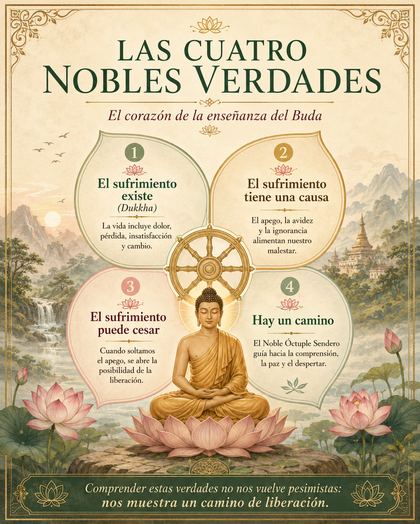
Not to sink us into it. Nor to turn it into an identity. Still less to tell us that life lacks beauty.
He pointed to it because whatever we do not look at clearly governs our life from the shadows.
The First Noble Truth
The Buddha's first great teaching is known as the First Noble Truth:
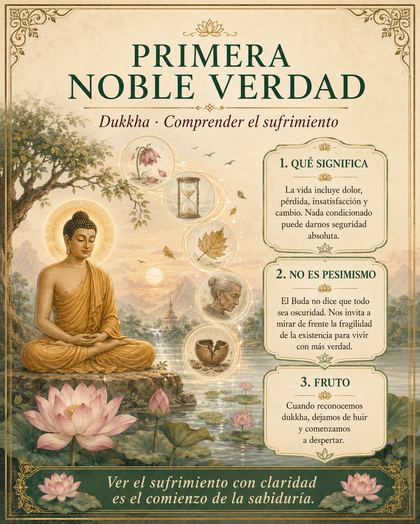
dukkha exists.
Suffering exists. Dissatisfaction exists. There is a fragility in everything we live. Nothing remains exactly the same. What we love can be lost. The body changes. The mind grows restless. Relationships pass through transformations. The things we desire do not always arrive, and when they do they cannot guarantee us lasting peace.
This truth does not mean to depress us. In fact, it can be profoundly liberating.
A person begins to heal when they stop pretending it does not hurt. A situation improves, or changes in a more honest way, when someone dares to acknowledge that something is causing harm. Grief begins to breathe when we stop demanding of ourselves that we be well before our time.
The First Noble Truth does not say: “everything is horrible”.
It says: “look closely”.
See that there is pain. Observe that you try to avoid it. Recognise how you cling to what changes. Notice that your mind adds stories. Check how often you suffer more from resisting life than from life itself.
This truth is noble because it does not humiliate. It does not accuse. It does not say that suffering is a personal failing. On the contrary, it includes us all. Every human being, without exception, knows some form of dukkha.
Dukkha is not pessimism
It is important to insist on this: to acknowledge suffering is not to be a pessimist.
A pessimist would say: “everything is wrong and nothing can be done”. Buddhism says something different: “there is suffering, it can be understood, and there is a path to free ourselves from a very deep part of it”.
A doctor is not a pessimist for diagnosing an illness. It would be irresponsible to deny it. In the same way, the Buddha did not begin by speaking of suffering because he despised life, but because he wanted to cure an essential confusion.
If a person loses someone dear, they need someone who can tell them the truth with tenderness: “this hurts”. It does not help much to hear empty phrases such as “be strong”, “everything happens for a reason” or “you have to carry on”. Perhaps those phrases mean to console, but at times they deny the depth of the wound.
The Buddhist way of looking would be more honest: “yes, there is pain; let us learn to keep it company without adding more suffering to it”.
When we lose a way of life, it is no use pretending it does not matter either. There was closeness to a routine, hope, habit, plans, belonging. Something breaks when that way of recognising ourselves disappears. The First Noble Truth allows us to say: “this too is dukkha; I am not mad for feeling this way”.
If we fall ill, lose a job or move out of the family home, the teaching is just as necessary. We often want to convince ourselves that it does not hurt because the change was inevitable, reasonable or even good. But a necessary change can also hurt. It can bring relief, freedom and sadness at the same time. Buddhism helps us not to turn that mixture into moral confusion.
It hurts because there was attachment. It hurts because there was hope. It hurts because we are human. That does not mean that grief is a mistake.
Loneliness deserves to be named with care. It is not always noticeable from the outside. A person can meet their duties, smile, work, care for others and still feel deeply alone. They can live surrounded by people and not feel truly accompanied. This form of dukkha is silent because it is often hidden out of shame.
The First Noble Truth also allows us to say: “there is loneliness here”. Not to dramatise it or turn it into an identity, but to stop denying it. What is acknowledged with honesty begins to be able to receive care.
The subtle forms of dukkha
Not all suffering shouts.
There is a finer dissatisfaction, more everyday, less dramatic. It appears in people who seemingly have an orderly life. There is work, a home, a family, enough health, a certain comfort. And yet something does not rest.
We want more recognition. We compare ourselves with others. We fear not measuring up. We seek to be liked. We need to be admired. We look at the body as if it were a project that is always insufficient. We feel that others are moving faster. We find it hard to enjoy because at once we are thinking of what comes next.
This form of dukkha is seen very clearly in self-image.
A person may groom themselves because they like to, because they enjoy taking care of themselves or because they want to express something beautiful. There is no problem in that. They may also go to the gym to feel strong, improve their health or gain energy. That can be a healthy form of care.
The difficulty begins when everything is done to sustain an image before others.
Grooming oneself to the point of anguish over looking perfect. Training not for health, but to have a body others envy. Posting photos in the hope of approval. Comparing oneself endlessly. Feeling bad if no one comments, if no one looks, if someone seems more attractive, younger or more desired.
That is where dukkha appears.
Not because the body is bad or because taking care of oneself is superficial. Suffering is born when our sense of worth depends too much on how we are seen.
The ego, put simply, works like this: it tries to build an image that will receive approval, and it avoids anything that might make it feel less. It wants to be liked, to stand out, to be right, to be validated, to seem strong and not to be exposed. When that image wavers, we suffer.
Old age, for example, becomes more painful when we believe that losing youth amounts to losing worth. A loss wounds more if we live it as proof that we are no longer needed. An illness grows harder when we fear what others will think: “can they not manage any more?”, “will they be a burden?”, “have they lost their place?”, “who will they be now?”.
Dukkha is not always in the fact. It is often in the dependence on an image.
The pleasant also contains dukkha
This teaching can seem difficult at first: even the pleasant contains a form of dissatisfaction.
Not because the pleasant is bad. Buddhism does not reject beauty, love, pleasure or joy. The problem is that we tend to demand of them more than they can give.
A beautiful dinner ends. A young body changes. A happy relationship passes through uncertainties. A professional achievement loses its intensity after a few days. Praise gladdens us, but at once we need more. A wonderful stage of life cannot be repeated exactly the same.
The pleasant contains dukkha because it does not remain.
When we love someone, a part of us wishes that person would not change, would not leave, would not fall ill, would not die. We want to freeze what is alive. But what is alive changes precisely because it is alive.
In the case of the death of a loved one, the suffering becomes enormous because what was a source of love also becomes a source of pain. It does not hurt because the love was false. It hurts because it was true and because it was subject to impermanence.
Something similar happens with a stage of life. Happy moments can become a trap when we use them to deny the present. Someone remembers the work that once gave them meaning, the family home full of voices or the healthy body of other years, and clings to that memory even though the present reality is another.
When we must accept a loss, the pleasant of the past can make grief harder. The mind says: “but it was different before”. It is true. Almost always it was. But a partial truth must not conceal the whole truth.
The practice consists in looking at the whole picture.
There was love, perhaps. There was also change. There were good moments. And there is a present reality that asks for care. There can be tenderness for what was lived. And even so, it may be necessary to learn to live in another way.
The pleasant contains dukkha when we try to use it to deny change or to justify neglecting ourselves.
The unpleasant and aversion
The other face of attachment is aversion.
We want to hold on to the pleasant and expel the unpleasant. This reaction seems natural. No one desires pain, sadness, illness, loneliness or fear. But when aversion becomes automatic, we add suffering to suffering.
In grief, aversion can appear as a refusal to feel. “I do not want to cry”, “I do not want to talk about this”, “I do not want to remember”, “I do not want to go through these dates”. Sometimes we need rest, of course. Not everything must be faced all at once. But if we reject pain completely, it usually finds other ways to express itself: anxiety, irritability, exhaustion, isolation.
After a loss, aversion can turn into hatred towards life, towards the body, towards those who seem to go on well or towards our own vulnerability. Hating seems to give strength for a time. It lets us not feel fragility. But if it settles in too far, it hardens the heart and keeps us tied to pain from the other extreme.
In a painful situation, aversion can be understandable. If there has been real harm, perhaps we need distance, protection and firm boundaries. Buddhism does not ask us to deny that. In time, however, it can help us not to be left defined by resentment. Setting boundaries does not require feeding an inner war.
Aversion says: “this should not be here”. The practice replies: “this is here; I can see it and decide with clarity”.
Accepting an emotion does not mean acting according to it. I can feel anger without destroying. It is possible to feel sadness without sinking. It is possible to feel fear and still take a wise step.
The suffering of wanting to be someone else
A very common form of dukkha is the rejection of oneself.
We want to be more serene, more attractive, younger, more successful, more interesting, stronger, more spiritual. We compare ourselves with an ideal version of ourselves and always come off worse.
This suffering is closely tied to the everyday ego.
The ego does not only want to be liked by others. It also creates an inner image of how we ought to be. Then it punishes us for not reaching it.
“I should be over this grief by now”. “I ought to be better after the loss”. “I should not miss my former life so much”. “If I were strong, I would not feel guilt”. “A spiritual person would not feel anger”. “At my age I should have my life sorted out”. “My body ought to be more attractive”.
These phrases seem like demands, but at bottom they express rejection.
Buddhism does not propose that we stay trapped in our habits or justify everything. But true change rarely springs from contempt towards oneself. The practice needs honesty and kindness at the same time.
If we are in grief, we can keep ourselves company without demanding a perfect recovery. After a loss, we can observe our patterns without becoming enemies of ourselves. In illness, loneliness or the change of identity, we can acknowledge contradictions without using every emotion as proof of weakness.
We do not need to be perfect to begin the path.
In fact, the path begins precisely where we stop pretending to be perfect.
The nobility of admitting “I am suffering”
To admit suffering requires humility.
Sometimes we would rather say we are busy, tired, irritable or confused than acknowledge something simpler: “I am suffering”. We find it hard because we believe that suffering makes us weak. Also because admitting it may oblige us to change.
If I recognise that grief is too much for me, perhaps I need to ask for help. In accepting that a loss has wounded me, I stop feigning indifference. When I see that a situation is harming me, perhaps I can no longer go on justifying it. If I admit that I live anxious to please, perhaps I must review the image I am trying to sustain.
The First Noble Truth is noble because it returns honesty to us.
There is no shame in suffering. Shame appears when we believe that we ought to be above the human condition.
The Buddha did not begin by saying: “you should be strong”. His first teaching was more compassionate: “look at suffering”.
Looking does not destroy us. What usually destroys us is to live for a long time denying the obvious.
An exercise: to acknowledge dukkha without judging
Find a quiet moment. If you can, write by hand.
Complete these sentences with sincerity:
Right now there is suffering in…
It may be a loss, a loss, a painful situation, a worry, a comparison, a demand on your body, a need for approval or a guilt.
Then write:
The basic pain is…
For example: “I miss”, “I am afraid”, “I feel alone”, “it hurts me to accept that I had to leave”, “I am frightened of not being liked”, “growing old weighs on me”, “I feel rejected”.
Now add:
The story my mind is building is…
Perhaps there appears: “I am worthless”, “I will never be well”, “I should be perfect”, “if I am not admired I am not enough”, “if I rest I am guilty”, “if I keep suffering it means I am failing”.
Then ask yourself:
What would happen if I acknowledged this suffering without punishing myself for feeling it?
Do not look for a brilliant answer. Stay a few seconds, breathing.
You can close with this sentence:
“This is dukkha. I am not the only human being who feels it. I can look at it with honesty and care”.
To remember
Dukkha names the evident pain and also the dissatisfaction that accompanies everything conditioned. To acknowledge it is not pessimism, but diagnosis. The First Noble Truth asks us to admit suffering without shame, so that we can understand it and stop feeding it.
The root of suffering
Recognising that we suffer is the first step. Understanding why we suffer is the second.
The Buddha did not simply say: “there is pain in life”. Anyone can verify that. His teaching went further. He looked inside human experience and asked: what turns pain into repeated suffering? Why do we return again and again to the same wounds? What mechanism binds us?
The Buddhist answer is clear: suffering is born of a confused way of relating to reality.
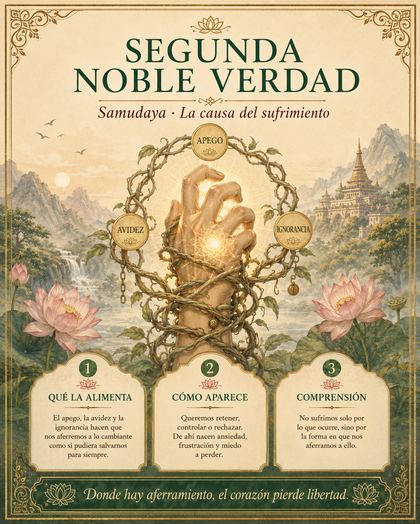
We cling to what changes. We reject what hurts. We believe that things, people and we ourselves are more fixed than we really are.
Traditionally we speak of three roots or three poisons: ignorance, attachment and aversion. They are not sins in the Western moral sense. They are rather deep habits of the mind. Ways of seeing wrongly. Learned reactions that promise to protect us but end up increasing our suffering.
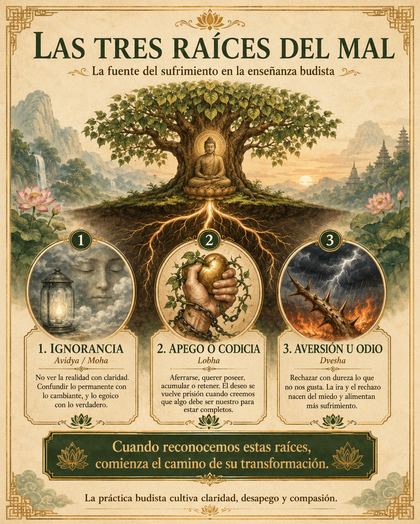
These three poisons do not live in some distant place. They appear in grief, in love, in the body, in our self-image, in the need to be liked, in relationships that end and also in those we must walk away from so as not to keep being harmed.
Seeing them clearly does not make us guilty. It makes us responsible.
And that difference matters a great deal.
Ignorance: not seeing clearly
In Buddhism, ignorance does not mean a lack of education or an absence of intelligence. A person may have qualifications, professional success, a good memory and great analytical capacity, and still live trapped in ignorance.
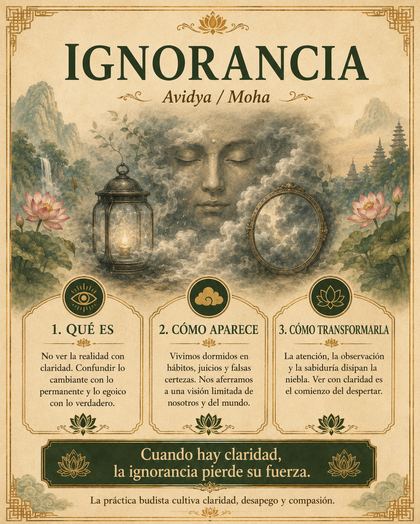
Here ignorance means not seeing reality as it is.
We do not see that everything changes. We forget that the body is vulnerable. We mistake thoughts for truths. We believe that companionship can give us absolute security. We take other people’s approval as the measure of our worth. We call “I” a mental image that we try to protect at all costs.
Ignorance is a kind of fog. It does not stop us from living, but it distorts what we see.
When someone we love dies, ignorance appears in the form of deep disbelief: “this cannot have happened”. At first that reaction is natural. The mind needs time to absorb the loss. But if the denial settles in for too long, we begin to suffer because we demand that reality be different from what it is.
In a major loss, ignorance can make us believe that our identity depended on what is now gone. The mind says: “if I no longer have this, then I am not worthy”. There we are not seeing clearly. The pain of the loss is real, but our worth does not disappear because a circumstance changes.
When a situation harms us, ignorance can be even more dangerous. It tells us we must endure, even if we live in fear. It calls resignation “patience”, letting ourselves be trampled “compassion”, repeating the same cycle of harm “hope”. Sometimes we do not see because seeing would force us to act.
Ignorance is not always a lack of information. Very often it is fear of accepting what we already know.
Attachment: grasping what changes
The second root of suffering is attachment.
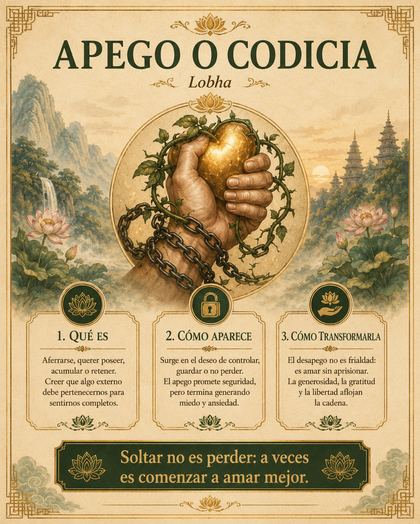
Loneliness shows very clearly how these roots work. Ignorance can make us believe that being alone means being worthless. Attachment can push us to accept any bond rather than feel empty. Aversion can lead us to reject loneliness so forcefully that we run towards distractions, painful situations or forms of anaesthesia that later increase our suffering.
Looked at with awareness, loneliness need not become an enemy. It can reveal a legitimate need for connection, but also show where we desperately seek outside a confirmation that we need to learn to cultivate within.
Attachment does not mean love. This distinction is fundamental.
Love wishes for the good. Attachment wants to possess, retain or control. Love can care. Attachment needs security. Love recognises the other as a free being. Attachment turns the other into a guarantee of our own stability.
In real life, love and attachment usually blend together. There is no shame in that. Almost all of us love with some measure of fear. We want the people we love to stay, to choose us, not to die, not to change, not to drift away. That desire is understandable. But when it becomes rigid, suffering appears.
Faced with the death of a loved one, attachment rebels against the irreversible. It does not only say “I love you and I miss you”. That is natural pain. Attachment adds: “I need you to still be here for my life to have meaning”. Since reality cannot obey that demand, the heart is left trapped.
In loneliness, attachment can feel like a physical force. We want to look for signs, to check, to understand and to recover a sense of security. The mind believes it can only rest if someone confirms that we matter.
When we must transform a painful situation, attachment can act with great force. We know it harms us, but we miss the moments of relief. We cling to a kind version of the past. We remember the truces. Attachment tells us: “hold on a little longer; maybe this time it really will change”.
Sometimes it will change. Many other times it will not.
Wisdom consists in looking at the facts, not only at hope.
Attachment is not love
This idea deserves a space of its own.
We often confuse attachment with depth of love. We think that the more incapable we are of letting go, the greater the love must have been. But it is not always so.
There are attachments that look like love because they are intense. They occupy our mind, they disturb our body, they give us fear and desire. But intensity does not prove the truth of a bond. It can also prove dependence, habit, insecurity or a need for approval.
A person may say: “I cannot live without him” or “without her I am nothing”. It sounds romantic in some songs, but spiritually it is a sign of suffering. Loving someone should not require disappearing as a person.
If someone has died, love can go on living in memory and in gratitude. Attachment, by contrast, demands that reality should not have changed. That is why it finds no rest.
When a chapter ends, love can acknowledge what was lived and mourn the loss. Attachment needs to recover, to control or to prove its worth.
In a situation that harms us, love can wish for the good without denying the limits. Attachment insists on recovering what came before in order to soothe the immediate fear.
The question is not only: “do I love?”. We must also ask: “does this bond allow me to live with dignity and clarity?”.
Because we can love someone and, even so, need to leave.
Aversion: rejecting what we do not want to feel
The third root is aversion.
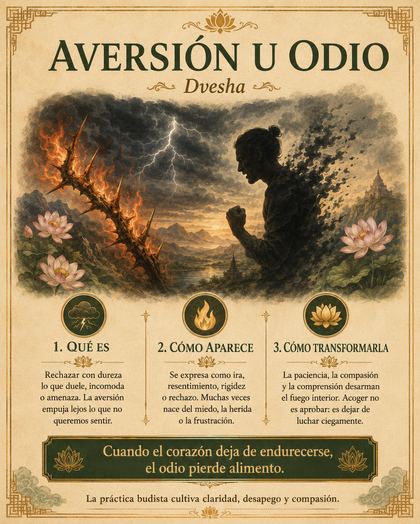
If attachment tries to grasp the pleasant, aversion tries to expel the unpleasant. We do not want to feel pain, fear, shame, sadness, guilt, loneliness or uncertainty. We reject those experiences so forcefully that they end up growing.
Aversion takes many forms.
It can be anger. It can also be avoidance. Sometimes it disguises itself as coldness. In other cases it appears as hyperactivity. It can even take the form of a false strength: “it doesn’t affect me”.
When someone we love dies, aversion can lead us to avoid any memory. We do not look at photographs, we do not speak of that person, we do not enter certain rooms, we do not allow anyone to mention their name. Sometimes we need to protect ourselves temporarily. The problem arises when our whole life is organised around not feeling.
After a loss, aversion can turn into contempt. “I never cared”, “it was all a lie”, “that person is worth nothing”. Perhaps there was real harm, and putting it into clear words is necessary. But when hatred becomes a refuge, we remain bound.
In a painful situation, aversion can appear at the end as an explosion. We have endured too much, kept silent too much, denied too much. Then one day it all comes out as rage. That rage can give us the energy to leave, but it is not wise to let it govern the whole road that follows.
Leaving with firmness does not require living poisoned.
Aversion wants to eliminate the uncomfortable. Buddhist practice teaches something harder: to feel the uncomfortable without immediately turning it into destructive action.
When attachment and aversion alternate
In many painful experiences, attachment and aversion take turns.
After a loss, one day we want the person to come back. The next we hate them. Later we go over beautiful memories. Then we grow angry. Afterwards we feel guilt. That oscillation is exhausting because the mind finds no centre.
In a painful situation something similar happens. There are moments of relief that feed attachment. Then come episodes of harm that awaken aversion. A pause calms things temporarily. The pattern returns. And so a cycle is formed.
Grief over a death can also contain both movements. We cling to the memory and, at the same time, reject the reality of the absence. We want to feel the person close, but we cannot bear the pain that this awakens.
The practice does not consist in choosing a “correct” emotion. It consists in seeing the cycle.
“Now there is attachment”. “Now there is rejection”. “Now the mind wants to recover”. “Now the mind wants to destroy”. “Now I need to breathe before acting”.
Naming what is happening reduces the automatic force of the reaction.
The root is not outside
A difficult teaching of Buddhism is that the root of suffering does not lie solely in external circumstances.
This does not mean denying the reality of harm. There are unjust situations, terrible losses, illnesses, forms of abuse, destructive relationships and very harsh social conditions. Serious Buddhism should never be used to tell someone: “it is all in your mind, endure it”. That would be a dangerous distortion.
If a situation causes harm, we must look at the harm. If there is violence, humiliation or manipulation, the priority is to protect oneself and ask for help. Inner practice does not replace concrete decisions.
What Buddhism points to is something more precise: besides what happens outside, we need to understand how our mind relates to it.
Two people can live through a loss and suffer in different ways. A loss can open an honest inquiry or turn into years of resentment. A painful situation can drag on because the mind clings, denies or fears loneliness. The same remark about our body can pass us by or destroy us for days, depending on the worth we have placed in the image.
The root is not only outside. Nor is it only inside. There are real facts and there is a mind that interprets them.
Freedom begins when we attend to both planes.
To understand is not to justify
It is worth clarifying something essential: understanding the roots of suffering does not mean justifying everything.
If we understand that someone acts out of their ignorance, attachment or aversion, that can awaken compassion. But compassion does not require allowing any and every behaviour.
We can understand that a person wounds because they too are wounded. Even so, we have the right to protect ourselves. It is possible to see that someone acts out of fear and to decide that we do not want to go on being the recipients of that fear. We can wish well to the one who harmed us without exposing ourselves to the harm again.
This point is very important for painful situations.
Sometimes, when a person begins a spiritual path, they believe they must put up with more. They think that being compassionate means enduring, forgiving quickly, justifying the other or silencing their own pain. That idea is not wisdom; it is confusion.
Buddhism does not ask us to be doormats.
Compassion includes others, but it must also include us. If a situation is destroying us, asking for help and setting limits can be a form of compassion towards the life we are responsible for caring for.
Understanding the root of suffering helps us act with less hatred. It does not oblige us to stay.
Cutting the root little by little
We do not eliminate ignorance, attachment and aversion from one day to the next.
It would be naive to believe that reading a single chapter is enough to let go of years of habits. The mind has practised its patterns for a long time: comparing itself, clinging, defending, denying, idealising, rejecting, seeking approval.
The path begins with small moments of awareness.
When the need to be liked appears, we can recognise it. When we feel attachment, we can name it. If rejection arises towards a painful emotion, we can breathe. When the ego wants to be right, we can pause. If we idealise a situation that harmed us, we can remember the whole picture.
Each time we see a root at work, we weaken its power a little.
It is not about tearing it out by force. Inner violence usually creates more suffering. Buddhist practice works through insight, patience, discipline and compassion.
Seeing clearly. Returning to the body. Acting with care. Asking for help when needed. Not feeding destructive stories. Choosing what protects our dignity.
That is the work.
An exercise: recognising the three roots
Look for a situation that is causing you suffering. It may be grief, a loss, a painful situation, a worry about your image, a physical comparison or a strong need for approval.
Write three sections.
1. Ignorance
Ask yourself:
What am I not seeing clearly? Am I mistaking a thought for a truth? Am I taking my personal worth as if it depended on another person, on my body or on external approval? Is there some fact that I find hard to accept?
Example: “I find it hard to accept that this person died”, “I believe that if I lost this place I am worthless”, “I call love a dynamic that harms me”, “I believe I need to seem perfect in order to be loved”.
2. Attachment
Now look:
What am I clinging to? What do I want not to change? What do I need to control? What image of myself am I trying to preserve?
Example: “I cling to a chapter as it was at the beginning”, “I need someone to confirm that I matter”, “I want to keep up the image that everything is fine”, “I cling to having an admired body”.
3. Aversion
Finally ask:
What emotion am I rejecting? What reality do I not want to feel? What am I trying to expel with rage, avoidance or hardness? Am I using hatred so as not to feel sadness?
Example: “I reject loneliness”, “I don’t want to feel grief”, “I am afraid to admit that I must leave”, “I hate my body when it does not meet my ideal”, “I reject guilt instead of listening to it calmly”.
Then breathe three times and say inwardly:
“I can see these roots without punishing myself”. “What I see clearly begins to lose power”. “I do not need to act out of ignorance, attachment or aversion”.
To remember
Ignorance distorts, attachment tries to retain and aversion rejects what it does not wish to feel. These roots combine and sustain much of the added suffering. Understanding them does not mean blaming ourselves, but learning to recognise the mechanism before obeying it.
The possibility of becoming free
After speaking of suffering and its roots, Buddhism offers a deeply hopeful teaching:
suffering can cease.
This is the Third Noble Truth.
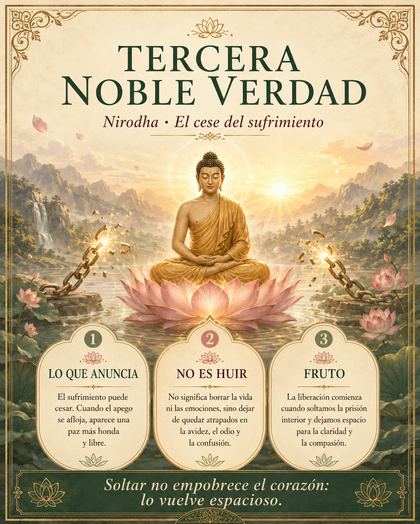
It does not mean that life will stop hurting. It does not mean that we will never lose anyone, that the body will not fall ill, that relationships will not end, or that every wound will be closed for ever. Buddhism does not promise an existence without loss, without ageing, without death or uncertainty.
The liberation the Buddha speaks of is more precise and more profound: we can stop living enslaved by ignorance, attachment and aversion. We can learn to relate to pain without adding so much war to it. We can love without turning love into possession. It is possible to care for the body without basing all our worth on being admired. We can also set limits without turning into hatred or guilt.
The Third Noble Truth says that there is a way out.
Not a way out of the world. A way out of confusion.
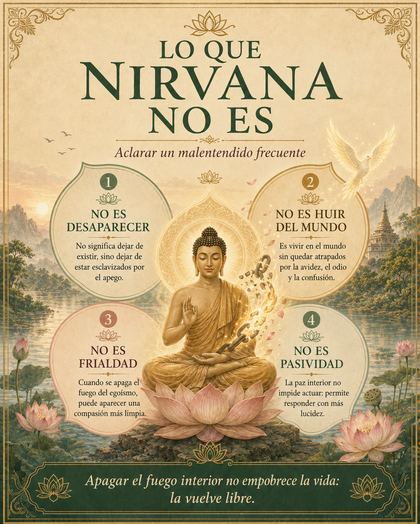
What it means for suffering to cease
When we hear “the cessation of suffering”, we may imagine a perfect, permanent, almost supernatural peace. But if we begin there, we turn the teaching into a fantasy.
The cessation of suffering begins in a much simpler way.
It happens when we see a painful thought and do not automatically believe it. When we feel an intense emotion and do not act at once. When we recognise attachment and breathe before acting compulsively. When we see guilt and do not let it decide for us. Each time we stop feeding a story that destroys us, suffering gives way a little.
Liberation does not always come as a great enlightenment. Often it appears as a small space.
Before, we could not sleep because the mind replayed a scene over and over. One day the scene appears, but it does not drag us along for hours. Before, we needed to check the phone compulsively. Later we feel the urge, we breathe and we do not obey. Before, we punished ourselves for having changed a painful situation. In time, we recognise that sadness does not mean error and that setting a limit was not cruelty. Before, a criticism about our appearance destroyed the day. Then we feel the blow, but we remember that our dignity does not depend on looking perfect.
That space is important.
Freedom begins there.
To be liberated is not to stop loving
One of the greatest confusions consists in believing that to let go means to love less.
Many people fear that, if they accept the death of a loved one, they will be abandoning their memory. As if lasting pain were the only proof of love. But Buddhism does not teach us to forget. It teaches us to stop turning absence into a prison.
Loving the one who died can take new forms. It can be expressed in gratitude, memory, inherited gestures, values we go on living, words we pass on to others. Love can no longer lean on physical presence, but it does not disappear for that reason. The practice consists in allowing it to change its form.
In a significant loss something similar happens. Letting go does not mean declaring that nothing mattered. Nor does it demand that we despise what was lived. We can recognise that there was love, beauty, learning, and still accept that a form has ended.
When it is a matter of a painful situation, letting go is even more delicate. We may still feel nostalgia or compassion. None of that obliges us to repeat the pattern. Letting go does not mean hating. Sometimes it means admitting: “I wish you well, but I cannot stay inside a dynamic that breaks me”.
Attachment says: “if I love, I have to hold on”. Wisdom answers: “I can love and not possess; I can feel and not go back; I can remember and keep walking”.
To be liberated does not cool the heart. It cleanses it of chains.
Cessation begins with seeing clearly
The three roots of suffering —ignorance, attachment and aversion— lose their strength when we see them at work.
Ignorance lessens when we recognise: “this is a thought, not an absolute truth”. Attachment loosens when we admit: “I want to hold on to something that is changing”. Aversion softens when we say: “I am rejecting an emotion that is already here”.
There is no need to do it perfectly. It is enough to see it once more than before.
In grief, the mind can repeat: “if I smile again, I betray the one who died”. Seeing clearly means recognising that this sentence is not pure love; it is a mixture of love, guilt and fear of forgetting. On seeing it, we can weep and still allow a small joy without feeling that we are failing.
After a loss, the thought may appear: “if that person does not come back, I will not be able to be well”. The practice does not consist in arguing for hours with the sentence. It is enough to see it: “this is attachment speaking”. Then we return to the body, to the breath, to the concrete day.
When we have interrupted a painful situation, there may arise: “if it hurts, it means I was wrong”. Clarity answers: “pain does not always indicate error; sometimes it indicates grief”. This distinction can protect us from repeating the harm.
In physical comparison, we may think: “that person has a better body, so they are worth more”. Looking clearly lets us recognise an old programming: we are measuring dignity by appearance. On seeing it, the thought loses some of its authority.
What we see clearly ceases to dominate us completely.
Nirvana: putting out the fire
The traditional word for speaking of liberation is nirvana.
It is sometimes imagined as a heavenly place, but its original meaning is related to putting out or extinguishing a fire. The fire that is put out is that of greed, hatred and confusion. In other words: the fire of attachment, aversion and ignorance.
Nirvana is not disappearing. It is not becoming indifferent or being emptied of humanity. It is to stop burning in the same way.
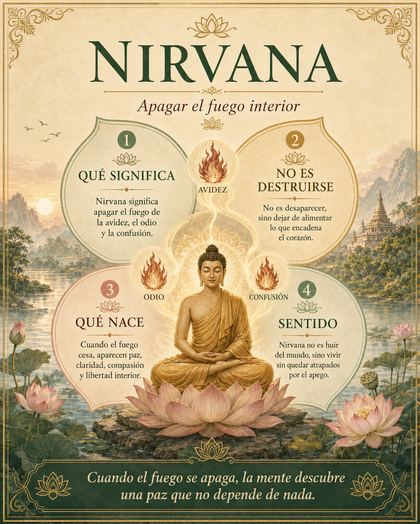
We all know that fire.
The rage that will not let us sleep. The desire to regain security at all costs. The need to prove that we are worth something. Constant comparison. The guilt that bites us after setting a limit. The hatred we keep so as not to feel sadness. The obsession with controlling what others think.
When that fire burns, everything we touch grows hot. A conversation turns into a battle. A memory becomes a condemnation. A body stops being a home and becomes an anguished project. A stage ends, but we go on feeding the blaze for months or years.
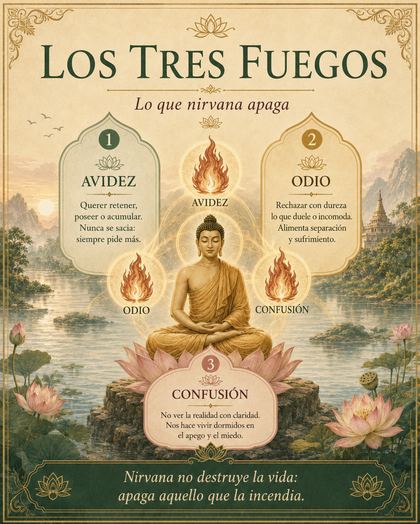
The cessation of suffering does not mean that a spark never appears. It means that we learn not to add more wood to it.
We do not feed attachment by going over and over what destroys us. We avoid reinforcing aversion by repeating speeches of hatred that keep us bound. We do not sustain ignorance by pretending that a painful situation is not one. We stop strengthening the ego by building a whole life to impress.
Putting out the fire is a daily practice.
Small everyday cessations
There are also small cessations in the midst of loneliness. They happen when we feel the urge to fill the emptiness with any company and, instead of doing so automatically, we breathe. When we recognise “I feel alone” without adding “I am worthless”. On calling someone we trust instead of repeating a behaviour that harms us. When we sit with ourselves for a few minutes without turning that silence into punishment.
Liberation does not belong only to the great masters. There are small cessations within reach of an ordinary life.
A small cessation happens when you are about to react out of anxiety and you decide to wait. Also when you remember someone who has died and you allow the sadness to appear without adding guilt. It arises when you feel the urge to repeat a harmful behaviour and first call a person you trust. It appears when you look at yourself in the mirror and do not turn your body into an enemy. It shows itself when you listen to a criticism without having to defend yourself at once. It is present when you recognise that you are comparing yourself and you return to your breath.
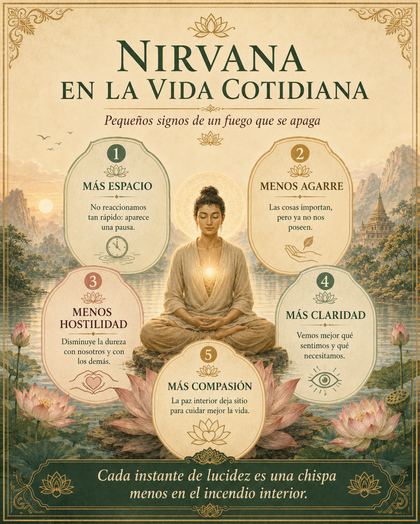
These moments may seem modest, but they are of enormous importance.
Each time we do not obey a pattern, we weaken its authority a little. Each pause creates a new possibility. Little by little, the mind learns that it does not need to follow the old path.
We should not despise small advances.
A person in grief may not be able to feel peace all day, but can for three breaths. That counts. Someone going through a loss may not be able to let go completely, but can refrain from checking the phone for an hour. That too is practice. Someone who has changed a painful situation may still feel guilt, but can refrain from turning the guilt into a command. That small space is freedom. A person caught up in image may still want to be liked, but can train today for health and not for comparison. There is already a change there.
Liberation is built out of instants of lucidity.
The obstacle of wanting to be liberated quickly
The desire to be liberated can also turn into attachment.
We want to stop suffering now. We want to get over grief, to forget the loss, not to feel attachment, not to compare ourselves, not to need approval, not to miss the one who harmed us. The mind turns the spiritual path into another demand: “I should be better”, “I should be more aware”, “I should have let go”.
This is very common.
The ego can appropriate spirituality. It wants to be a good meditator, an elevated person, someone who feels no rage, who does not get hooked, who does not make mistakes. It seeks a new image: the image of being spiritual.
But the real path is more humble.
There will be good days and difficult days. Some wounds will return. Grief can appear on unexpected dates. A loss can hurt after months of apparent calm. Guilt for having changed a painful situation can come back when we remember moments of relief. Physical comparison can be triggered on a beach, at a gathering or in front of a photo.
That does not mean failure.
The practice consists in returning. Seeing again. Breathing again. Letting go once more. Asking for help if need be. Not turning an emotional relapse into an identity.
Liberation is not achieved by hating our chains. It is cultivated by understanding how they are formed.
The difference between resignation and liberation
Some people confuse accepting with resigning themselves.
Resignation says: “there is nothing to be done”. Liberation says: “I am going to stop adding useless suffering and I will act from whatever clarity is possible”.
They are very different things.
In grief, to resign oneself would be to switch off life completely. To be liberated is to allow love for the one who died to find a form that does not prevent us from going on living.
In a loss, to resign oneself might mean hardening and concluding that loving is not worth it. To be liberated means learning from the experience without closing the heart.
Within a painful situation, to resign oneself is to endure indefinitely, thinking there is no way out. To be liberated may require a concrete action: speaking, asking for help, setting limits, moving away, protecting oneself.
Buddhism does not ask us for passivity in the face of harm.
Acceptance looks at reality in order to respond better. If the house is burning, to accept is not to sit inside saying “everything is impermanent”. To accept is to recognise the fire and get out.
In the same way, if a situation is destroying us, we do not use spirituality to justify staying. We see the suffering, we understand the attachment and we act with the greatest possible clarity.
To be liberated is to stop collaborating with confusion.
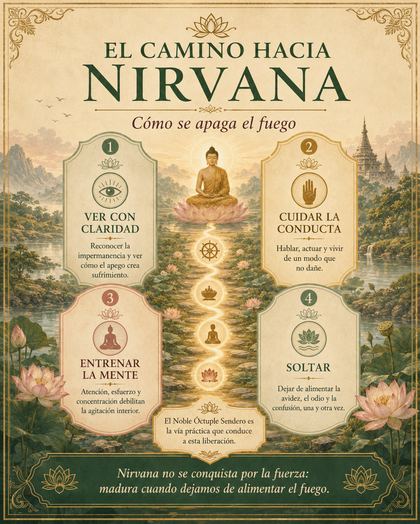
Cessation as rest in reality
Suffering feeds on fighting with what is real.
The death happened. A stage has ended. The body changes. Illness may come. Loneliness may hurt. Not everyone will approve of us. We cannot control how others see us. We are not perfect. Nor do we need to be.
Resting in reality does not mean that reality is comfortable. It means that we stop spending all our strength on denying it.
A person who gradually accepts the death of someone loved may go on weeping, but no longer fights the basic fact of the absence. That acceptance creates a space where gratitude, memory and life also have room.
Whoever accepts a loss stops constantly looking for a secret door into the past. It may hurt, but the energy begins to return.
On recognising that a painful situation really was painful, we stop negotiating with the obvious. The sadness remains, though it no longer needs to become repetition.
When we accept that our appearance will change, we can care for ourselves with more peace. The gym stops being a courtroom. Clothes stop being armour. The mirror stops passing sentence.
The cessation of suffering has much to do with this: living less at war with what is.
An exercise: where can I stop adding wood
Look for a concrete situation in which you are suffering. It may be a bereavement, a loss, a painful situation, a worry about your body or a need for approval.
Write first:
The fire that is burning is…
For example: “fear of loneliness”, “guilt over a difficult decision”, “rage at an injustice”, “need to look perfect”, “pain at the death of someone dear”, “fear in the face of an illness”.
Then ask:
What wood am I adding to the fire?
Perhaps it is using social media to compare yourself, repeating a story, seeking approval, isolating yourself, hating yourself, justifying a painful situation, denying grief or arguing mentally with reality.
Now write:
A small way of not feeding this today would be…
Do not choose something heroic. Look for a possible gesture.
Not looking at the phone for an hour. Going out for a walk without music and feeling the body. Putting away a photo that now opens the wound too much. Calling someone you trust before answering impulsively. Training for health, not for punishment. Eating calmly. Repeating: “this is guilt, not necessarily truth”. Remembering the full facts of a painful situation. Allowing a joy without feeling that you are betraying the one who died.
End with three breaths and this sentence:
“Today I can stop feeding one part of the suffering”.
To remember
The cessation of suffering does not amount to a life without pain. It appears each time we stop adding fuel to attachment, aversion or confusion. Nirvana points to the extinguishing of those fires; in everyday life it is heralded in small instants of clarity and non-reaction.
The path that can be practised
After recognising suffering, understanding its roots and discovering that it can cease, an inevitable question arises:
how is it done?
It is not enough to understand that we suffer through ignorance, attachment and aversion. Nor is it enough to wish for peace. Understanding needs to become a path, a practice, a concrete way of living.
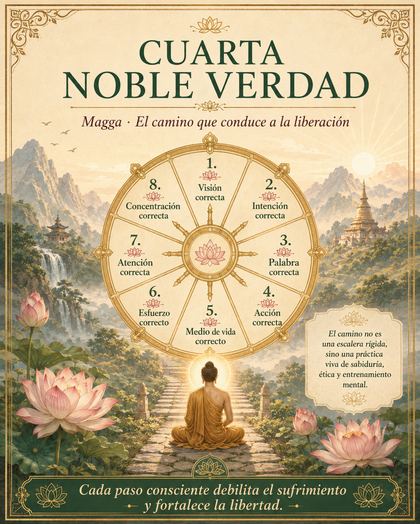
The Buddha did not leave only a consoling idea. He left a way.
That way is known as the Noble Eightfold Path.
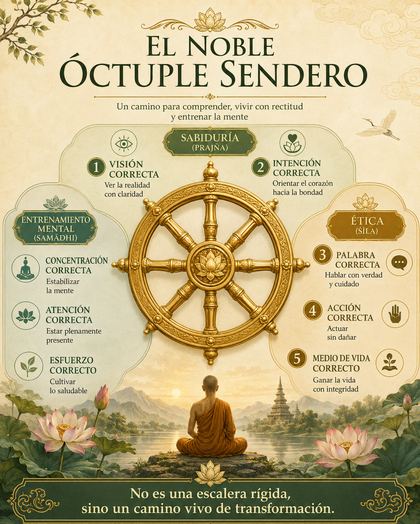
It is one of the central maps of Buddhism. It is not a set of commandments imposed from outside, but eight aspects of a life that is gradually awakening. It does not work like a rigid ladder, where we first finish one rung and then move on to the next. It is more like a wheel: all the elements support one another.
When we see better, we speak better.
By speaking more carefully, we act with less harm.
If we act with less confusion, the mind grows calm.
A calmer mind allows us to see more clearly.
The path feeds itself.
It is not reserved for monks, specialists or people withdrawn from the world. It can be practised in a home, in an office, in the family, in a loss, in grief, in illness, in a difficult conversation, in the way we care for the body or in the decision to change a situation that is harming us.
Buddhism becomes real when it stops being an idea and begins to touch the way we live.
A path for ordinary life
Many people come to Buddhism looking for meditation. That is understandable. Meditation has enormous power. But the Buddhist path is not reduced to sitting in silence.
To meditate for twenty minutes and then live the rest of the day from lying, aggression, attachment or the constant need for approval would be an incomplete practice.
The Noble Eightfold Path reminds us that awakening involves the whole of life.
The way we think matters.
So does the way we speak.
Our actions leave a mark.
The way we earn our living can ease or increase suffering.
Attention transforms the everyday.
Well-directed effort changes habits.
Concentration steadies the mind.
Intention orients the heart.
It is not about being perfect. That obsession with perfection is usually another strategy of the ego. Practice consists in returning, again and again, to a more conscious life.
A grieving person can practise the path by speaking of their pain without turning it into guilt, by allowing help, by caring for the body, by remembering with gratitude and by not demanding that sadness disappear before its time.
Someone living through loneliness can also practise the path. Right view, to distinguish being alone from being worthless. Right intention, to seek bonds from dignity, not from desperation. Right speech, to ask for company without manipulating or hiding the pain. Right action, to create real conditions for encounter: to call, to take part, to go out, to ask for help, to care for the body, to open some door without surrendering to just any bond.
Someone going through a loss can practise it by ceasing to feed cruel stories, by avoiding words that only seek to wound, by accepting the loss without destroying their dignity and by observing attachment without always obeying it.
If a situation causes harm, the path can be expressed as clarity, limit and compassion. Not necessarily as remaining. Sometimes right action is to stay and work honestly. At other times, to step back in order to protect life.
Even in something as everyday as personal image, this path can be practised. Grooming ourselves, training or caring for the body can be done out of health and joy. It can also be done out of the anxiety to please, comparison and the need to appear flawless. The outward act may look similar; the inner root changes completely.
The path does not ask only what we do. It asks where we are doing it from.
The three great areas of the path
Traditionally, the Noble Eightfold Path is grouped into three great areas:
wisdom, ethics and mental training.
Wisdom helps us to see better. It includes right view and right intention.
Ethics guides the way we relate to the world. It includes right speech, right action and right livelihood.
Mental training cultivates inner discipline. It includes right effort, right attention and right concentration.
These three areas are not separate.
Without wisdom, ethics can become rigid. Without ethics, meditation can be an elegant form of selfishness. Without mental training, good intentions weaken when intense emotion arrives.
Let us imagine someone who knows they must change a painful situation. They need wisdom to see reality without self-deception. They also need ethics so as not to act from revenge or cruelty. They require mental training to bear guilt, fear and attachment without automatically repeating the same pattern.
Grief, too, calls for the three areas. Wisdom to understand impermanence. Ethics so as not to unload the pain onto others. Mental training to accompany difficult thoughts without turning them all into truth.
In an important loss, the path helps us not to live only from reaction. We can feel pain and still speak with dignity. We can miss someone without acting compulsively. It is possible to remember without idealising.
The Noble Eightfold Path is practical because it is directed at the whole of life, not only at calm moments.
1. Right view
Right view does not mean adopting a religious opinion and defending it against everyone. It means learning to see reality with less distortion.
We see rightly when we recognise that everything changes, that our actions have consequences, that suffering has causes and that thoughts do not always show the whole truth.
In grief, right view is to remember that death is not a failure of life, however deeply it hurts. Every being that is born is mortal. Accepting this does not remove the tears, but it reduces the fight against the irreversible.
After a loss, right view is to understand that the end of a stage does not define our worth. The pain speaks of its importance, not of any lack of dignity in us.
When a situation causes harm, seeing rightly demands looking at the whole of the facts. Not only the good moments. Also the repeated patterns, the fear, the humiliation, the wearing down, the way we stop being ourselves. Right view does not let itself be deceived by a hope that never turns into real change.
In the body and in image, this view distinguishes care from dependence. It is healthy to want to be well, to dress with taste or to train. It is another thing to believe that we deserve love only if we turn out to be admirable.
Seeing rightly does not always bring immediate calm. Sometimes it hurts. But the pain of seeing is usually healthier than the false peace of carrying on in denial.
2. Right intention
Right intention asks: in what direction is my heart turned?
We can do the same thing from very different places. Speaking of a loss can arise from clarity or from manipulation. Training the body can spring from care or from self-hatred. Leaving a stage behind can be done from dignity or from the desire to punish. Keeping silent can be prudence or fear.
Right intention cultivates renunciation, good will and non-cruelty.
Renunciation does not mean despising life. It means letting go of what binds us to suffering. Good will is the wish not to harm. Non-cruelty implies abandoning violence, both towards others and towards ourselves.
In grief, a healthy intention might be: “I want to honour the one who died without abandoning my life.” That sentence does not deny the pain, but it keeps it from becoming a prison.
After a loss, right intention might sound like this: “I want to get through this without destroying myself or harming anyone.” It will not always be easy. There will be anger, sadness and attachment. But intention sets the bearing.
In changing a painful situation, a clear intention would be: “I want to protect my dignity without feeding hatred.” That balance takes practice. It does not require denying the harm or repeating the pattern. It only keeps the wound from turning into permanent poison.
In personal image, right intention asks: “do I groom myself out of joy or out of fear? do I train out of health or out of comparison? do I want to care for myself or to prove something?” It does not judge the act; it illuminates the motivation.
Intention is the seed. It is worth looking at what we are planting.
3. Right speech
Right speech is one of the most difficult practices.
Speaking seems simple, but our words can heal or wound, clarify or confuse, bring closer or destroy. Buddhism invites us to speak with truth, usefulness, timeliness and kindness. It is not about always saying soft things. Sometimes right speech is firm. It can even be uncomfortable. But it is not born of the desire to harm.
In grief, right speech means allowing ourselves to speak of the one who died without dramatising to get attention or holding back so as not to make others uncomfortable. It also means taking care of how we respond to another's pain. Not all consolation consoles. Phrases like “everything happens for a reason” can sound spiritual and, even so, wound.
After a loss, right speech becomes crucial. Pain can push us to insult, humiliate, plead or manipulate. We may have the right to express what we feel, but not everything we feel should come out unfiltered. Speaking from an open wound can create more harm than necessary.
In a painful situation, right speech can be to say: “this is hurting me”, “I do not accept this treatment”, “I need distance”, “I am not going to carry on in this dynamic”. It is not aggression; it is clarity. Right speech does not always seek to please. Sometimes it protects.
As for image, it is also worth observing how we speak about ourselves and about others. Constant comments about bodies, beauty, age, attractiveness or success feed comparison. Saying “I look awful”, “how old I am getting”, “no one will look at me like this” may seem a joke, but it often reinforces suffering.
Right speech begins before speaking. It begins by listening to the intention.
4. Right action
Right action has to do with conduct.
It is not enough to think noble things. Life is defined by concrete acts: what we do when we are angry, what we choose when no one is watching, how we treat those who depend on us, what limits we set, what habits we feed.
In Buddhism, right action avoids harm and cultivates respect for life, honesty and responsibility.
In grief, right action can be to care for the body even when we do not feel like it, to ask for support, to put pending matters in order little by little, to rest, not to isolate ourselves completely. It can also be to allow rituals of farewell that help the heart.
After a loss, it may consist in not acting compulsively, not using third parties to keep control and not exposing ourselves needlessly to stimuli that reopen the wound. Right action does not always coincide with what the impulse demands.
When a situation harms us, acting rightly can mean asking for help, seeking protection or setting clear limits. If there is violence, severe manipulation or fear, the priority is not to analyse the situation spiritually, but to get to safety with proper support.
In relation to the body, right action is to care for it without punishing it. To sleep, to eat, to move, to rest and to accept its limits. Not to use the gym as a war against ourselves, nor appearance as currency to buy approval.
Right action asks: does this reduce suffering or increase it?
5. Right livelihood
Right livelihood refers to how we earn our living and how we take part in the world.
For many people in the West, this point is especially important. We spend a great part of our existence working. Work can be a source of dignity, service, learning and sustenance. It can also become a place of harm, blind ambition, exploitation, lying or loss of humanity.
The question is not only “how much do I earn?”. It also matters: “what effects does my work have? whom does it serve? whom does it harm? what kind of person am I becoming by doing it?”
We do not always have complete freedom to choose a job. Many lives are shaped by economic needs, family, responsibilities or lack of opportunities. For this reason this teaching must be treated with realism, not with moralism.
Even so, we can observe.
Does my work force me to lie constantly?
Do I increase suffering with what I sell, design, manage or allow?
Do I use my position to care or to dominate?
Do I live so identified with my post that, if I lose it, I feel I am no one?
Right livelihood also touches the ego. We often use work to sustain an image: to seem important, successful, busy, indispensable. Professional recognition can be valuable, but if it becomes the basis of our identity, we will suffer greatly when it changes.
In grief, work can be a healthy refuge or a way of escape. After a loss, some people plunge into productivity in order not to feel. In a painful situation, recovering economic autonomy can be an essential part of self-care.
This teaching invites us to live and work in a way that does not betray conscience.
6. Right effort
Right effort is not constant tension.
Many people confuse spiritual practice with demand. They want to do everything well: to meditate perfectly, to always speak calmly, not to feel envy, to get over grief quickly, to let go without relapses, never to compare themselves. That attitude usually ends in frustration.
Right effort is well-directed energy.
Neither laziness nor violence against oneself. Neither abandonment nor obsession. It is more like tending a garden than winning a battle.
We must water what is healthy and stop feeding what harms us.
In grief, right effort can be to get up, to eat something, to walk, to talk to someone or to sit for five minutes to breathe. It does not demand being well. It only gently orients life towards care.
After a loss, it can consist in not using social media to feed comparison, not acting from anxiety, not repeating the same story for hours and not reaching for any distraction just to cover the emptiness.
In changing a painful situation, right effort means holding the decision with support, recalling the facts when nostalgia edits the past, building new routines and not confusing guilt with an order.
In body image, right effort can be to train in a balanced way, to rest when the body asks for it, not to compare ourselves continually and to speak of our body with less contempt.
This effort does not shout. It perseveres.
7. Right attention
Right attention is the capacity to be present with what is happening.
It does not mean watching ourselves rigidly or analysing everything. It consists in knowing what is going on in the body, in the mind, in the emotions and in behaviour while it is going on.
Right attention notices: “there is sadness”, “there is anger”, “there is attachment”, “there is a wish to please”, “there is fear of not being enough”, “there is an impulse to repeat”, “there is a desire to punish”, “there is comparison”.
That awareness creates space.
In grief, right attention lets us feel a wave of sadness without concluding that all is lost. In a loss, it helps us recognise the impulse to seek distraction before obeying it. In a painful situation, it observes guilt without automatically turning it into truth.
With personal image, this practice is very revealing. We can notice what happens before we groom ourselves, post a photo, train or compare ourselves. Is there joy? Is there insecurity? Is there a wish for expression? A need for approval? Attention does not condemn. It simply illuminates.
Right attention is a lamp. It does not change everything at once, but it lets us stop walking completely in the dark.
8. Right concentration
Right concentration steadies the mind.
A scattered mind is easily dragged along by any stimulus. It jumps from memory to fear, from fear to the phone, from the phone to comparison, from comparison to desire, from desire to guilt. Without some stability, it is hard to see clearly.
Meditation cultivates that stability.
We can begin with something simple: to sit, to feel the breath, to notice when the mind wanders and to come back. That repeated return trains the capacity to remain.
In grief, concentration helps us not to be dragged for hours by thoughts of guilt or despair. After a loss, it lets us not live completely ruled by urgency. In a painful situation, it strengthens the clarity needed not to fall always into the same cycle.
As for the body and image, a more concentrated mind observes comparison without following it so much. It sees a photo, feels insecurity, breathes and does not turn that stimulus into a verdict on its worth.
Right concentration does not seek to disconnect us from life. It helps us to be in it without being dragged along by every wave.
The path is not a list for judging ourselves
On reading these eight aspects, a very human reaction may arise: “I do everything wrong”.
That reaction must also be observed. The aim of the Noble Eightfold Path is not to create another list with which to punish ourselves. It is not about reviewing all our faults each night so as to feel worse.
The path is an orientation.
If we speak badly, we can see it and make amends. When we act from attachment, we recognise it and learn. If we catch ourselves seeking approval, we breathe and come back. On noticing that the ego wants to be right, perhaps we keep quiet for a moment. If we fall once more into a story of loss, we do not need to hate ourselves; we practise returning.
Perfection is not the point. Direction does matter.
A ship does not need to be always exactly aligned in order to reach port. It needs to correct its course again and again.
That is how the path works.
The path in the face of a difficulty
The Noble Eightfold Path does not demand applying eight rules mechanically. It works as a web of questions that orients a concrete situation.
In the face of a family conflict, a loss, a problem at work or a difficult decision, right view distinguishes facts from interpretations. Intention examines whether we are moved by care, fear or revenge. Speech and action seek to reduce harm without betraying the truth. Livelihood reminds us that our decisions are part of wider systems. Effort cultivates what is useful without violence; attention allows us to see what is happening, and concentration holds the mind steady so that it does not decide from the first jolt.
No element acts in isolation. A more conscious word changes the action; a more stable mind sees consequences it ignored before. The path becomes real when it stops being a list and begins to orient the next possible step.
An exercise: my path for today
Do not try to apply the eight aspects to the whole of your life at once. Choose a current situation.
It can be a loss, a loss, a painful situation, a difficulty with your body, a comparison, a family conflict or a professional worry.
Write briefly:
View: what do I need to see more clearly?
Intention: from where do I want to act?
Speech: what should I say, keep quiet about or phrase better?
Action: what concrete gesture would reduce suffering?
Livelihood: is there something in my work or material dependence that bears on this?
Effort: what pattern should I stop feeding today?
Attention: what emotion or impulse do I need to observe?
Concentration: what simple practice will help me to steady myself?
Do not write perfect answers. Look for an honest orientation.
End with this sentence:
“Today I do not have to walk the whole path. I only need to take one step with more awareness.”
To remember
The Noble Eightfold Path integrates view, conduct and mental training. Its elements support one another and are not there for judging ourselves. Practice consists in orienting the next decision towards greater clarity, less harm and a more stable mind.
Seeing rightly
Seeing correctly does not mean always being right.
This clarification matters, because we often confuse clarity with rigid certainty. We believe that a person sees well when they defend their ideas forcefully, when they never doubt, when they can explain everything that happens, or when they manage to convince others.
But in Buddhism, seeing correctly is something else.
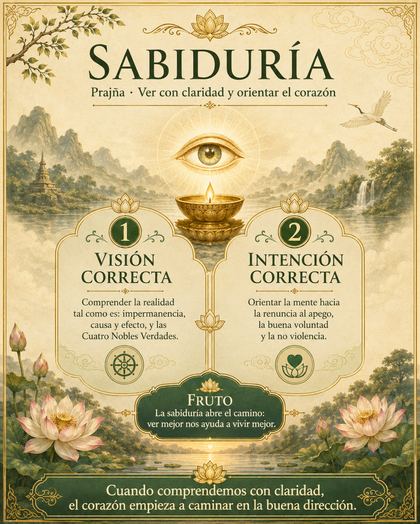
It means learning to look at life with less ignorance, less attachment and less rejection. It is seeing that everything changes, that our actions have consequences, that thoughts do not always tell the whole truth, and that we often suffer because we want to turn what is changing into a definitive refuge.
Seeing correctly is not looking down from above. It is looking with humility.
Right view is the first element of the Noble Eightfold Path because everything else depends on it. If we see wrongly, we act wrongly even when our intentions seem good. If we confuse attachment with love, we may call it loyalty to refuse ourselves the chance to change. If we confuse image with worth, we can spend half our life trying to look perfect without ever feeling enough. If we believe that a thought is an absolute truth, we will obey the mind even when it is pushing us towards suffering.
That is why the path begins here: learning to see.
Reality before the story
The mind does not merely perceive reality. It also interprets it.
Someone does not reply to a message and the mind says: “I no longer matter to them”. A person criticises us and we think: “I am worthless”. The body ages and we conclude: “I am losing my appeal, I am losing my worth”. A job is lost and the phrase appears: “I have failed”. We remember someone who died and the mind whispers: “if I go on living with joy, I betray their memory”.
Right view begins when we distinguish the fact from the story.
The fact can be painful. The story, on top of that, can make it unbearable.
A loved one has died. That is the fact. It hurts, it throws life into disorder and it deserves grief. But the story can add: “I will never be well again”, “I cannot carry on”, “if I suffer less I will be forgetting them”. Those phrases are not the death; they are interpretations born of pain.
A loss happened. That is the fact. A stage ended, changed shape or stopped being the place we imagined. The story can say: “I was not enough”, “no one will ever need me”, “everything I lived was a lie”. Perhaps they express fear, anger or sadness, but not necessarily truth.
A situation overwhelms us and we need to ask for help or set limits. That is the fact we may have taken a long time to accept. The story can punish us: “I am to blame”, “if I were strong I could manage everything”, “resting is selfish”. Seeing correctly requires looking beyond that initial guilt.
Not every thought deserves obedience.
A mental phrase can be intense and false. It can feel true because it hurts, not because it is true. Right view teaches us to create a space between what we think and what we decide.
Seeing impermanence
An essential part of seeing correctly is recognising impermanence.
Everything conditioned changes. The body changes, the mind changes, relationships change, emotions change, projects change, the people we love change. Even what seems stable is slowly being transformed.
This teaching can sound sad at first. Yet, rightly understood, it does not destroy life. It makes it more true.
When someone dear dies, impermanence stops being an idea. It becomes a direct experience. Until then we may have known that we all die, but we knew it in a distant way. After the loss, we understand it with our whole body.
Seeing correctly does not mean saying: “since everything changes, I should not love”. That would be a poor understanding. The teaching is more delicate: precisely because everything changes, it is worth loving with presence, gratitude and less possessiveness.
Identity too is run through by impermanence. It can begin with strength, grow, mature, change, cool, break or be transformed. To insist that our life keep the same shape forever can create a great deal of suffering.
In a painful situation, impermanence has another nuance. Sometimes we cling to what was. We remember a kinder stage, an old state of health, a full house, a promise of stability. But right view asks: what is happening now?
It is not enough to look at what a stage once was. Nor is it enough to look at what it promised to be. We have to look at what it is.
If there is now fear, exhaustion, isolation, illness, constant insecurity or loss of dignity, right view must not stay hypnotised by the memory of the good times.
Impermanence does not only teach us that everything can be lost. It also helps us not to remain prisoners of an old version of things.
Seeing suffering without disguising it
Seeing correctly means recognising dukkha when it appears.
This seems simple, but it is not always so. We often disguise suffering because acknowledging it would force us to change.
In a painful situation, for example, it is common to use phrases that soften the obvious:
“Everyone is tired”. “I have no right to complain”. “There are people worse off than me”. “When I am busy, I do not notice it”. “It is just a bad spell”. “If I am more patient, it will change”.
Some of those phrases may hold part of the truth. Everyone suffers. Gratitude matters. Many difficult stages also have good aspects. But seeing correctly requires looking at the whole, not only the part that lets us carry on without caring for ourselves.
If the pattern of suffering repeats, we have to see it.
In grief we can also disguise suffering. Sometimes we say “I am fine” because we do not want to worry anyone. At other times we demand of ourselves that we function as before. Perhaps we keep working, replying, caring and smiling, while inside the loss still has no space.
After a loss, we may feign indifference. We post that we are happy, we show ourselves stronger than we are, we try to prove that nothing affected us. But that performance can be another way of staying tied to the image.
Seeing correctly is being able to say: “this hurts me”.
Without theatre. Without shame. Without turning it into identity.
Simply acknowledging it.
Seeing the consequences
Right view also includes understanding that our actions have consequences.
Every word, every silence, every mental repetition, every habit and every decision leaves a mark. We do not always see the result immediately, but what is sown ends up shaping our life.
If we feed resentment every day, the mind becomes harder. When we repeat stories of guilt, the guilt grows stronger. If we compulsively check for signs on social media, the attachment stays alive. When we train the body out of hatred, we may gain muscle, but we also deepen the inner war. If we normalise a painful situation, it can become harder and harder to ask for help.
The opposite is also true.
A pause before speaking creates space. Not obeying an impulse weakens the pattern. Asking for help opens a door. Naming pain honestly reduces confusion. Caring for the body with respect changes the relationship with ourselves. Setting a limit can restore dignity.
Right view does not separate spirituality and everyday life. It understands that everything counts.
Not in an obsessive way. Not so as to live watching ourselves in fear. But so as to recognise that the mind is trained by what we repeat.
We are, in part, what we practise each day.
Seeing the difference between guilt and responsibility
Guilt is one of the emotions that most confuse our vision.
Sometimes it has a useful function: it shows us that we have done harm, that we need to make amends, to ask forgiveness or to act better. But many other times guilt becomes a fog that stops us from seeing.
In grief, guilt can appear forcefully. “I should have been there more”, “I should have called”, “I did not do enough”. Perhaps there is something concrete to learn. But guilt often tries to create an illusion of control: if I had done something else, the death would not have happened. That idea can be very painful and is not always fair.
In a loss, guilt can lead us to take on the whole weight of what happened. A life is usually more complex than a single cause. Seeing correctly means recognising our part without appropriating the entire story.
When we need to change a painful situation, guilt can be especially intense. Someone may be disappointed, may protest or may not understand. Perhaps we ourselves feel sad at leaving a stage behind. But feeling guilt does not prove that caring for ourselves is wrong.
Responsibility is looking honestly at our acts. Destructive guilt is punishing ourselves without clarity.
If we have done harm, we make amends when we can. When we have set a necessary limit, we hold it. If we have made a mistake, we learn. When it was not possible to keep something, we stop demanding omnipotence of ourselves.
Seeing correctly is distinguishing these things.
Seeing the emotion without turning it into a command
Emotions are real, but they are not always orders.
Feeling fear does not mean we must flee. Feeling desire does not mean we must obey it. Feeling guilt does not mean we must punish ourselves. Feeling anger does not mean we must attack. Feeling sadness does not mean all is lost.
Right view allows us to respect the emotion without blindly obeying it.
Someone who has just lost a loved one may feel they do not want to see anyone. Perhaps they need silence for a while. But if the isolation becomes absolute, it can increase the suffering. The emotion should be listened to, not made the only guide.
After a loss, the desire to seek immediate relief can be overwhelming. The body asks for contact. The mind looks for an explanation. Seeing correctly is recognising: “I have an impulse, but I do not need to act now”.
In grief, nostalgia can be very strong. Remembering the good moments awakens tenderness. But nostalgia should not erase the facts. A true emotion can point to a part of reality, not necessarily to all of it.
With body image, feeling insecure does not mean our body is wrong. It may mean we have learnt to measure ourselves by an external demand. The emotion points to a wound, not to a definitive truth.
This distinction is one of the most useful practices on the path.
The complete gaze
Seeing correctly is learning to look completely.
Not only the good moment of a stage, but also what could no longer sustain us. Not only the pain of a loss, but also the possibility of rebuilding ourselves. Not only the death of someone loved, but also the life we shared. Not only the body that ages or falls ill, but the body that lets us breathe, walk and embrace when it can. Not only the mistake made, but the capacity to learn. Not only the ego that seeks approval, but the awareness that can see it.
The mind tends to select. When it is attached, it remembers the beautiful and minimises the painful. When it feels aversion, it remembers the painful and erases the good. Seeing correctly is not choosing the story that best suits our emotional state. It is trying to open the field.
This requires patience.
At first we may see only fragments. Little by little we learn to hold more truth without breaking.
In a painful situation, looking completely can be decisive: “there was love and there was change; there were good moments and also suffering; I can be grateful for what was real and still care for the life I now have”.
In grief: “this person died and also lived; the absence hurts and the love remains in another way; I can weep and also go on living”.
In loss: “this ended and it hurts me; I am no less valuable for having lost this way of life; I can learn without hating myself”.
The complete gaze does not eliminate pain. It makes it more liveable.
An exercise: looking at a situation with right view
Choose a situation that is causing you suffering.
It may be a loss, an illness, a painful situation, a worry about your body, a comparison, a sense of guilt, loneliness or a need for approval.
Write five sections.
1. The fact
What happened or what is happening in concrete terms?
Avoid interpretations. Write something verifiable.
“This person died”. “I lost an important job”. “I have left home for the first time”. “I have compared myself with another body”. “I am worried about not being liked”. “I received a criticism”.
2. The story
What is my mind saying?
“I am worthless”. “I will never be well”. “I should be able to manage everything”. “If I grow old, I lose my appeal”. “If I am not approved of, I am not enough”. “It was all my fault”.
3. The emotion
What do I feel and where do I notice it in the body?
Sadness, anger, fear, guilt, shame, attachment, loneliness, relief, confusion. Pressure in the chest, a knot in the stomach, tiredness, tension, heat, emptiness.
4. The complete gaze
What part of reality am I leaving out?
Am I remembering only the good? Only the bad? Am I confusing an emotion with an order? Am I measuring my worth by the gaze of others? Am I using guilt to avoid accepting something? Am I denying a loss out of fear of letting go?
5. The next lucid gesture
What small act would be born of seeing better?
Not acting yet. Asking for help. Resting. Speaking with clarity. Remembering the facts in full. Caring for the body without punishing it. Allowing an emotion without acting from it. Setting a limit. Accepting a joy without guilt.
End by breathing three times and repeat inwardly:
“I can see this more clearly”. “I do not need to believe every story my mind tells”. “I can act from reality, not from fear”.
To remember
Right view looks at the facts, impermanence, the consequences and the limits of our interpretation. It does not justify harm nor confuse guilt with responsibility. Seeing well does not require knowing everything; it requires holding a sufficiently complete gaze before acting.
Desiring without possessing
Desire is not a mistake.
This is worth saying early, because many people come to Buddhism believing that desire is something bad, something that must be repressed or eliminated altogether. They imagine that a spiritual person does not desire, does not love, does not enjoy, does not grow excited, expects nothing from anyone, and lives in a kind of perfect neutrality.
That image does not help.
The problem is not feeling desire. The problem appears when desire turns into possession, demand, dependence or blindness.
We can desire company. We can desire health. We can desire love. We can desire beauty, rest, security, closeness, recognition or a more serene life.
All of that is part of the human condition.
The Buddhist question is more subtle: what happens when we do not get what we desire? What do we do when the thing desired changes? How do we treat others when we turn them into the source of our security? When does desire cease to be vital energy and become attachment?
The second element of the Noble Eightfold Path is right intention. We might also call it well-directed desire. It is not about switching off the heart, but about educating it.
To desire without possessing is to learn to love without turning the loved one into property.
Desire as energy
Desire moves life.
If we desired nothing, we would not care for our children, would not seek food, would not learn, would not create, would not call a friend, would not ask for help, would not try to heal. Desire can be a noble energy when it is guided by lucidity.
There are desires that open. Others narrow.
A healthy desire can say: “I want to care for my body because it is my home.” A confused desire says: “I need to have an admired body in order to feel that I am worth something.”
A healthy desire expresses: “I want to care and to receive affection.” One dominated by attachment demands: “I need to control this person in order to be all right.”
A healthy desire affirms: “I want to live with dignity.” Confused desire whispers: “I would rather keep this way of life even if it destroys me, because I am terrified of being alone.”
Right intention consists in looking at the direction of desire.
It is not enough to ask what I want. I also need to ask where I want it from. From fear? From comparison? From loneliness? From compassion? From the need to control? From clarity?
The same act can have very different roots.
Going to the gym may be born of health, of the joy of moving, of discipline or of the desire to live better. It may also come from hatred of one's own body, from the need to be envied or from the fear of not being desirable. Dressing well can be an expression of care; grooming oneself with anguish in order to look perfect is usually something else. Loving someone can open the heart; needing someone to confirm our worth at every moment chains us.
Buddhism does not ask only about the surface. It asks about the root.
Attachment is not love
The confusion between love and attachment causes a great deal of suffering.
Love sees others as living, free, changing and complex beings. Attachment turns their closeness into a guarantee of company, identity, security, future or personal worth.
Love can say: “I want your good.” Attachment says: “I need you to be the way I need you to be.” Love is glad to care. Attachment grows frightened if it is not in control. Love can suffer a loss. Attachment turns the loss into despair.
In real life, they almost never appear entirely separate. We love with fear. We want with history behind us. We bond from old wounds. The practice is not about feigning purity, but about learning to tell them apart.
When someone we love dies, love hurts. That pain is natural. We miss their voice, their body, their way of being in the world. Attachment adds another demand: “I do not accept a world where this person is not here.” The difference is subtle, but profound. Love weeps. Attachment fights against the irreversible.
In a significant loss, love can recognise the importance of what was lived and move through the mourning. Attachment wants to recover at any cost, to control what does not depend on us, to seek guarantees, to use social media to compare itself, to force explanations or to turn the ending into proof of worthlessness.
When a situation does harm, attachment can disguise itself as duty with great skill. It says: “I cannot change because it would be disloyal.” But perhaps, underneath, there is fear of loneliness, dependence, guilt, habit or the need for that situation to confirm an image of ourselves.
We can love someone and still need to move away.
This sentence can save an inner life.
Right intention
In the Noble Eightfold Path, right intention is traditionally linked to three movements: renunciation, goodwill and non-harming.
Put simply:
To renounce is to let go of what enslaves us. Goodwill desires the good. Non-harming means acting without cruelty towards others or towards ourselves.
The word “renunciation” usually sounds unpleasant in the West. It seems like loss, prohibition or sadness. In Buddhism, however, it has another flavour. To renounce is not to despise life. It is to stop clutching at what increases suffering.
A person in mourning may have to renounce the impossible demand that the death not have happened. They do not renounce love. They renounce the war against the fact.
Someone going through a loss may need to renounce the search for an answer that will never bring them peace. They do not renounce what was lived. They let go of the idea that an external explanation can restore their worth.
Someone who changes a painful situation renounces the hope that keeps them trapped when the facts show repeated harm. They do not renounce their capacity to care. They renounce continuing to abandon themselves in order to preserve a dynamic that harms them.
Goodwill keeps the heart human. It does not desire revenge, even when it sets limits. It does not need to destroy in order to separate. Nor does it force itself to feel affection while the wound is still there. It simply tries not to turn pain into cruelty.
Non-harming includes something we sometimes forget: not harming ourselves.
Enduring indefinitely where we are humiliated is not virtue. Forcing ourselves to appear perfect in order to receive approval is not care. Punishing ourselves at the gym because we hate our body is not wise discipline. Repeating a dynamic that breaks us only to soothe a momentary guilt is not compassion either.
Right intention asks us for honesty.
The renunciation that does not harden
Many people fear that renouncing attachment will make them cold.
But letting go is not freezing.
A mother who accepts that her child will grow up does not love him any less. She loves differently. A person who accepts the death of a loved one does not erase the relationship; they allow the love to be transformed. Whoever lets a finished stage go does not deny its beauty; they stop demanding that the past return. Someone who acknowledges their limits need not hate life; they can take care of themselves because they want to live.
Buddhist renunciation is compatible with tenderness.
In fact, attachment often makes it impossible to love well. When we need to possess, we stop seeing the other. We turn them into an answer to our anxiety. Instead of asking ourselves who they really are, we ask whether they give us security. Instead of listening, we demand. Instead of caring, we control.
Renouncing attachment allows us to live with more clarity.
It will not always be possible to keep a way of life. Sometimes the circumstances have already changed and we must adapt. Even then, letting go of attachment can keep the heart from closing in hatred.
One can say goodbye with pain and dignity. One can remember without staying trapped. It is possible to wish someone well without demanding anything in return. We can also acknowledge: “I do not need to recover what was destroying me.”
Healthy renunciation does not harden. It orders.
Desiring justice without living in hatred
There are sorrows that awaken legitimate anger.
When someone hurts, manipulates, humiliates or betrays us, it is natural to desire justice. Buddhism does not ask us to deny that desire. It does not demand that we smile at harm or call any wound a “lesson”.
The question is what we do with the anger.
A right intention may seek reparation, protection, truth or distance. Intention dominated by aversion seeks to destroy, to humiliate, to strike back, to make the other person suffer as we have.
Sometimes firm measures are needed: limiting harmful conversations, turning to professional support, setting legal boundaries, protecting the children and telling trusted people what happened. That is not hatred. It can be right action.
Hatred begins when the wound becomes an identity and we no longer want freedom, but the permanence of the conflict.
In a painful situation, there may be a necessary stage of anger. Anger helps us stop minimising. It gives us the strength not to repeat what breaks us. But if it remains as our only nourishment, it can keep us tied to the same harm, even when outwardly life has changed.
Desiring justice without living in hatred is difficult. It takes time. It is not achieved through pretty phrases.
The practice begins with something basic: protecting ourselves without deliberately feeding inner destruction.
Desiring the pain to end
We also desire to stop suffering.
This desire is understandable. No one wants to remain in mourning, anxiety, guilt or attachment. But even the desire to be well can turn into suffering if it becomes a demand.
“I should have got over this by now.” “I shouldn't still be crying.” “If I meditate, I should be at peace.” “If I know that stage was harming me, I shouldn't miss it.” “If I am an adult, I shouldn't need approval.”
These phrases do not help. They add pressure.
Right intention does not say: “I have to be well now.” It says: “I want to accompany myself in a way that reduces suffering.”
There is an enormous difference.
In grief, to desire peace is natural. To demand immediate peace can be violence. After a loss, wanting to rebuild oneself is healthy. Hating oneself for not moving on quickly deepens the wound. In changing a painful situation, desiring clarity is necessary. Punishing oneself for feeling nostalgia only adds confusion.
Healthy desire walks with patience.
It does not push the heart as though it were a machine. It guides it.
Right intention in everyday life
This teaching is practised in small decisions.
Before speaking, we ask: “do I want to clarify or to hurt?” Before reacting, we look: “am I trying to communicate or to calm my anxiety?” While training, we observe: “am I caring for my body or punishing it?” When we groom ourselves, we feel: “is there joy, or fear of not being liked?” When we remember a stage of life, we ask: “am I seeing the whole reality or only what my attachment selects?” When we want to recover what came before, we look: “is this desire born of fear, of loneliness, of guilt or of habit?”
These questions do not always give immediate answers. But they educate the mind.
Right intention is like checking the compass. We can walk a long way, but if the direction is off, we will end up far from where we meant to go.
In Buddhist practice, every moment offers a chance to orient the heart anew.
Desiring the good
At bottom, right intention trains us to desire the good.
Our own good and the good of others.
This does not mean pleasing everyone. Nor does it mean avoiding conflict or always giving in. Sometimes our own good requires disappointing someone. At times, the good of others consists in no longer taking part in a destructive dynamic. There are boundaries that are uncomfortable and, even so, healthy.
To desire the good of someone who has died can be to honour their life without staying frozen in the loss.
To desire the good of a difficult memory may be to stop seeking control, to stop insulting and to refrain from feeding needless harm. Perhaps we cannot feel it at first. There is no need to force it.
To desire the good of someone who hurt us does not mean drawing closer. It can mean something more sober: “I do not want to live hating, but I keep my distance.”
To wish ourselves well involves something equally important: not treating ourselves as enemies. Not using the body as a battlefield. Not sustaining relationships that destroy us. Not demanding perfection of ourselves in order to deserve care.
Right intention joins clarity and kindness.
Without clarity, kindness turns into weakness. Without kindness, clarity turns into hardness.
We need both.
An exercise: reviewing the intention
Choose a concrete situation. It can be a pending conversation, a loss, a bereavement, a painful situation, an impulsive reaction, a decision about your body or a strong need for approval.
Write:
What I desire is…
Be honest. Do not write what you ought to desire. Write what really comes up.
“I desire to recover my health.” “I desire to be admired.” “I desire not to feel guilt.” “I desire to have a more attractive body.” “I desire that someone pay for what they did.” “I desire that everyone understand my decision.” “I desire to stop missing it.”
Then ask:
What lies beneath this desire?
Fear, loneliness, love, attachment, anger, shame, the need for security, weariness, dignity, compassion.
Now write:
If I acted from this desire just as it is, would it reduce suffering or increase it?
Do not answer in order to judge yourself. Answer in order to see.
Finally, formulate a clearer intention:
“I want to care for myself without punishing myself.” “I want to love without controlling.” “I want to set limits without hatred.” “I want to train for health, not for comparison.” “I want to honour the one who died without abandoning my life.” “I want to change this dynamic without losing my dignity.” “I want to feel this sadness without turning it into guilt.”
Close with three breaths.
Repeat inwardly:
“I can desire without possessing.” “I can let go without hardening.” “I can act from clarity and not only from fear.”
To remember
Desire is energy and does not need to be condemned. It becomes a source of suffering when it demands possession, identity or definitive security. Right intention transforms that energy: it orients desire towards care, justice and the good without making the outcome a condition for having worth.
The word that does not wound
There are words that go on hurting many years after they were spoken.
They were not always shouts. Sometimes a short sentence was enough, said with contempt, with coldness or with mockery. A word can lodge itself inside someone like a splinter. It can change the way a person looks at themselves, defends themselves or loves. It can also open a door, ease a burden, ask forgiveness, hold a grief or set a necessary limit.
Buddhism gives great importance to speech, because to speak is no small act.
With words we care or we harm. We clarify or we confuse. We join or we separate. We tell the truth or we build deceptions. We protect dignity or we attack it.
The third element of the Noble Eightfold Path is right speech.
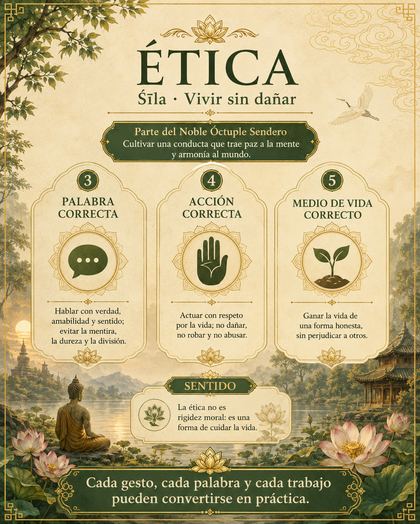
It does not mean speaking perfectly. Nor does it consist of always being soft, compliant or pleasant. Sometimes a right word is firm, serious and uncomfortable. At times telling the truth can hurt. But there is a deep difference between a truth that awakens and a word used as a weapon.
Right speech tries to reduce suffering.
Speaking is not only making sounds
We believe that speaking is simply saying what we think. But in reality, speaking is acting.
A sentence can change the climate of a house. It can humiliate a child, console a friend, close a conversation, ask for help, manipulate a relative or give back dignity to someone who felt lost.
That is why, before speaking, it is worth looking at where the word is born.
Does it come from clarity or from rage? Does it seek to help or to win? Does it want to express a need or to punish? Does it mean to tell the truth or to control the other’s reaction? Is it in the service of dignity or of image?
The ego appears a great deal in speech. There is no need to explain it in a complicated way. It is that part which wants to come out on top, to have the last word, to prove it is right, to defend an image, not to seem weak or to make the other feel guilty.
When the ego speaks, there is usually urgency.
It needs to answer at once. It wants to correct. It interrupts. It exaggerates. It brings up old matters. It uses irony. It posts veiled hints. It looks for witnesses. It does not converse in order to understand; it speaks in order to win.
Right speech begins just before that impulse.
In that brief second in which we can still choose.
The four forms of wrong speech
The Buddhist tradition usually points to four main forms of speech that generate suffering: lying, dividing, speaking harshly, and speaking without meaning or carelessly.
It is best not to understand them as a moralistic list. They are rather signals for observing how we use the voice.
Lying breaks trust. It may be a great lie or a small distortion. There is also the lie of omission, when we hide something important in order to manipulate reality.
Speaking in order to divide consists of sowing conflict: telling one person something about another so as to set them against each other, exaggerating a story, feeding factions, using a confidence as a weapon.
Harsh speech wounds deliberately. It may present itself as sincerity, but in reality it seeks to humiliate, to belittle, to take revenge or to unload rage.
Useless or careless speech fills the mind with noise. Not all silence is virtue, nor is all light talk bad. The problem appears when we use words always to escape from ourselves, to feed gossip, comparisons, mockery or superficiality that leaves the heart more scattered.
These four forms appear in daily life far more than we like to admit.
In a major loss, we can lie in order to look good, speak ill in order to divide friendships, use harsh words in order to give back pain, or fill the hours with stories that only feed attachment and resentment.
In a painful situation, speech can become a tool of control: promises that are not kept, apologies that transform nothing, constant criticism, silences used as punishment, phrases that make the other person doubt their own perception.
In grief, too, we must take care of our words. Sometimes, meaning to console, we say things that hurt: “you have to be strong”, “it’s been a while now”, “everything happens for a reason”, “at least they lived many years”. Perhaps the intention was good, but the word did not listen enough to the pain.
Right speech requires presence.
Telling the truth without using it as a knife
Many people confuse sincerity with brutality.
They say: “I only tell the truth”, when in reality they are using the truth to wound. But a truth said without care can turn into violence. Right speech does not give up the truth, yet it tries to join it with timing, respect and compassion.
Before speaking, we can ask ourselves:
Is it true? Does it need to be said now? Can it be said in a less harmful way? Am I trying to help or to unload? Do I want to clarify or to win?
Not every truth needs to be said at any moment. Nor must every truth be silenced in order to avoid discomfort. The practice lies in finding the most conscious way.
In a situation that causes harm, for example, right speech can be very clear:
“This is hurting me”. “I can’t go on in this dynamic”. “I need distance”. “I won’t accept being spoken to like this”. “I understand your pain, but I can’t be the place where you unload it”. “I’m leaving because I need to take care of myself”.
These sentences may hurt whoever hears them. But they do not necessarily come from cruelty. Sometimes a right word wounds the illusion, not the dignity.
Something else would be to say:
“You’ve ruined my life”. “No one will ever put up with you”. “You’re a disaster”. “Without me you’re nothing”. “I’m going to make sure everyone knows what you’re like”.
There the word seeks to harm.
The difference does not always lie in the subject, but in the intention, the tone and the manner.
Speech in difficult situations
Pain changes the way we speak. In grief we may receive well-meaning phrases that rush the process; in a family argument, the need to be right can turn a partial truth into a weapon. Work, too, offers occasions to humiliate, to exaggerate or to stay silent out of fear.
Right speech does not demand perfect formulas. Sometimes it consists of acknowledging: “I don’t know what to say, but I’m here”. Other times it asks us to express a limit without insulting, to admit a mistake, not to spread a confidence or to wait until the anger has subsided.
Someone who feels alone needs conversation, but also listening. Someone going through a family conflict may need to avoid written messages meant to provoke guilt or to get an immediate reaction. In every case the same question serves: does what I am about to say clarify, care and fit the facts, or is it trying to unload onto another person an emotion I have not yet understood?
Listening is also right speech
Speaking well requires listening well.
Many times we do not listen in order to understand, but in order to answer. While the other person speaks, we are already preparing a defence, advice, judgement or reply. The ego wants to look good even while listening. It wants to seem wise, useful, intelligent or superior.
Right listening is more humble.
It lets the other exist without turning them immediately into our project.
In grief, listening can simply be letting someone repeat the same story several times. Pain needs to return to certain places. It does not always seek a solution. Sometimes it seeks company.
After a loss, a friend may need to speak about the same person more than once. Listening does not mean feeding an obsession indefinitely, but it does mean understanding that the heart takes time to put things in order.
If someone tells us they are living through a situation that harms them, listening demands special care. It is best not to judge quickly. Phrases like “why do you stay there?” can increase the shame. It is better to help the person see clearly, remember their dignity and find real support.
To listen rightly is not always to agree. It is to be present without crushing.
Right silence
Silence, too, is part of speech.
There are wise silences and cowardly silences. Silences that care and silences that punish. Silences that let us breathe and silences that manipulate.
Keeping silent can be right when speaking would only add harm, when we need time to order an emotion, when the other person is in no condition to listen, or when a conversation would lead us once again into a destructive cycle.
But to stay silent is not always virtue. Sometimes we keep silent out of fear, out of comfort or to sustain an image. We do not say that something hurts us because we fear being a nuisance. We do not set limits so that we will not be rejected. We do not denounce an unjust situation because we want to look good.
Right speech includes knowing when to speak and when to stay silent.
In a painful situation, silence can become a prison if we never express what is happening. It can also be protection when we have already spoken many times and going on arguing only drags us to the same place.
After a loss, silence can help us heal. Not every ending needs a last conversation. Sometimes the mind asks to speak because it wants to reopen.
In grief, silence can be deep company. To sit beside someone without demanding words of them can be a very high form of care.
Right silence does not abandon. It holds. Wrong silence avoids, punishes or manipulates.
Telling them apart requires honesty.
Repairing with words
We all make mistakes when we speak.
We will say things out of rage. We will stay silent when we should have spoken. We will speak too much. We will give clumsy advice. We will tell truths without care. We will use irony to defend ourselves. We will wound someone we love.
The practice does not consist of never failing. It consists of repairing when we see the harm.
Repairing can begin with simple sentences:
“What I said was unfair”. “I spoke to you out of rage”. “I shouldn’t have used that to hurt you”. “Forgive me; I want to say it another way”. “I see now that I didn’t listen well”. “I need to own my part”.
Asking forgiveness does not guarantee forgetting or absolution. Repair is not a tool for regaining control. It is a way of cleansing our action.
In a loss, asking forgiveness may be necessary. But we must look at the intention. If we ask forgiveness only to reopen contact, perhaps we are not repairing; we are trying to get back in.
In a painful situation, there may also be things to repair without denying the reason for the limit. We can acknowledge our own mistakes and, even so, keep up the care. Admitting a fault does not oblige us to return to a dynamic that destroys us.
Right speech holds both things: humility and dignity.
An exercise: before speaking
Before a difficult conversation, take a few minutes.
It may be with a difficult memory, with someone in your family, with a person who wounded you, with someone in grief, or even with yourself in front of the mirror.
Write down or answer mentally:
1. What do I really want to say? Look for the essential sentence. Not the embellishments, not the accumulated reproaches, not the whole history.
2. From where do I want to speak? Rage, fear, guilt, a wish to control, a need for approval, clarity, care, dignity.
3. What part could I say in a simpler and less harmful way? Do not soften it until it becomes a lie. Just take out the unnecessary poison.
4. Do I need to speak now or to wait? Urgency usually comes from attachment, rage or fear. Not always, but it is worth examining.
5. What limit must I take care of? Perhaps not to descend into insults, not to justify myself for hours, not to answer provocations, not to beg, not to speak if there is risk.
Then form an intention:
“I want to tell the truth without using it as a weapon”. “I want to listen without losing my dignity”. “I want to speak clearly without adding cruelty”. “I want to stay silent if speaking now only increases suffering”.
Breathe three times before you begin.
Sometimes that pause changes the whole conversation.
To remember
Speaking rightly involves truth, timing, intention and effect. A sentence can be true and still be used as a weapon. Listening, keeping silent when it is fitting, and repairing a harmful word are part of the same practice. Before speaking, it matters to know what we are trying to do with the other person.
Acting without betraying yourself
There comes a moment when clarity must turn into action.
We can understand many things, read profound teachings, recognise our patterns, tell attachment from love and speak with greater care. But if we then go on acting against our own dignity, the path remains unfinished.
Buddhism is not merely a way of thinking. Nor is it merely a way of feeling. It is a way of living.
The fourth element of the Noble Eightfold Path is right action.
It does not refer to perfect conduct or to a rigid morality. It speaks of acting in such a way that we reduce harm, care for life and do not betray what we see clearly. Right action joins awareness and behaviour. It asks us to let understanding descend into the body, into our decisions, our habits, our limits and our concrete gestures.
Because it is one thing to know that a situation is harming us. It is quite another to stop taking part in the harm. It is one thing to understand that the body deserves respect. It is another to stop punishing it. It is one thing to recognise that a loss has ended. It is another to stop feeding it with small acts. It is one thing to accept that someone has died. It is another to learn to live without turning one's own life into a tribute of permanent suffering.
Right action begins when we stop abandoning our life in order to sustain an illusion.
Acting leaves its mark too
Every action trains something.
Each time we obey an impulse, that impulse grows stronger. Each time we pause, the pause becomes more possible. If we repeat a behaviour born of attachment, attachment finds its way. When we act from dignity, even if the voice trembles, dignity begins to take on a body.
This is seen very clearly in relationships.
After a loss, going over digital memories again and again may seem like a small act. No one sees it. There is no great scene. But that behaviour feeds rumination. Each review tells the mind once more: “I still depend on this to know how I am”.
Acting from anxiety also leaves its mark. Perhaps we seek immediate relief, an answer or a sign. But if every surge of distress ends in an impulsive reaction, the mind learns that it cannot bear the emptiness.
In a habit that harms us, each return after the intention to change can reinforce the cycle. Not because we are weak or foolish, but because body and mind grow used to a dynamic: tension, momentary relief, promise, repetition. Interrupting that pattern demands different acts, not just different thoughts.
Grief for the death of someone loved also has actions that can imprison or heal. Keeping every object may be necessary for a time. Avoiding every memory may protect us at first. But if, over the years, one's whole life is organised around not touching the wound, grief can remain frozen.
Right action asks a simple question:
this thing I am doing, does it help me live with more clarity or does it feed my suffering?
Doing no harm
In the Buddhist tradition, right action is usually linked to not killing, not stealing and not engaging in harmful sexual conduct. Put in broader terms, it is about not harming life, not taking what does not belong to us and not using desire in a way that destroys one's own dignity or that of others.
Doing no harm sounds simple, but carried into real life it demands a great deal of attention.
Doing no harm does not mean avoiding all discomfort. Sometimes we will have to say no. Someone may suffer because we set a limit. A person close to us may be hurt because we stop sustaining a role we can no longer sustain. A family member may be upset for the same reason. That discomfort is not always unjust harm.
Harm is something else.
We harm when we manipulate, humiliate, use, lie, pressure, invade, punish with silence, promise changes we do not try to keep, or unload our pain on others as if they were responsible for saving us.
We also harm ourselves.
We harm ourselves when we stay where we are treated with contempt. When we use the body as a field of punishment. When we repeat, again and again, a dynamic that breaks us only to calm the anxiety of the moment. When we demand of ourselves that we appear perfect in order to deserve love. When we deny grief and force the heart to function as if nothing had happened.
Right action includes care towards oneself.
This idea is important because some people confuse kindness with self-abandonment. They believe that being good means putting up with everything, understanding everything, forgiving everything and never being a nuisance. But a kindness that forgets its own dignity ends up turning into suffering.
Doing no harm also means not collaborating with what destroys us.
Acting when life grows complicated
Right action is recognised better in concrete situations than in grand declarations. It may be accompanying a sick relative without promising what we cannot deliver, apologising after an unjust reaction, refusing a deceitful workplace practice or leaving a conversation before turning it into aggression.
It also includes decisions that will not please everyone. Setting a limit, asking for help or ceasing to keep up an appearance may disappoint someone and still be necessary. Intention matters, but it is not enough: it is worth looking at the foreseeable effects of what we do.
To act without betraying oneself means seeking a response that protects one's own dignity and that of others. It will not always be comfortable or perfect. Buddhist ethics does not ask us to control every outcome; it asks us not to collaborate knowingly with harm when a more lucid alternative exists.
Right action and sexual desire
Buddhism also pays attention to sexual conduct, because desire can unite, care for and express intimacy, but it can also use, confuse and harm.
Right action in this field does not consist in imposing a puritanical view. It has to do with respect, consent, honesty and responsibility.
Sexual desire becomes harmful when it uses another person as an object, when it promises what it does not want to sustain, when it manipulates, when it invades, when it seeks revenge, when it tries to cover an emptiness without looking at its consequences, or when it enters into dynamics that break trust.
After a loss, for example, some people quickly seek stimulation or constant activity so as not to touch the pain. That is not always wrong, but it is worth looking at the intention. If we use it to numb ourselves, perhaps we are only displacing the wound.
Sexuality can become mixed with dependence, control or guilt. Sometimes it is used to falsely close a harm that has not been repaired. Right action asks us to look at whether it is born of freedom, respect and responsibility.
Sexual desire also crosses into body image. We want to be desired, and we can turn that need into a measure of worth. But being desired is not the same as being worthy. Dignity does not depend on arousing desire.
Right action protects intimacy from manipulation and from self-deception.
Right action is not perfect action
It is easy to turn this chapter into another form of demand.
“I should always act well”. “I ought not to make mistakes”. “If I were aware, I would not relapse”. “If I already know that stage was harming me, I should not miss it”. “If I know that my body does not define my worth, I should not compare myself”.
These phrases do not help. Practice needs responsibility, but it also needs patience.
We are going to fail.
Sometimes we will react in haste. We will fall into an absurd comparison. We will speak from anger. We will look at ourselves with harshness. We will idealise a difficult stage. We will avoid grief for longer than necessary.
The point is not to build an image of a perfect person. That would be another trap of the ego. The point is to repair, to learn and to return.
Right action unfolds like a training. Each conscious act counts. Each relapse seen with honesty can also teach. The path does not demand that we never fall; it demands that we not live forever asleep within the fall.
Responsibility without self-hatred: that is a much-needed combination.
Right action can disappoint
Sometimes acting rightly disappoints someone.
This is hard to accept, above all for people used to pleasing. If our worth depends on others being happy with us, every limit feels like a threat.
But there are necessary decisions that will not be applauded.
Changing a painful situation may disappoint someone who hoped everything would stay the same. Saying no may upset someone who benefited from our automatic yes. Resting may trouble someone who expected our constant output. Postponing a reply may frustrate someone who demands immediate availability.
Right action does not always coincide with outside approval.
This holds too for one's personal image. We can decide not to live as slaves to appearing perfect, and others may still judge. We can train less obsessively, dress with more freedom, grow older without so much war, or stop posting in order to prove something. Perhaps someone will have an opinion. The practice consists in not handing our peace over to every gaze.
The ego asks: “what will people think?”. Awareness asks: “what is the most honest and least harmful thing?”.
We will not always have a clear answer. But the second question leads better than the first.
Small actions, great changes
Life changes many times through small, repeated acts.
There is no need to wait until we have immense strength. Often strength is born after acting, not before.
A person in grief begins by opening the window, walking for ten minutes, calling someone, eating something warm, allowing themselves to cry. They are modest gestures, but they remind the body that life goes on.
After a loss, someone decides not to use social media to compare themselves tonight. Tomorrow the impulse may return. But today they have created a small space. That space matters.
When a dynamic grows confusing, it helps to write down the facts so as to read them when nostalgia embellishes the past. It can also help to talk with a friend before replying, to mute a channel for a few days, or to seek guidance. Each act reduces the power of the cycle.
A person caught up in image decides to train today without punishing themselves, not to weigh themselves compulsively, to buy comfortable clothes without an obsession to impress, or to look in the mirror without insulting themselves.
None of this looks heroic from the outside.
But the path is built this way: with small actions that stop betraying us.
An exercise: an action that does not betray me
Choose a concrete situation in which you tend to act from attachment, fear, guilt, anger or the need for approval.
It may be a loss, a time of grief, a painful situation, the body, the gym, food, social media, a conversation or a pending decision.
Write down:
1. The usual pattern
What do I tend to do when the discomfort appears?
“I check compulsively”. “I keep quiet”. “I repeat a habit that harms me”. “I punish myself by training”. “I look at myself with contempt”. “I pretend to be fine”. “I seek approval”. “I argue until I am exhausted”.
2. What that pattern promises
What relief does it promise?
“To calm the anxiety”. “To avoid loneliness”. “To avoid conflict”. “To feel in control”. “To appear strong”. “To be liked”. “Not to feel guilty”. “To recover hope”.
3. What that pattern actually produces
Look with honesty.
More peace or more anxiety? More dignity or more dependence? More clarity or more confusion? More health or more punishment?
4. A small right action
Choose a gesture that is possible for today.
Not to act from impulse. To eat calmly. To walk for ten minutes. To ask for help. To say no. To rest. To put a photo away. To use social media with a pause for an hour. To train for health, not for punishment. To write down the full facts of a painful situation. To speak to yourself with less cruelty.
5. A supporting phrase
“I can act from my dignity, not from my fear”. “I do not need to obey every impulse”. “Caring for myself is also a way of doing no harm”. “A small action can open a different path”.
Breathe three times and carry out that action as soon as possible.
Practice becomes real when it takes shape.
To remember
Right action seeks to do no harm and to take on consequences without demanding perfection. Sometimes it will be gentle; at other times firm or uncomfortable. Ethics becomes real in small decisions: limits, apologies, honesty, care of the body and the refusal to collaborate with what degrades life.
Earning a living without harming
Working is not only about earning money.
It is also a way of taking part in the world. Through our work we keep a home running, feed a family, pay bills, develop skills and spend a good part of our daily energy. But beyond that, even when we do not always see it, every occupation leaves a mark: on us, on others and on the life we help to build.
Buddhism calls right livelihood the fifth element of the Noble Eightfold Path.
This teaching asks something uncomfortable and necessary:
does the way I earn my living reduce suffering or increase it?
This is not about looking at work through moralism. Many people cannot freely choose their job. There are mortgages, children, debts, responsibilities, age, social circumstances, lack of opportunities or fear of losing stability. It would be unfair to speak of right livelihood as if everyone could change profession tomorrow.
The teaching must be applied with realism.
Even so, it is worth looking.
Because work can be a place of dignity, service and growth. It can also become a constant source of harm, lies, anxiety, pride, comparison and loss of oneself.
Work as practice
We often separate spirituality and work.
We imagine that practice lies in meditation, in reading, in silence or in quiet moments. Then we go to work and act as if other laws held sway there: competing, keeping up appearances, applying pressure, pretending, enduring, dominating, coming out on top.
But if Buddhism does not enter into work, it remains incomplete.
The office, the workshop, the shop, the surgery, the computer, the lorry, the factory, the classroom or the hospital are also places of practice. There the ego appears, along with fear, the desire for recognition, frustration, comparison, lies, ambition and compassion.
Work shows us very clearly who we are when there is pressure.
How do we treat someone who depends on us? What do we do when we can lie without being noticed? How do we react to criticism? Do we use our position to serve or to feel important? Do we compete by destroying or do we try to grow without harming? Do we work responsibly or do we live dragged along by reluctance? Do we demand so much of ourselves that we end up falling ill?
Right livelihood does not necessarily begin by changing jobs. Sometimes it begins by changing the way we are present in it.
Not every job leaves the same mark
There are jobs that, by their very nature, generate suffering in an obvious way.
Activities based on exploiting, deceiving, destroying, intoxicating, manipulating or encouraging direct harm clash with a life guided by compassion. The classical Buddhist tradition advised against ways of earning a living connected with killing, trafficking in living beings, dealing in weapons, selling intoxicants or deceiving in harmful ways.
In the modern world, situations are more complex.
A person can work in a seemingly respectable company and take part in unjust practices. Another can have a humble trade and live it with enormous dignity. There are whole sectors that operate in grey areas: manipulative advertising, products that create dependence, labour exploitation, businesses built on personal data, industries that harm the environment, abusive financial services, technologies designed to hook our attention.
It is not always easy to determine to what extent we are responsible for the whole system in which we work. But neither is it right to wash our hands of it completely.
The path begins with honest questions:
Who does my work benefit? Who can it harm? Am I forced to lie in order to keep it? Am I taking part in something that goes against my conscience? Can I reduce harm from my current post? Do I need to plan, calmly, a way out towards something more coherent?
Not all the answers will be quick. Some will call for time, prudence and strategy. Buddhism does not demand theatrical gestures. It asks for clarity and direction.
When work makes us ill
There are jobs that harm us little by little.
Not always out of explicit malice. Sometimes through an excess of workload, continuous pressure, lack of support, constant conflicts, impossible hours, disproportionate responsibility or the sense of never being allowed to fail.
The body begins to speak.
Insomnia. Irritability. Anxiety. Tiredness that sleep does not fix. Muscular pain. Digestive problems. Emotional disconnection. Loss of joy. The sense of always living on alert.
The mind tries to justify it: “it is only a phase”, “I have to put up with it”, “I cannot fail”, “if I stop, everything collapses”, “others can cope with more”, “I ought to be strong”.
But right action and right livelihood also include not destroying ourselves through work.
It is important to say this clearly: working a great deal is not always a virtue. Enduring a situation that breaks us is not always responsibility. Being indispensable may seem prestigious, but at times it is a trap. If work demands sacrificing our health, our family, our dignity or our mental stability on a permanent basis, something needs to be reviewed.
We will not always be able to change it straight away. But we can stop calling it normal.
Buddhism does not ask us to be productive machines. It reminds us that human life is precious, vulnerable and limited.
Earning a living without losing yourself
A useful question would be:
what price am I paying for this way of life?
Not only in money. In health, presence, calm, time, ethics, relationships, sleep, joy, the capacity to love.
Sometimes the price is reasonable. All work involves effort, tiredness and difficult moments. We should not expect every day to be comfortable. But at other times the price is too high.
A person can earn well and live inwardly impoverished. Another can have prestige and not see their children grow up. Someone can keep up an impeccable professional image while their body cries out for help. There are also those who hold on to a job out of fear of social judgement, not because it is truly necessary.
The ego asks: “what will people think if I slow down, if I change, if I resign, if I ask for help, if I admit that I cannot go on?”.
Conscience asks: “what kind of life am I building?”.
Earning a living without losing yourself does not always mean great changes. It can begin with concrete limits: not answering at certain hours, asking for support, documenting impossible workloads, speaking clearly, reviewing priorities, looking for alternatives, saving in order to have some leeway, taking care of sleep, recovering spaces of silence.
Spirituality does not replace a good strategy. Clarity needs practical forms.
Ambition without blindness
Buddhism does not demand a lack of ambition.
We can want to improve, to learn, to start a business, to be promoted, to earn more, to develop talent, to offer something useful to the world. Ambition can be a vital energy when it is guided by healthy values.
The problem appears when ambition becomes blind.
Then it no longer matters what we harm, whom we trample on, what we lie about or what we lose in order to get ahead. We want more out of sheer inertia. More money, more visibility, more control, more recognition. It is never enough.
This mechanism closely resembles the desire to have an enviable body or a perfect image. There is always another level. Another comparison. Another mirror. Another round of applause. Another figure.
The question is not “can I want to grow?”. Of course I can.
The question is: what do I want to grow for, and what am I willing to sacrifice?
A healthy ambition seeks to develop capacities and to contribute. An ambition ruled by the ego seeks to prove its worth.
If we need to succeed in order to feel that we exist, every obstacle will be a humiliation. If we seek to create something valuable, even failure can teach us.
Right livelihood does not kill energy. It directs it.
Money and freedom
Money is not a spiritual enemy.
In a lay, everyday life, money matters. It makes it possible to eat, to care for children, to pay for housing, to attend to illnesses, to rest, to help others and to have some leeway to choose. To deny this would be naïve.
The problem is not money. It is our mental relationship with it.
Some use it to sustain a dignified life. Others turn it into the absolute measure of worth. Some people live in constant fear of losing it, even when they have enough. Others sacrifice ethics and health in order to accumulate more. Sometimes money is used to impress: clothes, cars, trips, restaurants, appearances. People do not so much enjoy the things themselves as being seen with them.
The ego attaches itself easily to money because it gives it a sense of security and importance.
But money changes. It can come and it can go. It does not protect us from death, it does not guarantee love, it does not do away with old age, it does not by itself resolve loneliness. It helps with many things, but it cannot bear the weight of being our ultimate refuge.
The practice consists in using money with awareness.
Earning honestly. Spending without losing our heads. Saving with prudence. Sharing when possible. Not buying an image at the cost of our peace. Not selling our dignity for approval.
Money can serve life. Or it can become our master.
When change is not yet possible
Someone may read this chapter and think: “my work harms me, but I cannot leave it”.
That situation exists.
Not every life allows for quick changes. Sometimes a family must be supported, debts paid, an opportunity awaited, someone cared for, training finished or strength gathered. Saying “drop everything” may sound liberating, but it can also be irresponsible.
Right livelihood does not always begin with an outward renunciation. Sometimes it begins with an inner and practical strategy.
Recognising the truth without exaggerating or denying it. Caring for the body in order to hold out better while a change is being prepared. Seeking allies. Cutting back expenses to gain freedom. Updating our training. Asking for advice. Setting small limits. Documenting abuses if they exist. Exploring alternatives. Not confusing patience with endless resignation.
Clarity cannot always act straight away, but it can begin to prepare the ground.
If a person is in a painful situation, the same often holds true. They cannot always get out in a day. They need a plan, support, resources, security. What matters is not to use the difficulty as an excuse to deny the truth.
There are situations in which the first right act is to stop lying to oneself.
Vocation and service
Not everyone will have a great professional vocation. That too is worth accepting.
Some people love their work. Others live it as a means to sustain life. There are those who find meaning in a profession and those who find meaning outside it: family, art, friendship, community, contemplation, care.
Buddhism does not demand that we turn work into a sacred identity.
But it does invite us to bring in service wherever possible.
Service does not mean sacrificing ourselves without limit. It means asking ourselves how our work can ease something, put something in order, care for something, contribute something true. An office worker can serve with precision. A driver, with responsibility. A doctor, with attentiveness. A programmer, by creating useful tools. A person who cleans, by making a space fit to live in. An entrepreneur, by generating dignified employment. A teacher, by awakening confidence.
When work is connected with service, the ego loses some of its prominence.
It is no longer only about “how people see me” or “how much I am worth”. Another question also appears: “what good can I do from here?”.
That question can transform even simple tasks.
An exercise: reviewing my livelihood
Find some paper and answer honestly. There is no need to make immediate decisions.
1. The mark of my work
What good does my work produce? What suffering can it generate, directly or indirectly? Is there anything that makes me uneasy ethically?
2. My relationship with my professional image
Do I use my work to feel important? Do I find it hard to rest because I fear looking weak? Do my position, salary or success define my worth too much? Do I compare myself continually?
3. My health
What physical or mental price am I paying? Do I sleep well? Am I irritable, anxious or exhausted? Is my body warning me of something?
4. My working relationships
Do I treat others with respect? Do I speak truthfully? Do I use my position to care or to control? Am I allowing abuses that I ought to look at?
5. A possible step
What small change would reduce harm?
Setting a limit on hours. Asking for help. Putting priorities in order. Not lying about a particular thing. Speaking with more respect. Beginning to look for alternatives. Taking care of rest. Cutting back expenses to gain leeway. Ceasing to measure my worth by performance.
Finish with this sentence:
“I want to earn my living without losing my life”.
Breathe three times and choose a small gesture for this week.
To remember
Right livelihood asks what effects our work has and how much we can reduce harm from our real situation. Not everyone can change jobs straight away. Even so, there is always room to review our honesty, our responsibility and the direction in which we are walking.
Energy well directed
There are people who suffer not because they lack strength, but because they use it against themselves.
They try very hard. They work, they help, they deliver, they respond, they train, they hold families together, they try to improve, they read, they think, they look for solutions. From the outside they seem responsible. Even strong. But inside they live exhausted, tense, guilty or forever in debt to an impossible image.
Not every effort sets us free.
There are efforts born of clarity and others born of fear. Some tend to life; others wring it dry. An effort can help us rise in the middle of grief, rebuild ourselves after a loss, or transform a situation that is harming us. But it can also turn into a cruel demand: “I should be able to cope with everything”, “I should be over this by now”, “I should have a perfect body”, “I should be more likeable”, “I should always be available”.
The sixth element of the Noble Eightfold Path is right effort.
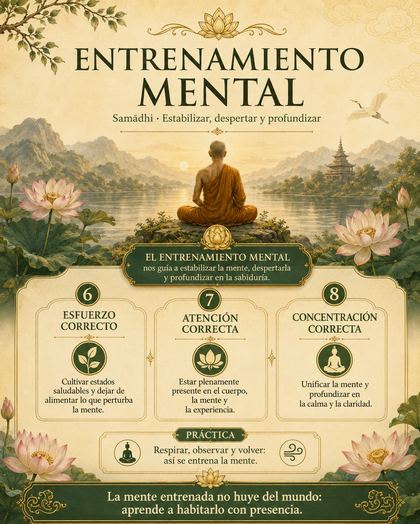
It does not mean trying harder. It means trying better.
The question is not only how much energy we put into something. The decisive question is: where is my energy going?
Not every effort is wise
In our culture, effort is held in high regard.
We are told we must fight, endure, surpass ourselves, never give up, give it everything. These words can be useful at certain moments. Discipline, perseverance and responsibility are necessary. But they can also become dangerous when applied without discernment.
Sometimes “giving more” is not wisdom. It is self-abandonment.
Someone in grief may strive to function as before. They answer emails, attend to everyone, hold back their tears, smile, keep producing. Perhaps they believe this is strength. But if that effort is born of denying the wound, sooner or later the body will send the bill.
After a loss, someone may strive to prove that they are fine. They fill their diary, post photos, train more, go out more, present themselves as invulnerable. From the outside it looks like recovery. Inside, perhaps they are only fleeing the emptiness.
In a painful situation, effort can be even more deceptive. “I will hold on a little longer”, “I will understand better”, “I will be more patient”, “I will change myself so that everything changes”. Sometimes that work can be useful if there is respect, responsibility and real change on both sides. But when the harm keeps repeating and only one person is making the effort, that effort becomes a way of losing oneself.
It happens with the body too. Training can be healthy. Looking after oneself can be beautiful. But when the gym becomes punishment, when rest is lived as guilt, when appearance takes up too much space, effort is no longer in the service of health. It is in the service of the fear of being worthless.
Right effort does not consist of gritting one's teeth harder. It consists of looking at whether the energy we use reduces suffering or increases it.
The four tasks of right effort
In the Buddhist tradition, right effort is often explained through four tasks.
First, to prevent harmful mental states that have not yet arisen from arising. Second, to abandon the harmful states that are already present. Third, to cultivate healthy states that have not yet arisen. Fourth, to maintain and strengthen the healthy states that already exist.
Put simply:
Avoid what feeds suffering. Let go of what is already harming us. Cultivate what helps. Tend to the good that is beginning to be born.
These four tasks can be applied to any ordinary life.
If I know that checking the traces of the past on social media opens the wound, avoiding it is right effort. When I am already caught in a story of guilt, letting it go little by little is right effort too. If I have no habit of sitting in silence, cultivating five minutes of breathing is practice. When an honest conversation with a friend does me good, tending to that bond strengthens what is healthy.
There is nothing spectacular here.
The path is built with a sober, repeated, kindly energy.
Avoiding what feeds suffering
The first task is to prevent.
This does not mean living in fear or shutting ourselves away so as not to feel. It means knowing our tendencies and not needlessly placing ourselves in situations that increase confusion.
Someone going through a loss may know that looking at old photos during the night leaves them shattered. They can decide not to do it. Not because they deny the story, but because they understand that they do not yet have the stability to expose themselves to that.
Whoever notices that a tense conversation drags them back into confusion can keep their distance for a while. That too can be a form of care.
Someone in grief may know that certain cold conversations or certain atmospheres harm them in an early stage. Protecting oneself is not weakness. It is emotional intelligence.
It is the same with the body. If we know that certain social media lead us to compare ourselves and hate ourselves, limiting that content can be right effort. If certain conversations always revolve around who is younger, more attractive, stronger or thinner, perhaps we need to take an inner step back, change the subject or take part less.
Right effort does not wait until we are sunk to act. It learns to recognise the doors through which suffering enters.
Not everything must always be confronted. Sometimes to practise is not to feed.
Abandoning what is already harming us
The second task is to let go of harmful states that have already arisen.
Here belong obsessive rage, destructive guilt, constant comparison, the attachment that chases, the fantasy of returning to a place that wounds us, the need to prove that we are worth something, cruel self-criticism.
To abandon does not mean to eliminate all at once. Many times we cannot. It means to stop collaborating.
If the mind keeps repeating “I will not be able to live without this person who has died”, perhaps we cannot switch off the sentence at once. But we can recognise it: “this is despair speaking”. We can return to the body, breathe, call someone, walk, not shut ourselves away for hours in the same story.
After a loss, if the urge to act quickly appears, perhaps it will not vanish just because we wish it. But we can wait ten minutes. Then twenty. Then a whole night. Each time we do not obey automatically, something weakens.
When we have changed a painful situation, guilt can present itself with great force. “I have let someone down”, “maybe I should be able to cope with everything”, “perhaps I exaggerated”. To abandon that state does not mean not to feel guilt. It means not to hand it the keys to our life. We can listen to it, check whether there is something to repair, and still hold the boundary.
In the matter of body image, to abandon can mean cutting off a chain of inner insults. If, facing the mirror, “you look awful” appears, perhaps we cannot manage to love ourselves straight away. But we can say: “I am not going to speak to myself like that”. That sentence already interrupts something.
Letting go begins, many times, with no longer adding fuel.
Cultivating what helps
The third task is to cultivate healthy states that are not yet strong.
The mind does not change only by ceasing to do things. It also needs to learn new paths.
If we stop using social media to compare ourselves, we need another way to hold the anxiety. If we change a painful situation, we need to build support, routine, security and self-esteem. When we let go of the obsession with the body, we need to discover a kindlier relationship with it. If grief leaves us without meaning, we need small acts that give back presence and care.
To cultivate is to sow.
It is not enough to say “I do not want to suffer”. We must practise conditions that reduce suffering.
Patience is cultivated by waiting before responding. Calm is cultivated by returning to the breath. Dignity is cultivated by keeping small boundaries. Compassion is cultivated by looking at pain without hatred. Trust in the body is cultivated by treating it with respect. Freedom is cultivated by not obeying every impulse of the ego.
Someone in grief can cultivate gratitude by writing down three memories of the one who died without forcing themselves to be fine. Someone who has suffered a loss can cultivate stability by recovering routines of their own. Whoever has left a painful situation can cultivate clarity by writing out the full facts so as not to idealise the past.
Right effort does not only cut. It also plants.
Maintaining the good that already exists
The fourth task is to tend to the healthy states that have arisen.
Sometimes we attain a little peace and we neglect it. We have a conversation that helps us, but we go straight back to the noise. We spend a few days without using social media to compare ourselves and then return out of boredom. We begin to speak better to the body and, faced with a comparison, we go back to contempt. We set a boundary and later weaken it out of guilt.
What is healthy needs protection.
If a meditation practice helps us, it is worth giving it continuity. If a friendship gives us back clarity, we must tend to it. If a certain sleep schedule improves our mind, we should not always sacrifice it. If stepping away from a harmful person brings peace, it is worth remembering why that distance exists.
To maintain does not mean to cling rigidly. It means not to abandon what is bearing fruit.
In grief, perhaps there is a simple ritual that helps: lighting a candle, writing, walking, praying, meditating, visiting a place with serenity. Keeping it up can give order to love.
After a loss, maintaining what is healthy can be following a routine, recovering friendships, limiting compulsive behaviours and not returning to circular conversations.
In the relationship with the body, maintaining the good is training with balance, resting, eating with respect, ceasing to follow accounts that feed comparison, speaking to oneself with less violence.
The old mind will come back many times. That is why the good must be tended to with patience.
Effort is not absolute control
Right effort does not seek to control everything.
This distinction is essential. Sometimes we believe that to practise means to master the mind, eliminate emotions, prevent any negative thought, feel no attachment, have no anger, never fall back into sadness.
That aim is impossible and, what is more, aggressive.
Practice does not consist of controlling the inner life as one controls a machine. It consists of relating to it in a wiser way.
We cannot stop sadness from arising in grief. But we can refrain from adding guilt. Perhaps we cannot avoid feeling an urge to act out of anxiety. We can refrain from obeying it at once. We will not always be able to prevent the longing for a painful situation. We can remember the whole picture. Perhaps physical comparison arises. We can see it, breathe, and not turn it into an insult against ourselves.
Right effort works with what is possible.
It does not demand that there be no storm. It teaches us not to throw open every window.
The danger of violent effort
There is a form of effort that looks like discipline but is in truth violence against oneself.
It is recognised by the inner tone.
“Come on, do not be weak”. “You should be better by now”. “You cannot fail”. “If you rest, you lose”. “You have to cope with everything”. “Your body is worthless until it is perfect”. “Do not cry”. “Do not feel”. “Do not need”.
That effort can produce outward results for a time. We can perform, lose weight, train, work, endure, smile. But the inner price is usually high.
Buddhist discipline is not like a whip. It is more like a firm, kindly hand on the back.
It encourages us without humiliating us. It lifts us up without despising us. It corrects us without insulting us. It reminds us of the path without turning every fall into failure.
Someone who changes a painful situation will need effort. There will be days of weakness, of longing, of guilt. Shouting at oneself will not help. What will help is remembering, firmly: “today I will not repeat what breaks me”.
Someone in grief will need energy to go on living. But they do not need to treat themselves like a soldier. They can move forward with tenderness.
Whoever looks after the body needs perseverance. But they must not use training as punishment for not being perfect.
Right effort unites discipline and compassion.
Persevering without hardening
There are processes that take time.
Grief is not set in order in a week. A loss is not integrated just because we understand the theory. Rebuilding oneself in a painful situation can take months. Changing the relationship with the body and with outside approval demands a great deal of repetition.
That is why we need perseverance.
But to persevere is not to harden. It is not to clench the jaw and carry on as if nothing were happening. It is to come back again and again with intelligence.
If today we fall back into a comparison, we come back. When we react out of attachment, we learn and come back. If we spend an afternoon caught in guilt, we see it and come back. When we idealise a hard stage again, we remember the full facts and come back. When grief knocks us down on a significant date, we rest and come back.
To come back is a key word of the path.
The mind will wander off. The ego will stir. Attachment will insist. Aversion will appear. Ignorance will confuse.
Practice consists of coming back.
Not once. Many times.
An exercise: redirecting the energy
Choose a situation in which you are spending a great deal of energy.
It may be a loss, a grief, a painful situation, a worry about the body, a comparison, work, social media or the need for approval.
Write:
1. Where is my energy going?
Examples:
“On checking whether there is a reply”. “On proving that I am fine”. “On hating my body”. “On justifying a dynamic that harms me”. “On working without rest so as not to feel”. “On seeming perfect”. “On repeating guilt”.
2. What does that expenditure of energy promise?
“Control”. “Approval”. “Relief”. “Security”. “Avoiding loneliness”. “Not feeling grief”. “Seeming strong”.
3. What does it actually produce?
More anxiety, tiredness, dependence, comparison, confusion, self-abandonment, rage or sadness.
4. Where could I direct a part of that energy?
Into resting. Into asking for help. Into meditating for five minutes. Into walking. Into arranging an outing. Into looking after the body without punishing it. Into speaking honestly. Into not feeding a compulsive impulse. Into sorting out a practical matter. Into writing to put in order what I feel.
5. A small commitment for today
Choose something concrete and possible:
“For two hours I will not open the social media that unsettle me”. “I will train without insulting myself”. “I will go to bed thirty minutes earlier”. “I will ask one person for support”. “I will make a simple, nourishing meal”. “I will read my list of facts before idealising a stage”. “I will allow myself to cry without demanding that I be fine”.
End with three breaths and repeat:
“My energy is valuable”. “I do not want to use it to destroy myself”. “Today I can direct it towards something that tends to life”.
To remember
Right effort does not consist of tensing up more, but of managing energy with wisdom: preventing what is harmful, abandoning what already does damage, cultivating what is useful and sustaining it. The discipline that humiliates ends up feeding the very thing it meant to overcome.
Being here
The mind rarely wants to be where it is.
When the body sits, the mind remembers. When we walk, it anticipates. While we talk with someone, it prepares its reply. When we lie down, it reviews what went wrong. In a moment of calm, it looks for future problems. Faced with a loss, it returns to the past. After a loss, it imagines scenes, messages, explanations. If we leave a painful situation, it goes back over what happened and asks again and again whether we did the right thing.
The mind moves.
That movement is not a flaw. Remembering helps us learn. Imagining lets us plan. Thinking can be useful. The problem arises when we live almost always outside the present moment, trapped in memories we can no longer change or in futures that do not yet exist.
The seventh element of the Noble Eightfold Path is right mindfulness.
It is also known as conscious presence or mindfulness. But we should not reduce it to a modern technique for relaxing. In Buddhism, right mindfulness is a deep way of looking: knowing what is happening while it happens.
It is not about being calm all the time. Nor does it consist in emptying the mind. Still less does it require us to feel spiritual.
Right mindfulness is to recognise clearly: “this is happening now”.
There is sadness. There is fear. There is breathing. There is tension in the chest. There is an urge to act. There is comparison. There is guilt. There is thought. There is a seated body. There is life happening in this instant.
It seems simple. But it can change everything.
Living somewhere else
A great deal of everyday suffering is born of not inhabiting the present.
We are not in the shower: we are in yesterday's conversation. We are not eating: we are thinking about what is left to do. We are not listening to a child: we are mentally going over a problem at work. We are not resting: we are comparing ourselves with others. We are not in the body: we are in the image we want to project.
The mind lives somewhere else and the body is left abandoned.
In grief, this happens with great force. A person may be physically in the present, yet their mind returns again and again to the hospital, to the last conversation, to the funeral, to what they said, to what they did not say, to what they could have done. The memory is understandable. Love seeks the one who is no longer there. But when the mind stays trapped there for too long, the present becomes uninhabitable.
After a loss, thought travels towards past scenes and imagined futures. It goes back over what was lived, analyses messages, reconstructs moments, imagines how everything would have been, fantasises about turning back or about proving that it no longer hurts. Real life, the life of now, grows faint.
When we leave a painful situation, the mind can live in a mixture of past and doubt. It remembers the bad in order to feel angry. Then it remembers the good and grows confused. It imagines that perhaps everything might have changed. Then it fears future loneliness. The body is here, but the mind keeps negotiating with a story that has already shown too much suffering.
Right mindfulness does not erase the past nor prevent us from thinking about the future. It only gives us back a question:
what is happening right now?
Not yesterday. Not tomorrow. Now.
The present is not always pleasant
Sometimes we speak of the present as if it were an always peaceful place.
“Live in the now”, people say, as if the now were necessarily bright, simple and kind. But very often the present hurts. It can hold an empty bed, a call that never comes, a difficult conversation, an intense anxiety, a tired body, a decision that breaks us.
Right mindfulness does not consist in embellishing the moment. It consists in being with it without adding so much confusion.
If I am grieving, the present can be: “there are tears, there is pressure in the chest, there is memory, there is love in the form of absence”. That is not pleasant, but it is more habitable than the story: “I will never be able to live”.
After a loss, the present can be: “there is loneliness, there is a longing for contact, there is a knot in the stomach, there is thought about that person”. Again, it is not comfortable. But it is different from living inside the sentence: “without this I am nobody”.
When changing a painful situation, the present can be: “there is guilt, there is fear, there is nostalgia, there is a small relief, there is weariness”. If we see it this way, we can accompany it. If we turn it into “I was wrong to change”, we may return to the cycle.
The present does not always soothe. But it tends to be clearer than the mental film.
Attention to the body
The body is a direct door to the present.
The mind can travel years back or decades ahead. The body, by contrast, is always here. It breathes here. It feels here. It tenses here. It tires here. It trembles here. It leans here.
That is why many Buddhist practices begin with the body.
Feeling the feet on the floor. Noticing the hands. Perceiving the breath. Recognising the posture. Becoming aware of a tension. Listening to a nearby sound. Returning to a simple sensation.
This is no small thing. In moments of suffering, returning to the body can keep a mental story from sweeping us away completely.
When someone remembers a person who has died and feels the pain open up, they can bring a hand to the chest and notice: “this is tightness; this is heat; this is trembling”. It does not remove the loss, but it turns a mental catastrophe into an experience that can be breathed.
After a loss, if the impulse to act appears, feeling the body helps a great deal. Where is the urgency? In the stomach? In the throat? In the hands? What happens if we wait three breaths before acting?
If a person feels the urge to repeat a painful situation, the body can reveal important information. Sometimes, when imagining the repetition, what appears is not peace but contraction. Or perhaps immediate relief appears, mixed with fear. Bodily attention lets us listen beyond the mental story.
With our self-image, too, the body is key. We can live the body from outside, as if we were spectators of our appearance, or from inside, as living experience. When we only see it from outside, we ask: “how do they see me?”. When we inhabit it from inside, we ask: “how am I?, what do I need?, is there weariness?, is there strength?, is there tension?, is there respect?”.
The body is not only something to show. It is the place where we live.
Attention and emotion
Right mindfulness does not repress emotions. It recognises them.
This difference is essential.
To repress would be to say: “I must not feel this”. To attend is to say: “this is here; I am going to look at it”.
An emotion seen with attention changes its nature. It may still hurt, but it stops being a nameless monster.
Anger. Fear. Sadness. Guilt. Shame. Attachment. Loneliness. Desire. Envy. Relief.
Naming does not solve everything, but it brings order.
In grief, anger may appear against life, against the doctors, against family members, against oneself, or even against the person who died for having gone. That anger can generate shame. Right mindfulness allows us to recognise it without turning it into a sin: “there is anger in grief”. Looking at it honestly keeps it from acting from the shadows.
After a loss, there can be envy, desire, humiliation, hope, resentment. The mind will want to justify each emotion. Attention simply names it: “envy”, “pain”, “need for validation”, “fear of loneliness”.
When a painful situation ends, the emotions can seem contradictory. There is relief and sorrow. There is guilt and dignity. There is love and rejection. There is a longing for contact and the memory of harm. Right mindfulness allows that complexity to exist without forcing us to draw a hasty conclusion.
We do not need the emotion to be simple in order to observe it. Awareness can hold mixtures.
Attention and thought
Right mindfulness also observes thoughts.
It does not try to fight with them. Nor does it automatically take them as truth. It sees them appear, move and change.
A thought can say: “I am worthless”. Attention responds: “there is a thought of self-devaluation”.
The mind can repeat: “if I rest, I am guilty”. Attention notices: “there is guilt telling a story”.
After a death, perhaps this appears: “I should have done more”. Attention recognises: “there is a thought of guilt in grief”.
When we look at ourselves in the mirror, this can arise: “my body is not enough”. Attention says: “there is comparison; there is demand; there is fear of not being liked”.
This small change of language is very important.
It is not the same to say “I am a failure” as “a thought of failure is appearing”. In the first sentence we are inside the story. In the second there is already a little space.
The practice of right mindfulness creates that space many times a day.
It does not eliminate the mind. It illuminates it.
Attention in difficult situations
Mindfulness does not remove the problem; it keeps us from losing ourselves completely inside it. In a tense conversation it lets us notice the heat in the face before raising our voice. Faced with a professional mistake it shows the shame without turning it at once into a verdict about our worth. During a night of loneliness it helps us tell real silence apart from the story “no one needs me”.
Being present does not oblige us to remain in a harmful situation either. Attention can reveal precisely that the body shrinks, that fear has become habitual, or that we have spent too long justifying the unjustifiable. Seeing clearly is compatible with acting.
The practice consists in returning to the fact, to the body, and to the present emotion. From there it is more likely that we will choose a response that is not born solely of urgency.
Attention in everyday life
Right mindfulness does not belong only to formal meditation.
We can practise it while eating, walking, working, listening, showering, getting dressed, training, driving, cleaning a house, embracing someone, or closing a door.
While eating, we feel the taste and notice whether we eat out of hunger, anxiety, or emptiness. While walking, we perceive the feet and observe whether the mind races towards imaginary problems. When we work, we notice tension, haste, a desire for recognition, or fear of failing. While getting dressed, we look at whether there is joy or pressure to seem perfect. During training, we feel whether we care for the body or punish it. In a conversation, we observe whether we are listening or only waiting for our turn to defend ourselves.
Daily life offers thousands of opportunities.
There is no need to add a spiritual activity to an already full life. We can turn small moments into practice.
Right mindfulness is remembering life while we are living it.
Attention is not obsessive watching
It is worth avoiding a misunderstanding.
Right mindfulness does not mean watching oneself tensely all the time. It is not analysing every gesture, every emotion, and every thought until we are exhausted. That watchfulness can become another form of control.
Buddhist attention has more gentleness.
It is like lighting a lamp, not shining a police spotlight.
Observe without getting caught up. Name without punishing. Return without humiliating yourself. Recognise without turning everything into a problem.
If we spend an hour distracted and suddenly realise it, that moment is already attention. We do not need to say: “what a disaster, I have been unconscious”. It is enough to return.
Returning to the body. To the breath. To the conversation. To the present action. To the real fact.
Right mindfulness does not seek perfection. It seeks presence.
An exercise: three pauses of presence
During today, take three brief pauses. They need not last more than a minute.
First pause: the body
Stop and feel the feet on the floor. Notice the posture. Perceive the breath without changing it.
Ask yourself:
what is my body feeling now?
Do not look for an elaborate answer. Tension, weariness, calm, hunger, pressure, heat, cold, movement.
Second pause: the emotion
At another moment, stop and ask:
which emotion is most present now?
Sadness, fear, anger, guilt, shame, joy, loneliness, attachment, peace, restlessness.
Name it without judging.
Third pause: the story
Before acting from an impulse, ask:
what story is my mind telling?
It may be a story of grief, loss, guilt, image, comparison, or fear.
Then add:
“This is a mental story. I can see it before obeying it”.
Breathe three times.
If you like, at the end of the day write down what you noticed. Not to evaluate yourself, but to get to know your mind better.
To remember
Mindfulness brings the mind back to present experience without turning the present into an idealised place. Body, emotion, and thought can be observed before reacting. Being here is not resignation; it is gaining the clarity needed to act on what is really happening.
The mind that grows still
The mind does not grow still because we force it into silence.
This idea matters. Many people give up meditation because they believe that to meditate is to empty the mind. They sit down, close their eyes, and up come thoughts, memories, plans, worries, images, old phrases, and they conclude: “I am doing it wrong.”
They are not doing it wrong.
They are seeing the mind.
The mind produces movement. That is its nature. It thinks, compares, remembers, imagines, fears, desires, judges and comments. Just as the heart beats and the lungs breathe, the mind generates activity. Buddhist practice does not begin by declaring war on that movement, but by learning to relate to it in another way.
The eighth element of the Noble Eightfold Path is right concentration.
It does not mean tension or absolute control. Nor does it consist in reaching some special state so that we may feel superior or spiritual. Right concentration is the capacity to steady the attention, to remain with a simple object, and to come back when the mind wanders off.
To come back once. To come back many times. To come back without insulting ourselves. To come back without turning distraction into failure.
That humble, patient repetition begins to still the mind.
A scattered mind suffers more
A scattered mind is easily swept away.
It sees an image and compares itself. It receives a piece of news and is thrown off. It remembers a loss and sinks. It imagines a conversation and grows angry. It looks at the body in the mirror and passes sentence. It feels anxiety and wants to act at once. It recalls a painful situation and swings between nostalgia, guilt and rage.
When the mind has no stability, every stimulus governs it.
Right concentration does not do away with the stimuli. It does not stop the world from changing, nor keep emotions from arising. But it creates a firmer centre from which we can respond.
In grief, a scattered mind may leap for hours between guilt, memories, images of the end, things left unsaid and fear of the future. Concentration does not erase the death of the one we love, but it helps us not to be wholly caught in each thought.
After a loss, the mind moves between hope and despair. One minute it remembers what was lovely. The next it imagines that no one will ever love us again. Then comes the urge to look at the phone. Afterwards comes shame at being still so hooked. Concentration offers a small stability, so that we need not obey every wave.
When we have changed a painful situation, a scattered mind can be dangerous. It remembers the good moments and forgets the whole pattern. It hears a song and wants to go back. It feels guilt and turns it into a command. Concentration helps us stay a little closer to clarity.
The same happens with our self-image. A scattered mind compares endlessly: bodies, clothes, age, attractiveness, success, approval. Concentration does not make the body perfect. It helps us stop looking at it only through the anxiety of being liked.
To concentrate is not to clench
Right concentration is not achieved through harshness.
If we sit down to meditate and try to force the mind, tension soon appears. We want to control every thought. We grow irritated when the attention wanders. We judge ourselves. We clench the jaw. We turn the practice into one more task that must be done well.
That does not still us. It exhausts us.
Buddhist concentration is more like holding something gently than gripping it tightly.
Imagine we have a small bird in our hands. If we squeeze too hard, we hurt it. If we open our hands completely, it escapes. The practice needs that middle point: firmness without violence, gentleness without neglect.
This is how we work with the breath.
We feel the air come in and go out. The mind wanders off. We notice. We come back. We need not grow angry. There is no need to comment too much. We return to the air, to the body, to the moment.
That return is the practice.
It does not matter so much how many times we are distracted. What matters is how we come back.
If we come back with insults, we cultivate aggression. If we come back with patience, we cultivate the path.
The object of meditation
To steady the mind we need an object.
An object of meditation is that towards which we direct the attention. It may be the breath, the body, a sound, a phrase, a sacred image, a sensation, or even an emotion observed with clarity.
In this book we shall begin with the simplest and most universal object: the breath.
The breath is always near. We need not buy anything, believe anything special, or be in a perfect place. We breathe in a quiet room and also in the midst of pain. We breathe in grief, after a loss, before a difficult conversation, when we feel guilt, when fear appears, when we want to prove that we are fine.
The breath does not resolve the whole of life. But it returns us to the present.
Someone who misses a person who has died can sit down and feel three breaths. The absence will still be there. Yet, during those three breaths, perhaps there is no need to add one more story.
Someone who feels an urge to act can come back to the air before touching the phone. Perhaps afterwards they will decide not to act. Or perhaps they will be able to respond later with less urgency. The breath creates space.
Whoever feels the impulse to return to a painful situation can sit down, breathe, and notice the body. Sometimes that brief contact shows something the mind did not want to see: there is no peace, there is anxiety seeking relief.
The breath is small, but honest.
It always happens now.
Calm and clarity
Concentration can bring calm, but its aim is not only to calm us.
This is worth understanding well. If we use meditation solely to feel better, we may grow frustrated when pain appears. The practice can calm, yes, but it can also show us uncomfortable things: attachment, rage, fear, the need for approval, self-deception, unfelt sadness.
True calm is not anaesthesia.
A concentrated mind becomes clearer. Being less swept along by every thought, it can see better.
It sees that guilt in grief does not always tell the truth. It recognises that the urge to act after a loss need not be obeyed. It distinguishes nostalgia from a command. It notices when we train the body for health and when out of a need for admiration. It perceives how the ego seeks to come off well, to be right, or to seem strong.
Calm without clarity can turn into avoidance. Clarity without calm can turn harsh. Right concentration unites the two: it steadies the mind so that it can see without breaking.
Not seeking special experiences
Some people expect meditation to give them extraordinary experiences.
Light, visions, absolute peace, a sense of unity, the disappearance of the body, sublime emotions. It is possible that some practices produce intense experiences. But making them the goal tends to feed the ego.
Then the mind thinks: “I want a spiritual experience”, “I want to feel elevated”, “I want to prove that I am making progress”, “I want to be someone special”.
That is not liberation. It is another form of desire.
Right concentration is simpler. To sit, to breathe, to come back. To notice a thought, to come back. To feel an emotion, to come back. To hear a sound, to come back. To see that we want to do it well, to come back.
What is extraordinary, often, is to stop seeking the extraordinary.
In an ordinary life, the practice can yield very concrete fruits: less reaction, more pause, more honesty, more capacity to be with pain, less need to prove ourselves, more care of the body, more firmness not to return to what harms us.
That may not seem mystical. But it transforms a life.
Stability is cultivated slowly
No one steadies the mind in two days.
Concentration is training. Just as a muscle grows stronger through repetition, the attention steadies by coming back many times to the object.
At first we may remain only three seconds with the breath. Then we lose ourselves. Afterwards we come back. That return counts.
We must not scorn beginnings.
Five minutes a day over weeks can transform more than one long session done with violence and then abandoned. What matters is continuity.
The ego wants quick results. It wants to say: “I am already good at meditating”. It wants to compare itself even in spiritual practice. Right concentration has no need to show off. It is like sweeping a room every day. Something falls into order little by little.
There will be agitated days. In some sessions the mind will seem a marketplace. In others there will be more calm. None of them defines our worth.
The practice is to sit and to come back.
Frequent obstacles
In practising concentration, familiar obstacles appear.
The first is drowsiness. We sit down and fall asleep. It may be lack of rest, too comfortable a posture, or accumulated tiredness. Sometimes the right effort will not be to meditate more, but to sleep better.
The second is agitation. The mind races, plans, remembers, grows restless. In that case, we come back to the object with patience. If the agitation is very strong, we can open our eyes, feel our feet, or walk slowly.
The third is judgement. “I am doing it terribly”, “this is no use”, “my mind is a disaster”. That judgement is also thought. We notice it and come back.
The fourth is the search for results. “Am I calmer yet?”, “when will this pain go away?”, “why do I keep thinking about that person?”. That impatience is also observed.
The fifth is avoidance. Sometimes we use meditation in order not to do what needs doing: to ask for help, to set a limit, to rest, to act. Right concentration does not replace right action.
To see these obstacles is part of the path.
A basic concentration practice
Find a relatively quiet place. It need not be perfect.
Sit with your back dignified but not rigid. You may use a chair. Rest your feet on the floor. Place your hands comfortably.
Leave your eyes closed or half open.
For a few seconds, feel the whole body.
Now bring the attention to the breath. Do not change it. Just notice how it comes in and goes out.
You can feel it in the nose, in the chest, or in the abdomen. Choose one point and stay there.
The mind will wander off. When you notice, say inwardly: “thinking”. Then come back to the breath.
If sadness appears, acknowledge: “sadness”. Come back. If guilt appears, acknowledge: “guilt”. Come back. When body image or comparison arises, acknowledge: “comparison”. Come back. If an urge to act appears, acknowledge: “impulse”. Come back. When a memory of a painful situation arrives, acknowledge: “memory”. Come back.
Do not struggle with anything. Nor follow the story.
For five minutes, practise coming back.
When you finish, notice the body. Open your eyes slowly. Before you stand up, ask yourself:
what have I seen of my mind?
Do not seek a special experience. To see a little more is already enough.
To remember
Concentration gathers a scattered mind without clenching it. Choosing a simple object and coming back to it strengthens stability and clarity. We are not seeking special experiences, but a capacity that allows us to remain present when life turns out ambiguous or uncomfortable.
Sitting without fleeing
Sitting seems easy.
You place the body on a chair, on a cushion or on the edge of the bed. You rest your feet, let your hands be still, you breathe. From the outside almost nothing happens. There are no grand gestures. There are no brilliant words. There is no spectacular scene.
But inside, a battle can begin.
Thoughts appear. Memories arise. The body grows restless. The mind protests. An emotion we did not want to feel arrives. An old sadness opens up. A guilt returns. The urge to get up surfaces, to look at the phone, to eat something, to tidy a room or to do anything other than stay there.
That is why sitting down to meditate is not simply being still.
It is learning not to flee from ourselves.
Meditation, understood honestly, is not a technique for manufacturing immediate calm. It can bring calm, yes, but it can also show us the noise we carry within. Sometimes we sit down seeking peace and the first thing we find is anxiety. Other times we seek silence and up comes an unfinished conversation, a person who died, an undigested loss, a painful situation we have not yet fully come out of inside.
It does not mean that the meditation is failing.
It means that at last we are looking.
Why we flee
We flee because feeling hurts.
The human mind has learned many ways to escape: working too much, entertaining ourselves without rest, checking the phone, talking non-stop, eating without hunger, buying, training to excess, seeking approval, arguing in our heads, fantasising about another life, repeating a situation that wounds us just so as not to be alone.
Not all of those actions are bad in themselves. Work can be dignified. Training can be healthy. Talking to someone can help. Being distracted for a while is also human. The problem appears when everything becomes a way of never feeling what is waiting inside.
Someone who is grieving may flee from silence because in the silence the absence appears. While there are tasks, papers, calls and arrangements, the pain seems more manageable. But one night the house grows still and the heart remembers.
After a loss, we flee by seeking distraction. We check social media, photographs or the news over and over. We do not always want information; often we want to soothe the anguish of not being in control.
When a situation hurts us, we can flee from the truth in many ways. We justify, we wait, we minimise, we remember only the good, we believe another promise, we tell ourselves it is not so bad. Fleeing does not always mean moving. Sometimes fleeing is staying where we do not want to look.
We also escape through image. We make ourselves up to look strong, attractive or impeccable. We train so that the body speaks for us: “look at me, I am fine, I am desirable, I still matter”. We display an orderly life while inside there is fear. That image can protect for a while, but it does not heal what is being avoided.
To sit without fleeing is to stop using life as a screen.
Meditating is not about becoming perfect
Many people turn meditation into another project of perfection.
They want to do it well. To sit up straight, breathe correctly, not think, not move, not feel anger, not get distracted. Three minutes in, they discover that the mind has wandered off twenty times and they judge themselves: “I am hopeless”, “this is not for me”, “my head is no good for meditating”.
That judgement is part of the very problem.
The ego, explained simply, wants an image it can approve of: “I am a good meditator”, “I am serene”, “I am spiritual”, “I control my mind”. But meditating is not about creating a new image of an elevated person. It is about seeing honestly what is happening.
Loneliness can touch precisely that image. A part of us fears that being alone means not having been chosen, not being interesting or not being worth enough. As we sit, that wound can appear without disguises. The practice is not about using meditation to cover it, but about recognising: “there is loneliness”, “there is a longing for connection”, “there is a fear of not mattering”.
Seen this way, loneliness stops being an accusation and begins to be an experience that can receive attention, care and concrete decisions.
If there is anxiety, we see anxiety. When there is boredom, we see boredom. If sadness appears, we see sadness. When pride arrives, we see pride. When a need for approval arises, we see that too.
None of that excludes us from the path.
Sitting down to meditate does not require being at peace before we begin. That would be like wanting to shower only once we are already clean.
The practice begins with what there is.
The first act of courage: to stay
Staying does not mean putting up with anything in outer life. It is important not to confuse the two.
If a situation is harmful, remaining in it is not necessarily a virtue. If there is violence, manipulation, humiliation or fear, the right action may be to ask for help and protect oneself. Meditation must never be used to endure the unbearable or to justify harm.
Here we are speaking of another way of staying: remaining for a few moments with the inner experience without automatically escaping.
I can change a painful situation and, at the same time, stay present with the guilt that appears. I can accept that a stage has ended and stay breathing with the urge to seek immediate relief. I can mourn someone's death and stay with the wave of sadness without turning it into eternal despair. I can feel insecure about my body and stay without insulting myself or running off to seek approval.
That staying is very different from resigning oneself.
Resignation says: “I can do nothing”. Presence says: “I can feel this without obeying it blindly”.
Meditation trains that capacity.
The seated body
To meditate we need to begin with the body.
Not because the body is less spiritual, but because it is the nearest door. The mind can invent a thousand stories, but the body always happens now.
Find a stable posture. It can be on a chair. There is no need to sit on the floor or adopt a complicated posture. The back can be upright, but not rigid. The shoulders, loose. The hands, resting. The feet, in contact with the floor if you are on a chair.
Posture communicates an intention.
We are not slumped as if nothing mattered. Nor are we tense as if we were soldiers. We are present.
This bodily presence already teaches the middle way: neither abandonment nor aggression.
In grief, the seated body may tremble or sink. There is no need to correct everything. It is enough to feel it. After a loss, perhaps the chest is closed and the stomach restless. In a painful situation, perhaps a mixture of relief and fear appears. When we worry about image, tension can arise in the face, the abdomen or the jaw.
Sitting is listening to those signals without immediately turning them into a story.
The body does not need to look perfect in order to meditate. It does not need to be young, flexible, attractive or enviable. The body needs to be inhabited.
The breath as a place of return
Once seated, we choose a simple point: the breath.
There is no need to breathe in any special way. At first it is enough to feel the air coming in and going out. It can be noticed in the nose, in the chest or in the abdomen. We choose one place and return there.
The breath serves as a home.
Not because it is magical, but because it is always happening in the present. While the mind goes off to the past or the future, the breath reminds us: “here”.
We think of the person who died. We return. A scene of loss appears. We return. Guilt arises for having left. We return. A bodily comparison comes up. We return. We wonder whether we are doing it right. We return. We get bored. We return.
The key word is return.
Not to stay for ever. Not to win a competition. Not to expel thoughts. Only to return.
Each return is a small renunciation: we give up following the story for a few seconds. It is also a small act of freedom: we choose where to place our attention.
What appears when we sit down
When we sit without fleeing, our life appears.
An ideal mind does not appear. Our real mind appears.
Perhaps unfinished matters come up. Phrases from an argument. Work plans. A longing for recognition. Financial fear. Childhood memories. Worry about the children. Body image. Tiredness. Anger. Sadness. Fantasies. Shame.
Some people are surprised: “I did not know I had so much noise inside”.
The noise was already there. Meditation has only turned down the volume of the outer distractions.
This can be uncomfortable, but it is also an opportunity. We cannot free ourselves from what we do not see. If the mind is full of comparison, we need to see it. If there is attachment to a relationship, it is good to see it. When guilt tries to steer us, we must see it. If the ego seeks to look good even in spiritual practice, that too deserves to be seen.
Seeing does not mean analysing everything.
During meditation, the basic instruction is simple: recognise and return.
“Thought”. “Memory”. “Fear”. “Guilt”. “Comparison”. “Attachment”. “Anger”. “Sadness”.
And we go back to the breath.
Discomfort is not a sign of failure
As we sit, discomfort can appear. Physical, mental or emotional.
Our nose itches. Our back aches. We get bored. We want to move. We feel impatience. It seems useless to us. We think of all the things we ought to be doing.
There is no need to dramatise. Nor to endure any pain heroically.
The practice consists of observing before reacting.
If an itch appears, we wait a moment. Does it change? Does it grow? Does it disappear? If we need to move, we move with awareness, not automatically.
If boredom arises, we name it: “boredom”. Boredom is interesting: it is often the doorway into what we are avoiding. When there is no stimulus, the mind is left without a toy.
If impatience appears, we see that too. The ego wants results. It wants meditation to work quickly. It wants to feel better. The practice answers with simplicity: “only this breath”.
Discomfort does not mean that meditation is not for us. It means that we are getting to know the habits of our mind.
Not using meditation to avoid acting
There is another danger: using meditation as an excuse not to do what is necessary.
Sometimes we need to sit down. Other times we need to get up and act.
If a situation is harmful, it is not enough to meditate on our reaction. Perhaps we must ask for help, set limits or leave. If the body is ill, it is not enough to observe sensations; perhaps we need medical attention. If we have hurt someone, it is not enough to breathe; perhaps it is time to ask for forgiveness. If we are sunk in grief, perhaps along with meditating we need company, therapy or family support.
Meditation does not replace life.
It prepares us to respond better.
Sitting without fleeing does not mean staying still for ever. It means ceasing to act from blind impulse. Afterwards, with more clarity, we can act.
Authentic practice unites silence and responsibility.
Simple regularity
To begin with, it is good to be modest.
Ten minutes a day can be enough. Even five. What matters is regularity, not heroics.
It is better to sit for five minutes each morning over several weeks than to attempt forty minutes with so much demand that we end up giving up. Meditation needs to enter life as a possible practice.
We can choose a moment: on waking, before sleeping, after eating, before starting work. We can also practise briefly when a strong emotion appears.
Regularity creates trust.
Over time, the mind learns: “I can sit; I can feel; I can return; I do not need to flee immediately”.
This trust is very valuable.
A basic practice: ten minutes without fleeing
Sit on a chair or cushion. Place the body in a stable way. Do not seek a perfect posture. Seek an honest posture.
During the first minute, feel the body. The feet, the legs, the hands, the back, the face.
Then bring your attention to the breath. Choose a point: nose, chest or abdomen.
When the mind wanders, gently recognise what happened.
“Thought”. “Memory”. “Plan”. “Grief”. “Loss”. “Guilt”. “Attachment”. “Comparison”. “Image”. “Fear”.
And return to the breath.
If a strong emotion appears, feel where it lives in the body. Do not analyse it too much. Pressure, heat, a knot, emptiness, tension. Then return.
If you need to move, move slowly, knowing that you are moving.
When you finish, do not get up abruptly. Ask yourself:
what have I been fleeing from lately?
There is no need to answer with a grand theory. One word can be enough.
Then add:
“I can stay with myself a little longer”.
To remember
To meditate is to stay with the experience without demanding a perfect version of ourselves. Posture, breath and regularity offer a basic structure. Discomfort does not always indicate failure, and the practice must never be used to avoid a necessary action.
The body as a simple temple
The body is always here, even when the mind lives somewhere else.
We think about the past, we imagine the future, we remember the one who died, we go over a loss, we agonise about a situation that hurt us, we work out how others see us. Meanwhile, the body breathes. It holds us up. It walks. It grows tired. It hurts. It gets hungry. It needs rest. It warns us when something is wrong.
Often we treat it as if it were a secondary tool.
We demand performance from it. We compare it. We correct it. We display it. We hide it. We force it. We judge it in the mirror. We want it to be younger, stronger, slimmer, more attractive, more desirable, more like the image we think others will admire.
But the body is not only an image.
It is the place where our life happens.
That is why, in Buddhist practice, the body holds a fundamental place. We do not meditate outside the body. We do not awaken by despising the body. We do not cultivate compassion by treating it as an enemy. The body is the first home of attention.
We can call it, quite simply, a temple.
Not a perfect, solemn or untouchable temple. Rather a humble temple, ever-changing, vulnerable, sometimes tired, sometimes clumsy, sometimes aching. A temple that grows old, falls ill and needs care. For precisely that reason it deserves respect.
Returning to the body
When we suffer, we tend to lose ourselves in stories.
After the death of someone we love, the mind repeats memories, guilts, scenes, questions. After a loss, it imagines conversations, analyses messages, searches for explanations. In a painful situation, it hesitates, compares, remembers the good, fears loneliness. In front of the mirror, it builds judgements: “I don’t look good”, “I’ve aged”, “I’m not attractive”, “my body is worthless”.
The body returns us to something more direct.
It does not answer every question. It does not explain the meaning of death. It does not resolve a crisis. It does not decide for us what to do about a difficult situation. But it shows us how all of that is being lived right now.
Grief can feel like a weight on the chest. Loss, like an emptiness in the stomach. Guilt, like pressure in the throat. Fear, like tension in the jaw. Shame about the body, like a wish to hide. Attachment, like restlessness in the hands reaching for the phone.
Returning to the body means feeling those signals before we become trapped in the story.
We do not say: “my life is destroyed”. First we notice: “there is pressure, there is tiredness, there is sadness”. We do not conclude: “I must recover what I’ve lost”. We observe: “there is anxiety, there is longing, there is fear”. We do not immediately believe: “my body is not enough”. We feel: “there is comparison, there is tension, there is shame”.
The body does not remove the pain. It makes it more concrete. And the concrete is usually more liveable than the imaginary.
The body is not a shop window
Dressing with taste, training or improving one’s physical fitness can be legitimate expressions of care. Movement brings health, energy and discipline; clothing too can be creativity and enjoyment.
The difficulty arises when those actions stop answering to our own well-being and begin to depend on the gaze of others. The body then becomes a credential: it must prove youth, strength, attractiveness or control. Comparing ourselves hurts, ageing seems a loss of status, and resting is experienced as failure.
It is not care that chains us, but the need to obtain through the body a constant confirmation of our own worth. No physical form can guarantee permanent approval. There will always be another comparison, an inevitable change, or a gaze that does not respond as we hoped.
To inhabit the body in another way means caring for it for what it allows us to live, not using it as an argument before others. We can strengthen it without turning it into a product, dress it without demanding perfection, and accept its changes without concluding that dignity diminishes with them.
Inhabiting the body from within
There is an enormous difference between looking at the body from outside and inhabiting it from within.
From outside, the body is appearance. From within, it is experience.
From outside we ask: “how do they see me?”. From within we ask: “what do I feel?”.
From outside, comparison appears. From within, presence appears.
We can try it right now. There is no need to close the eyes, though it may help. Feel the hands. Notice whether they are warm or cold. Sense the contact of the feet with the floor. Observe the breath moving the chest or the abdomen. Notice whether there is tension in the forehead, in the shoulders, in the jaw.
For a few seconds, the body stops being an image and becomes life again.
This form of presence is deeply healing.
Someone who feels insecure about their appearance can move from the mirror to the sensation: “my body breathes, holds me up, walks, lets me be here”. That does not remove the insecurity all at once, but it changes the place from which they relate to themselves.
Someone who trains can feel the movement from within: strength, support, balance, limit, breath. Then exercise stops being merely a search for admiration and becomes a conversation with the body.
In grief, inhabiting the body allows us to hold the sadness without turning it into a total idea. After a loss, it helps us feel the anxiety before acting. In a painful situation, it lets us detect whether the body contracts at certain memories or contacts.
The body knows things that the mind justifies.
Listening without blind obedience
Listening to the body does not mean obeying every sensation as if it were an absolute truth.
The body can be conditioned by fear, trauma, habit or attachment. It can feel anxiety in the face of freedom because it was used to a painful situation. It can miss a presence that was not good for us. It can ask for immediate relief even when that relief leads us back into suffering.
That is why we listen with respect, but also with discernment.
If after a loss the body feels an urge to write, we listen: “there is anxiety, there is a desire for contact”. It does not necessarily mean that writing is the right thing to do.
If, in remembering a painful situation, longing appears, we feel it. We do not immediately conclude that we should repeat it. Perhaps the body is remembering the familiar, not the healthy.
When we feel shame about the body, we attend to the sensation. But we do not believe that the body is shameful. We recognise that there is a wound of comparison.
Listening to the body means gathering information, not handing the wheel over to every impulse.
Wisdom integrates body, mind, facts and values.
The body during a crisis
Difficult experiences do not occur only in the head. A loss can disrupt sleep and appetite; anxiety quickens the breath; a prolonged conflict keeps the muscles on alert. Even after making a necessary decision, the body may take time to feel safe.
Listening to those signals does not mean interpreting them as orders. A tightness in the chest may be asking for rest, support or medical attention; it does not by itself prove that we should repeat the familiar. Bodily longing, tiredness and fear need care, not hasty conclusions.
In a crisis it is best to begin with the essentials: eating enough, sleeping as much as possible, walking, receiving help and recovering moments of safety. Spiritual practice does not replace that care. It makes it more conscious.
To care is not to punish
One of the great confusions about the body is calling care what is in reality punishment.
Eating with attention can be care. Controlling food out of hatred can be punishment. Training can be care. Driving ourselves to the limit to compensate for guilt or shame can be punishment. Grooming ourselves can be care. Doing it out of anguish over looking perfect can be punishment.
The difference lies in the inner tone.
Care says: “I want to help you be well”. Punishment says: “you are worthless until you change”.
Care listens to limits. Punishment despises them.
Care seeks health. Punishment seeks approval.
Care can be disciplined. Punishment is usually cruel.
Buddhist practice does not promote a disordered indulgence. It is not about always doing what we feel like doing. Sometimes caring for the body demands effort: training when we feel lazy, eating better, sleeping earlier, dropping a harmful habit, seeking treatment, cutting back on excess.
But right effort does not need hatred.
We can improve without despising ourselves. We can train without becoming enemies of the body. We can lose weight, gain strength or dress better without believing that we were unworthy before. We can care for our health without becoming obsessed with our image.
The body responds better to kind firmness than to constant violence.
Posture as teaching
The way we sit teaches us a great deal.
If we slump, perhaps we are expressing surrender. If we go rigid, perhaps we are acting out of control. The meditative posture seeks another path: stability without hardness.
A dignified back. Relaxed shoulders. A loose jaw. Hands resting. Feet or legs supported. A face without strain.
This posture says: “I am here”.
It does not try to impress anyone. It does not need to look perfect. A person can meditate on an ordinary chair, with a tired body, with aches, with age, with limitations. What matters is the intention of presence.
In that posture we learn something that applies to all of life.
Neither to sink nor to harden. Neither to abandon ourselves nor to do ourselves violence. Neither to live to please nor to neglect ourselves. Neither to flee the body nor to become obsessed with it.
The middle way is also practised with the back, the shoulders and the breath.
The body as an anchor in difficult moments
When emotion is intense, thinking more does not always help.
Sometimes the mind has already thought too much. It has repeated, analysed, compared, imagined, argued, justified. In those moments we need a bodily anchor.
An anchor is something that keeps us close to the present.
It can be feeling the feet. Gently squeezing the hands and releasing them. Noticing five objects we can see. Listening to three sounds. Drinking water slowly. Walking, feeling each step. Breathing, lengthening the exhalation a little. Touching a surface and noticing its temperature.
These practices seem simple, but they can be very helpful.
When a wave of grief arrives, the body anchors us. In the face of the urge to act, the body anchors us. If guilt comes for having changed a painful situation, the body anchors us. When a physical comparison strikes us, the body anchors us.
We do not use the body to deny the emotion. We use it so as not to drown in it.
Breathing with the whole body
Breathing does not happen only in the nose.
The whole body takes part. The chest moves. The abdomen responds. The back expands a little. The ribs open and close. Even the posture changes with each inhalation and exhalation.
Breathing with the whole body means allowing the breath to inhabit us.
There is no need to breathe in a spectacular way. It is enough to feel.
On an inhalation, we notice that the body receives. On an exhalation, we release a little tension. We do not release all the sadness. We do not resolve the whole of life. We release a little.
This practice can accompany specific situations.
Before entering a difficult conversation. After receiving painful news. When looking at a photo of the one who died. When a desire arises to recover a stage that has already changed. In front of the mirror, before insulting ourselves. At the end of a training session, thanking the body instead of judging it.
Breathing with the whole body reminds us that we are still alive.
And while there is life, there is practice.
The vulnerable body
Accepting the body means accepting its vulnerability.
The body grows old. It can fall ill. It has limits. It does not always respond to our wishes. It changes even when we try to control it. It needs care and, sooner or later, it will need help.
This truth can frighten the ego, because the ego wants an image that is strong, attractive and controlled. Vulnerability seems to it like failure.
But the vulnerable body also teaches humility.
It reminds us that we are not absolute masters of life. That we need others. That health should not be taken for granted. That time passes. That it is good to use the body to love, to care, to walk, to embrace and to live, not only to display or to judge it.
When someone we love dies, we understand all at once the fragility of the body. A body that spoke stops speaking. Hands that touched lie still. This sight can be devastating. But it can also awaken gratitude for the bodies that still breathe near us.
Vulnerability does not reduce dignity.
A sick body is still dignified. An aged body is still dignified. A body that is not admired is still dignified. A grieving body is still dignified. A body that trembles in a painful situation is still dignified.
Dignity does not depend on appearance.
An exercise: returning to the body as home
Find a quiet place and sit on a chair.
Rest the feet on the floor. Let the hands lie on the legs. Do not try to look any special way.
1. Feel
For a minute, travel through the body with attention.
Feet. Legs. Hips. Back. Shoulders. Hands. Neck. Face. Breath.
Do not correct too much. Just feel.
2. Name
Ask yourself:
what is my body living through today?
Tiredness, sadness, tension, restlessness, calm, pain, strength, fear, emptiness, warmth.
Name it without judgement.
3. Distinguish care from punishment
Now ask:
how have I treated my body lately?
Have I listened to it? Have I forced it? Have I compared it? Have I cared for it? Have I used it to seek approval? Have I punished it for not looking perfect?
Do not answer in order to blame yourself. Answer in order to see.
4. A gesture of care
Choose one small gesture for today.
Drinking more water. Going out for a walk. Sleeping earlier. Eating calmly. Training without insulting yourself. Resting if you are exhausted. Not looking at yourself with contempt. Breathing before writing a message. Asking for help if the body can take no more.
5. A phrase
Place a hand on the chest or on the abdomen and say:
“This body is my home”. “It need not be perfect to deserve care”. “I can inhabit it with more respect”.
Breathe three times.
To remember
The body deserves care because it is the concrete form in which we live, not because it must prove our worth. Listening to it requires distinguishing need from command and health from punishment. Inhabiting it from within allows us to strengthen it, dress it and attend to it without turning it into a shop window.
The monkey mind
The mind leaps.
It leaps from the past to the future, from one worry to another, from an image to a conversation, from a guilt to a desire, from a comparison to a fantasy. The moment we sit down to breathe, we discover that inside there is no quiet room, but a kind of jungle.
That is why some teachings speak of the monkey mind.
The image is simple: a monkey that leaps from branch to branch, restless, curious, frightened, hungry, unable to stay too long in any one place. That is how our mind works much of the time. Not because it is bad. Not because it is broken. Simply because it has not been trained to stay.
It wants stimulation. It seeks safety. It remembers wounds. It anticipates threats. It compares. It judges. It desires. It rejects. It imagines. It starts all over again.
The first time we see this clearly it can be disheartening. Someone sits down to meditate and thinks: “my mind is a mess”. But that conclusion is not accurate. The mind has not become chaotic through meditation. It was already so before. The difference is that now we are seeing it.
Seeing the monkey mind is not a failure of the practice.
It is the beginning of the practice.
The monkey wants to protect us
It is worth not hating the monkey mind.
Although it wears us out, much of the time it is trying to protect us. It leaps to the future to anticipate dangers. It returns to the past to learn from what happened. It compares in order to find a safe place. It imagines conversations in order to avoid rejection. It goes over mistakes so as not to repeat them. It seeks approval so as not to feel alone.
The problem is that it does this clumsily.
It wants to help us, but it usually increases the noise. It wants to avoid pain, but it often multiplies it. It wants to find a way out, but it runs so fast that it cannot see clearly.
After the death of a loved one, the monkey mind leaps to the final days, to things left unsaid, to doctors, phone calls, decisions, memories, photographs, dates still to come. It wants to understand the loss. It wants to find a way for it to hurt less. But by leaping without rest, it can turn grief into an endless repetition.
After a loss, the monkey has many branches available: the phone, social media, memories, songs, hypotheses, mutual friends, shared places. It leaps to a lovely scene, then to an argument, then to the question of whether that person is with someone, then to the need to prove that we are fine.
When we have left a painful situation, the monkey mind can be especially confusing. One branch says: “you did the right thing”. Another replies: “perhaps you overreacted”. One remembers the harm. Another salvages the sweet moments. One wants to go back. Another knows that going back would mean losing dignity. That coming and going is exhausting.
With the body and with image it is the same. The mind leaps from the mirror to comparison, from comparison to the gym, from the gym to the need to be liked, from there to the fear of growing old, then to a photo of someone else, then to the phrase: “I am not enough”.
The monkey is not always an enemy.
But neither should it run our life.
Thinking is not the problem
The aim of Buddhism is not to stop thinking.
This idea must be repeated many times, because a mistaken understanding of meditation has made a great many people suffer. Thinking is not a sin. Remembering is not a fault. Planning is not anti-spiritual. The mind has necessary functions.
The problem appears when we believe everything we think and obey every impulse that arises.
One thought says: “I will not be able to live without this person”. Another states: “if I lost this place, I am worthless”. Then comes: “if I miss a painful situation, it means I was wrong”. Later appears: “if my body is not liked, I do not deserve love”.
The practice does not consist in forbidding those thoughts. It consists in seeing them as thoughts.
There is a great difference between saying:
“I am worthless”
and saying:
“a thought of being worthless is appearing”.
The first sentence shuts us in. The second opens a space.
The monkey mind will go on leaping. But if we learn to see it, we no longer have to leap with it to every branch.
The monkey feeds on stimulation
The restless mind does not appear out of nowhere. Much of the time we feed it.
Each check of the phone can give it another branch. Each comparison on social media, another. Each repeated conversation, another. Each old photo, another. Each fantasy, another. Each comment about bodies, success, age or attractiveness, another.
We live surrounded by stimuli designed to capture attention. Notifications, images, messages, news, advertising, opinions, shop windows of perfect lives. The monkey mind finds a whole playground there.
Then we sit down to meditate and expect it to calm down in two minutes.
It does not work like that.
If all day long we feed distraction, comparison and urgency, the mind will follow that rhythm when we close our eyes. That is why the practice does not happen only on the cushion. It also happens when we choose what we consume, what we look at, what we repeat and what we stop feeding.
After a loss, using social media compulsively keeps the agitation alive. In grief, exposing oneself again and again to memories when the wound is too open can prevent rest. In a painful situation, returning compulsively to the same information can reactivate guilt, nostalgia or confusion. If we suffer over body image, consuming content of ideal bodies without any filter can reinforce the sense of inadequacy.
This is not about living in isolation.
It is about caring for the mind just as we would care for a wound. No one rubs an open wound to check whether it has stopped hurting yet. With attention something similar happens.
When the mind finds a theme
The monkey mind tends to choose whatever matters to us most. It may leap between a financial worry, a conversation left pending, a child's health and a mistake made years ago. The content changes; the movement is similar: seeking certainty through repetition.
When the theme touches a wound, each leap seems urgent. The mind reviews messages, imagines scenarios or rehearses defences. It is not always resolving something; much of the time it is only trying to avoid the discomfort of not knowing.
Recognising the pattern allows us to give it a simpler task: to feel three breaths, to write down the verifiable fact or to devote ten minutes to a single action. It is not about winning an argument against the mind, but about ceasing to follow it to every branch.
Giving the mind a simple task
The monkey mind needs training, not punishment.
One way to train it is to give it a simple task: to feel the breath, to count out-breaths, to notice the feet, to listen to sounds, to observe bodily sensations.
It is not a spectacular task. That is precisely why it works.
The mind will want to leave. We return.
If we count breaths, we may reach three and already be thinking about something else. When we notice, we go back to one. That going back is not a step backwards. It is practising.
If we feel the feet, the mind will remember a conversation. We return to the feet. If we follow the breath, an image will appear. We return. If a strong emotion arises, we name it and return.
Little by little, the mind learns that it does not have to leap at every stimulus.
It does not become motionless. It becomes better mannered.
Not fighting the monkey
When we try to fight with the mind, the agitation usually increases.
“Stop thinking”. “You should not be feeling this”. “Concentrate”. “What a mess”. “The same thing again”.
That inner tone creates more tension. The monkey mind takes fright or rebels. The practice turns into a battle.
The Buddhist way is more intelligent: to see, to name, to return.
If a thought appears, there is no need to strike it. When an emotion arrives, we do not need to expel it. If comparison arises, we should not insult ourselves for comparing. When we notice attachment, we do not become bad people.
We simply acknowledge:
“This is happening”.
Then we return to the object.
Kindness is not softness. It is effectiveness. A mind treated with violence does not truly grow still; it only hardens or hides.
Observing the patterns
Over time, as we watch the monkey mind, we begin to recognise patterns.
Perhaps we discover that the mind seeks approval when we are tired. Or that it idealises a painful situation when we feel lonely. Perhaps we see that guilt appears every time we set a boundary. Or that comparison about the body intensifies when we use certain social media a great deal. It may be that grief is triggered more at night or on particular dates.
These discoveries are very valuable.
They are not general theories. They are direct knowledge of our own mind.
When we know a pattern, we can take better care of ourselves.
If I know that at night I idealise that person, I will not make big decisions at midnight. If I notice that guilt appears after talking with a certain person, I will be more careful. If I see that certain images feed hatred of my body, I will limit that exposure. If I know that grief intensifies on anniversaries, I will arrange for company or rituals.
Attention turns chaos into information.
The monkey mind is not our whole identity
One of the most liberating teachings is this: we are not each movement of the mind.
There are thoughts, but we are not only thoughts. There are emotions, but we are not only emotions. There is attachment, but we are not solely attachment. Guilt appears, but we are not the guilt. There is comparison, but we are not the comparison.
Awareness can see all of that.
This capacity to see is an enormous doorway. When the monkey mind leaps, something in us can notice. That “noticing” does not leap in the same way. It is wider than the particular thought.
There is no need to turn it into a complicated idea. It is enough to experience it.
If I can say “there is anger”, then I am not only the anger. If I can notice “there is a wish for approval”, there is something more than that wish. In recognising “there is a thought of going back”, I am not completely trapped in it. When I observe “there is sadness for the one who died”, there is an awareness accompanying the sadness.
The practice strengthens that awareness.
And the more we inhabit it, the less each leap of the monkey governs us.
A practice: observing the leaps
Sit for five minutes.
Choose the breath as the point of return. During the practice, each time the mind goes off, briefly name the branch it leapt to.
“Memory”. “Plan”. “Grief”. “Loss”. “Guilt”. “Image”. “Comparison”. “Painful situation”. “Fear”. “Desire”. “Work”. “Judgement”.
Do not analyse the branch. Do not follow the story. Just name it and return to the breath.
When you finish, ask yourself:
which branches does my mind leap to most?
Perhaps you will discover something important: that it leaps a great deal to guilt, to image, to the past, to a particular person, to fear or to the need for approval.
Do not use that information to punish yourself. Use it to know yourself.
Then write a sentence:
“My mind tends to leap to… and I can learn to return”.
This exercise, practised regularly, begins to change our relationship with the mind.
To remember
The mind leaps because it has learned to seek stimulation and certainty. Fighting against it adds agitation. Giving it a simple object, recognising the patterns and returning with patience allows us to stop following every thought without trying to destroy the capacity to think.
You are not doing it wrong: you are seeing your mind
Many people believe they are failing at meditation precisely when meditation is beginning to work.
They sit down, close their eyes, try to attend to the breath, and discover a mind full of thoughts. They remember unfinished business, old conversations, worries about work, desires, fears, images, aches in the body, guilt, tiredness, comparisons. Within a few minutes a harsh conclusion arises: “I’m no good at this”.
But that conclusion is usually mistaken.
You are not failing because thoughts appear. You are not doing it wrong because emotions arise. You are not a worse meditator because your mind wanders. It does not mean that no peace is possible for you just because noise appears.
What is happening is simpler and more important: you are seeing your mind.
You thought before too. You compared before too. Before, there was also clinging, fearing, judging, remembering and anticipating. The difference is that now, when you sit down, there are fewer external distractions and you can observe more clearly what was always going on.
Meditation does not create the disorder. It reveals it.
And seeing the disorder is the beginning of a deeper order.
The mistake of expecting immediate silence
We have been sold many false images of meditation.
A person seated in a beautiful place, with a serene face, soft light, a perfect body, a calm mind and a barely visible smile. That image can inspire, but it can also do harm. Because when a real person sits in a real room, with a real life, what appears does not always resemble that postcard.
The shopping list appears. A phrase that hurt. The fear of the future. Nostalgia for a stage of life. An argument. A judgement about the body. The need to be liked. An old guilt. The memory of someone who died. The urge to act out of anxiety. The doubt about a situation that harmed us.
Then we think: “this isn’t meditating”.
But it is.
To meditate does not mean entering silence immediately. It means learning to know what happens in the mind and returning, again and again, to the object of attention.
Silence may come. Calm may come. But they do not come because we shove our inner life out by force. They come little by little, when we stop fighting every thought and learn not to follow all of its stories.
Distraction is not the enemy
In the practice with the breath, distraction has a bad reputation.
We believe that getting distracted is the problem. But, in reality, the key moment is not avoiding distraction. The key moment is noticing.
First we are with the breath. Then the mind drifts away. We think about anything at all. Suddenly, we see that we have drifted off. Then we return.
That instant of noticing is very valuable.
Without distraction there would be no return. Without return there would be no training. Each time we return, we strengthen a new capacity: that of not remaining completely lost in the story.
That is why it makes no sense to insult ourselves when we discover the distraction.
If, on returning, we say “what a disaster”, we add a second layer of suffering. There was already distraction. There is no need to add contempt. It is more useful to acknowledge simply: “thought”, “memory”, “plan”, “fear”, and to return to the breath.
The practice does not consist in never falling. It consists in returning without turning the fall into an identity.
Seeing thoughts is not believing them
When we meditate, we begin to notice the quantity of phrases the mind produces.
Some seem harmless. Others are harsh. Many have been repeating themselves for years.
“I can’t cope with this”. “I’m worthless”. “I should have done more”. “If I rest, I’m guilty”. “If I lost this place, I’m not enough”. “My body isn’t liked”. “I ought to be better”. “I need to prove that I’m all right”. “I mustn’t feel this”.
When those phrases appear outside meditation, we usually live inside them. During the practice, by contrast, we can begin to see them as mental events.
This changes a great deal.
A thought can hurt without being an absolute truth. It can express fear, habit, upbringing, trauma, attachment or shame. But merely appearing in the mind does not entitle it to direct our life.
If “I’m worthless” appears, we do not have to argue for half an hour. We can acknowledge: “thought of worthlessness”. And return.
If “I ought to be able to recover what I lost” arises, we can name it: “thought of return”, “attachment”, “fear”. And return.
When “my body isn’t enough” comes, we observe: “comparison”, “image”, “need for approval”. And we return.
Seeing a thought as a thought does not always eliminate it. But it strips it of its authority.
Not everything that appears has to be analysed
Seeing the mind does not mean analysing every thought.
This is a frequent trap. When they begin to observe, some people turn meditation into an endless session of interpretation. A memory appears and they wonder why. An emotion arises and they look for its origin. An image comes and they begin to explain it. The practice becomes another form of thinking.
Sometimes it will be necessary to reflect, to write, to talk with someone or to go to therapy. But during basic meditation, the instruction is simpler:
acknowledge and return.
If sadness appears, there is no need to construct the whole biography of the sadness. When desire arises, we do not need to follow it to the end. If guilt comes, we do not have to resolve it in that instant. When bodily comparison appears, there is no need to argue with every image.
We name it gently and return to the breath.
This simplicity is difficult because the mind wants to do something. It wants to resolve, to understand, to control, to improve. But meditation trains another capacity: remaining without turning every appearance into a project.
There are moments for understanding with words. There are moments for returning to the air.
The shame of seeing ourselves
Sometimes, when we meditate, we do not like what we see.
We discover envy. Rage. The desire to be liked. The need to be right. Fantasies of revenge. Attachment to someone who harmed us. The urge to impress. Fear of growing old. Mean-spirited comparisons. Guilt. Pride. Exaggerated self-pity.
The first reaction may be shame.
“I shouldn’t think this”. “How unspiritual I am”. “No wonder I suffer”. “I’m worse than I thought”.
But the practice does not consist in discovering that we are impeccable. It consists in discovering the truth with enough kindness to be able to work with it.
We all have difficult contents. The human mind is made of habits, wounds, upbringing, defences and desires. Seeing something unpleasant does not turn us into that. It gives us the chance to stop acting from there without knowing it.
If we see that we seek approval all the time, we can begin to let go a little. When we notice that we want to be right, perhaps we learn to keep quiet. On recognising attachment to a painful situation, we can ask for support before returning. If we see hatred towards the body, we can begin to speak to it differently.
What is seen can be transformed. What is denied goes on ruling.
Kindness towards the mind
An essential part of meditation is the attitude with which we return.
We can return with harshness or with kindness.
Returning with harshness sounds like this:
“You’re thinking again”. “You do nothing right”. “You’re incapable of concentrating”. “You ought to be at peace”. “What a disaster of a mind”.
Returning with kindness says something different:
“Thought”. “I return”. “This too can be seen”. “It’s all right; the breath again”. “We begin anew”.
The difference is enormous.
Each return trains not only concentration, but also our relationship with ourselves. If we practise with violence, we reinforce violence. If we practise with patience, we cultivate a more habitable way of being inside our own mind.
This does not mean softness or a lack of discipline. Kindness can be firm. Just as one guides a small child who gets distracted: there is no need to shout at them each time. It is enough to take them gently by the hand and bring them back.
The mind needs that kind firmness.
Meditating with pain is not failing
There are days when we meditate and it hurts.
No calm appears. Grief appears. Or anxiety. Or rage. Or guilt. Or tiredness. Or a difficult loneliness.
The mind may say: “it was no use”. But perhaps it was of use. It served to spend ten minutes with something we normally avoid. It served to keep from reacting out of an impulse. To see the guilt without obeying it. To cry without adding a story of failure. To notice the body without insulting it.
The usefulness of a meditation is not measured only by the calm it produces.
Sometimes a useful session is one in which we see clearly that we are full of attachment. Or that we need to rest. Or that a loss still hurts. Or that we go on treating the body as a shop window. Or that the painful situation left more fear than we wanted to admit.
Not all pleasant practices are deep. Not all uncomfortable practices are bad.
The criterion is not “did I feel good?”. A better question would be: “was I able to see something more clearly and return with less violence?”.
When a painful theme appears
During meditation, memories, conversations, financial fear, bodily shame or scenes of a loss may arise. Their appearance does not prove that the practice is failing. It shows what occupies space in the mind.
It is not necessary to analyse each image or to expel it. We can acknowledge “memory”, “fear” or “planning” and return to the object of meditation. If the intensity overwhelms us, we open our eyes, feel the points of support and shorten the session. Seeing honestly includes respecting our own limits.
Progress is not always noticed as we expect
Very often we make progress without realising it.
Perhaps we still have thoughts, but we take less time to see them. We still feel rage, but we do not speak so quickly out of it. The comparison continues, but we no longer believe it completely. Grief hurts, but we can breathe inside a wave. The loss returns to the mind, but we do not check the phone so many times. Guilt appears, but it does not automatically take us back to a painful situation.
That is progress.
It will not always be spectacular. Sometimes no one will see it. We will receive no applause for not acting out of an impulse, for not insulting ourselves in the mirror, or for letting a thought pass without feeding it.
But life changes in those invisible places.
The ego wants visible signs of advancement. It wants to feel special, to say “I’ve made it now”, to compare itself even on the spiritual path. The real practice is more discreet.
Less reaction. More pause. Less identification. More return. Less inner cruelty. More honesty.
That is where the path shows itself.
Not using meditation to judge others
When we begin to see our mind, another trap may appear: feeling superior to those who do not practise.
“I observe my emotions”. “I am more aware”. “Other people live asleep”. “That person understands nothing”. “My family does no inner work”.
That thought is ego too.
Meditation should not turn us into refined judges. If we really see our mind, we ought to become a little more humble. Because we discover how much confusion, fear, desire and pride there is in us.
Seeing our mind helps us to understand others better, not to despise them.
This does not mean justifying harm. Someone may act out of their confusion and we may still need to set limits. But the practice allows us to do so with less superiority.
Humility is a sign of good meditation.
An exercise: changing the phrase “I’m doing it wrong”
During your next meditation, use this instruction.
Sit for five minutes with the breath.
Each time you notice that the mind has drifted away, avoid saying: “I’m doing it wrong”.
Instead, say inwardly:
“I’ve noticed”.
Then return to the breath.
If judgement appears, name it:
“judgement”.
And return.
When you finish, write three things:
1. Where did my mind go? Grief, loss, body, work, fear, guilt, painful situation, comparison, future.
2. How did I return? With harshness, with impatience, with kindness, with tiredness, with humour.
3. What phrase would help me to return better?
For example:
“This too is practice”. “Seeing is beginning”. “I don’t need to do it perfectly”. “I return with patience”. “My mind can be known”.
Practise that phrase for a week.
Not to convince yourself of something pretty, but to change the way you treat yourself when you wake from a distraction.
To remember
Distraction is part of the training. Noticing and returning is the practice, not an interruption of it. What appears may feel uncomfortable, but seeing it with kindness offers information about our habits without obliging us to analyse everything.
Meditating ten minutes when everything is burning
There are moments when meditating seems impossible.
We are not talking about a quiet morning, with the house in silence, the body rested and the mind relatively available. We are talking about those days when everything seems to be burning inside. An argument has just broken us. A piece of news has left us shaking. The absence of someone who has died becomes unbearable. A loss hurts again as it did on the first day. The guilt after changing a painful situation tightens the chest. The mirror hands back an image we cannot accept. Anxiety leaves no room.
In those moments, many people think: “I can't meditate right now”.
And, in a sense, they are right.
They cannot meditate the way they imagine meditation should be done: with serenity, impeccable posture, gentle breathing and an orderly mind. But they can practise in another way. A more humble practice, briefer, more real.
When everything is burning, meditating does not mean putting out the fire all at once.
It means not pouring more petrol on it for ten minutes.
Practice in difficult moments
Daily meditation is important because it trains us before the storm arrives. But sooner or later we will have to practise in the middle of the storm itself.
That is where we find out whether the teaching has begun to enter our life.
Meditating when everything is burning is not seeking a profound experience. It does not aim to reach perfect concentration. Nor does it demand understanding everything that is happening. Its goal is simpler: to create a pause between impulse and action.
Because when the pain is very raw, we tend to act out of urgency.
We react in a way we later regret. We go back to a conversation we already know is destructive. We check social media and open the wound further. We insult ourselves in front of the mirror. We drink, eat or shop so as not to feel. We respond with cruelty. We shut ourselves away. We repeat what harms us to soothe an hour's loneliness.
Ten minutes do not fix a life.
But they can prevent an action that would increase suffering.
When everything is burning, reduce the practice
In moments of intensity, it is not wise to demand too much.
If the mind is very agitated, a long meditation can turn into a fight. If the body is on alert, closing the eyes may increase the distress. If an emotion is too strong, trying to observe it directly may flood us.
That is why, when everything is burning, we reduce the practice to the essentials.
Sitting down. Feeling the body. Breathing. Naming what is happening. Not acting for a few minutes. Returning to the body. Asking for help if needed.
Nothing more.
We do not need to understand the root of the suffering in that instant. There is no need to analyse the whole story. Nor should we decide the entire future.
The question is more immediate:
can I stay with this for ten minutes without hurting myself further?
Sometimes the answer will be yes. Other times, we will only manage a minute. That works too.
Practice is not measured by its heroic duration, but by the awareness it brings.
Preparing an emergency place
It is worth having a simple way to practise ready before we need it.
When we are overwhelmed, we do not have much clarity to improvise. That is why it helps to decide in advance: “when I feel swept away, I will do this”.
It can be a particular chair. A corner of the house. A nearby bench. The edge of the bed. The car seat, if we are parked and safe. A room where we can close the door for a few minutes.
It does not have to be a spiritual place. It has to be a possible place.
We can also prepare a phrase:
“For ten minutes I will not act from the fire”.
That phrase can protect a great deal.
It does not say we will never act. It does not say the pain does not matter. It only postpones the reaction long enough for awareness to enter.
The ego wants to act quickly when it feels threatened. It wants to defend itself, to prove itself, to regain control, to come out on top, to confirm that it is still worth something. The emergency practice does not argue with it for hours. It simply says: “wait ten minutes”.
First minute: stopping
The first minute consists only of stopping.
If you are standing, sit down. If you have your phone in your hand, put it face down or move it away. If you are about to react, do not act yet. If you are in front of the mirror attacking yourself, look away for a moment. If you are about to enter an argument, leave the room if possible.
Stopping is already practice.
It seems like little, but it is not. Many cycles of suffering hold together because there is no pause between emotion and behaviour.
During this first minute, do not try to calm down. Just interrupt the automatic movement.
You can say inwardly:
“I am stopping”. “I am not acting yet”. “Right now there is fire”. “I am going to wait”.
If the body trembles, it trembles. If the breathing is agitated, it is agitated. We do not need to improve anything straight away.
Just stop.
Second and third minute: feeling the points of support
After stopping, bring your attention to the body's points of support.
The feet on the floor. The weight on the chair. The hands on the legs. The back touching the chair. The contact of the clothes against the skin.
Do not look for a special sensation. Look for contact.
When the mind is burning, we need ground. The mind goes to the past, to the future, to the threat, to guilt, to desire. The body, by contrast, can remind us that we are here.
If you are suffering over the death of someone you love, the mind may say: “I can't bear this absence”. Return to the feet. If a loss drives you to act quickly, return to the weight of the body. When guilt appears after changing a painful situation, feel the hands. If the mirror has stirred up shame, notice the breathing in the real body.
This does not remove the problem. But it slows things down a little.
Mental fire needs speed in order to grow.
The body introduces slowness.
Fourth and fifth minute: naming
Now name what is happening.
Do not tell the whole story. Do not explain. Do not justify. Just name.
“Sadness”. “Anger”. “Fear”. “Guilt”. “Attachment”. “Shame”. “Loneliness”. “Urgency”. “Comparison”. “Desire for approval”. “Desire to recover what is lost”. “The pain of grief”. “The pain of loss”.
Naming turns a confused mass into something a little clearer.
If you say “my life is a disaster”, the mind closes in. If you say “there is fear”, space appears. If you say “I am guilty”, the phrase weighs like a sentence. If you say “there is guilt”, you can observe it.
This is very important in a painful situation. Guilt can sound like a moral authority. But, by naming it simply as guilt, it stops holding all the power.
It also helps with body image. “I am hideous” is not the same as “there is shame and comparison”. The first phrase attacks. The second observes.
The practice is not after pretty phrases. It is after precision.
Sixth and seventh minute: breathing without forcing
Now bring your attention to the breathing.
Do not try to make it perfect. If it is short, notice that it is short. If it is fast, notice that it is fast. If there are sighs, allow sighs.
You can count five exhalations.
One. Two. Three. Four. Five.
Then start again.
If you lose track, it does not matter. Go back to one.
In moments of emotional fire, the exhalation can be a help. Without forcing, let the out-breath be a little longer than the in-breath. Do not turn it into a complicated technique. Just let the body release a little.
You can accompany it with short phrases:
I breathe in: “this is here”. I breathe out: “I don't need to act yet”.
I breathe in: “there is pain”. I breathe out: “I can hold one breath”.
I breathe in: “there is guilt”. I breathe out: “guilt does not decide on its own”.
I breathe in: “there is urgency”. I breathe out: “I can wait”.
These phrases do not fix everything. They serve so that we do not obey automatically.
Eighth minute: remembering the facts
When the emotion is very strong, the mind selects.
In a loss, it remembers only what feeds the attachment. In a painful situation, it may remember only what was lovely and erase the harm. In grief, it may remember only what was missing and forget all the love that was there. Facing the body, it selects flaws and erases everything the body sustains.
That is why, in the eighth minute, we remember facts.
Not interpretations. Facts.
If you are grieving:
“This person died”. “I loved them”. “There are things I did well”. “There are things I couldn't control”. “Right now I am alive and breathing”.
If you are going through a loss:
“This stage has ended”. “It hurts”. “I don't need to resolve it today”. “Acting out of urgency can increase my suffering”.
If you need to break a dynamic that is harming you:
“There were good moments”. “There was also harm”. “I left to protect my dignity”. “An intense emotion does not tell the whole story”.
If you are suffering over your appearance:
“This is my body today”. “It is breathing”. “It does not need to be perfect to deserve care”. “A comparison does not define my worth”.
Facts are anchors.
They do not always console, but they bring order.
Ninth minute: choosing a small action
Now ask:
what is the most caring action for the next ten minutes?
Not for a whole life. Just for the next ten minutes.
It can be:
Not acting yet. Putting the phone away. Drinking water. Going out for a walk. Calling someone you trust. Having a shower. Eating something simple. Lying down and resting. Writing on a piece of paper. Not looking at the mirror for a while. Reading a list of complete facts. Asking for help. Leaving a conversation if there is harm.
The action should be small and concrete.
When everything is burning, big decisions can wait if there is no immediate danger. First we need to bring the intensity down a little.
Meditation does not end in calm. It ends in a less harmful action.
Tenth minute: closing without demanding peace
At the end of the ten minutes, do not ask yourself whether you are already all right.
That question adds pressure.
Better to ask:
am I a little less ruled by the impulse?
If the answer is yes, the practice has served its purpose. If the answer is only “a little”, so has it. If you still feel bad, but you have not done anything that increases the harm, that counts.
Close with a simple phrase:
“I have not resolved everything, but I have stopped”. “I can keep caring for this moment”. “I do not need to act from the fire”. “I am going to take the next small step”.
Then carry out the action you chose.
The practice is not after an artificial peace. It is after a wiser direction.
Applying the protocol to a real situation
The same protocol can be adapted to different problems. After a painful phone call, the first few minutes serve to keep us from responding automatically. Before a difficult work conversation, they help us separate the facts from the fear of looking bad. On a lonely night, they allow us to move through the urge to seek any relief without deciding a whole life from that instant.
The practice does not demand that the emotion disappear. Its goal is to create a long enough interval to choose a small action: calling someone reliable, postponing a reaction, going out for a walk, resting or asking for professional help. Ten minutes do not solve the problem; they can keep us from adding a new one.
When ten minutes are not enough
There are moments when ten minutes are not enough.
If the emotion is too intense, if there is a risk of hurting oneself or hurting others, if there is violence, threat or real fear, if the anxiety becomes unmanageable, the practice must be accompanied by outside help.
Asking for help is not failing.
Calling someone, turning to a professional, seeking medical support, contacting protection services, asking for company or leaving a dangerous place may be the most important right action.
Buddhism does not replace safety. It does not replace therapy. It does not deny the need for human support. It does not ask us to go through everything alone.
Meditating for ten minutes when everything is burning is a tool. It must not become a heroic obligation.
Wisdom knows when to sit down and when to ask for help.
Turning the practice into a habit
For this practice to work in difficult moments, it is worth rehearsing it in less intense moments.
We can do ten minutes of simple breathing each day. Or practise three minutes before responding. Or stop for a minute in front of the mirror. Or breathe before entering complicated conversations.
That way, when the fire comes, the body will know the way.
It will not be perfect. But there will be a route.
The mind learns through repetition. If we repeat urgency, urgency rules. If we repeat pausing, the pause becomes more accessible.
Each small practice prepares the next.
To remember
In a crisis it is best to simplify: stop, feel the points of support, name, breathe, remember facts and choose a small action. Ten minutes do not remove the pain, but they can keep urgency from deciding entirely. When they are not enough, asking for help is also wise practice.
Anxiety learns too
Judson Brewer is a psychiatrist, neuroscientist and researcher specialising in the relationship between the mind, habits, anxiety and meditation. For more than twenty years he has studied how the mechanisms of worry, addiction, compulsive craving and mindfulness work. His work is especially valuable because it unites two worlds that have often walked apart: meditative experience and scientific research. Brewer speaks of meditation not only as a spiritual or philosophical idea, but as a practice that can be observed, measured and studied in real patients.
In addition to his medical and scientific training, Brewer has practised meditation for many years. This allows him to speak from a double perspective: that of the researcher who studies the brain and that of the practitioner who knows from direct experience what happens when one sits down to observe the mind. His main contribution has been to show that anxiety is not only an emotional state, but also a learned habit. That is why, in order to transform it, it is not enough to tell ourselves “don't worry”; we need to learn to see how it is born, how it repeats itself and what apparent reward the brain receives each time it returns to it.
Not all habits are a problem. In fact, it would be impossible to live without them. If every morning we had to learn all over again how to get up, get dressed, walk, wash, prepare something to eat or respond when someone speaks to us, life would be exhausting. The brain needs to turn many repeated actions into learned behaviours, almost automatic ones, so as not to spend energy on every small gesture.
The problem appears when a behaviour that once served to protect us begins to repeat itself even though it no longer helps us. Anxiety can work this way. A sensation, a thought or an uncomfortable situation appears; the mind responds by worrying, controlling, anticipating or avoiding; and for a few seconds it seems that this gives us relief. Then the brain learns: “when I feel this, I do that”. And so a loop is born.
Brewer explains this process very simply: every habit has a trigger, a behaviour and a result. Something happens inside or outside us; we do something in response; and the brain records whether that response produced relief, pleasure or a sense of control. If the result seems useful, even if only for an instant, the mind tends to repeat it.
That is why worry can become so sticky. One thinks about the future, imagines what could go wrong, tries to solve it mentally over and over, and at first feels that one is doing something responsible. But often one is not solving anything: one is only feeding the circuit of anxiety. The mind confuses worrying with dealing with things.
This point is important because it helps us stop treating ourselves harshly. Anxiety does not mean we are weak, flawed or incapable. It means the brain has learned a path. And every learned path can begin to be seen more clearly.
Meditation enters here not as a technique for forcibly emptying the mind, but as a way of observing how it works. When we sit down to breathe and thoughts, memories, plans, fears or discomforts appear, we are not failing. We are seeing the natural movement of the mind. And in seeing it, we begin to recognise its habits.
Buddhist monks often remind us that the past and the future do not exist as places we can go to. The past lives now as memory, image or emotion. The future appears now as anticipation, fear or desire. The only thing we can directly inhabit is the present. Contemporary science has studied how the mind tends, precisely, to wander towards that remembered past and that imagined future. In these movements, worry, rumination and the repetition of stories about oneself appear easily. Brewer links this activity with brain networks involved in repetitive and self-referential thinking. Put simply: the brain can get used to going round and round the same subjects.
The practice consists in noticing that movement without automatically entering into it. It is not about fighting with the thought, but about recognising: “this is worry”, “this is fear”, “this is anticipation”, “this is a sensation in the chest”, “this is tension in the throat”. Simply naming what is happening already creates a small space.
Brewer insists that curiosity is a very powerful tool. Instead of asking ourselves “how do I make this go away?”, we can ask ourselves: “what is happening right now?”. That question changes our relationship with the experience. Anxiety stops being an invisible enemy and begins to become something we can observe in the body, in the breathing and in the thoughts.
For example, if anxiety appears, we can stop for a moment and look carefully: where do I notice it? Is it pressure, heat, trembling, a knot, emptiness, tension? Does it move or stay the same? Does it increase when I reject it? Does it change when I observe it? There is no need to answer with perfect words. It is enough to look directly.
Breathing helps because it is always in the present. We do not breathe yesterday or breathe tomorrow. We breathe now. A simple way to practise is to ask oneself: “how do I know I am breathing?”. Perhaps we know because we feel the air in the nose, the movement of the chest, the abdomen rising and falling, or a brief pause between one breath and another. That return to the concrete interrupts, even if only for a few seconds, the automatic chain of worry.
We can also observe the real result of our mental habits. If I worry for half an hour, do I end up freer or more exhausted? If I try to control everything, do I feel peace or more tension? If I avoid an emotion, does it disappear or come back stronger? This observation is not meant to blame us, but to update the brain's learning. The mind begins to see that some responses that seemed useful actually produce suffering.
I can tell it from my own experience. For almost two decades I ate far more than my body needed without realising it. It was not hunger: it was anxiety. When the discomfort appeared, eating brought a brief relief —that small reward Brewer talks about, the dopamine that rewards and teaches the brain to repeat—. And so, without seeing it, eating twice or three times as much as I really wanted became my way of responding to fear.
The change did not come through diets or resolutions. It came when, as I left behind a significant loss and a work situation that was harming me, the anxiety began to ease. Almost without meaning to, I started to eat less: not because I forced myself, but because I no longer needed that relief. Then what the nutritionists repeat —“keep a good relationship with your food”— made sense: for years I had been feeding anxiety, not hunger. In four or five months I lost nine kilos, without a diet, and I never put them back on. Seeing the real result of that habit, and feeling it in the body, did more than any willpower.
There a small but very valuable freedom is born. Perhaps the thought appears, but we do not follow it for ten minutes. Perhaps we feel fear, but we do not need to obey it immediately. Perhaps an urge appears to control, to check, to respond or to escape, and we can breathe before acting. That instant of pausing is already practice.
Meditating, then, is not about becoming someone who never feels anxiety. It is about learning to recognise how anxiety forms, how it is fed and how it can weaken when we stop following it automatically. Mindfulness does not remove difficult life, but it teaches us not to add unnecessary suffering to what is already happening.
Seen this way, anxiety can also become a teacher. Each time it appears, it shows us a place where the mind has learned to close down, defend itself or anticipate. And each time we observe it with presence, breathing and curiosity, we open a different possibility: not to live trapped in the habit, but to begin to respond with more awareness.
Judson Brewer, Deshacer la ansiedad: la nueva ciencia que te ayudará a romper el ciclo de preocupación y miedo que domina tu mente, Paidós, 2022. ISBN ePub: 978-84-493-3923-3. See especially his explanations of habits as learned memory, anxiety as a habit loop, reward-based learning, the default mode network, mindful awareness and brief breathing practices.
Do not believe everything you think
The mind talks a great deal.
It talks when we walk, when we work, when we try to sleep, when someone is slow to reply, when we look at ourselves in the mirror, when we remember the one who died, when a chapter of life ends, when we doubt a difficult decision.
Sometimes it speaks in the voice of worry. At other times, in the voice of a judge. It can also speak as a victim, as an accuser, as an adviser, as a prophet of disaster or as a false friend.
It tells us things with great certainty:
“You won’t manage it”. “It was all your fault”. “No one will ever love you the same way”. “If you left, you’re a bad person”. “If you’re still suffering, it means you haven’t moved forward”. “Your body isn’t enough”. “You need to prove that you’re all right”. “You should have done more before they died”. “If that person doesn’t come back, your life loses its worth”.
The problem is not that these thoughts arise. The mind produces thoughts just as the sky produces clouds. The problem begins when we believe that every thought is true simply because it has arisen within us.
A thought can feel very real and still not be entirely true.
It can hurt a great deal and not be a verdict. It can repeat itself for years and not be wise. It can sound logical and be born of fear. It can hold a grain of truth and, at the same time, distort the whole.
The Buddhist path invites us into a freer relationship with the mind:
listen to your thoughts, but do not obey them without examining them.
Thinking is not seeing
Thinking and seeing are not the same.
To see is to meet reality directly. To think is to interpret, compare, remember, anticipate, judge or imagine. Thinking can help us understand, but it can also cover reality with a layer of stories.
Someone is slow to reply. That is a fact. The mind thinks: “I don’t matter to them any more”. That is an interpretation.
We look in the mirror and see a tired body, aged or changed. That is a partial fact. The mind adds: “like this I’m worthless”, “no one will desire me”, “I have to do more to myself to be accepted”. That is already story.
A loved one dies. That is a painful fact. The mind says: “I won’t be able to live”, “I should have done more”, “if I laugh again, I betray them”. These thoughts are born of grief, but they must not automatically become truth.
A chapter ends. That is the fact. The mind concludes: “I have failed”, “I wasn’t enough”, “my chance of being happy is over”. That conclusion speaks more of fear than of the whole reality.
We change a painful situation. That is the fact. The mind whispers: “if it still hurts, it means you should go back to it”. But pain does not always signal a mistake. Sometimes it only signals attachment, grief, habit and humanity.
The practice begins when we ask:
is this a fact, or a story my mind is building?
That question does not remove the pain, but it brings in clarity.
The mind has habits
We do not think from scratch each day.
The mind has well-worn paths. Some were born in childhood. Others formed in important relationships, in wounds, in successes, in failures, in family messages, in experiences of rejection or abandonment. In time, these paths become automatic.
Someone who learned to feel responsible for everything will easily think: “it must have been my fault”. Someone who has lived through abandonment may read any distance as a threat. Someone heavily judged for their body may turn every mirror into a courtroom. Someone used to pleasing others will feel guilt each time they set a limit. Someone who had to appear strong may think that asking for help is failing.
The mind does not always describe what is happening. Often it repeats what it learned.
That is why some thoughts return so often. Not because they are true, but because they are well practised.
Buddhism works precisely here: in recognising mental habits before they sweep us away completely.
When “I’m not enough” appears, we can ask: “is this true now, or is it an old wound speaking?”. If “I have to be liked” arises, we can observe: “there is a need for approval”. On thinking “I should put up with more”, we may discover a pattern of self-abandonment. When “it was all my fault” comes, we may see the habit of taking on more responsibility than is ours.
Seeing a habit does not undo it at a stroke, but it begins to weaken it.
Thoughts that look like facts
Some thoughts take the form of a statement of fact: “I’m going to fail”, “no one listens to me”, “if I rest I’m irresponsible”, “I’ve lost my chance”. Their confident tone hides that they contain predictions, interpretations or old lessons learned.
The practice consists in rephrasing them precisely: “I am having the thought that I’m going to fail”. That small distance does not prove the idea false, but it allows us to examine it. What facts support it? What evidence contradicts it? What part of it comes from fear?
A useful thought allows revision and leads to a concrete action. One that only punishes tends to repeat the same conclusion without opening any possibility.
Not arguing with every thought
In observing the mind, we can fall into another trap: arguing with every thought.
“I’m worthless” appears, and we spend half an hour trying to prove that we are worth something. “It was all my fault” comes, and we build a mental defence. “I should get back what I had before” arises, and we enter an inner trial. “My body isn’t attractive” appears, and we hunt for arguments to convince ourselves otherwise.
Sometimes it will be useful to reflect. But often arguing keeps the thought alive.
Meditation offers another way: to recognise and return.
“Thought”. “Story”. “Guilt”. “Attachment”. “Comparison”. “Image”. “Fear”.
And we return to the breath, to the body, to the present fact.
Not every thought needs an answer. Some need to be seen and let pass.
If someone knocks at the door and we know we must not open it, there is no need to argue for an hour behind the door. It is enough not to open.
With many thoughts it is the same.
Useful thoughts and useless thoughts
It is not about distrusting the whole mind.
There are useful thoughts. They help us to repair, to plan, to learn, to ask forgiveness, to set limits, to look after our health, to organise money, to get out of danger, to improve a relationship.
The point is to tell them apart.
A useful thought tends to bring clarity, even if it is uncomfortable. A useless thought tends to repeat, to sink, to obsess or to narrow.
“I need to apologise for what I said” can be useful. “I’m a horrible person and I ruin everything” probably is not.
“This situation is hurting me and I need help” can be useful. “If I change, I’m guilty for ever” only adds confusion.
“My body needs to move and be cared for” can be useful. “My body is worthless until it is admired” wounds.
“I miss the one who died” is a truth of the heart. “I will never be able to live again” is a prophecy born of pain.
The practice consists in listening without swallowing whole.
We can ask:
Does this thought help me see more clearly? Does it push me towards a wise action? Does it shut me inside guilt, fear or comparison? Is it a signal or a chain?
The mind as a radio
A useful image is to think of the mind as a radio.
Through the day it broadcasts many stations. Some are practical: “buy bread”, “call the doctor”, “prepare that meeting”. Others are repetitive: “you’re worthless”, “you don’t matter”, “you have to be liked”, “it was all your fault”. There are stations of fear, guilt, desire, anger, comparison and fantasy.
We are not responsible for every broadcast that appears.
But we can learn not to turn up the volume on all of them.
Meditation teaches us to listen: “ah, the guilt station is playing”. Or “the body-comparison station is back”. Or “the station of recovering what was lost is on”.
There is no need to smash the radio. Only to stop dancing to every song.
With practice, some stations lose their strength because we stop feeding them. Others will go on appearing, but they will no longer sweep us away as before.
The test of the body
Sometimes, to weigh up a thought, it helps to feel what it produces in the body.
A wise thought can be uncomfortable, but it tends to bring a certain steadiness. A thought born of fear tends to quicken, to contract, to close or to agitate.
For example:
“I need to take some distance from this situation” can hurt, but perhaps the body feels a small clarity. “I must get back what I had right now or I won’t bear the guilt” can bring urgency and contraction. “I want to look after my body” can feel steady. “I have to change my body to be worth something” tends to feel like pressure. “I miss the one who died” opens sadness. “Without this person who has died my life has no meaning at all” can sink and close.
The body is not infallible, but it offers information.
We can breathe with a thought and notice: does it carry me towards dignity or towards despair?, towards responsible action or towards impulse?, towards care or towards punishment?
Wisdom listens to body, mind and facts together.
Practising a kindly disbelief
Not believing everything we think does not mean becoming cynical or distrusting ourselves.
It means practising a kindly disbelief.
Kindly, because we do not attack ourselves for thinking. Disbelief, because we do not hand our life over to every mental sentence.
When a painful thought appears, we can say:
“Perhaps this isn’t the whole truth”. “I’m going to look a little longer”. “This may be fear”. “This may be attachment”. “This may be an old wound”. “This may be the ego defending an image”.
That “perhaps” is a door.
The rigid mind says: “that’s how it is”. Awareness says: “let’s look”.
An exercise: putting thoughts on the table
Take paper and write for five minutes all the thoughts that arise about a difficult situation.
Do not order them. Do not censor them.
It can be about grief, a loss, a painful situation, your body, work, a guilt or a need for approval.
Then read the list and mark each thought with one of these labels:
Fact: something verifiable. Story: an interpretation by the mind. Fear: a painful anticipation. Guilt: an accusation or a responsibility. Attachment: a wish to hold on or to recover. Ego/image: a need to look good, to be liked or to be right. Care: a thought that points towards a healthy action.
Example:
“This chapter has ended” → Fact. “No one will need me” → Fear. “I should be able to cope with everything because I feel guilty” → Guilt/attachment. “I want to train to feel healthier” → Care. “I need to be perfect to be liked” → Ego/image. “This person died” → Fact. “I won’t be able to live” → Fear/story.
Then choose a single painful thought and write:
“I am having the thought that…”
For example:
“I am having the thought that I will never be all right”. “I am having the thought that if I rest I’m guilty”. “I am having the thought that my body is worthless”. “I am having the thought that I need to prove I’m all right”.
Breathe three times.
Ask:
What small action would be wise even though this thought is here?
You do not need to get rid of it. Only not to hand it the controls.
To remember
Thinking is inevitable; believing without examination is not. Thoughts can be useful, distorted or simply repetitive. Adding “I am having the thought that…” creates a kindly distance from which to check facts, intention and consequences.
The emotion before the story
Before the mind explains, the body has already felt.
Sometimes we believe we suffer because of an idea, a conclusion or a complete story. But if we look closely, we discover something more basic: first an emotion appears. Then the mind tries to explain it.
First the chest tightens. Then comes: “I won't be able to cope”.
First a knot appears in the stomach. Then arises: “I don't matter”.
First the body trembles. Then the mind says: “I have to fix it now”.
First shame comes. Then appears: “my body is not enough”.
First the absence hurts. Then the story forms: “my life no longer has any meaning”.
The emotion is usually faster than thought. It is born as an energy in the body: fear, sadness, anger, guilt, desire, shame, loneliness, attachment. Then the mind looks for an explanation, someone to blame, a way out, a verdict.
The problem begins when we believe that the later story is the emotion itself.
But it is not.
The emotion is a wave. The story is what the mind tells about that wave.
Learning to tell them apart is an essential part of the path.
The emotion is not an enemy
Many people live as if emotions were a problem.
They want to stop feeling anxiety, sadness, anger, desire, envy, guilt, shame. They approach meditation hoping that all of this will disappear. They imagine that a wise person lives calmly, without shocks, without contradictions and without uncomfortable movements of the heart.
But emotions are part of human life.
They are not spiritual failings. They are not signs of weakness. They do not make us bad. They do not automatically turn us into what we feel.
Anger does not force us to destroy. Fear does not force us to flee. Guilt does not force us to repeat a decision. Desire does not force us to act. Sadness does not condemn us to sink. Shame does not prove that we are unworthy.
An emotion is an experience that appears. It has body, intensity, duration, movement. If we attend to it with care, it can inform us. If we believe it blindly, it can drag us along.
Buddhism does not ask us to kill emotions. It invites us to know them.
The story comes afterwards
Let us imagine that someone we love has died.
One day we find a photograph. Before thinking anything, the body responds. The throat tightens, the eyes grow moist, the chest feels heavy. That is direct emotion: sadness, love, absence.
A few seconds later the story arrives:
“I will never be well again”. “I should have done more”. “if I keep this photo, I will suffer forever”. “if I stop looking at it, I will be forgetting”.
The initial emotion was pain. The story adds fear, guilt or demand.
After a loss something similar happens. We see a shared place, we hear a song or the person's name appears. First a surge comes: emptiness, anxiety, desire, sadness. Then the mind constructs:
“I need to do something”. “surely I don't matter”. “nobody needs me”. “I have to prove that I am fine”.
The emotion was attachment or grief. The story turns it into urgency.
When we have changed a painful situation, this distinction is crucial. Nostalgia may appear. Nostalgia, in itself, is an emotion. Perhaps it recalls good moments, habit, relief or company. But the mind adds:
“if I miss what came before, I must get it back”. “if it still hurts, I made a mistake”. “if there was love, it wasn't so harmful”. “if I feel guilty, I am guilty”.
There the story can be dangerous.
A true emotion does not always tell the whole truth.
Feeling before explaining
The practice consists of learning to feel the emotion before explaining it.
This seems simple, but it is not. The mind races ahead at once. It wants to interpret, resolve, accuse, defend, justify, decide. It finds it hard to stay a few seconds with the bare experience.
Yet those seconds are very valuable.
If we feel fear, we can notice where it lives. In the stomach? In the chest? In the throat? In the back? If anger appears, we can feel heat, pressure, tension in the jaw, an impulse in the hands. When sadness comes, there may be heaviness, tears, tiredness, a sinking feeling. Guilt can feel like contraction, a knot, pressure, a wish to repair or to disappear. Shame usually wants to hide the face, to shrink the body, to look away.
Feeling in this way does not mean staying trapped. On the contrary, it helps us not to fuse with the story.
Instead of saying “I am guilty”, we notice “there is pressure in the chest and a thought of guilt”. Instead of “I must get back what came before”, we observe “there is nostalgia, anxiety and a wish for relief”. Instead of “my body is horrible”, we feel “there is shame and comparison”. Instead of “I won't be able to live without the one who died”, we recognise “there is very strong sadness and fear”.
The emotion becomes more manageable when it stops being an identity.
The emotion in the body
Every emotion has some bodily reflection.
Sometimes it is clear. At other times, subtle. Some people are so used to living in their heads that at first they find it hard to feel the body. That is all right. It is learned little by little.
We can begin with simple questions:
Where do I feel this? Does it have a temperature? Does it have a shape? Is it moving or still? Does it squeeze, burn, weigh, tremble, push, close? Does it want to come closer or move away? Does it ask me to act or to hide?
We are not looking for perfect answers. We only want to come down from the story into the body.
A person in mourning may discover that their sadness is not an abstract idea, but a concrete pressure in the chest. Someone going through a loss may notice that the urgency to act lives as restlessness in the hands. Someone who has changed a painful situation may feel guilt as a weight in the stomach. A person worried about their image may recognise shame as tension in the face and a wish to disappear.
When the emotion is located in the body, it no longer fills the whole universe.
It still hurts, but it becomes something that can be accompanied.
Mixed emotions
An important difficulty is that we rarely feel a single emotion.
Emotions come mixed together.
In grief there may be sadness, love, anger, gratitude, guilt, tenderness and relief if the person suffered greatly. This mixture can frighten us. Someone might think: “how can I feel relief if I loved them?”. But relief at the end of suffering does not deny love. It only shows that the heart is complex.
After a loss there may be pain and freedom. Desire and anger. Nostalgia and tiredness. Fear and curiosity about the new life. None of this means that the affection was false or that the loss is misunderstood. It means that an important experience touches many layers.
In a painful situation, the mixtures are usually even more intense. There may be relief at taking distance and, at the same time, a wish to recover what is familiar. There may be anger at the harm and compassion for other people. There may be clarity and guilt. Care and exhaustion. Dignity and fear.
The mind wants to simplify. It wants a definitive label: “it was all bad” or “it was all love”, “I did right” or “I did wrong”, “I am a victim” or “I am guilty”.
Correct attention allows something more mature: holding the mixture without turning it at once into a conclusion.
We can say:
“There is relief and sadness”. “There is nostalgia and memory of the harm”. “There is affection and a need for a boundary”. “There is guilt and dignity”. “There is fear and clarity”.
This way of naming prevents a single emotion from taking command.
The emotion does not decide alone
Emotions deserve to be heard, but not absolute rule.
An emotion can point to something important. If we feel fear in an everyday setting, it is worth attending to it. If anger appears at a humiliation, perhaps it is defending a wounded dignity. If sadness arises, perhaps we need care. If there is guilt, perhaps we should review whether we did harm or whether we are carrying a responsibility that is not ours.
But to listen does not mean to obey without discernment.
Fear can protect us or shut us in. Anger can help to set boundaries or destroy needlessly. Guilt can lead us to repair or to repeat a harmful behaviour. Desire can open us to affection or push us to act without clarity. Shame can point to a wound or make us live in hiding.
That is why we need to join emotion, facts and values.
If I feel nostalgia for a stage that harmed me, I listen to the nostalgia. But I also remember the facts. When I feel guilt for changing, I attend to it. But I ask whether I truly did unjust harm or whether I am failing to please. If I feel shame about my body, I do not insult myself. But neither do I accept that shame defines my dignity. When I feel anger after a loss, I can acknowledge it without turning it into cruel words.
The emotion informs. Consciousness decides.
Emotions that ask for care
Some emotions do not need explanation. They need care.
A child who cries does not always need a speech. Sometimes they need arms, water, rest, presence. With our inner life something similar happens.
If we are grieving, perhaps we do not need to analyse the sadness for hours. Perhaps we need to sleep, eat, talk to someone, sit down, cry, walk or allow a ritual.
After a loss, anxiety may not need more investigation. Perhaps it needs body, routine, support, distance from the phone and breathing.
In a painful situation, guilt may not need more mental turning that increases the confusion. Perhaps it needs written clarity, accompaniment, protection and time.
When bodily shame appears, we do not always need a new plan to change the body. Sometimes we need to stop attacking it for a day, to dress comfortably, to train from a place of respect or to rest.
Not every emotion is healed by thinking.
Many calm down when they are given the right conditions.
When the emotion is too intense
There are emotions that exceed our capacity in the moment.
In those cases, it is not advisable to force inner observation. If looking directly at an emotion overwhelms us, we can return to something external and safe: opening the eyes, feeling the feet, naming objects in the room, walking, calling someone, seeking professional help.
Buddhist practice must not become a test of endurance.
If the pain of grief is unbearable, we need company. If a painful situation left intense fear, perhaps we need specialised support. If impulses to harm ourselves appear or we cannot guarantee our safety, seeking immediate help is the right action. If bodily anxiety becomes unmanageable, it is also wise to seek support.
The emotion need not always be passed through alone.
Wisdom includes knowing when we need others.
Emotion and wise action
An emotion can become wise action when it passes through attention.
Anger can be transformed into a boundary. Sadness, into a request for care. Fear, into prudence. Healthy guilt, into repair. Shame, into tenderness towards a wound. Desire, into more conscious affection. Nostalgia, into memory without automatic repetition.
For that we need a pause.
Without a pause, anger insults. With attention, it sets a boundary. Without a pause, fear flees. With attention, it assesses. Without a pause, guilt pleads. With attention, it distinguishes responsibility from self-abandonment. Without a pause, shame hides or seeks desperate approval. With attention, it remembers dignity. Without a pause, desire pursues. With attention, it asks whether that action helps or harms.
The path does not eliminate emotional energy. It transforms it into more lucid conduct.
A practice: emotion before story
When a strong emotion appears, try this exercise.
1. Stop
Do not act for a moment. If you can, sit down. If not, feel your feet.
2. Name the emotion
Choose one or several words:
fear, anger, sadness, guilt, shame, attachment, desire, loneliness, relief, confusion.
3. Locate it in the body
Ask:
Where is it felt? How does it feel? How intense is it, from one to ten?
Do not analyse yet.
4. Separate emotion and story
Write down or say to yourself:
“The emotion is…” “The story my mind tells is…”
Example:
“The emotion is guilt”. “The story is: if I rest or change, I am failing”.
“The emotion is sadness”. “The story is: I will never be well again”.
“The emotion is shame”. “The story is: my body is worthless”.
“The emotion is nostalgia”. “The story is: I must get back what came before”.
5. Ask about wise action
What does this emotion need: care, a boundary, rest, repair, company, distance, silence, help?
Do not ask only what it wants. Ask what it needs.
There are emotions that want one thing and need another.
Anxiety may want to act quickly, but it needs to breathe. Guilt wants to repeat a pattern, but it needs clarity. Shame wants to hide, but it needs respect. Sadness wants to isolate itself completely, but perhaps it needs gentle company.
End with three breaths.
To remember
The emotion appears as bodily energy before becoming an explanation. Feeling it with precision prevents confusing intensity with a command. An emotion can be heard without deciding alone, and when it overflows it is wise to turn to support, regulation and time.
Anger, fear, sadness and desire
There are emotions that visit us with such force that they seem larger than ourselves.
Anger can set the mouth ablaze before we think. Fear can shut the body down and make everything seem a threat. Sadness can make the whole day heavy. Desire can drag us towards an image, a purchase, a distraction or a promise of relief.
When these emotions appear, we tend to go to one of two extremes.
Sometimes we obey them without pause. We shout, we flee, we write, we chase, we go back, we buy, we eat, we drink, we shut ourselves away, we punish ourselves or we seek approval.
Other times we try to deny them. We say we are not angry, that we are not afraid, that it no longer hurts, that we desire nothing, that it is all behind us. But what is denied does not disappear. It hides, it hardens or it comes out some other way.
Buddhist practice proposes a third way: to recognise the emotion, to feel it in the body, to understand what feeds it and to decide with greater awareness what to do with it.
We are not bad for feeling anger. We are not weak for feeling fear. We are not failing for feeling sadness. We are not impure for feeling desire.
The problem is not that the emotion appears. The problem is being possessed by it.
Anger: the fire that promises strength
Anger usually feels powerful.
When we are hurt, anger gives us an immediate sense of energy. It straightens the body, clenches the jaw, heats the blood and looks for a way out. It wants to say something, to break something, to accuse someone, to defend itself.
Sometimes anger protects a real dignity.
If someone humiliates, manipulates, uses us or invades our boundaries, anger can signal: “this is not right”. In a painful situation, for example, anger can be the first emotion that gives us back clarity after a long time of justifying everything.
But anger also deceives.
It promises strength, but it can leave us more bound. It makes us speak in a way we later regret. It turns a truth into an attack. It mixes justice with the wish to wound. And, if it is fed for a long time, it transforms pain into identity: “I am the one who was harmed”, “I am the one who is right”, “I am the one who does not forgive”.
In grief, anger can appear against life, against doctors, relatives, God, fate or even against the person who died. This can be very frightening. But anger in grief does not mean a lack of love. Sometimes it is love looking for someone to blame because it cannot bear the helplessness.
After a loss, anger can help us recover our dignity if we have been mistreated or scorned. But it can also push us to insult, to expose, to take revenge or to post things to prove that we do not care.
In a painful situation, anger should be listened to with respect, but it should not guide the whole response. It can give us strength to set boundaries. However, if it turns into permanent hatred, we go on living around the same harm.
Anger is fire. It can light up a boundary. It can also burn down the house.
Working with anger
The first practice with anger is to stop the immediate action.
We will not always be able to avoid feeling it. But many times we can avoid speaking or acting from its highest point.
When anger appears, it helps to come down into the body:
Where is it? In the jaw? In the chest? In the hands? In the throat? Is it hot? Does it push forward?
Naming it helps:
“There is anger”. “There is rage”. “There is a sense of injustice”. “There is a wish to wound”. “There is a need to defend myself”.
Then we ask:
what does this anger want to protect?
Perhaps it protects dignity. Perhaps it protects an old wound. Perhaps it protects pride. Sometimes it protects fear. At other times, an image of “I am right”.
This question matters because not all anger has the same quality.
A clear anger can say: “I need to set a boundary”. An egoic anger says: “I need to win”. The anger born of pain says: “I need someone to see how much it hurt me”. Confused anger says: “if I cause harm, I will stop suffering”.
Wise action does not deny anger. It transforms it.
Instead of insulting, I set a boundary. Instead of taking revenge, I protect myself. Before reacting out of rage, I wait. If I need to speak, I look for words that are firm, not cruel. When the anger is very intense, I walk, I breathe, I write to put in order what I feel and I ask for help.
Anger can turn into clarity when it passes through awareness.
Fear: the mind seeking safety
Fear wants to protect us.
It warns us of danger. It makes us prudent. It helps us not to cross certain limits, to ask for help, to prepare, to take care. Without fear, we would be reckless.
But fear can also exaggerate, distort and confine.
The frightened mind confuses possibility with certainty. If something can go wrong, it acts as if it were already happening. It imagines losses, rejections, illnesses, loneliness, poverty, humiliation, abandonment. The body responds as if all of this were present.
In grief, fear appears when we understand that life is fragile. If someone we love dies, the mind may think: “it can happen to anyone”, “I am not safe”, “everything can be lost”. That fear is not irrational. It has seen a hard truth. But if it governs completely, life narrows.
After a loss, fear says: “I will be left alone”, “no one will need me”, “I will not be able to rebuild myself”. It does not describe the future; it describes a wound speaking from the present.
In a painful situation, fear can keep us motionless. Fear of loneliness, of conflict, of outside judgement, of getting it wrong or of not finding a better alternative. It can also appear after we have stepped back, when the body is still expecting danger.
With body image, fear takes on subtler forms: fear of growing old, of not being liked, of losing attractiveness, of not being desired, of seeming weak, of not measuring up. We then struggle to control the body and our image as if all our security depended on it.
Fear does not always lie. But it tends to speak too loudly.
Working with fear
The first question in the face of fear should not be “how do I get rid of it?”, but:
is there a real danger now?
If the answer is yes, the right action is to protect oneself. To leave, to ask for help, to call someone, to seek professional support, to turn to appropriate resources, to put distance between us. Spiritual practice does not consist of breathing calmly in the midst of a real danger.
If there is no immediate danger, we can work with fear as an emotion.
We feel our feet. We look around the room. We name five things we can see. We breathe. We return to the body as it is now.
Fear lives largely in the future. That is why it needs the present.
We can say:
“I am here now”. “This is fear”. “My mind is imagining”. “I do not need to solve my whole life in this minute”.
Then it helps to distinguish prudence from confinement.
Prudence takes care. Confinement shrinks life.
If fear tells us not to respond to a provocation, it may be wise. If it tells us never to ask for support again because we might suffer, it is closing the heart. If it advises us to prepare a safe way out of a painful situation, listen to it. If it pushes us to stay motionless so as not to face loneliness, we must look at it more carefully.
Fear needs a hand that is firm and kind.
We do not shout at it: “be quiet”. Nor do we hand it the government. We say to it: “I am listening to you, but let us look together”.
Sadness: the weight of what is loved
Sadness appears when something matters.
What is indifferent does not sadden us. We weep for what we love, for what we lose, for what never was, for what breaks, for what we could not save, for what changes before we were ready.
That is why sadness must not be despised.
In grief, sadness is a form of love. The person is no longer physically here, but the bond goes on expressing itself as absence. To weep is not to go backwards. To miss someone is not to fail. To have grey days does not mean the path has been lost.
After a loss, sadness honours something that existed or something we hoped would exist. Even if the chapter was not perfect, even if ending it was necessary, there can be sadness. There is no need to deny the good in order to accept the ending.
In a painful situation, sadness can be complex. We do not only weep for what happened; we weep for the hope, for the time we invested, for the version we imagined, for the part of us that wanted to believe. We can also weep for ourselves, for what we endured, for what we stopped being.
With the body, sadness appears when we notice ageing, illness, tiredness or the loss of an old image. There is a small grief when we understand that the body changes and that we cannot keep one version of ourselves indefinitely.
Sadness makes us human.
The danger is not in feeling it. The danger is in turning it into a fixed identity: “I am my sadness”, “this will never change”, “there is no life left”.
Working with sadness
Sadness needs space and care.
It does not always need explanation. Many times it needs presence.
We can sit with it and notice its shape in the body: heaviness, moisture in the eyes, tiredness, emptiness, slowness. We can breathe without demanding joy. We can allow tears without adding shame.
A useful phrase is:
“This is sadness”. “I can keep it company”. “I do not need to resolve it now”.
Sadness becomes heavier when we reject it. Also when we feed it with absolute stories.
It is not the same to say: “I am sad because this person died” and “my life will no longer have meaning”. It is not the same to say “this loss hurts me” and “no one will ever need me”. Nor is it the same to say “I weep for what this chapter could have been” and “I have lost all my worth”. Nor “my body is changing” and “I am no longer worthy of love”.
Sadness deserves to be felt, but the stories that turn it into despair must be examined.
It also needs gentle movement. To walk, to shower, to eat something, to talk with someone, to tidy a small space, to light a candle, to write a few lines. Not to cover it over, but so that it does not immobilise us completely.
Sadness does not ask us to die with what is lost. It asks us to honour it without abandoning the life that remains.
Desire: the energy that seeks
Desire is a powerful force.
We desire contact, love, rest, pleasure, food, recognition, security, beauty, success, companionship, relief, meaning. Without desire there would be no movement. We would not study, we would not build, we would not care for others, we would not love, we would not seek awakening.
Buddhism does not simply say that to desire is bad.
The problem appears when desire turns into blind attachment: “I need this to be worth anything”, “without this I cannot live”, “if I do not get it, my life has no meaning”, “I have the right to take it even if it causes harm”.
Desire can open the heart or enslave it.
After a loss, desire looks for a sign that will soothe the emptiness. It wants to recover the feeling of security. That desire is understandable. But if we always obey it, it can keep the wound open.
In a painful situation, desire remembers moments of relief and promises calm. “Do it again and it will stop hurting”. But sometimes repeating it brings calm for an hour and restarts months of suffering.
With body image, desire can seek admiration. We want to be liked, to be desired, to receive signs of worth. Taking care of ourselves can be healthy, but desiring a perfect image in order to feel worthy leaves us trapped.
Even on the spiritual path desire appears: wanting to be calm, to be better, to have special experiences, to seem wise. This desire can drive practice, but it can also feed the ego.
Desire is not an enemy. It needs direction.
Working with desire
The first practice with desire is to recognise it without shame.
“There is desire”. “There is attachment”. “There is a need for contact”. “There is a hunger for approval”. “There is a search for relief”. “There is an urge to possess”. “There is a desire to care”.
Then we ask:
what does this desire promise?
Perhaps it promises security. Perhaps it promises love. It may promise forgetting. Approval. Control. Pleasure. Rest. Identity.
Then we ask:
what does it produce when I obey it?
This second question is decisive.
If I desire to act out of anxiety, what usually happens afterwards? If I desire to repeat a painful situation, what pattern repeats itself? When I desire my body to be admired, do I take better care of myself or do I hate myself more? If I desire to be right in an argument, does it bring clarity or more distance? When I desire to drink, to buy or to eat so as not to feel, what is left afterwards?
Not every desire must be rejected. Some must be listened to and transformed.
The desire to receive affection can turn into the capacity to love and to care for oneself. The desire to have a good body can be directed towards health and respect. The desire for justice can turn into a firm boundary. The desire for contact can turn into an honest request or into conscious grief. The desire for peace can lead us to practise without demanding immediate results.
The question is not “how do I kill desire?”. The question is “where do I direct it?”.
When emotions link together
Emotions rarely come alone.
One emotion can trigger another.
Sadness can trigger fear: “if I am this sad, I will never come out of it”. Fear can trigger anger: “I do not want to feel vulnerable, so I attack”. Desire can trigger guilt: “I want to do it again, but I know it harms me”. Shame can trigger a desire for approval. Anger can hide sadness. Guilt can hide a fear of rejection.
In grief, a person can feel sadness and then anger towards those who go on living as if nothing had happened. Then guilt for feeling anger. After a loss, a desire for contact appears, then shame at needing it, then rage to cover the shame. In illness or loneliness, relief arises when we take care of ourselves, then guilt, then fear, then a desire to recover all at once what came before so as to calm everything. Faced with the body, shame appears, then a desire to change it quickly, then frustration, and finally sadness.
Right attention helps us to see the chain.
Not in order to analyse endlessly, but so as not to obey the last link without knowing the first.
We can ask:
which emotion came first?
Perhaps beneath the anger there is pain. Behind the desire there is loneliness. Beneath the guilt there is a fear of disappointing. Behind the shame there is a need to be accepted.
When we find the first emotion, the action changes.
We do not shout when what we really need is to cry. We do not go back when what we really need is company. We do not punish the body when what we really need is respect. We do not attack when what we really need is to set a clear boundary.
The body as a traffic light
The body can help us recognise emotions before they take over.
We can learn our own signals.
Anger perhaps begins in the jaw. Fear, in the stomach. Sadness, in the eyes and the chest. Desire, in the hands, in the leaning towards the object desired. Shame, in the face or in the urge to shrink.
These signals work like traffic lights.
They do not say exactly what to do, but they indicate: “pay attention”.
If I notice my jaw clenched before speaking, I can wait. When I feel my stomach tighten before repeating a behaviour, I can breathe and seek advice. If I see my hands reaching for the phone, I can put it out of reach. When the body shrinks in front of the mirror, I can let go of judgement and feel my feet.
The body warns us before the story grows huge.
Listening to it is a form of practical wisdom.
Emotion and right action
The aim is not to become people without emotion. That would be impossible and hardly human.
The aim is for emotion to pass through awareness before it becomes action.
Anger with awareness can be a boundary. Fear with awareness can be prudence. Sadness with awareness can be care. Desire with awareness can be a direction for life.
Without awareness, those same emotions can turn into harm.
Anger without awareness insults. Fear without awareness confines. Sadness without awareness becomes despair. Desire without awareness becomes attachment.
The difference does not lie in feeling or not feeling. It lies in the relationship with what is felt.
A practice with four questions
When a strong emotion appears, try this exercise.
1. Which emotion is here?
Name it simply:
anger, fear, sadness, desire, guilt, shame, loneliness, attachment.
2. Where does it live in the body?
Locate the sensation.
Jaw, chest, throat, stomach, hands, face, back, breath.
3. What story does it want to tell?
Listen to the phrase it brings:
“I have to respond”. “I will not be able to”. “I must get back what came before”. “I am worthless”. “I need to prove myself”. “it was all my fault”.
4. What action would reduce suffering?
Do not ask which action discharges the emotion most quickly. Ask which one reduces suffering in the medium term.
Perhaps it is to keep quiet for now. To set a boundary. To ask for help. Not to act yet. To cry. To rest. To go out for a walk. To eat something. To read the full facts. To speak with respect. To move away from a harmful place. To care for the body without punishing it.
Finish with a breath and a phrase:
“I can feel this without obeying it blindly”.
To remember
Each emotion holds different information and different risks. Anger points to a frontier, fear seeks safety, sadness responds to a loss and desire orients us towards something. Working with them calls for feeling their energy, understanding their message and choosing an action that does not multiply the harm.
The sacred pause
Between what we feel and what we do there is a space.
Sometimes it is very small. Barely a second. A single breath. An instant before we answer, react, look at our phone, repeat a behaviour, raise our voice, insult ourselves in front of the mirror or act out of guilt.
That space may seem insignificant.
Yet that is where freedom begins.
Most of our repeated suffering is not born only of feeling pain, anger, fear, sadness or desire. It is born of reacting automatically to all of it. Something touches us and we respond without seeing. An emotion appears and we obey. A wound is triggered and we act as we always have. Then the consequences arrive: more guilt, more confusion, more harm, more dependence, more regret.
The sacred pause is not passivity.
It does not mean always staying silent. It does not mean enduring what is unjust. It does not mean remaining where we are being harmed. Nor does it consist of repressing what we feel. It is, rather, that conscious moment in which we stop being swept along by the first impulse and give time for something wiser to appear.
A pause can change a word. A word can change a conversation. A conversation can change a relationship. A relationship can change a life.
Before reacting
To react is to act from the first blow of the emotion.
Someone criticises us and we attack. We feel ignored and we seek approval. Guilt appears and we give in. We feel shame and we hide. Sadness overwhelms us and we sink into absolute stories. We look at our body and we punish it. A provocation arises and we respond before breathing.
Reaction is usually in a hurry.
It wants to discharge tension. It wants to regain control. It wants to stop feeling. It wants to cover a wound right now. That is why it seems so convincing.
The pause introduces a question:
do I have to obey this impulse now?
It does not say that the emotion is false. It does not scorn it. It only prevents it from turning automatically into behaviour.
In Buddhism, this capacity is essential because suffering feeds on habits. We repeat ways of thinking, feeling, speaking and acting. The pause cuts the chain for an instant. And an instant can be enough not to add more suffering.
The pause in different conflicts
The pause takes different forms. In an argument it may be keeping silent for three breaths. Faced with an email that wounds, it consists of not replying until we have reread the facts. When a child challenges a limit, it allows us to distinguish firmness from the wish to impose authority. Faced with an impulsive purchase or the need to prove something, it opens a space between desire and behaviour.
Not every situation allows for much waiting. If there is danger, the right action may be to move away or ask for help at once. Beyond a real emergency, a few seconds are usually enough to notice the body, name the emotion and decide which response reduces harm.
The pause does not guarantee a perfect decision. It prevents the first reaction from turning automatically into destiny.
The pause and the word
Many wounds are opened by words spoken without a pause.
A sentence can remain for a long time in someone's memory. That is why the right word needs space.
Before speaking, we can ask:
Is it true? Is it necessary? Is this the moment? Can I say it without cruelty? Am I trying to clarify or to wound? Do I want to protect dignity or win a battle?
We will not always be able to answer with perfect calm. We are human. But a small pause can change the tone.
In a family argument, it can prevent a humiliation. With a child, it can stop an unjust sentence. At work, it can transform a defensive reaction into a firm response. After a loss, it can prevent a reaction that reopens the wound. In a painful situation, it can help us not to fall again into endless explanations.
Staying silent for a few seconds is not losing.
Sometimes it is protecting the word so that it does not become a weapon.
The pause and the ego
The ego hates the pause.
It wants to react quickly to defend its image. If someone criticises, it wants to answer back. If we feel ignored, it wants to prove its worth. If it sees another person's comparison, it wants to prove its worth. If the body does not look as it wishes, it wants to correct it at once. If someone crosses a limit, it wants to win. If we feel shame, it wants to cover it.
The pause takes away its automatic command.
That is why it can feel uncomfortable. During the pause there appears what the ego wanted to avoid: insecurity, shame, fear, sadness, the sense of not being in control.
That is where the practice lies.
We do not need to attack the ego. It is enough to recognise it:
“I want to respond so as not to seem weak.” “I want to be liked because I feel insecure.” “I want to be right.” “I want to prove that I am fine.” “I want to repeat it because I cannot bear this guilt.” “I want to control how I am seen.”
Seeing this already opens freedom.
The ego lives on immediate reaction. Awareness grows in the pause.
The pause is not repression
To pause does not mean to swallow everything.
This clarification matters a great deal. Some people have learned to stay silent, to endure and to please. For them, “pausing” might be confused with going on erasing themselves. That is not it.
The authentic pause does not deny the emotion. It listens to it better.
If a limit has to be set, it is set. When it is time to say no, it is said. If distance has to be taken, we take it. If help needs to be asked for, we ask for it. When a situation causes harm, the pause must lead to clarity, not to submission.
Repression says: “I feel nothing.” The pause says: “I feel a great deal; that is why I am going to respond with care.”
Repression accumulates. The pause transforms.
The difference is felt in the body. Repression hardens, closes and leaves resentment. The pause, however difficult, usually brings a little more space and dignity.
Small everyday pauses
There is no need to wait for great crises.
The pause can be practised in simple moments:
Before picking up the phone in the morning. Before answering a call. Before beginning to eat. Before coming into the house. Before sending an email. Before looking at an old photo. Before talking about someone. Before training. Before looking at ourselves in the mirror.
A single conscious breath can change the way we enter an action.
Before eating: “am I hungry or anxious?”. Before training: “care or punishment?”. Before speaking: “truth or discharge?”. Before opening a social network: “does this look after me or feed comparison?”. Before answering someone: “am I responding from clarity or from a wound?”.
Life is full of doors. The pause is touching the frame before crossing them.
A practice: three breaths before
For one week, choose a specific situation in which to practise the pause.
It could be:
Before looking at the phone. Before answering. In front of the mirror. Before eating. On feeling anger. When the wish arises to go over memories of the past on social media. Before entering a confusing conversation. When guilt surfaces over a painful situation.
The practice is simple:
First breath: I feel the body. Second breath: I name the emotion. Third breath: I ask which action reduces suffering.
Example:
I feel my feet. I name: “urgency”. I ask: “will looking at this help me?”.
Or:
I feel my chest. I name: “anger”. I ask: “what word protects without wounding?”.
Or:
I feel my stomach. I name: “guilt”. I ask: “does this guilt point to repair or to fear of disappointing?”.
Do not try to do it perfectly. A single remembered pause already alters the habit.
A practice for difficult decisions
When you have to decide something important, especially in the face of a loss, guilt or fear, do not decide from the highest emotion.
Make a wider pause.
Write on a sheet of paper:
1. What I feel now. Anger, fear, sadness, desire, guilt, relief, confusion.
2. What story my mind is telling. “I must recover what was before”, “I will not be able to”, “I am guilty”, “I have to prove myself”.
3. What facts I know. Not interpretations. Facts.
4. What values I want to respect. Dignity, non-harm, honesty, care, safety, respect, compassion.
5. What small action I can take today without closing off a whole life.
Then wait if you can. A night's sleep, a conversation with someone trustworthy or a professional consultation can be part of the pause.
Important decisions deserve more space than a five-minute emotion.
To remember
The pause opens an interval between impulse and behaviour. It does not repress, nor does it guarantee getting it right; it allows the body to settle and the view to widen. In a real emergency we act, but in many conflicts three breaths are enough not to hand over the course to the first reaction.
Becoming a friend to yourself
There is a form of suffering that cannot always be seen from the outside: living as your own enemy.
You do not need to shout at yourself out loud. It is enough to have that inner voice that judges, compares, demands, despises or refuses to forgive. A voice that shows up when we make a mistake, when we look in the mirror, when we feel afraid, when we remember a stage of our life, when we go through grief, when we fall short of the image we wanted to uphold.
That voice says:
“You should be over it by now.” “You always do the same thing.” “You are not enough.” “You have failed.” “With that body you cannot be attractive.” “If it still hurts, it means you are weak.” “If you left, you are to blame.” “If that person died and you are still alive, you are betraying something.”
Sometimes we believe that talking to ourselves this way will make us better. We think that harshness will make us stronger, more disciplined, more attractive, more responsible or more able to control life.
But contempt does not awaken.
Contempt shrinks.
Buddhist practice proposes something very different: learning to relate to ourselves with honest friendship. Not a soft friendship that justifies everything. Nor a kind of artificial self-esteem based on pretty phrases. Befriending yourself means standing by yourself with firmness and compassion while seeing clearly what hurts, what we repeat, what we need to change and what we must care for.
A good friend does not sink us when we fall. Nor does the friend encourage us to keep harming ourselves. The friend tells us the truth in a way that lets us get back up.
Inner enmity
Many people live under constant surveillance.
They watch themselves to catch flaws. They go over what they said. They compare themselves with others. They assess their bodies. They are afraid of disappointing. They try to be liked. They need to appear capable, strong, interesting, serene, attractive or correct.
That surveillance is exhausting.
The ego plays a clear part here. Let us recall its most everyday form: it is the part that wants to protect an image of “me.” It wants to look good, to be right, to be liked, to control how others see us, to avoid feeling inferior or rejected.
When that image wobbles, the inner attack appears.
If someone moves away, the wounded ego says: “you are worthless.” Faced with the body ageing, it responds: “you have to correct yourself.” After a mistake, it concludes: “you have embarrassed yourself.” When we cry, it protests: “you look weak.” In a painful situation, it asks: “what will people think of you?”
Inner enmity is often born of trying to protect ourselves. We want to avoid rejection, shame or pain. And yet the method we choose harms us: we attack ourselves before others can.
This way we believe we are controlling the wound.
In reality, we are deepening it.
Friendship is not indulgence
Befriending yourself does not mean saying that everything is fine.
This clarification matters. Some people confuse compassion with excuse. They think that treating themselves kindly amounts to correcting nothing, taking on no responsibility, not apologising or not changing harmful patterns.
That is not so.
True inner friendship includes responsibility.
If we have hurt someone, friendship with ourselves does not say: “it does not matter.” It says: “let us look at what happened, repair what we can and learn without destroying ourselves.” When we are trapped in a painful situation, it does not whisper: “put up with it because you must.” Rather it asks: “what is happening to you, that you accept so little care?” Faced with habits that harm us, it does not merely console us. It helps us take a concrete step. After we have spoken cruelly, it does not turn us into monsters, but neither does it gloss over the hurtful word.
A good friend does not humiliate us, but neither does the friend abandon us in a lie.
Mature compassion has a backbone.
Speaking to ourselves as we would to someone we love
A simple way to discover our own harshness is to ask ourselves:
would I speak this way to someone I love?
If a friend were grieving and still crying months later, would we say “you are weak”? When a daughter suffered a loss, would we say “if you feel alone, you are worthless”? If a brother changed a painful situation and felt guilt, would we say “do it again, do not be selfish”? Faced with a loved one who looks in the mirror with sadness, would we say “with that body no one is going to value you”?
Probably not.
We would speak to them more carefully. Not because we wanted to deceive them, but because we would understand their pain.
Why, then, do we believe that we deserve less tenderness?
Sometimes we have normalised a cruel inner voice because it has been with us for a long time. We mistake it for realism, discipline or clear-sightedness. But a sentence is not true merely because it sounds harsh.
Kindness can be far more precise than contempt.
Inner friendship on the hard days
Friendship towards ourselves is put to the test when we fail, feel alone or cannot sustain the image of a strong person. In those moments a voice appears that confuses demand with usefulness: it insults, compares and recalls every mistake.
An honest friend does not deny responsibility. The friend helps us look at what happened without reducing us to it. We can acknowledge a harmful behaviour, repair what we can and learn, without claiming that our whole identity is a failure.
Changing the inner tone is not sentimentality. It reduces the shame that paralyses and leaves more energy available for acting. The practical question is simple: how would I speak to a loved one who was going through exactly this?
The voice that corrects without destroying
We all need to correct ourselves.
Without correction, we repeat mistakes. We can do harm, deceive ourselves, put things off, fall into destructive habits or justify the unjustifiable. The question is how we correct.
The enemy voice says:
“You are a disaster.” “You never change.” “You do everything wrong.” “You are beyond help.”
The friendly voice says:
“This was not right.” “Look at the consequences.” “You can repair a part of it.” “You need to ask for help.” “Today take one more concrete step.” “Learn without sinking.”
The second voice is no less demanding. It is more useful.
Those who hate themselves do not change any better. Often they freeze, hide or seek quick relief. By contrast, a person who can look at themselves honestly and not destroy themselves has more chance of learning.
Inner friendship creates the conditions for responsibility.
Befriending the mind
The mind can be exhausting.
It thinks too much. It races ahead. It remembers. It compares. It takes fright. It clings to the past. It makes up stories. It seeks approval. It repeats old fears.
It is easy to grow impatient with it.
“Be quiet.” “Leave me alone.” “Here we go again.” “I should not be thinking this.”
But the mind is not stilled by force. We have seen this already. It needs training, yes, but also a less violent attitude.
Befriending the mind means knowing its patterns without hating it for having them.
“My mind jumps to guilt.” “My mind seeks approval when it feels insecure.” “My mind turns loneliness into an accusation against me.” “My mind attacks my body when it compares.” “My mind wants to be right when it feels small.”
Put this way, space appears.
We are not the whole of the mind. We can observe it, care for it, educate it. Just as a frightened horse is not calmed by blows, the restless mind needs firmness, patience and repetition.
The practice does not say: “my mind is always wonderful.” It says: “this mind can be known and accompanied.”
Inner friendship and boundaries
Being your own friend includes setting boundaries.
With others and also with our own habits.
Sometimes the most compassionate act is to say no. No to a conversation that confuses us. No to using the social networks that reopen a wound. No to a dynamic that diminishes our dignity. No to speaking cruelly. No to treating ourselves as a defective body. No to working until we break. No to a guilt that demands self-abandonment.
A boundary is not a lack of love. Often it is the shape love takes when it needs to protect life.
This is well understood in painful situations. We can feel compassion for those who suffer and still keep our distance. We can acknowledge another's suffering without letting it destroy us. In grief too there are boundaries: not looking at certain photos when we cannot bear it, not talking to people who minimise our pain, not demanding of ourselves an impossible normality.
With the body, the boundary can be directed at comparison: stopping the consumption of content that wounds us, not entering cruel conversations about appearance, not using exercise as punishment.
A friendship without boundaries becomes abandonment.
A boundary without compassion can become harshness.
The path seeks to join the two.
Forgiving yourself without erasing responsibility
Forgiving yourself is delicate.
It does not consist of saying that nothing happened. Nor does it mean forgetting the harm caused. To forgive yourself is to stop using the mistake as proof of eternal unworthiness.
There are mistakes that must be repaired. Words that call for an apology. Decisions that ask for learning. Behaviours that need changing. But no deep transformation is born of repeating for ever: “I am unforgivable.”
In grief, some people need to forgive themselves for not having known how to love perfectly. In a loss, perhaps for mistakes made during a stage of life. In a painful situation, perhaps for having stayed too long or for having lost parts of themselves. Faced with the body, forgiveness may be needed for years of contempt or neglect.
Forgiving yourself can sound like this:
“I see what happened.” “I take on my part.” “I will repair what I can.” “I will learn from this.” “I do not need to become my mistake.”
This forgiveness is not cheap. It is serious. It has memory and direction.
The practice of maitri
In some Buddhist teachings there is talk of maitri, a word usually translated as loving-kindness or benevolent friendship.
Maitri is not sentimentality. It is the capacity to meet ourselves and others without hatred. A basic disposition of non-aggression.
Applied to oneself, maitri means ceasing to treat ourselves as a problem to be eliminated.
We are not a defective project that must be corrected in order to deserve peace. We are human beings, conditioned, wounded, changing, capable of harming and of caring, of falling and of learning, of losing our way and of returning.
Practising maitri does not require feeling warm love towards ourselves straight away. Sometimes that would be too far off. We can begin with something more modest:
“I am not going to insult myself today.” “I am going to treat my pain with respect.” “I can acknowledge this fear without feeling ashamed.” “My body deserves care.” “This guilt needs to be heard, not blindly obeyed.” “I can begin again.”
Inner friendship often begins as a truce.
A practice: the friendly hand
Sit for a few minutes.
Place a hand over your chest, your abdomen or any area where you feel a kindly contact. Do not look for a special emotion.
Breathe.
Now bring to mind a current difficulty: a bereavement, a loss, a painful situation, a worry about the body, a mistake, a guilt, a fear.
Name what is present:
“This is sadness.” “This is fear.” “This is guilt.” “This is shame.” “This is attachment.” “This is tiredness.”
Then imagine what you would say to a loved one who was living through exactly the same thing.
Not a grand phrase. Something human.
“I am with you.” “You do not have to solve everything today.” “Let us look at this calmly.” “You can take care of yourself even though it hurts.” “You are not only this mistake.” “You do not have to return to harm out of guilt.” “Your body deserves respect.”
Repeat one of those phrases to yourself slowly.
If you do not fully believe it, it does not matter. The practice does not require believing straight away. It merely opens a different path in the mind.
Finish by asking:
what would a person who treats themselves as a friend do today?
Choose one small action.
Rest. Apologise. Not act just yet. Ask for help. Eat something. Walk. Put the phone away. Plan an outing. Train with respect. Stop looking at yourself harshly. Cry without insulting yourself.
Inner friendship is shown in concrete acts.
To remember
Inner friendship combines tenderness and honesty. It does not excuse harm or turn every mistake into identity. Speaking to ourselves with respect makes it easier to acknowledge responsibilities, to repair and to learn. The voice that corrects without destroying is more demanding and more useful than contempt.
Everything changes
Nothing stays the same.
We know this, yet we often live as though it were not true. We make plans, build bonds, keep a home, raise a family, seek stability, work, grow older, imagine futures. In a sense, we need to. A life without any trust in anything would be unbearable.
And yet, beneath everything we try to secure, there is a silent truth: everything changes.
The body changes. Relationships change. Desires change. Emotions change. The ideas we held about ourselves change. The people we love change. Even what promised to stay changes.
Buddhism calls this truth impermanence.
It is not a sad idea, though at first it may hurt. Nor is it a phrase to be repeated with resignation. Impermanence is one of the deepest teachings of the path, because it helps us look at life without the fantasy that anything can be held on to forever.
Everything that is born changes. Everything that is joined can come apart. Everything that has form is transformed. Every experience arises, lingers for a while and passes away.
Understanding this does not make us cold.
It makes us more awake.
Resistance to change
Suffering grows when we demand permanence from what cannot give it to us.
We want a person to be there always. We want love to feel always the same. We want the body to keep the same strength, the same beauty, the same youth. We want a happy stage never to end. We want a weary life to look like the beginning again. We want our children not to grow up so fast. We want our health not to fail. We want those we love not to die.
This resistance is human.
We must not mock it. The heart wants stability because it loves. The mind seeks safety because it fears loss. The body grows used to presences, rhythms and places. No one accepts impermanence automatically.
Practice begins by acknowledging this tension:
I want something changing to give me absolute security.
That is where much suffering is born.
A person who loses someone dear does not suffer only because that person has died. They suffer too because a part of their heart cannot yet accept that what was so loved has changed irreversibly in form.
After a loss, it is not only the absence that hurts. It hurts that the imagined future no longer exists. It hurts that a promise, a routine or a shared identity has come undone.
In a painful situation, the mind can cling to the old version: “it wasn’t like this at the start”, “there were beautiful moments”, “perhaps it will be as it was again”. Impermanence, in this case, forces us to look at something difficult: we are not at the beginning; we are here, now, with what life has actually become.
Before the body, resistance appears every day. We want to preserve an image. Growing old frightens us. A wrinkle, a loss of strength or a physical change can feel like a threat to our personal worth. The ego rebels because it wants a fixed image of us: attractive, strong, desirable, recognised.
But the body signs no contracts with the ego.
The body changes because it is alive.
Impermanence does not mean indifference
Some people hear “everything changes” and misunderstand the teaching.
They think that nothing matters, then. That it is not worth loving. That forming bonds is naive. That the wise thing would be not to feel too much, not to grow attached to anyone, not to expect anything, not to suffer over anything.
That is not Buddhist wisdom. It is defence.
Impermanence does not ask us to close the heart. It invites us to open it with more truth.
Precisely because everything changes, it is worth loving better. Knowing that no one is guaranteed, we listen with more presence. Since the body ages, we can care for it with gratitude. Recognising that a stage ends, we live it with less distraction. Since life is fragile, it is unwise to keep putting off what matters indefinitely.
Impermanence does not take value away from things. It gives it to them in another way.
A flower is worth no less because it withers. A conversation is worth no less because it ends. An embrace is not false because it does not last a lifetime. A relationship may have been important even though it has ended. A person who has died does not cease to have transformed our life just because they are no longer here physically.
What is passing is not useless.
Sometimes it is precious precisely because it cannot be repeated in the same way.
Health changes too
Health changes.
Energy, mobility, sleep, memory, strength and the body’s needs all change. The way we ask for help and organise a day changes too.
Sometimes change brings recovery. Other times it demands treatments, rest, adjustments or the acceptance of a new limit. Practice denies none of these realities.
We find it hard to accept because we tend to take for granted the version of the body we used to know.
When a limitation arrives, the ego can take a blow: “I used to cope with everything”, “I don’t need help”, “this shouldn’t be happening to me”. But a living body is not a machine bound to obey our expectations.
If we do not accept that health changes, we can cling to the earlier image of ourselves.
“I used to be stronger.” “I used to do everything without thinking.” “I’ll only get my life back if I become exactly who I was again.”
Seeking treatment, rehabilitation or support can be wise. But demanding that the present copy the past prevents us from seeing what care is needed today.
This matters especially when an illness upsets our plans.
It is not enough to remember how the body used to be. We have to look at what it needs now: attention, rest, professional help, patience or a new way of taking part in life. Impermanence also means accepting that a condition can change without erasing our dignity.
Caring does not require us to freeze the past.
The changing body
The body is a daily teaching in impermanence.
There is no need to read ancient texts to see it. It is enough to look at photographs from ten years ago, to feel an injury, to feel tired, to notice a wrinkle, to discover that something once easy now takes more care.
The problem is not that the body changes. The problem is believing that this change lessens our dignity.
The ego wants to fix an image. It wants to keep attractiveness, strength, youth, performance, the desire of others. That is why it lives certain changes as a personal defeat.
Harsh phrases appear:
“I’m worse.” “I’m not attractive any more.” “My body is failing me.” “I need to get back who I was.” “I can’t accept seeing myself like this.”
Caring for the body is wise. Denying its change is not.
We can train, eat better, dress with taste, look after our health and improve our habits. All of that can be part of the path. But if we do it from a war against impermanence, we will suffer even as we make progress. There will always be another comparison, another sign of age, another younger body, another demand.
Practice consists in caring for a changing body without hating it for changing.
This body is not a fixed object. It is a living process. It has been a child, an adolescent, an adult. It has fallen ill and healed many times. It has loved, worked, wept, endured, slept, embraced. It is not a shop window. It is living history.
Treating it with respect is a way of honouring impermanence.
Clinging freezes life
To cling is to try to turn something living into a fixed object.
We want to hold on to a person, a youth, a stage, an identity, a pleasant emotion, an image of ourselves. But the harder we squeeze, the more we suffer.
Love becomes possession. Memory becomes prison. The body becomes an impossible project. Spirituality becomes image. A relationship becomes dependence. Grief becomes a refusal to go on living. The past becomes a permanent home.
Clinging promises security, but it produces tension.
It is not about not loving or not remembering. The difference lies in the shape of the hand. An open hand can hold, caress, care for. A closed hand squeezes until it hurts.
Buddhist practice teaches us to open the hand little by little.
Not all at once. Not without tears. Not by pretending that nothing matters.
Opening the hand means acknowledging:
“This was beautiful and it changed.” “This person died and my love must find another form.” “This stage ended and I can mourn it without demanding that the past repeat itself.” “This identity no longer holds me up and I don’t need to idealise the past.” “This body changes and I can care for it without demanding it last forever.” “This emotion burns now and it too will move on.”
Letting go does not always feel like freedom at first. Sometimes it feels like loss. In time, it can become space.
Impermanence and gratitude
Impermanence can make us more grateful.
When we believe that something will last forever, we stop seeing it. We grow used to it. We put off words. We treat it carelessly. We imagine there will be time.
Remembering that everything changes need not sadden us all day. It can awaken a finer kind of presence.
Listening better to a child because they will not always be that age. Being grateful for the body that can walk today. Looking at a loved one without taking for granted that everything is guaranteed. Tending a friendship. Enjoying a simple meal. Not putting off an apology. Valuing a quiet morning. Recognising a moment of health.
Gratitude is born when we understand that nothing belongs to us entirely.
Even pain can become more tender in this light. Sadness for someone who has died recalls that there was love. Grief over a loss shows that something mattered. Sorrow for the changing body reveals that we have lived within it. It is not that we should be grateful for suffering, but that we should recognise the life that suffering points to.
Impermanence does not only take away.
It also makes worth visible.
Living without denying change
Understanding impermanence does not mean repeating “everything changes” while we go on living just the same.
It must enter our decisions.
If everything changes, it is wise not to keep putting life off indefinitely. Since relationships change, we must tend them with care. Since the body changes, it makes sense to treat it well today. Knowing that emotions change, we need not obey every urge. Since stages change, we can let go of old identities. The fragility of life invites us to love with less pride.
It also helps us accept endings.
Not all endings are failures. Some are ripening. Others are protection. There are endings that hurt and save at the same time. Ending a painful situation can hurt a great deal and still be an act of life. Leaving behind an identity can be frightening and open up freedom. Accepting that a body is no longer what it was can bring grief and also a deeper kind of respect.
Impermanence does not remove responsibility. On the contrary, it intensifies it. Precisely because everything changes, our actions matter now.
What we say, do, care for, leave out or postpone leaves its mark on a world that does not stand still.
A practice: contemplating change
Choose a simple object from your home.
It can be a cup, a garment, a photograph, a plant, a book, a stone, a clock.
Look at it for a minute.
Ask yourself:
Where did it come from? How many hands made it possible? Has it changed since it came to me? Will it change over time? Will it one day break, wear out, be lost or stop serving me?
Then bring the contemplation to your body.
Feel your hands, your face, your breathing.
Say inwardly:
“This body changes.” “I can care for it without demanding permanence.” “Its dignity does not depend on preserving an image.”
Now think of an important relationship or situation.
It can be a grief, a loss, a painful situation, a friendship, a stage of life or a worry.
Ask yourself:
What am I trying to keep fixed? What change do I find hard to accept? What part of my suffering is born of demanding that something be as it was before? What small gesture would help me to live this change with more honesty?
Do not force an answer. Let the question do its work.
To remember
Impermanence does not take value from life; it explains its fragility and its beauty. Bodies, relationships, emotions and circumstances are transformed. Clinging tries to freeze that movement. Practice consists in caring for what is present, being grateful for it and responding to change without denying it.
Nothing can be wholly possessed
We want to possess what we love.
We don't always put it that way. It sounds too harsh, too cold, almost shameful. We prefer to say that we want to keep, to care for, to protect, to secure, not to lose. And often there is genuine love in that desire.
We want a person to stay close. We wish a relationship would never end. We would like the body to respond always. We try to hold on to a happy stage of life. We seek to have those we love belong to us a little, at least enough not to feel afraid.
But life does not let itself be possessed completely.
We can care, accompany, love, commit, remember, give thanks. We can build homes, promise presence, sustain bonds, keep photographs, wear wedding rings, write names, hold on to objects. All of that has value.
Even so, nothing that is alive becomes absolute property.
A person is not ours. A child is not entirely ours. No loved one is our possession. The body does not always obey us either. The past cannot be recovered intact. Life signs no permanent guarantees.
This teaching does not aim to make us cold. On the contrary: it invites us to love with more lucidity, without turning love into a prison.
Possessing is not loving
Love and possession can look alike at first.
Both want closeness. Both feel joy in the presence of the other person. Both suffer in the face of distance. That is why it is easy to confuse them.
Their inner movement, however, is different.
Love looks at the other as a living being. Possession looks at the other as something that must reassure me.
Love desires what is good. Possession demands security.
Love can commit. Possession wants to control.
Love cares for freedom. Possession is so afraid of losing that it tightens its grip.
In any important bond, this difference is decisive. To love someone does not mean to have a right over their conscience, their time, their friendships, their body, their decisions or their destiny. Care may include responsibility and presence, but it does not turn the other person into an object.
When fear appears, possession disguises itself as love:
“I control you because I care about you.” “I get angry because I love you.” “I need to know everything in order to feel at peace.” “You can't do this to me.” “After everything I did for you, you owe me obedience.”
There love begins to narrow.
Buddhism helps us see that clinging to someone does not prove more love. Very often it proves more fear.
The possessive root of suffering
A great deal of suffering is born from wanting to hold on to what changes.
We don't only want to enjoy someone's company or a stage of life. We want it not to change. We don't only love a body. We want it not to grow old. We don't only cherish an ability. We want it to last. We don't only want to receive affection. We want guarantees that it will never be lacking.
The mind clings because it believes that possessing will bring peace.
But possessing is impossible, and that impossibility creates tension.
If I need constant confirmation in order to feel safe, I will live watching over every gesture. If my worth depends on being liked, every sign of ageing will be a threat. When my identity rests on a single source of recognition, any change will seem like destruction. If I believe that my children must live up to the image I have of them, I will suffer every time they turn out to be different.
Possessive attachment never rests.
Even when it has what it wants, it fears losing it.
That is why a person can have company and suffer imagining loneliness. They can have a healthy body and suffer comparing it. They achieve recognition and fear losing it. They are surrounded by family and, even so, try to control things so that nothing changes.
Possession promises security, but it manufactures vigilance.
Our children do not belong to us
Impermanence and non-possession are understood deeply through our children.
A child is born completely dependent. For years it needs care, protection, food, guidance, presence. It is natural to say “my son” or “my daughter”. That expression is born of love and responsibility.
And yet, to raise is not to possess.
Children do not come into the world to fulfil the image their parents have of them. They do not exist to repair our frustrations, to prop up our pride, to follow our preferences or to become proof of our success.
Accompanying them involves a paradox: to care for them greatly so that, little by little, they can belong to themselves.
This process can hurt. They grow, they separate, they hold different views, they choose their own paths, they make mistakes, they develop their own tastes, they love other people, they no longer need us in the same way. The parents' ego may feel wounded: “after everything I did”, “she no longer tells me things”, “he doesn't appreciate it”, “she is drifting away”.
Mature love learns to open its hand.
It does not abandon. It does not disengage. It goes on offering guidance, limits and presence. But it stops treating the child as an extension of its own identity.
To love a child is to watch over a life that is not entirely ours.
Having without grasping
Not possessing completely does not mean renouncing everything.
We can have a home, a family, friendships, objects, projects, books, photographs, memories, money, clothes, tools. Life needs forms. Buddhism does not demand that we despise the everyday.
The question is how we have.
There is a way of having that grasps. Another, freer, cares.
Grasping says: “this defines me.” Caring says: “this is part of my life now.”
Grasping lives in fear. Caring lives in gratitude.
Grasping demands permanence. Caring knows that everything changes.
A cup can break. A house can cease to be ours. A friendship can be transformed. The body can fall ill. A job can end. A cherished object can be lost. Knowing this does not prevent us from enjoying; rather it invites a less blind kind of attention.
We use, we care for and we give thanks, without forgetting that nothing can be held for ever.
The open hand can also hold.
To let go is not to abandon
Another common confusion is to believe that letting go means disengaging.
It is not so.
Letting go does not mean ceasing to love the one who has died. It means allowing love to take a form that does not demand physical presence. Nor does it imply despising a stage that has ended. It allows us to honour what was lived without demanding that the past repeat itself. In a painful situation, letting go is not the same as hating. It can mean taking inner distance without remaining bound by guilt or hope. With regard to the body, it does not mean abandoning it. On the contrary, it makes it easier to care for it without demanding that it be the ego's property. With children, letting go is not leaving them alone. It is accompanying their growth without possessing their destiny.
Letting go is ceasing to tighten the grip.
Sometimes we let go with tears. Other times, with anger. It can also be let go of little by little, after many relapses. Sometimes we first let go physically and the heart takes longer. Other times, we understand first with the mind and the behaviour follows later.
The path does not demand that we let go perfectly. It invites us to see where we are grasping so hard that we are hurting ourselves.
Gratitude instead of possession
Gratitude changes our relationship with what we love.
When we possess, we live worried about losing. When we give thanks, we recognise the gift of having received something, even if we cannot keep it the same for ever.
Giving thanks does not mean that the loss does not hurt. It hurts. Sometimes a great deal. But gratitude can coexist with grief.
“Thank you for having been in my life.” “Thank you for what I learned in this experience.” “Thank you, body, for sustaining me even when I judged you.” “Thank you for this stage of life, even though it is ending.” “Thank you for this love, even though it must now change its form.”
We will not always be ready to give thanks. In recent losses, to ask for gratitude too soon can be a form of violence. First, perhaps, we need to weep, to rage, to rest, to survive.
Later, when the heart has a little space, gratitude can appear as a way of loving without possessing.
What we have received does not cease to have value because it does not last for ever.
The freedom of not possessing
Not possessing completely may seem like bad news.
But it also holds freedom.
If a person does not belong to me, I do not have to control them. I can love them with respect. If my body is not a fixed object, I do not need to devote my life to defending an impossible image. By not possessing other people's opinion, I can act with more honesty. If my children are not extensions of me, I can accompany them better. When a stage of life ends, I do not have to turn the loss into a war against reality.
Non-possession lightens the load.
It does not take away our responsibility. It frees us from the impossible attempt to turn life into property.
Love can become cleaner when it stops demanding dominion. Presence can grow more intense when it knows it does not control. Care becomes kinder when it is born of gratitude and not of fear.
None of this is learned all at once.
Each loss, each bodily change, each relationship, each farewell and each fear of not being liked offers us practice.
Opening the hand is a slow learning.
A practice: opening the hand
Sit for a few minutes and gently close one hand.
Don't clench it until it hurts. Just feel the gesture of closing.
Imagine that inside that hand there is something you want to hold on to: a person, an image of your body, a stage of life, someone else's opinion, an ability or an idea of how life ought to be.
Observe the body.
What happens in the hand? Is there tension? Does the arm harden? Does the breathing change? Does fear appear?
Now open the hand little by little.
It does not mean that you stop loving. It does not mean that you give up caring. It simply lets the body experience another form.
Repeat inwardly:
“I can love without possessing.” “I can care without controlling.” “I can remember without living in chains.” “I can let go without hating.” “I can open my hand a little.”
Breathe three times with the palm open.
Then ask:
what am I grasping so hard that it is hurting me?
Don't force an answer. Let it ripen.
To remember
Having a friendship, a home or a responsibility is not the same as possessing its existence. Mature love cares without turning the other into property. Opening the hand does not mean abandoning, but recognising that every bond lives within change and deserves freedom.
The self as a river
Many times a day we say “I”.
I think. I feel. I want. I remember. I suffer. I have changed. I used to be different. I can’t cope with this. I need to be loved. I am afraid.
The word seems to point to something firm, a kind of solid centre that stays the same while life moves around it. And yet, when we look closely, that “I” turns out to be less fixed than we believe.
Our body changes. The mind changes. Our tastes change. Emotions come and go. Opinions shift. Wounds shape us. Relationships influence us. Work, age, losses, love, fear, upbringing, culture and the choices we make all give form to what we call “I”.
We are not a motionless thing.
We are more like a river.
A river has a name. We can point to it on a map. We say “this is the Guadiana”, “this is the Tagus”, “this is the Ebro”. But the water that makes it up is never exactly the same. It flows, takes in tributaries, carries sediment, changes with the rains, narrows, widens, calms, stirs.
Something similar happens with us.
There is continuity, but not rigidity. There is a history, but no frozen essence. There is memory, character and tendencies, but also change. We recognise a life as our own, even though nothing within it stays identical.
This Buddhist teaching is related to what is usually called non-self, or anatta.
It does not mean that we do not exist. It means that we do not exist as a fixed, separate, independent and permanent entity.
Understanding this can be frightening at first.
Then, little by little, it can bring a great deal of rest.
We are not a statue
We often live as though we had to defend a statue of ourselves.
An image. A character. An identity. We want others to see us in a certain way: strong, attractive, intelligent, good, spiritual, successful, desirable, confident, innocent victims or people who are always right.
That statue demands maintenance.
It has to be polished, justified, protected; its cracks hidden, its contradictions denied. If someone criticises it, we suffer. In the face of loss, it seems to break. Before the body’s ageing, it wobbles. In grief, it discovers that it does not control life. In a painful situation, it may feel humiliated at not being able to cope with everything, at asking for help, or at what others might think.
The ego works to defend that statue.
Let us recall its everyday form: the ego is the part that wants to look good, to be liked, to be right, to control how we are seen and not to feel inferior or rejected. It is not some strange monster. It is a strategy of protection. It tries to avoid shame, loneliness and fear.
But living in defence of a statue is utterly exhausting.
Because life does not respect statues. Life moves, changes, corrects, ages, strips bare, transforms. Sooner or later cracks appear. And those cracks are not necessarily failure. Sometimes they are the way in for truth.
We are not a statue.
We are a living process.
The five components of experience
To understand non-self, Buddhism speaks of five components, or aggregates. There is no need to learn them as a complicated theory. We can see them in our own experience.
The first is the body: form, physical sensations, age, health, posture, breathing, tiredness, energy.
The second is the pleasant, unpleasant or neutral sensations that arise in response to what we live through.
The third is perceptions: recognising, naming, identifying. “This is a criticism”, “this is a look”, “this is a loss”, “this is a message”.
The fourth is mental formations: habits, emotions, impulses, desires, intentions, fears, reactions, patterns.
The fifth is consciousness, that capacity to know what appears: to see, hear, feel, think, remember.
To that whole changing collection we give the name “I”.
There is no problem in using the word. It would be impossible to live without it. Suffering is born when we believe that behind all of that there is a solid identity which must be defended at any cost.
If the body ages, we think: “I am losing value”. When an emotion arises, we say: “that’s just how I am”. When someone leaves us, we conclude: “I am not enough”. If we feel guilt, we declare: “I am to blame”. Before a dark thought, we believe: “I am that thought”.
Practice introduces a more precise way of looking.
There is a body changing. There is an emotion arising. There is a thought passing. There is a story switching on. There is consciousness seeing all of that.
We need not turn every phenomenon into an identity.
The body is not the whole self
The body is part of us, but it does not exhaust what we are.
This seems obvious, until we start living as if it were not. Appearance then takes on an enormous weight. The body becomes a presentation, a measure of worth, a promise of acceptance. If it is liked, we feel more secure. If it changes, ages or fails to match the ideal, we suffer as though our whole being were in danger.
The Buddhist outlook invites us to inhabit the body without confusing it with a fixed identity.
This body has been a child, a young person, an adult. It will be different in a few years. It has been healthy and ill. It has been strong and weary. It has been liked by some and not by others. None of those stages defines our worth in full.
Caring for it still matters. Precisely because it is the place where we live, it deserves respect. But we do not need to turn it into the absolute centre of the “I”.
When the ego says “if my body is not admired, I am worthless”, practice replies: “there is fear of not being liked; there is attachment to an image; there is a body that deserves care”.
It is not the same thing.
The first sentence shuts us in. The second opens space.
Emotions are not identity
Feeling anger does not turn us into anger.
Being afraid does not mean we are cowards. Sadness does not make us broken people for ever. Desire does not prove impurity. Guilt does not automatically prove that the whole responsibility is ours.
Emotions are movements of the river.
They arise from causes and conditions: a loss, a word, a memory, a tired body, a relationship, an expectation, an old wound, a hormonal change, a sleepless night, an unjust situation. They come, they intensify, they change, they mix together and they gradually transform.
The problem arises when we say:
“I am an angry person”. “I am weak”. “I am to blame”. “I am not enough”. “I am dependent”. “I am incapable of letting go”.
Perhaps there are patterns. It is worth recognising them. But seeing a pattern is one thing, and shutting ourselves inside an identity is another.
We can say it more precisely:
“A great deal of anger arises in me when I feel humiliated”. “My fear is triggered by abandonment”. “Guilt arises when I set limits”. “My sadness is bound up with this loss”. “The desire for approval flares up when I compare myself with others”.
This way of speaking denies nothing. On the contrary, it sees more clearly.
And what is seen with precision can be worked with.
Our personal history is not a prison either
Our history influences us greatly.
Family, childhood, upbringing, loves, rejections, losses, mistakes, illnesses, achievements and failures all leave their mark. We are not abstract beings floating in a void. We come from a concrete history.
But that history is not an absolute prison.
A person who has lived through abandonment can learn to bond in a different way. Someone who has suffered a painful situation can rebuild limits and trust. Someone who has hated themselves in front of the mirror for years can begin to treat the body with respect. A person trapped in guilt can learn responsibility without self-aggression.
It is not easy. The old grooves run deep. But deep does not mean eternal.
The self as a river lets us understand this: the water has direction, a channel and a memory of the terrain, but it also takes in new currents.
Every conscious act introduces a new condition.
A pause before reacting. A limit held firm. A breath in the middle of fear. A message not sent. A sincere apology. A therapy session. A gesture of care towards the body. A decision not to go back to what harms us.
None of this erases the past. It carries it towards another course.
The freedom of not always being the same
There is great freedom in understanding that we do not have to be always the same.
We are not obliged to repeat the same reaction indefinitely. Nor do we need to uphold an image that is already suffocating us. We can stop living to be liked. It is possible to care for the body from another place. We can love without possessing. We can feel fear and act with dignity. We can also feel guilt without handing it the controls.
Every conscious moment introduces flexibility.
This freedom is not naïve fantasy. Changing requires work, support, practice and time. There are deep conditionings. There are real wounds. Certain situations need professional help, protection or outside intervention.
Even so, reducing ourselves to a fixed identity adds suffering.
We are not “the anxious one”, “the wounded person”, “the failure”, “the guilty one”, “the body that is not liked”, “the one who repeats a pattern”, “the woman who never can”, “the one who never gets over it”.
We are living processes in which those experiences appear.
Some are strong. None of them has to be the whole.
The consciousness that observes
In meditation we discover something important: we can observe many aspects of what we call “I”.
We observe the body. We notice sensations. We see thoughts. We recognise emotions. We detect impulses. We notice stories. We can even see the ego trying to protect its image.
If we can observe all of that, then we are not exactly any of those parts taken on its own.
There is a consciousness that knows.
There is no need to turn this into an abstract theory. It is enough to experience it in something everyday.
The thought “I am worthless” appears. We see it. Bodily shame arises. We notice it. Guilt over a stage of life comes. We recognise it. A desire to write arrives. We observe it. Sadness opens up for someone who died. We keep it company.
In each case, there is experience and there is knowledge of the experience.
That little space is very important. There, obeying every thought, every emotion or every old identity ceases to be compulsory.
The river flows, and consciousness learns to look at the water without always confusing itself with each whirlpool.
Non-self does not mean lack of responsibility
A mistaken reading would be to think: “if there is no fixed self, nothing matters; I am not responsible”.
That is not Buddhism. It is evasion.
Even though no solid, independent self exists, actions have consequences. Words wound or heal. Habits build character. Limits matter. Decisions leave their mark. Harm that has been caused must be acknowledged. Reparation is still necessary.
Non-self does not remove responsibility. It makes it more precise.
If I see that my anger arises from causes and conditions, I can work with those causes. If my need for approval comes from an old wound, I can tend to it without justifying manipulative behaviour. On recognising that my attachment is triggered after a loss, I can take steps not to feed the cycle. If I notice that guilt is pushing me to repeat a painful situation, I can ask for support before acting.
I am not an evil essence, nor a pure essence.
I am a set of conditioned processes that can learn to act with more awareness.
This is demanding and hopeful at the same time.
A practice: watching the river
Sit in silence for a few minutes.
Bring your attention to the breath. Then observe what appears, as if you were sitting on the bank of a river.
A bodily sensation may appear. Then a thought. After that an emotion. Later a memory. Perhaps an image of the body. Perhaps a sense of guilt. Or a sentence about someone who died. An urge to act may arise. A need for approval too.
With each appearance, say gently:
“This too flows”.
Do not force it to leave. Simply recognise that it appeared as part of the river.
Then ask:
which part of my experience am I turning into a fixed identity?
Perhaps a pain. A mistake. A loss. A body. A relationship. A guilt. An image. A family history.
Look at it for a few seconds and add:
“This is part of my life, but it is not all of my life”.
Breathe.
To remember
The self is a process made up of body, sensations, perceptions, mental formations and consciousness. None of those elements stays fixed. Understanding this makes identity more flexible without removing responsibility. We can change because we are not a finished statue.
Emptiness does not mean nothing: it means openness
The word emptiness can be frightening.
In everyday life, when we say that something is empty, we usually think of absence, lack, a gap, a loss. An empty house. An empty chair. An empty stomach. An empty heart. That is why, on hearing that Buddhism speaks of emptiness, many people imagine a cold, sad or nihilistic teaching.
But that is not what it means.
In Buddhism, emptiness does not mean that nothing matters. It does not mean that people do not exist, that love is false, that pain does not count or that life is devoid of meaning.
Emptiness means that nothing exists in an isolated, fixed, independent and definitive way.
Everything depends on causes and conditions. Everything is related. Everything changes according to what sustains it. Nothing has an identity that is closed for ever.
This teaching is profound, and it is best to approach it slowly. Misunderstood, it can look like a denial of life. Well understood, it opens up space, compassion and freedom.
Emptiness does not empty the world of value.
It empties it of rigidity.
Nothing exists on its own
Let us look at a cup.
It seems a simple thing. There it is, on the table. We can touch it, use it, wash it, break it. No one would say that it does not exist.
But if we look more closely, we see that it does not exist on its own. For that cup to be here, clay or other materials, water, fire, hands, machines, transport, design, trade, a person who bought it, a table that holds it and a culture that drinks from cups have all been needed.
The cup is real, but not independent.
The same is true of us.
We are not isolated beings. We exist thanks to many conditions: body, food, air, language, family, history, education, culture, wounds, affections, climate, work, society, memory, the decisions of others, our own decisions. What we call “I” appears within an immense web.
An emotion, too, depends on conditions. Anger does not arise out of nowhere. It may come from tiredness, fear, wounded pride, injustice, a particular word, an old memory. Sadness appears bound up with loss, love, expectation, an exhausted body or loneliness. Desire feeds on images, lacks, habits and promises of relief.
When we understand this, we stop seeing things as closed blocks.
We begin to see processes.
Emptiness does not mean non-existent
This distinction is essential.
That something is empty of fixed existence does not mean that it does not exist.
A relationship exists, even though it changes. Pain exists, even though it is not a permanent identity. Guilt exists as an experience, even though it does not always tell the truth. The body exists, even though it is not a fixed image. The person we love exists, even though they do not belong to us. The self exists in a conventional way, even though it is not an inner statue.
Emptiness does not deny experience. It makes it more precise.
If someone is grieving, it would be cruel to say to them: “everything is empty, do not suffer”. That is not wisdom; it is insensitivity. Absence hurts. Death transforms a life. Tears are real.
The teaching points to something else: pain exists, but it does not have to turn into a solid, eternal prison. Sadness changes. Guilt can be examined. The identity of “I am a person destroyed for ever” is not a fixed truth.
In a loss, the love that was lived was not false because it ended. It existed, it left a mark, it had causes and conditions. Yet neither is it a permanent entity that can force the present to stay the same.
In a painful situation, confusion exists. So does longing. But no isolated emotion contains the whole truth of life. To see its emptiness means not turning a moment of tenderness, a guilt or a promise into absolute reality.
Emptiness does not mean “nothing matters”.
It means “look more closely; nothing is as solid as your fear says”.
Stories, too, are empty
The mind manufactures very convincing stories.
“My life ended with this loss”. “If I lost that place, I am worthless”. “If I still miss it, I must get it back”. “My body is not enough”. “I am guilty”. “I will never change”. “I need to be liked in order to be all right”. “That stage was my only chance”.
These stories seem compact when we believe them. They have weight, tone, images, selected evidence. The mind presents them as if they were complete reality.
But if we look at them attentively, we see that they, too, are made of parts.
A memory. An emotion. A bodily sensation. A learned phrase. An old wound. A fear of the future. An interpretation. A desire. An image.
The story is not a rock. It is a construction.
That does not mean it is a lie in every part. It may contain true elements. Perhaps there was real loss, real rejection, real harm, real guilt, real ageing. The practice does not deny the facts. What it questions is the closed story that the mind builds around them.
“This loss hurts me” is a direct truth. “I am worthless because it ended” is a solidified story.
“This person died” is a painful fact. “There is no possible life for me any more” is a conclusion born of pain.
“I miss something that harmed me” may be true. “That is why I must get it back” needs to be examined.
“My body has changed” may be obvious. “That is why I am less worthy of love” is a construction.
To see the emptiness of a story does not smash it to pieces. It loosens it.
Identity is not a sentence
We often suffer because we turn an experience into an identity.
We do not just say “I am afraid”. We say “I am weak”. We do not merely acknowledge “I made a mistake”. We conclude “I am a disaster”. We do not see “my body is changing”. We declare “I am finished”. We do not admit “I find it hard to let go”. We pronounce “I am dependent”. We do not observe “I feel guilt”. We believe “I am guilty in essence”.
Emptiness helps us to dismantle those rigid identities.
An identity, too, depends on conditions. If for years we received criticism, perhaps we learned to see ourselves as flawed. If we were rewarded only for being strong, perhaps we built an image of invulnerability. After a painful situation, the identity of a broken person may appear. After a loss, the identity of a discarded person may arise. As we age, the ego can manufacture the identity of an insufficient body.
But all of that is made of causes, words, experiences and habits.
It is not an essence.
We can work with it precisely because it is not solid.
There is great hope here. If a wound were a fixed identity, nothing could change. If a pattern were our definitive nature, there would be no path. The practice exists because what we are is open to transformation.
Emptiness does not erase us.
It frees us from being shut inside a single version.
The openness of not being closed
The most beautiful thing about emptiness is that it means openness.
If nothing has a fixed identity, nothing is completely closed.
An emotion can change. A pattern can weaken. Our relationship with the body can be transformed. A wound can receive care. Guilt can become responsibility. Anger can become a boundary. Fear can find support. Sadness can mingle with tenderness. Desire can turn towards a less possessive love.
Even the idea we have of ourselves can open up.
We are not condemned to be exactly the person we were in our worst moment. Nor are we only what others saw, said or rejected. We are not merely the stage that ended, the person who died, the ageing body, the mistake made or the wound we went through.
All of that is part of the river.
None of it closes the river for good.
Emptiness, understood in this way, does not destroy meaning. It allows meaning not to be trapped in a single form.
Compassion is born of seeing conditions
When we understand that we, as people, are made of causes and conditions, compassion can be born.
Not a naive compassion that justifies everything. Rather a wider understanding.
The person who wounds is usually conditioned by their own ignorance, fear, history, habits and pain. That does not erase their responsibility. Nor does it oblige us to stay close. But it helps us not to reduce them to an evil essence.
We, too, are conditioned.
Our need for approval did not appear out of nowhere. Guilt has a history. Attachment is born of causes. Fear learned its routes. Harshness towards the body was fed by messages, comparisons and wounds.
Seeing conditions makes it possible to work with them.
If we only say “that is how I am”, we close the door. If we see causes, we can introduce new causes: attention, boundaries, rest, therapy, friendship, meditation, right speech, right action, care of the body, distance from what is harmful.
Compassion does not deny responsibility.
It makes it more intelligent.
Not using emptiness to escape
There is an important trap: using profound teachings to avoid human emotions.
Someone might say: “everything is empty, so it should not hurt me”. Or “my self does not exist, therefore it does not matter what they do to me”. Or “that painful situation is empty too, perhaps I should not take it so seriously”. These ideas are not wisdom. They are disconnection.
Emptiness does not cancel out concrete suffering.
If there is harm, it must be seen. If a situation is destructive, one must protect oneself. When the body needs medical attention, it is attended to. In grief, one weeps. After a loss, one goes through the process. If we have caused harm, we make amends.
Ultimate truth must not be used to deny everyday truth.
In everyday life, words wound, bodies fall ill, people die, relationships end, boundaries matter. Emptiness helps us not to solidify all of that into eternal identities, but it does not erase it.
A good spiritual practice makes us more present, not more evasive.
A practice: taking a story apart
Choose a painful story that your mind repeats.
For example:
“I am worthless”. “I will never be well”. “I must recover what I have lost”. “I am guilty”. “My body is not enough”. “Without that person my life has no meaning”.
Write the story on a sheet of paper.
Now ask yourself:
What real fact is there within this story? What emotion feeds it? What bodily sensation appears? What memory takes part? What fear of the future does it contain? What need lies underneath? What part belongs to the ego or to image? What other facts are left out?
Then write a more precise version.
“I am worthless” can become: “I feel insecurity and a fear of rejection after this loss”.
“I will never be well” can be transformed into: “right now grief hurts a great deal and my mind sees no way out”.
“I must recover what I have lost” might become: “I feel longing, guilt and fear; I need to remember the whole picture”.
“My body is not enough” can be expressed as: “there is comparison and a need for approval; my body needs care, not condemnation”.
Read the new sentence as you breathe.
Notice whether there is a little more space.
To remember
Emptiness points out that nothing exists in an independent, fixed way. People, emotions and stories depend on causes and conditions. This understanding does not deny reality; it stops us from turning it into a sentence and opens up space for transformation and compassion.
Interdependence
Nothing exists alone.
This sentence seems simple, almost self-evident. And yet, if we look at it slowly, it can change the way we live. Everything that exists depends on other things. Every person is made of relationships, foods, language, history, care, wounds, climate, culture, bodies, decisions and circumstances.
A cup depends on clay, on water, on fire, on a pair of hands, on transport, on a shop, on someone who set it on the table.
A tree depends on the earth, the rain, the light, the roots, the insects, the seasons, the air.
A word depends on a learned language, on an intention, on whoever listens, on the moment in which it is spoken.
We too depend on countless conditions.
We breathe air we have not created. We eat food sown, transported and cooked by many hands. We think with words that others taught us. Our body comes from other bodies. Our way of loving was shaped by how we were loved. Even our wounds have a history.
Buddhism calls this interdependence.
We are not isolated pieces in a separate world. We are part of a living web where everything affects and everything is affected.
Understanding this is not a pretty idea to repeat in silence. It is a practical teaching. It makes us more humble, more responsible and more compassionate.
The illusion of being separate
A great deal of suffering is born of feeling separate.
Separate from others. Separate from the body. Separate from nature. Separate from life. Shut inside a “self” that must defend itself, be liked, win, control, protect its image and depend on no one.
The ego lives largely on that sense of separation.
It wants to say: “me alone”, “my success”, “my image”, “my reasons”, “my body”, “my pain”, “my story”, “my control”. It does not like to acknowledge dependence, because it confuses it with weakness. It would rather appear self-sufficient than admit need.
But no one is truly self-sufficient.
We need affection, food, rest, recognition, language, contact, guidance, help. Even the strongest person has been held by others at some point. We were born vulnerable. We learned to speak because someone spoke nearby. We survived because someone cared for us. We are still alive because the whole world collaborates in ways both visible and invisible.
Denying interdependence hardens us.
Recognising it does not make us less worthy. It makes us more real.
We are relationship
We are not just individuals who have relationships. In large part, we are made of relationships.
A word of encouragement can change a day. A repeated humiliation can mark years. An embrace in childhood can stay stored in the body. A betrayal can affect the way we trust. A friendship can give back to us a forgotten part of ourselves. A loss can rearrange our identity.
This does not mean that everything depends on others, nor that we bear no responsibility. It means that our inner life is not formed in isolation.
Think of grief. When someone dies, it is not only an external person who disappears. A web of gestures, calls, memories, routines, places and meanings changes. That is why it hurts so much. We do not lose an object. A part of the web that sustained us is transformed.
After a loss, something similar happens. That way of life had woven habits, expectations, plans, language and ways of seeing ourselves. When it ends, something is not merely missing; a way of being in the world comes undone.
In a painful situation, interdependence can be seen very clearly. Perhaps that experience altered our self-esteem, our confidence, our boundaries or our body. Not because we are weak, but because we are permeable. What we live through with others affects us.
That same truth holds hope: if certain relationships harm us, others can help us heal.
No one is saved alone
In many cultures self-sufficiency is admired.
The strong person needs nothing. They can cope with everything. They do not ask for help. They do not cry. They do not depend. They show no cracks. This image is appealing to the ego, because it seems to control the risk of being hurt.
But it is a false image.
No one gets through life well entirely alone. We may need silence, independence and space of our own. That is healthy. It is quite another thing to turn defensive solitude into a spiritual ideal.
Buddhism does not teach emotional isolation. It teaches clarity about attachment, compassion and responsibility. A community of practice, an honest friendship, a teacher, a sufficiently healthy family, a therapist, a person who listens without judging: all of that can be part of the path.
During grief, we need presence. Not always grand speeches. Sometimes it is enough to have someone who sits close and is in no hurry to fix everything.
After a loss, we can be helped by a friendship that does not feed the obsession, but neither minimises the pain. Someone able to say: “I understand you, and even so it is not good for you to do another compulsive check”.
When a situation harms us, asking for help is essential. The outside eye can recall what, inside the dynamic, we have stopped seeing. Shame wants to isolate us; interdependence invites us to lean on one another.
Asking for help is not failure.
It is recognising how life works.
Our actions do not end in us
If everything is connected, no action remains completely sealed inside the one who performs it.
A kind word can relieve someone, and that person may then treat another better. A cruel reaction can leave a mark, which is later passed on as defence, rage or fear. A healthy boundary can break a chain of harm. A sincere apology can open a possibility. A cowardly silence also has consequences.
Interdependence makes us responsible.
Not responsible for everything, but responsible for our part.
What we say matters. The way we love matters. The way we leave matters. How we treat the body matters. Our way of working matters. The attention or neglect we bring to a relationship matters.
In a loss, for example, we will not always be able to spare the other person pain. But we can take care with our words, not use cruelty as a defence, not manipulate, not falsely prolong a hope when we already know we do not want to continue.
In a painful situation, we may need firm distance. That too has effects. It can hurt others, it can provoke criticism, it can upset a family. Even so, interdependence does not mean sacrificing ourselves so that no one suffers. It means seeing the whole web: my dignity also affects the web; my destruction is not a compassionate solution.
If we treat our body with hatred, that hatred does not stay only inside. It affects how we live, how we speak, how we show ourselves, how we raise our children, how we look at other bodies. Taking better care of ourselves also radiates outwards.
Nothing stays completely isolated.
Healing also depends on conditions
Just as suffering is born of conditions, so is relief.
Wishing to be better is not enough. We need to create conditions that help.
To get through grief, we may need rest, company, rituals, time, emotional expression, patience, loving memory and an everyday life held gently.
After a loss, we are helped by distance from certain stimuli, care of the body, clear friendships, activities of our own, writing, therapy if needed, limits on the phone and a less cruel gaze towards ourselves.
In a painful situation, what proves decisive is outside support, safety, remembering the full facts, taking distance if necessary, rebuilding autonomy, recovering our own judgement and not confusing guilt with an obligation to repeat the same thing.
As for the body, something more than willpower is needed. It helps to sleep better, to train from a place of respect, to eat with care, to limit comparisons, to follow less harmful content, to speak to oneself differently, to treat shame as a wound and not as a truth.
Spiritual practice also depends on conditions.
A minimum of space. A posture that is possible. A realistic schedule. A simple instruction. Less demand. Continuity. Inner friendliness.
Will matters, but it does not work alone.
When we understand this, we stop insulting ourselves so much. Instead of saying “I don’t change because I’m a mess”, we can ask: “what conditions are feeding this pattern, and what new conditions can I introduce?”.
That question opens a way forward.
Compassion when we see the web
Understanding interdependence can soften judgement.
It does not remove everything. There are harmful behaviours that must be stopped. There are necessary boundaries. There are responsibilities that cannot be erased. But looking at the conditions behind a person helps us not to reduce them to their worst act.
Whoever hurts is usually conditioned too. There may be fear, ignorance, history, habits, pain, pride, immaturity or lack of awareness. That does not justify the harm. It only reminds us that no one acts from an isolated essence.
We too are conditioned.
Our anger has causes. The need for approval has roots. Attachment does not appear out of nowhere. The difficulty of leaving a painful situation can have a history. Hatred of the body was learned in a culture and in particular experiences. Guilt may have been born of years of pleasing others.
Seeing conditions does not mean removing responsibility.
It means working with more intelligence and less hatred.
We can say: “I understand that this person is suffering, and even so I need distance”. We can also acknowledge: “I understand why I acted that way, and even so I must make amends”. Another possibility is to admit: “my pattern has roots, but I do not want to go on feeding it”.
True compassion does not erase boundaries. It makes them less vengeful and clearer.
The invisible web of those who sustain us
Almost always we see our life in too individual a way.
We say “my work”, “my home”, “my food”, “my achievement”, “my effort”. There is truth in that. We have worked, chosen, persevered. But behind each thing there is a web.
The food that reaches the plate. The electricity. The water. The roads. The accumulated knowledge. The people who made a chair, a medicine, a book. Those who taught us to read. Someone who cared for us when we could not care for ourselves. A conversation that held us in a bad moment.
Recognising this web does not diminish our merit. It places it within reality.
Gratitude is born of seeing interdependence.
Not as a moral obligation, but as perception. All at once, the ordinary becomes less obvious. We understand that we live sustained by thousands of gestures, many of them anonymous.
This gratitude can be a medicine against the ego.
The ego says: “I did it all myself”. Awareness replies: “I took part, yes, but never alone”.
Interdependence and responsibility in love
To love from interdependence means understanding that we affect those we love.
Our presence touches them. Our absence does too. The way we argue, fall silent, care, promise, break off or hold a boundary creates consequences.
This does not mean we should live paralysed by fear of doing harm. All life has an effect. Even right decisions can hurt someone. Ending a stage, saying no or leaving behind a harmful situation can cause suffering. Even so, there is a difference between causing unavoidable pain and acting with carelessness.
Mature love asks:
Am I being honest? Am I manipulating? Do I use silence as punishment? Do I promise what I cannot sustain? Do I stay out of fear and then blame the other? Do I leave with cruelty so as not to feel guilty? Do I confuse compassion with self-abandonment?
Interdependence does not ask us to be perfect. It asks us to remember that our actions enter the lives of others.
It also reminds us of something complementary: we are not responsible for all the emotions of others. We can take care of our conduct, not control how each person will process what we do.
That balance is difficult, but essential.
What we feed grows
Interdependence teaches us that whatever we feed tends to grow.
If we feed comparison, inadequacy grows. When we repeat guilt, the prison expands. By constantly revisiting a wound, it is kept open. If we nourish gratitude, more presence can appear. By practising pauses, freedom is strengthened. If we tend healthy bonds, support grows. By setting boundaries, dignity grows.
Nothing appears without conditions.
The practical question is:
what am I feeding with my attention, my words and my acts?
This question serves in any situation.
In grief: do I feed loving memory or endless guilt? After a loss: do I feed obsession or reconstruction? In a painful situation: do I feed selective nostalgia or full clarity? Before the body: do I feed hatred or care? In meditation: do I feed judgement or a gentle return?
The life we will have tomorrow will depend, in part, on what we water today.
Not everything depends on us, but our part matters.
A practice: seeing the conditions
Choose a present difficulty.
It may be grief, loss, a painful situation, bodily insecurity, anxiety, guilt, anger or a longing for approval.
Write a short sentence in the middle of a sheet of paper:
“I am suffering because of…”
Then draw all around it every condition that takes part.
For example:
Tiredness. Loneliness. Fear. Memories. Social media. Lack of sleep. Family history. The need to be liked. Guilt. Attachment. Lack of support. Comparison. Significant dates. Contact with a certain person. Repeated thoughts.
Do not look for culprits. Look for conditions.
Then mark two kinds:
Conditions that feed suffering. Conditions that could feed care.
Choose a single small condition that you can change this week.
Sleep a little more. Stop making compulsive checks. Talk to someone. Book a professional appointment. Walk for ten minutes. Set certain memories aside for now. Write down the full facts. Reduce comparison. Meditate for five minutes. Eat more regularly. Set a boundary.
Interdependence is practised by changing concrete conditions.
To remember
We live sustained by webs both visible and invisible. Our actions depend on conditions and also change them. Recognising interdependence reduces isolation, increases gratitude and reminds us that healing, caring and acting ethically are never wholly solitary undertakings.
Compassion: to suffer with clear eyes
Compassion is not pity.
Nor is it weakness, sentimentality or an obligation to carry all the pain of the world. It is often confused with being soft, always giving in, forgiving too quickly, putting up with what is harmful, or trying to save anyone at all even if one ends up destroyed.
But true compassion is deeper and more demanding.
Compassion means recognising suffering, our own or that of others, and responding with the sincere wish to relieve it. It does not look away. It does not harden. It takes no pleasure in anyone’s pain. Yet it does not lose clarity either.
There is a naive compassion that says: “poor thing, it’s all right”. There is another, more mature, that says: “I see that there is suffering, and precisely for that reason I want to act in a way that does not increase the harm”.
This second compassion can embrace. It can also set limits. It can forgive in time. Sometimes it has to walk away. At times it speaks gently. At other times it says no firmly.
Buddhist compassion does not consist of suffering blindly with others. It consists of suffering with lucidity.
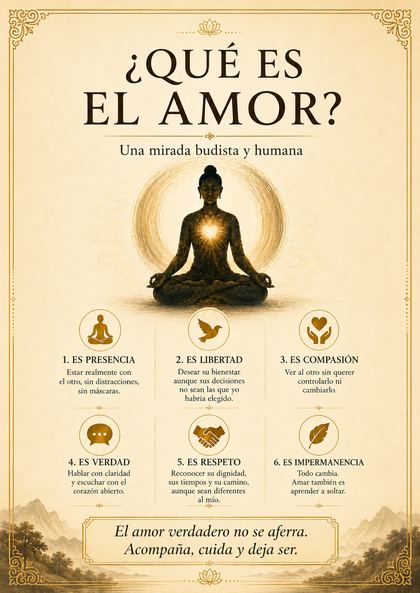
Seeing suffering
For there to be compassion, there must first be a gaze capable of recognising suffering.
It is not always easy. Sometimes we see another’s pain and we defend ourselves. We change the subject, we minimise, we give quick advice, we blame the one who suffers, or we tell ourselves it is not such a big deal. At other times, faced with our own pain, we do something similar: we demand that we carry on, we feel ashamed, we compare ourselves, we call ourselves weak.
Compassion begins when we stop denying.
Here there is sadness. Here there is fear. Here there is a wound. Here there is loneliness. Here there is a person trying to hold up what they can. Here there is a tired body. Here there is a mind trapped in attachment, guilt or shame.
In grief, compassion recognises the magnitude of the absence. It does not tell the person: “you have to be better by now”. Nor does it turn the loss into a pretty phrase. It draws near with respect and understands that wounded love needs time.
After a loss, it allows us to look at the pain without ridiculing it. A stage that has ended can break a great deal inside, even if from the outside others say it “will pass”. That something passes with time does not mean it does not hurt now.
In a painful situation, compassion sees the complexity. It recognises the guilt, the dependence, the longing, the fear and the shame. It does not ask cruelly: “how could you put up with that?”. It asks instead: “what do you need in order to be safe again and to recover clarity?”.
With the body, compassion detects the violence hidden in certain habits: comparing oneself relentlessly, training from hatred, grooming oneself from panic, insulting oneself in front of the mirror. It does not mock that insecurity. It treats it as a wound that needs care.
Compassion towards oneself
Many people believe that compassion should be directed first towards others.
In loneliness, compassion towards oneself becomes essential. A lonely person may treat themselves very harshly: “there must be something wrong with me”, “nobody seeks me out”, “I am invisible”. Compassion does not deny the need for real bonds, but it prevents that need from turning into contempt towards oneself.
It sounds noble, but it is often incomplete. If we do not learn to treat ourselves with some compassion, our help to others can become mixed with guilt, the need for approval, the fear of rejection or the desire to feel indispensable.
Compassion towards oneself is not selfishness.
It is to stop adding inner violence to the pain that already exists.
When someone is grieving, they may speak harshly to themselves: “I should have done more”, “I can’t fall apart”, “if I go on living I betray them”. Compassion replies: “you are suffering because you loved; you can review what is unresolved without punishing yourself forever”.
After a loss, the mind may say: “I wasn’t enough”, “I have to prove that I’m fine”, “I must change my body so that they regret it”. A compassionate response would be more sober: “this hurts; do not turn the rejection into a sentence against yourself”.
When changing a painful situation, guilt can strike hard. “I caused harm”, “maybe I overreacted”, “I should have put up with it”. Compassion does not remove responsibility, but it recalls something essential: protecting one’s own dignity also counts.
In front of the mirror, a compassionate gesture can be very simple: to stop insulting oneself. Perhaps love towards the body has not yet appeared. It does not matter. The first step can be a truce: “I am not going to speak to you as if you were my enemy”.
Sometimes compassion begins like this, in a low voice, without any grand emotion:
“This is hard”. “I don’t need to destroy myself in order to improve”. “I can take a little care of myself in the midst of this”.
Compassion does not mean justifying
A dangerous confusion consists in thinking that being compassionate forces us to justify everything.
It is not true.
We can understand that someone acts out of their pain and still recognise that their conduct causes harm. It is possible to see a person’s wounds without allowing them to humiliate us. It is also possible to wish that someone finds peace and, at the same time, keep our distance.
Compassion without clarity becomes naivety. Clarity without compassion can become harshness.
We need both.
In a painful situation, this distinction proves decisive. Perhaps the other person has a difficult history, a fear of not mattering, old wounds or an inability to manage their emotions. Understanding this can soften the hatred. Even so, it does not make repeated harm acceptable.
It is one thing to think: “I understand that they are suffering”. It is quite another: “that is why I must stay even if it destroys me”.
Mature compassion can say:
“I see your suffering, but I cannot allow this treatment”. “I wish you well, but I need distance”. “I understand that my limit hurts you, and I still keep it”. “I am not going to use your pain as an excuse to abandon my own”.
This form of compassion will not always be well received. Sometimes those who benefited from our lack of limits will call our clarity selfishness. The practice consists in not confusing compassion with submission.
Another’s pain does not belong to us entirely
When we see a loved one suffer, the desire to save them arises.
A child who cries. A relative in anguish. An ailing parent. A broken friendship. Someone trapped in their habits. Compassion feels the impulse to draw near.
That impulse is beautiful, but it needs wisdom.
We cannot live another person’s life for them. We cannot heal all their wounds, make all their decisions, avoid all their mistakes or bear all their consequences. To try can look like love, though at times it is born of the fear of enduring the pain of seeing someone suffer.
To help is not to take possession of another’s suffering.
We can accompany, listen, guide, support, offer resources, set limits, be available as far as possible. But each human being has their own path, their own causes, their own conditions and their own responsibility.
In grief, to accompany someone does not mean tearing their sadness away from them. It means not leaving them alone in it. After a loss, helping a friend does not involve feeding their obsession or automatically hating the other person out of loyalty. In a painful situation, offering support may require patience, but also clarity: recalling facts, offering refuge, encouraging them to ask for help, not pushing from the outside with contempt.
Compassion recognises a humble limit:
“I can accompany you, but I cannot live for you”.
Compassion and limits
A limit can be an act of compassion.
This is hard to understand if we associate compassion with pleasing others. But a limit often reduces suffering in the long run, even if it is uncomfortable at first.
Saying no to a destructive conversation can protect both people from further harm. Walking away from a painful situation can stop the cycle from feeding itself. Not replying to a manipulative message can break a dynamic. Refusing to insult during an argument takes care of our words. Ceasing to punish oneself at the gym can protect the body.
Compassion does not always caress.
Sometimes it stops.
A compassionate parent does not permit just any behaviour from a child. A compassionate friendship can tell us a difficult truth. A person who loves themselves with compassion does not let themselves be dragged again and again by the same attachment.
The compassionate limit is not born of the desire to punish. It is born of the desire not to increase suffering.
We can put it clearly:
“I am not going to continue this conversation if there are insults”. “I need distance in order to take care of myself”. “I understand that it hurts you, but my decision remains the same”. “I cannot help you in a way that destroys me”. “My body needs rest, not more punishment”.
Firmness is not at odds with the heart.
Compassion in concrete situations
Compassion changes according to need. Sometimes it accompanies in silence; at other times it offers a meal, a phone call or professional help. Faced with a person who hurts us, it can express itself through a clear limit. At work it might consist in not humiliating the one who makes a mistake and, at the same time, correcting the error.
We cannot always relieve another’s suffering. Mature compassion accepts that powerlessness without withdrawing or taking the pain as its own. It asks what truly helps, what falls to us and what requires the intervention of others.
Compassion is not absorbing everything
There are sensitive people who suffer greatly at the sight of the world’s suffering.
News, wars, illnesses, injustices, mistreated animals, the loneliness of others, family pain. Everything comes in. Everything weighs. And a guilt appears: “how can I be well if others are suffering?”.
Compassion needs balance so as not to turn into exhaustion.
We cannot absorb all the pain of the world with our limited body. To do so does not help those who suffer and can destroy our capacity to act. The practice consists in keeping the heart open without losing the ground beneath us.
We can stay informed without poisoning ourselves. Help where possible. Donate, accompany, take part, listen, vote, care, educate, act in our own surroundings. We also need to rest, laugh, eat, sleep and live.
Exhausted compassion turns into resentment or paralysis.
A sustainable compassion knows how to say:
“This matters to me”. “I will do my part”. “I cannot carry everything”. “I need to take care of myself in order to remain available”.
The suffering of the world needs people who are awake, not people burnt out inside.
Compassion as training
Compassion does not always arise spontaneously.
Sometimes we are closed off, tired, angry or too hurt. We must not pretend. Compassion can be trained little by little.
We begin with simple situations. A person who suffers without having harmed us. A vulnerable animal. A frightened child. Our own tired body. A part of us that is sad.
Then we widen the circle.
A difficult person. Someone who irritates us. A painful memory. A complicated relative. Even someone who harmed us, if that does not put our clarity at risk.
It is not about forcing ourselves to feel affection. Compassion can begin as a basic understanding: “this person also suffers and acts out of causes and conditions”. In some cases, we will add: “and precisely for that reason I keep my distance”.
Compassion does not always bring us physically closer.
Sometimes it brings us closer, inwardly, to our common humanity without removing outer limits.
A practice: compassion with limits
Think of a person towards whom you feel a mixture of compassion and difficulty.
It may be someone who is suffering, someone who hurt you, a painful memory, a relative, a person from a painful situation.
Write three sentences:
“I recognise that this person may be suffering because of…” “I recognise that their suffering does not justify…” “A compassionate limit would be…”
For example:
“I recognise that this person may be suffering out of a fear of not mattering”. “I recognise that their suffering does not justify the insults”. “A compassionate limit would be not to continue aggressive conversations”.
Or:
“I recognise that that person may also be hurt”. “I recognise that their pain does not oblige me to go back”. “A compassionate limit would be to keep my distance while I heal”.
This exercise helps to unite heart and clarity.
To remember
Compassion sees suffering and responds without justifying the harm or absorbing it all. It includes oneself, accepts limits and distinguishes help from compulsive rescue. Its question is not how to appear kind, but which response truly reduces suffering.
Loving kindness
There is a form of love that does not try to possess.
It does not ask first what it will receive. It does not demand that the other person soothe all its insecurities. Nor does it need to turn anyone into property, salvation or proof of personal worth.
The Buddhist tradition speaks of loving-kindness, often known by the word metta. It is a disposition of the heart that wishes well: for oneself, for the people we love, for those who leave us indifferent, even for those we find hard to understand.
It is not romanticism. It is not weakness. It is not naivety. It is not smiling at everything. It is not putting up with any kind of treatment.
Loving-kindness is a serene force that looks upon beings and wishes, sincerely, that they be free from suffering and find peace.
It may seem a simple thing. But it is not. Our heart is usually full of preferences, wounds, fears, judgements, comparisons and defences. We love some, reject others, ignore many. Even towards ourselves we can feel harshness, shame or contempt.
To practise loving-kindness means training a different direction.
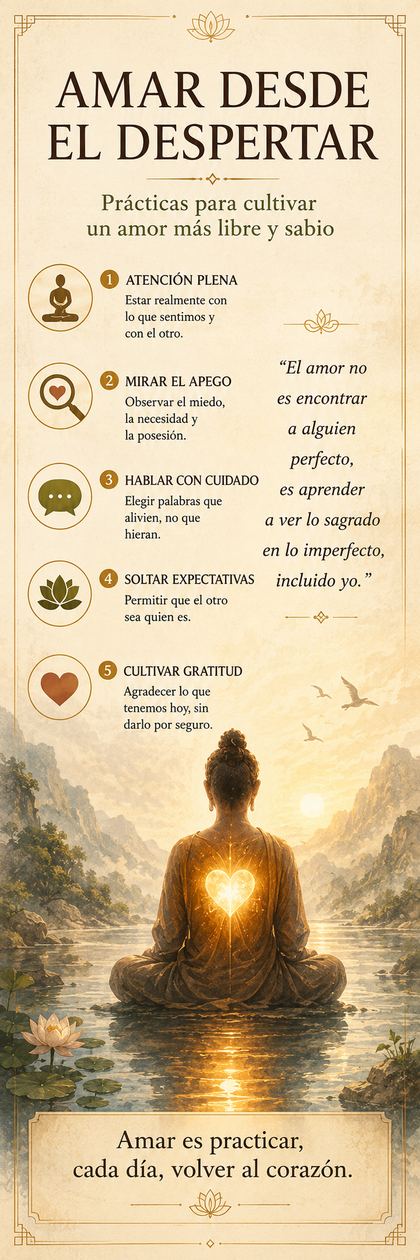
Instead of always living from defensiveness, we begin to cultivate a basic intention of non-aggression.
Wishing well
Wishing someone well does not mean approving of everything they do.
We can wish a person happiness and, at the same time, hold clear boundaries. We may hope that someone heals without allowing them to harm us again. It is also possible to love a person who has died without being tied to endless guilt.
Loving-kindness does not erase intelligence.
Rather, it cleanses the heart of unnecessary hatred.
When we say “may you be well”, we are not saying “do whatever you want with me”. We are not renouncing truth or boundaries. We are recognising that, deep down, no being wants to suffer. Even those who act in confused, hurtful or selfish ways are somehow seeking safety, relief, recognition or love, even if they go about it badly.
This does not justify the harm.
It only widens the gaze.
In a painful situation, for example, loving-kindness might sound like this: “I wish you peace and help, but I cannot stay inside this dynamic”. That sentence contains both heart and boundary. It does not feed hatred, yet it keeps distance. It does not turn the other into a monster, but neither does it turn us into a sacrifice.
Wishing someone well does not oblige us to stay.
Sometimes the healthiest way to love is to walk away without wishing destruction.
Starting with oneself
Many people find it hard to practise loving-kindness towards themselves.
It seems selfish to them. Or ridiculous. Or false. They tell themselves that first they should be better, calmer, more generous, thinner, stronger, more useful, more worthy. As if kindness were a prize that only arrives after correcting every flaw.
But the path works the other way round.
We do not begin to treat ourselves well because we are already perfect. We begin to treat ourselves better because hating ourselves does not set us free.
A grieving person may need to say to themselves: “may I move through this pain with care”. Not because they want to suffer less than others, but because they too deserve compassion.
After a loss, someone might repeat: “may I not turn this rejection into contempt for myself”. That sentence does not erase the loss. It protects the heart from an added wound.
Someone who has stepped out of a painful situation may need something even more concrete: “may I hold on to my dignity even though I feel guilt”. Here loving-kindness is not soft. It is a force that helps us not return to what breaks us.
Towards the body, the practice can begin humbly: “may I treat this body with respect”. Perhaps there is not yet full acceptance. It does not matter. The first gesture consists in laying down, if only for a moment, the war.
Loving-kindness towards oneself does not say: “I do everything right”. It says: “I do not need to hate myself in order to learn”.
The language of kindness
The traditional practice of metta usually uses short phrases.
They are not magic formulas. They do not seek to convince us by force. They work like seeds that we repeat in order to orient the heart.
Some possible phrases are:
May I be at peace. May I be free from suffering. May I live in safety. May I care for this body and this mind. May I treat myself with kindness. May I awaken.
There is no need to feel intense emotion while repeating them. Sometimes the practice feels dry. It may even be uncomfortable. If we have spent years speaking to ourselves harshly, a few kind phrases may sound strange at first.
That does not mean they are useless.
The mind learns through repetition. Just as we have practised comparison, guilt, demand or fear for years, we can practise another way of addressing life.
It is wise to choose phrases that are simple, believable and clean. If “I love myself deeply” feels too far away, we can begin with “may I not harm myself today”. If “my body is wonderful” feels false, it may be better to say “may I treat my body with respect”.
Loving-kindness does not need to exaggerate.
It needs to be honest.
Kindness towards those we love
It is easier to practise with someone we love.
We can bring to mind a person who awakens tenderness in us: a child, a friend, a teacher, a relative, even an animal. As we remember them, the heart softens naturally.
Then we repeat:
May you be well. May you be at peace. May you be free from suffering. May your heart find rest. May you live in safety and care.
This practice teaches the heart its own capacity to wish well.
In grief, it can be directed towards the one who has died. Although that person is no longer physically here, love can take the form of a serene wish: “may you be at peace; may my love not turn into guilt; may I remember you with tenderness”. We do not need to know exactly what happens after death in order to practise this way. It is enough to let love find a less possessive form.
After a loss, kindness towards the one who mattered may come later. At first it may hurt too much. There is no need to force it. When there is a little space, perhaps we can say: “may you be well, even though your path is no longer with me”. This sentence can hurt, but it also sets us free.
If there was serious harm, we should not force ourselves to wish well too soon. Loving-kindness cannot be used as a spiritual whip. First we need safety, clarity and protection. Later on, if it arises, perhaps we can wish that person to heal without coming near us again.
Kindness towards neutral people
The practice then widens towards people who do not usually take up much space in our mind.
The supermarket cashier. A delivery driver. Someone who cleans an office. A person we pass in the street. The driver of a bus. A voice on the telephone. Whoever works behind a screen and whom we never see.
We normally treat them as functions. They give us a service, they pass nearby, they appear and disappear. Loving-kindness remembers that each one has an inner life.
That person also fears. They too wish to be loved. Perhaps they are tired. Maybe they have lost someone. Perhaps they are supporting a family. They may be going through a loss. Perhaps they look at themselves in the mirror with harshness. Maybe they are living through a difficult relationship and no one knows.
We do not need to know their story in order to recognise their humanity.
Practising this way changes everyday life. It makes us less brusque, less focused only on our own hurry, less shut up in the bubble of the “self”. A kind look, a courteous word or a little patience may seem small gestures. Within the interdependent web, they are not.
Loving-kindness begins in the heart, but it shows in the way we treat the world.
Kindness towards difficult people
Here the practice becomes serious.
Thinking of someone we love is relatively easy. Wishing well to a neutral person can feel pleasant. But carrying loving-kindness towards someone difficult touches our wounds.
It may be a difficult memory. A complicated relative. Someone who humiliated us. A person who does not acknowledge the harm they cause. The one who hurt us. Someone who stirs up anger, envy or fear in us.
It is not wise to begin with the most painful case. That would be like trying to lift an excessive weight on the first day of training. We can first choose a moderate difficulty: someone who irritates us but does not destroy us.
The phrase must be careful.
There is no need to say “I love you”. There is no need to feel closeness. Nor should we deny what happened.
We can practise this way:
“May you free yourself from the suffering that makes you act with confusion”. “May you find clarity”. “May you not live ruled by hatred, fear or ignorance”. “May I not remain trapped in resentment”. “May I keep boundaries without wishing harm”.
These phrases protect two things: the heart and clarity.
If a person has done us deep harm, perhaps for now the right practice is not to direct kindness towards them, but to direct kindness towards ourselves: “may I be safe; may I heal; may I keep my distance”. That too is metta.
Loving-kindness must never force a return to a dangerous place.
The inner enemy
Sometimes the difficult person is ourselves.
We find it hard to forgive ourselves. Certain desires shame us. We cannot bear our sadness. We hate the body. We reject our weakness. We get angry at ourselves for still being hooked on a loss. We feel guilt for having stepped out of a painful situation. We think we ought to meditate better, love better, live better.
In such cases, the practice must reach the inner enemy.
We can bring to mind that part of ourselves we find hard to accept: the fear, the dependence, the anger, the bodily shame, the guilt, the craving for approval.
Not to hand it the reins. To stop hating it.
“May this frightened part feel cared for”. “May this guilt be heard without governing my life”. “May this shame not make me treat my body badly”. “May this craving for approval be able to rest”. “May my anger be transformed into a clear boundary”.
This form of practice is very concrete. It does not get lost in lofty ideas. It works with the places where we truly suffer.
Loving-kindness does not love a perfect image of ourselves.
It learns to look at our wounded parts without aggression.
Kindness as an antidote to hatred
Hatred hardens.
At first it can give a sense of strength. Later it closes us in. It keeps the hated person inside us, taking up space, marking our language and our breathing. Sometimes we believe that hating protects us, but it also binds us.
Loving-kindness does not demand that we deny the initial anger. Some forms of anger are necessary in order to recognise subjugation or to recover dignity. However, living for ever in hatred prolongs the bond with the harm.
Metta offers a gradual way out.
It does not begin by saying “forgive now”. It begins, perhaps, with something more modest:
“May I not be destroyed by this hatred”. “May my heart not always live around this wound”. “May I protect myself without feeding poison”. “May the harm end here”.
Later on, if it is possible:
“May this person awaken from the causes that led them to harm”. “May they stop creating suffering”. “May they find clarity far from me”.
This is not absolution. It is hygiene of the heart.
Not every case allows or requires a practice directed towards the one who harmed us. Each person must respect their own process. What matters is to remember that loving-kindness also seeks to free us from the inner poison.
Metta phrases for different situations
The practice can be adapted to real life.
For grief:
“May I hold this absence with tenderness”. “May my love not turn into guilt”. “May I remember without destroying myself”. “May the one who died be at peace, if that is part of my faith or my wish”.
For a loss:
“May I move through this ending with dignity”. “May I not turn the rejection into hatred of myself”. “May I let go without hardening my heart”. “May that person find their path, even if it is not with me”.
For a painful situation:
“May I be safe”. “May I remember my dignity”. “May I keep clear boundaries”. “May the other person find help, without my having to lose myself”.
For the body:
“May I care for this body with respect”. “May I not treat it as an enemy”. “May I inhabit it from within”. “May my worth not depend on being admired”.
For the need for approval:
“May I enjoy living without needing everyone to like me”. “May I rest from the image”. “May I not hand my peace over to other people's eyes”.
For loneliness:
“May I keep myself company with tenderness while I find true companionship”.
“May I not turn my loneliness into a sentence against myself”.
“May I open myself to healthy bonds without betraying my dignity”.
“May my heart find presence, within me and around me”.
These phrases are seeds. Some will sprout quickly. Others will need time.
A complete loving-kindness practice
Sit in silence for a few minutes.
Feel the body and the breath. Do not look for a special emotion.
Begin with yourself:
“May I be at peace”. “May I be safe”. “May I treat myself with kindness”. “May I live with more freedom”.
Then bring to mind someone you love:
“May you be at peace”. “May you be safe”. “May your heart find rest”. “May you live with kindness”.
Then think of someone neutral:
“May you be well”. “May you have peace”. “May you be free from suffering”. “May your life receive care”.
Later, if it is possible, bring to mind a difficult person of moderate intensity. Do not choose at the start the one who hurt you most.
“May you find clarity”. “May you free yourself from the suffering that confuses you”. “May I keep my heart free from hatred”. “May there be boundaries and peace”.
Finally, widen out towards all beings:
“May all beings be free from suffering”. “May all beings find peace”. “May all beings live in safety, dignity and care”.
If any phrase does not feel honest, change it. If resistance arises, name it kindly. Resistance too can receive kindness.
When we feel no kindness
There will be days when no kindness appears.
Only tiredness, anger, sadness or coldness. That is all right. The practice does not consist in manufacturing feelings. It consists in orienting the intention.
We can say:
“Right now I feel no kindness, but I do not want to feed hatred”. “There is resistance”. “There is pain”. “I can begin by doing no harm”. “I can take care of this moment”.
Sometimes metta begins as non-aggression.
Not insulting. Not acting out of anger. Not punishing oneself in front of the mirror. Not repeating out of guilt. Not feeding a comparison. Not using pain to wound.
That is already kindness in practical form.
The heart is trained through small gestures.
To remember
Metta trains the sincere wish for well-being for oneself, for the people we love, for the neutral ones and for the difficult ones. It does not demand feeling immediate affection or denying conflicts. Repeating intentions of kindness weakens hatred and prepares a more caring conduct.
Rejoicing in the good of others
There is a joy that does not come from gaining something for ourselves.
It appears when we see that another person is well. Someone receives good news. A friendship finds love. A colleague makes progress. A child discovers their path. A person recovers their health. Another gets through a difficult stage. Someone who suffered begins to breathe more freely.
We could feel glad.
And yet, so often something closes up inside.
Comparison arises. Envy appears. The mind calculates: “why him and not me?”. Another's success stirs our insecurity. The happiness of another person seems to remind us of what is missing in our own life. Even a legitimate joy can be mixed with a small sting.
Buddhism knows this movement well. That is why it speaks of a quality called mudita, usually translated as empathetic joy, shared joy or joy in the good of others.
Mudita is the capacity to feel sincerely glad when others experience wellbeing, virtue, beauty, love, peace or good fortune.
It is not a naive joy. Nor does it require us to feign enthusiasm. It does not deny our own wounds. It does not demand that another's life always be easy for us to look upon.
It is a practice of the heart: learning not to live the happiness of others as a threat.
Comparison narrows the heart
Comparison turns the good of others into an accusation against us.
Someone widens their circle of friends and the mind says: “I am alone”. Another person improves physically and up it comes: “my body is worthless”. A friend has professional success and it surfaces: “I am falling behind”. A person seems to regain energy after an illness and it hurts: “I mattered less”. A family celebrates something while we are grieving and we think: “my world has broken”.
Another's joy, seen through comparison, stops being joy. It becomes a mirror of lack.
This is very human. It is not worth being too ashamed of feeling it. Envy or comparison do not make us bad people. They are signs of a wound, a need or a fear.
The problem appears when we feed those emotions until we become incapable of celebrating anything that is not our own.
The ego suffers a great deal with the good of others because it lives preoccupied with position. It wants to know whether it is above or below, whether it is liked more or less, whether it has achieved enough, whether it is still chosen, admired or important. When another person shines, the ego fears being dimmed.
Mudita teaches something else:
another's light does not diminish our own.
Being glad does not always come spontaneously
Sometimes we would like to feel glad and we cannot.
A friend announces a pregnancy just when we are going through a loss. Someone celebrates a recovery while we are going through an illness. A person posts a strong, healthy body when we feel old, tired or insecure. A person smiles in a photo and we are flooded by a mixture of anger, sadness and comparison.
In such moments, feigning joy can feel violent.
The practice does not consist in lying to ourselves.
We can begin by acknowledging honestly:
“I am glad for this person, and something of mine also hurts”. “There is joy for her and sadness in me”. “There is comparison”. “There is envy”. “There is fear of being left behind”. “There is a wound touched by their happiness”.
This way of naming it is already a step forward. It allows us not to turn the difficult emotion into added guilt. It also keeps us from acting out of it.
We do not need to manufacture a pure joy at once. We can begin by not wishing for the other to lose what they have.
Sometimes mudita begins modestly:
“May this person be able to enjoy their good”. “May I be able not to close my heart”. “May my pain not turn into resentment”. “May there be room for their joy and for my wound”.
Another's joy does not cancel our pain
A significant difficulty appears when we are suffering.
In grief, the world goes on. Others celebrate birthdays, weddings, trips, meals, achievements. For someone who has just lost a person, that ordinariness in others can feel almost offensive. Not because others are doing anything wrong, but because the contrast hurts.
After a loss, seeing others celebrate can open the wound. It seems that everyone has what we lost. The mind selects images of wellbeing and uses them to strike at us.
In a painful situation, watching healthy relationships can awaken a mixture of hope and sadness. Joy for those who love well, sorrow at not having received that, anger at the time lost.
Faced with the body, seeing someone strong, attractive or admired can trigger comparison. Instead of inspiring us, it sinks us. The good of others is turned into false proof of our inadequacy.
Mudita does not ask us to deny any of that.
Empathetic joy does not cancel our pain. It can live alongside it. The human heart has room for more than one emotion, even if at first it does not seem so.
We can be sad and feel a little glad for someone. We can feel envy and not feed ill will. It is possible to mourn a loss and, at the same time, recognise the beauty of a life that continues in others. We can also feel bodily insecurity and wish for another person to enjoy their health.
This breadth is trained.
Envy: an uncomfortable teacher
Envy usually has a bad reputation, and rightly so when it turns into poison. But, looked at with attention, it can teach us a great deal.
Envy points to something we desire, something we feel is far off or something we believe we do not deserve.
If we envy the closeness others have, perhaps there is a longing for love, security or tenderness. Faced with another person's body, perhaps a yearning for health, attractiveness, discipline or acceptance appears. When another's success hurts us, there may be a part of us that wants to grow, to be recognised or to leave behind a narrow life. On seeing that a difficult memory seems happy, perhaps we do not envy exactly their life, but the feeling of having been left out.
Envy becomes destructive when it says: “if I do not have it, the other should not have it either”. Looked at with wisdom, it can turn into a question: “what legitimate longing is here, and how can I tend to it without attacking anyone?”.
The practice consists in not denying envy, but not obeying it either.
We can say:
“There is envy”. “There is the pain of comparison”. “This shows something I desire”. “I do not need to turn this desire into resentment”.
In this way envy stops being poison and becomes information.
Another's success
The success of others also puts us to the test.
A colleague is promoted. A friend publishes a book. Someone buys a house. An acquaintance earns more money. Another person seems to have recognition, beauty, stability or influence.
The mind compares quickly.
“I should be there”. “They have overtaken me”. “I have not done enough”. “My life is not moving forward”. “He was lucky”. “She does not deserve it that much”.
Some comparisons can point to legitimate desires for growth. Perhaps we need to review our life, order our goals, make a better effort or leave behind a certain passivity. But if comparison turns into resentment, we lose energy.
Mudita lets us admire without diminishing ourselves.
We can say:
“I am glad for their good”. “May they use that success with wisdom”. “May this inspire me without poisoning me”. “My path is not cancelled by their advance”.
Life is not a table with a single plate.
The good of others does not always take away our own.
Practising joy in small things
We do not have to begin with great challenges.
We can practise mudita with simple joys.
A child playing. A dog running. Two friends walking together. A person laughing freely. A friend resting after a hard stage. Someone receiving good news. A colleague learning something. A plant that blossoms.
Before each scene, we allow a phrase:
“May this joy continue”. “How good that this moment exists”. “May this being enjoy their wellbeing”. “May I be able to feel glad without possessing”.
These small practices educate the heart.
Later, when more difficult situations appear, there will be an open path.
Empathetic joy cannot be improvised in the most painful moments. It is cultivated in daily life.
Mudita towards oneself
We also need to feel glad for our own good.
It seems strange, but many people do not know how to do it. They achieve something and play it down. They receive affection and distrust it. They improve and look for the next flaw. They rest and feel guilty. They care for their body and think it is not enough.
The ego can use even achievements to demand more.
Mudita towards oneself means recognising what is good without arrogance.
“Today I have taken a step”. “I have held a boundary”. “I did not react out of an impulse”. “I treated my body with more respect”. “I asked for help”. “I was able to cry without punishing myself”. “I am learning”.
Being glad for one's own good is not vanity. Vanity wants superiority. Healthy joy recognises growth and gives thanks for it.
If we cannot feel glad for ourselves, it will be difficult to feel truly glad for others. We will live every good thing as comparison.
The practice begins close to home:
“May I be able to recognise my small advances”. “May I not need to despise myself in order to keep improving”. “May my wellbeing also be allowed”.
Joy without guilt
Sometimes we feel guilty for being well.
After a death, guilt can appear when we laugh. After leaving a painful situation, perhaps there is guilt at feeling relief. After a loss, we find it hard to enjoy because a part of us believes that letting go is a betrayal. Even when improving physically or emotionally, discomfort can arise: “do I have the right to be better?”.
Mudita includes allowing our own joy.
Suffering is not honoured by suffering more than necessary. Love for the one who died does not require cancelling all beauty. Having gone through harm does not oblige us to live always on the defensive. A significant loss does not turn future happiness into disloyalty to the past.
We can say:
“I can feel joy without denying what hurt”. “I can be better without betraying anyone”. “My relief also matters”. “May this joy be simple and clean”.
Joy does not have to be grand. It can be a pleasant meal, a conversation, a quiet afternoon, a song, a walk, a body less tense.
Allowing small goods is part of healing.
A practice: being glad without comparing
Choose a person who has recently received something good.
It can be a friend, a relative, someone from work or a person who is not too difficult for you.
Sit and breathe.
Bring that person to mind. Recognise their good: health, love, rest, success, joy, recovery, beauty, opportunity.
Repeat slowly:
“I am glad for your good”. “May you be able to enjoy it with wisdom”. “May this joy not turn you away from goodness”. “May your wellbeing continue”.
Observe what arises in you.
If there is comparison, name it. When envy comes up, recognise it without hatred. If your own sadness appears, give it space. When there is resistance, do not turn it into failure.
Then add:
“May my heart be able to feel glad without feeling less”. “May the good of others not be a threat to my dignity”.
Practise gently. Do not force emotion. The intention is already a seed.
To remember
Mudita answers comparison by remembering that another's joy does not take away our worth. Envy can be observed without shame and transformed into information about our needs. Celebrating the good, our own included, widens a heart accustomed to competing.
Loving without grasping
Loving is one of the most beautiful and most difficult experiences in life.
It opens us up. It makes us sensitive. It draws us out of ourselves. Thanks to love, a person stops being merely “someone” and becomes an important presence: a voice we wait for, a body we recognise, a story that mingles with our own, a happiness that matters to us.
That is why love also makes us vulnerable.
Whoever loves can lose. Whoever forms a bond can be hurt. Whoever opens their heart accepts, even without saying so, that some of their peace will be left exposed.
Buddhism does not despise love. It does not regard it as a mistake or a minor distraction. What it watches very closely is the way love becomes mixed up with attachment, fear, possessiveness, the need for control or self-image.
Loving is not the problem.
Suffering arises when we try to clutch at the one we love as if they could give us absolute security.
We want the beloved presence never to change, to soothe us, to confirm our worth, to fill our emptiness and to uphold the image we hold of ourselves. Then love, little by little, stops being space and turns into tension.
Loving without clutching does not mean loving less.
It means loving more truthfully.
The love that opens and the attachment that grips
Love wants what is good.
Attachment wants guarantees.
This difference seems simple, but in real life the two become deeply entangled. We can love someone sincerely and, at the same time, need that person to soothe our fear. We can wish for their happiness and also suffer if that happiness does not include us. We may care for someone tenderly and, underneath, hope they never change, never drift away, never stop looking at us the way we need.
Love opens the hand.
Attachment closes it.
When we love, we see the other as a living being. They have their story, their freedom, their limits, their wounds, their desires, their path. When we clutch, we turn them into an answer to our own insecurity.
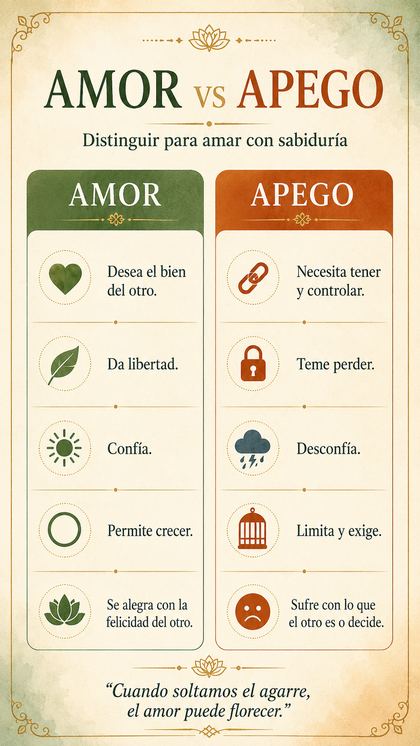
“Make me feel worthy.” “Do not leave me alone with my fear.” “Confirm that I am worth something.” “Do not change.” “Do not disrupt my plans.” “Do not force me to face my insecurity.”
These phrases are rarely spoken outright, but many bonds grow strained under their weight.
Love can commit deeply. It can care, accompany, sustain and build. Loving without clutching does not mean living shallow bonds. It means that commitment is born of freedom and responsibility, not of possessive fear.
Loving someone who has died
Death confronts us with the most painful limit of love.
A person dies, but love does not go out at the same moment. The body understands the absence only gradually. The mind keeps waiting for gestures, words, calls, routines. The heart searches for the one who can no longer return in body.
There a very understandable form of clutching appears: wanting to hold on to the impossible.
Wanting the house to stay the same. Keeping every object as if moving it were a betrayal. Going over the final days again and again. Feeling guilty when we laugh. Believing that suffering more proves we love more.
None of this should be judged harshly. In grief, love is learning a new form. It needs time.
Loving without clutching someone who has died does not mean forgetting. Nor does it mean ceasing to weep or closing off the bond. It means allowing love to find another way to live.
Perhaps it becomes grateful memory. It may express itself by caring for those who remain. It may take the shape of ritual, prayer, silence or writing. Sometimes it appears as a decision to live more consciously. On another day it will simply be breathing with the absence without punishing ourselves.
The beloved person does not need us to destroy our life in order to prove our loyalty. Love can go on being true without becoming a prison.
Letting go of the physical presence is not letting go of love.
It is ceasing to demand that reality turn back.
When caring also calls for limits
There are situations in which carrying on as before is not wise care.
A chapter may have held tenderness, history, beautiful moments and sincere promises. Even so, if it begins to diminish our dignity, if there is fear, exhaustion, humiliation or a constant loss of oneself, asking for help and setting limits can be an act of care.
This is very hard, because we confuse love with permanence.
“If I love, I must be able to bear everything.” “If I rest, I am abandoning others.” “If changing causes me pain, it means I am doing wrong.” “If I still feel tenderness, I must carry a little more.”
Not always.
Sometimes keeping our distance hurts precisely because there was affection. The presence of pain does not prove that the decision is wrong. The heart can weep and, at the same time, recognise that carrying on as before is destroying us.
Loving without clutching in a painful situation includes letting go of the fantasy that love alone will be enough. Love does not replace respect. Nor does it magically correct patterns that are never owned. Compassion cannot ask us to disappear in order to hold up another person’s wound.
Acting out of hatred will not always be necessary. Acting with clarity may well be.
The sentence might be:
“I wish you well, but I cannot keep losing myself in this dynamic.”
That sentence is not cold.
It is love with dignity.
Seeking companionship without demanding to be saved
Sometimes we look to companionship for an answer to pains that do not entirely belong to the bond.
We want someone to heal an old loneliness, confirm our worth, calm our anxiety, give meaning to life or save us from ourselves.
This is too much weight for one person.
No one can be the absolute home of another human being. No one can guarantee us freedom from fear. No one should become a permanent medicine for our insecurity.
A friendship or a healthy community can accompany, care for, inspire and sustain us. But they should not take the place of inner work.
When we ask someone to save us, affection turns into dependence. If we receive attention, we breathe; if we do not, we fall apart. If that person’s availability changes, we feel as though the whole world is shifting.
Loving without clutching means taking back a part of our own responsibility.
I can love and, at the same time, learn to be with myself. I can wish for closeness without demanding that another person calm all my fear. I can ask for care without turning it into a right of possession. I can receive affection without using it as the only proof of my worth.
Mature affection does not say “save me.”
It says: “I can ask for support and still be responsible for my own life.”
The fear of losing
We clutch because we are afraid.
Afraid of loneliness. Of not being enough. Of growing old. Of affection changing. Of discovering that we gave a great deal and it was not meant to last forever. Of accepting that we do not control another’s life.
This fear must not be ridiculed. It is human. Affection touches very deep places. The problem arises when fear governs our behaviour.
Then we keep watch. We demand guarantees. We read into silences. We compare ourselves. We try to control. We react out of insecurity. Or we stay frozen where it hurts because change seems worse.
Practice does not wipe out fear all at once. It teaches us to recognise it before it turns into behaviour.
“There is a fear of losing.” “There is a wish to control.” “There is a need for validation.” “There is attachment.” “There is insecurity.”
Then we breathe.
A bond does not become safer because we grip it harder. Often, by gripping, we damage it. The deepest security is not born of controlling another person, but of cultivating an inner presence capable of loving, losing, weeping, learning and remaining alive.
That does not mean that nothing matters. Commitments matter. Honesty and respect matter. But even in committed bonds, the other person remains a free being, not a possession.
Loving with limits
Love needs limits so as not to become deformed.
Without limits, it can turn into fusion, dependence, sacrifice, manipulation or invasion. With clear limits, it breathes more easily.
A limit says:
“I love you, but I cannot accept insults.” “You matter to me, but I need space.” “I want to help you, but I cannot live your life for you.” “I am listening to you, but I will not enter this conversation if you humiliate me.” “I feel compassion, but I will not continue in a dynamic that destroys me.”
These sentences can hurt. And yet, sometimes they protect love from turning into harm.
The ego reads limits as rejection. Awareness understands them as a form of care. A bond without limits tends to end up full of resentment. Whoever always gives way ends up far from themselves. Whoever always demands ends up leaving little room for the other.
Loving without clutching requires recognising where I end and the other begins.
Closeness must not erase dignity.
Loving and setting free
Setting free does not mean washing our hands of someone.
It means loving while recognising that the other has their own path. They can choose, change, make mistakes, grow and not respond as we expect. This does not prevent us from asking for responsibility within a bond. But it reminds us that we do not own another’s conscience.
With children, setting free is especially hard. For years they need guidance, protection and limits. Even so, little by little they must become the owners of their own lives. Loving them does not consist of shaping them to prop up our pride, but of accompanying them towards their own judgement.
With a relative or a friend, setting free does not mean accepting disrespect. It means not turning care into control. Trust cannot be born of constant surveillance.
After a loss, setting free takes a painful form: allowing life not to respond to our plans. Not because it does not hurt, but because reality cannot be wrenched back by force.
Before someone who has died, setting free may mean allowing their memory to be not a chain of guilt, but a bond that breathes in another way.
Freedom does not cool love.
It makes it less possessive.
Loving without clutching is not loving without pain
It is worth saying clearly: loving without clutching does not make us invulnerable.
It hurts to lose. It hurts when someone dies. It hurts when the body changes. It hurts to accept that a chapter cannot go on. Practice does not turn the heart to stone.
The difference lies in the added suffering.
We can feel pain without acting compulsively. Weep without becoming enemies of life. Miss someone without repeating what harms us. Care for the body without hating it. Wish others well without possessing them. Remember without living in chains. Set limits without closing off the heart entirely.
Loving without clutching does not remove the first arrow.
It reduces the second.
It does not prevent every loss, but it helps us not to add control, guilt, hatred, revenge, self-attack or endless despair.
The practice of the open hand
We have used the image of opening the hand before. In this chapter it takes on a special meaning.
We can imagine that we love with a closed hand. We grip so as not to lose. We want to make sure. The gesture gives a sense of control, but it also produces tension. If what we love changes, the hand suffers.
The open hand does not abandon. It can hold, caress, receive, offer. But it does not turn the beloved into a prisoner.
To love with an open hand means:
“I care for you, but I do not possess you.” “I love you, but I do not use you to confirm my worth.” “I remember you, but I do not punish myself in your name.” “You matter to me, but I do not lose myself trying to save you.” “I care for this body, but I do not force it to uphold an eternal image.” “I wish you well, even though I need to respect my own limit.”
This way of loving takes a great deal of practice.
Attachment will return. So will fear. Sometimes we will close the hand without noticing. The task is to notice the tension and open it a little.
Not all at once.
A little.
A practice: love or clutching?
Think of an important relationship or bond.
It may be someone who has died, a child, a friend, a relative, a painful situation or even your relationship with your body.
Write two columns.
In one put: love. In the other: clutching.
Under “love,” note down gestures that wish others well, that care, that respect freedom, that protect dignity or that give thanks.
Under “clutching,” write down behaviours born of fear: controlling, keeping watch, demanding, idealising, punishing yourself, needing approval, using the body as proof of worth, suffering to prove love.
Then ask:
Which part of this bond needs more of the open hand? What limit would help me love better? What fear am I trying to calm by clutching? What concrete action would reduce possessiveness and increase care?
Choose one small action.
Switching off the phone for a while. Waiting before acting out of anxiety. Keeping an object of grief with respect. Saying no to a harmful dynamic. Training from a place of care. Resting. Speaking honestly. Accepting what we cannot control. Asking for help in holding a limit.
Clarity becomes real when it takes the shape of behaviour.
To remember
Love cares; attachment demands guarantees. Loving without clutching does not remove pain, nor does it oblige us to stay in any circumstance whatever. It allows us to give thanks, to set limits, to grant freedom and to accept that no person can wholly uphold our identity.
The path of the bodhisattva
There is a question that arises when we begin to suffer less blindly:
what do I do now with what I have understood?
At first, the spiritual path usually springs from a personal wound. We want to suffer less. We seek calm. We need to understand death, a loss, a painful situation, anxiety, attachment, fear, guilt or the harshness with which we treat ourselves.
That is legitimate.
No one always begins from a great universal compassion. Often we begin because it hurts. Because something breaks. Because life forces us to look.
But, little by little, practice opens the field. We discover that our suffering is not only ours. Others too fear, love, lose, cling, compare themselves, grow old, fall ill, make mistakes, long to be seen, carry guilt, seek approval and do not know how to rest.
Then the heart can widen.
We no longer practise merely to feel better ourselves. We also practise so as not to increase the suffering of the world.
That is where the spirit of the bodhisattva appears.
In Mahayana Buddhism, a bodhisattva is someone who orients their life towards awakening not only for themselves, but for the benefit of all beings. They do not seek a private peace closed off to the pain of others. They wish to free themselves from ignorance, attachment and aversion so as to live with more wisdom and compassion in the midst of life.
There is no need to imagine this as a distant, perfect or heroic figure.
The path of the bodhisattva can begin very humbly: with a less cruel word, a pause before wounding, a boundary that cuts a chain of harm, a gesture of care, a sincere act of listening, a decision not to return to the world exactly the pain we receive.
Not only my peace
Personal peace is important.
If we are destroyed, exhausted or trapped in a dynamic that breaks us, we need care. If grief overwhelms us, it is wise to seek support. When a loss leaves us without ground, we must rebuild a life of our own. Faced with a body treated with hatred, we need to learn respect.
It would be a mistake to leap too quickly towards “helping everyone” while abandoning oneself.
However, the opposite risk also exists: turning the spiritual path into a private pursuit of well-being. Meditating only to be calm. Practising only to feel better. Using wisdom as an individual refuge, without allowing it to transform the way we speak, work, love or relate to others.
The bodhisattva remembers that true practice does not end on the cushion.
If I meditate and then speak with contempt, something is missing. If I seek inner peace but ignore the harm I cause, something is not integrated. If I feel spiritual while I humiliate my body or judge another's body, practice has not yet touched that area. If I speak of compassion but remain in a painful situation calling self-abandonment love, I need to look more closely. If I say that everything changes, yet try to control the lives of those I love, the teaching has not yet come down into the heart.
The peace that does not become responsibility remains incomplete.
The deep vow
In some traditions people speak of the bodhisattva vow: the commitment to work for the well-being and liberation of all beings.
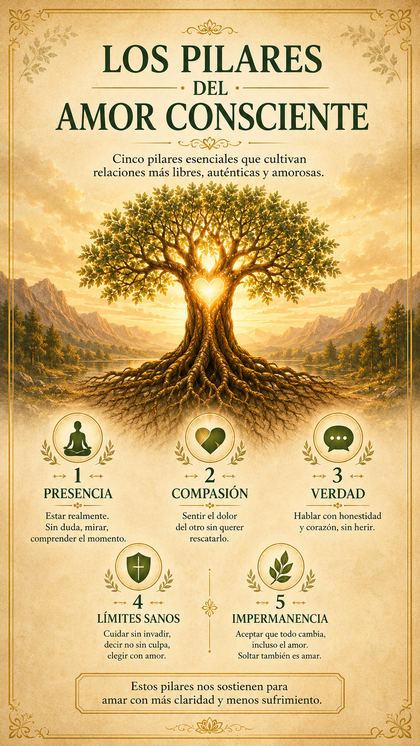
Put like that, it may seem immense. Too great for an ordinary life. How are we to liberate all beings if we can barely cope with our own wounds?
The answer lies in understanding it not as an arrogant task, but as a direction.
It does not mean: “I will save the world”. It means: “I do not want to live only for my small self”. It does not mean: “I will carry everything”. It means: “I will orient my life towards less harm and more awakening”. It does not demand that we resolve universal suffering tomorrow. It invites each gesture to take part, modestly, in easing suffering.
One person may practise the bodhisattva vow by caring for a sick relative without losing themselves in resentment. Another does so by raising their children with more presence. Someone expresses it by working with honesty. There are also those who practise it by leaving a painful situation so as not to keep feeding a destructive dynamic. Another person embodies it by ceasing to speak to themselves with hatred, because they understand that such hatred ends up splashing onto those close to them.
The deep vow does not always take a solemn form.
Sometimes it sounds like this:
“May my pain not make me cruel”. “May what I have lived through make me more aware, not harder”. “May the way I love not clutch”. “May my words not add needless wounds”. “May my body not be treated as an enemy”. “May my life, with all its imperfections, contribute a little to easing suffering”.
Compassion with a backbone
The bodhisattva is not a person who says yes to everything.
This image is worth correcting. Sometimes we believe that someone very compassionate must always be available, forgive at once, listen without tiring, never grow angry, set no boundaries and sacrifice themselves without measure.
That is not awakened compassion.
That may be fear, people-pleasing, guilt or the need to seem good.
The path of the bodhisattva joins an open heart with a backbone. It feels the suffering of others, but does not give up clarity. It wishes for the good, yet does not accept just any conduct. It understands the causes of harm, but does not justify it.
In a painful situation, this distinction is vital. We can recognise that the other person suffers, that they have wounds, that perhaps they act out of fear or confusion. Even so, if there is humiliation, manipulation, violence, contempt or repeated harm, the compassionate response may be to step back.
The bodhisattva does not offer themselves as fuel for another's fire.
Nor do they use their pain to destroy. They set boundaries seeking to reduce suffering in the long term. Sometimes the boundary hurts. It may stir rage in the other person. Even so, if it protects dignity and cuts a harmful dynamic, it is part of the path.
Mature compassion does not ask only: “how do I keep the other from suffering now?”. It also asks: “what action reduces more real suffering for everyone, including my own?”.
Not returning the harm received
We all receive wounds.
Some come from unavoidable losses. Others, from particular people. There are wounds from childhood, broken relationships, cruel words, abandonments, betrayals, illnesses, injustices, bereavements. There are also subtler wounds: feeling that we are not liked, that our body does not fit, that we must prove our worth, that we are only loved if we meet a certain image.
The automatic reaction is to pass on what we received.
Those who were humiliated may humiliate. Someone who felt ignored may try to control. A person wounded by a loss may turn cold. One who suffered contempt for their body may despise their own body or that of others. Those who have lived in fear may use fear to hold on. After a painful situation, one may harden until no one is let in.
The path of the bodhisattva tries to interrupt that transmission.
It does not deny the wound. It looks at it. It cares for it. It asks for help if needed. But it adds a decision: “I do not want this to become more harm through me”.
That decision can be small and enormous at the same time.
Not to insult when we could. Not to use silence as punishment. Not to manipulate out of our insecurity. Not to demand that others repair wounds they did not cause. Not to treat the body as an enemy. Not to raise children through shame. Not to turn a loss into revenge. Not to remain in a dynamic that destroys everyone.
Pain that is not worked through seeks a way out. Pain worked through can become compassion.
The bodhisattva in everyday life
There is no need to withdraw to a mountain to practise this path.
Ordinary life is the training ground.
In a kitchen, we can practise patience. During an argument, right speech. While driving, attention and non-aggression. At work, honesty. With our children, presence. Before the mirror, kindness towards the body. After a loss, tenderness. After a loss, dignity. In closing a painful situation, clarity without hatred.
The bodhisattva does not wait for perfect conditions. They know that practice happens precisely where irritation, attachment, tiredness, fear and ego appear.
A difficult meeting can reveal the need to be right. An unanswered message reveals attachment. A criticism awakens the defence of one's image. Another's success touches envy. The illness of a loved one opens fear. The ageing of the body teaches impermanence.
Everything can become path if we look at it with awareness.
This does not turn life into a spiritual exam. Rather, it frees it from the separation between “practising” and “living”. Each situation offers a simple question:
can I respond here with a little less ignorance and a little more care?
The humility of not saving everyone
Wanting to ease suffering does not mean being able to save everyone.
This truth protects us from much confusion.
There are people we will not be able to help. Some do not want to be helped. Others need resources we do not have. Certain bonds harm us if we stay too close. There are also situations where our intervention, though born of good intention, would not be appropriate.
The ego can disguise itself as a saviour.
It wants to be indispensable. It needs to be needed. It confuses love with rescue. It feels guilt when someone suffers and it cannot fix it. It struggles to accept that each person has their own process.
The bodhisattva, by contrast, cultivates a wiser humility.
They help when they can. They acknowledge limits. They do not abandon their own body and mind. They accept that to accompany is not to control. They understand that doing good does not always produce visible results. They learn to rest so as to remain available.
In the grief of someone close, we cannot take away the absence. We can accompany. After the loss of a friendship, we cannot live their process for them. Faced with another's painful situation, we can offer support and clarity, but not decide their whole path from outside. With a person who hates themselves physically, we can mind our words, though we cannot give them self-esteem all at once.
The wish to help needs patience.
It also needs respect for the other's freedom.
Caring for oneself in order to care
An exhausted, resentful or destroyed bodhisattva does not help better.
To care for oneself is not to abandon others. It is to protect the capacity to be present. Sleeping, eating, resting, asking for help, setting boundaries, attending to one's health, reducing overload, caring for the body: all of this can be part of a compassionate life.
Some people feel guilty for resting while others suffer. But extreme tiredness does not make us holier. Often it makes us more irritable, more confused and less available.
Caring for the body, moreover, is not vanity when it is born of respect. The body is the instrument with which we speak, embrace, work, walk, listen and practise. If we treat it as an enemy, our compassion is left without ground.
This also holds for emotional health.
After a loss, we may need distance before we can sincerely wish for the good. In a painful situation, the priority may be to recover safety, not to sustain what wounded us. In a recent bereavement, caring for oneself may consist of surviving one more day without grandiose demands.
The path of the bodhisattva does not ask us to burn out.
It asks us to learn to burn like a lamp, not like a house on fire.
The gaze towards those we find it hard to love
The path becomes especially demanding with difficult people.
It is easy to wish well to those who treat us well. It is more complicated not to close the heart to someone who irritates, disappoints or wounds us. Yet here too practice does not ask for naivety.
We can distinguish three levels.
First, not to feed hatred. If we cannot yet feel compassion, we at least try not to wish for destruction.
Then, to recognise humanity. That person, even if they act badly, is also conditioned by ignorance, fear, wounds or the wish to be happy.
Finally, if it is possible and safe, to wish that they awaken from what causes harm.
These stages must not be forced.
With someone who has wounded us deeply, the initial practice may be to keep our distance and direct compassion towards ourselves. Later, a less bitter understanding may appear. There is no need to feign it before its time.
The bodhisattva does not confuse forgiveness with denial.
Nor do they reduce anyone to their worst act, even while recalling clearly what happened.
Small acts of liberation
The path of the bodhisattva may seem immense, but it is expressed in small acts.
Preparing food for someone who has no strength. Accompanying without giving quick advice. Not ridiculing the pain of a loss. Helping someone remember their dignity. Caring for our health so as not to live from exhaustion. Not speaking ill of a body, our own or another's. Telling a difficult truth without humiliating. Giving time, money or attention where there is need. Withdrawing support from destructive dynamics. Raising children without sowing shame. Acknowledging a mistake and making amends. Ceasing to feed hatred.
No isolated act saves the world. Even so, each one changes something in the web.
Interdependence makes the small not so small.
A word that does not wound cuts a chain. A clear boundary can spare years of confusion. A person who stops hating themselves may treat those around them better. Someone who transforms their grief into tenderness may become a refuge for others.
Let us not underestimate modest gestures.
A practice: dedicating the merit
In many Buddhist traditions, at the end of a practice the merit is dedicated. This means offering the benefit of the practice to the well-being of all beings.
There is no need to understand it in a mysterious way. It can be seen as an orientation of the heart: “may what I have cultivated not stay locked inside me”.
After meditating, breathing or doing a practice of loving-kindness, you can say:
“May whatever clarity born of this practice help to reduce suffering”. “May my calm become better words and better action”. “May my worked-through pain not turn into harm for others”. “May all beings find peace, safety and inner freedom”.
If you are grieving:
“May my love for the one who died make me more compassionate towards those still here”.
After a loss:
“May this pain teach me to love with more freedom and less possession”.
In a painful situation:
“May my recovery cut a chain of suffering and help me live with dignity”.
Facing the body:
“May learning to treat myself with respect help me not to sow shame in others”.
Dedicating the merit widens the practice.
It turns an intimate moment into a seed for shared life.
A practice: today's commitment
Each morning, before beginning the day, formulate a small commitment.
Not grandiose. Not abstract. Something practicable.
“Today I will try not to speak from rage”. “Today I will care for my body with respect”. “Today I will not feed comparison”. “Today I will listen better to a person”. “Today I will hold a necessary boundary”. “Today I will not use my pain to wound”. “Today I will ask for help if I need it”. “Today I will remember that others suffer too”.
At night, review without judgement:
Did I remember it at all? Where did I forget? What did I learn? How can I begin again tomorrow?
The bodhisattva does not need daily perfection.
They need direction, humility and return.
To remember
The bodhisattva orients their practice to the well-being of all beings without imagining they can save them alone. Compassion and firmness walk together. The vow takes shape in modest acts: not returning harm, caring for one's words, holding boundaries and dedicating the fruits of practice.
Eating, walking, working, listening
Practice does not happen only when we sit down to meditate.
It also happens in the way we move through everyday loneliness. In a meal eaten alone, on a walk where no one is waiting for us, on a Sunday afternoon that drags on, in a house that is too quiet. Those moments can become sheer mental punishment, or they can open up a practice: recognising the pain, caring for the body, going out into the world, asking for contact and not abandoning our own presence.
It also happens when we prepare a meal, when we walk somewhere, when we answer a message, when we listen to a child, when we arrive at work, when we wash our face, when we do the shopping, when we close a door or when we go to bed tired.
This idea is very important.
Sometimes we imagine Buddhism as something separate from daily life: a cushion, a posture, a silence, a candle, a profound teaching. All of that can help. But if the practice does not reach the kitchen, the spoken word, the body, money, love, grief and conflict, it remains incomplete.
Everyday life is the true monastery.
Not because everything is calm. Precisely because it is not.
In the ordinary, our impatience, our automatic reactions, our attachments, comparisons, wounds, hurry, cravings for approval and ways of fleeing all appear. There we see whether we are present or lost. In an ordinary conversation the ego can appear more clearly than in a long spiritual reading. In front of a plate of food we may discover anxiety. While walking, we may notice that the mind always lives somewhere else. While working, the need for recognition may arise. Listening to someone we love, our inability to be truly present may be revealed.
The practice consists in bringing awareness to those gestures.
Not in order to turn life into something solemn.
In order to live it a little less asleep.
Eating with attention
Eating seems a simple act, but it says a great deal about our relationship with the body and with life.
We can eat with gratitude, presence and respect. We can also eat distracted, standing up, in a hurry, staring at a screen, without noticing the taste, using food to cover anxiety or punishing ourselves afterwards for having eaten.
Food is not only fuel. It is a relationship.
Behind a plate there is earth, water, sun, animals or plants, hands that sowed, transported, cooked, sold, served. There is a web of interdependence entering our body.
Eating with attention begins by recognising that.
Before the first mouthful, we can pause for a few seconds. Look at the plate. Smell it. Feel hunger or the absence of hunger. Notice whether we are eating out of need, out of anxiety, out of sadness, out of habit, out of a desire for pleasure or out of emptiness.
No answer should be used to judge ourselves.
If we are grieving, our appetite may have changed. Perhaps eating is hard. In that case, nourishing ourselves can be an act of basic care: not because we feel like it, but because the body that goes on living needs support.
After a loss, some people lose their appetite; others eat to soothe their distress. The practice does not consist in turning food into yet another field of guilt, but in asking gently: “what does my body need now?”.
In a painful situation, recovering eating rhythms can help to rebuild a sense of safety. Eating at reasonable hours, preparing something simple, sitting down, not living only on emergencies: all of that is also the path.
With body image, food often becomes a battlefield. Control, punishment, guilt, compensation. The ego wants a body that is liked and uses food as a tool for approval. Right attention returns a wiser question: “does this care for life or does it feed violence against myself?”.
Eating consciously does not mean eating perfectly.
It means being present, being grateful and treating the body as a home, not as an enemy.
Walking as practice
Walking can be a way of coming back.
We do not need to walk through a forest or a temple. We can practise on a pavement, in a corridor, at home, on the way to work, in a car park or during a short break.
The mind usually walks off somewhere else. The body moves forward, but the thoughts are arguing with someone, anticipating problems, remembering a loss or comparing our own life with other people's.
Walking with attention consists in feeling that we are walking.
A foot touches the ground. The weight shifts. The body moves. The breath accompanies it. The world appears all around.
For a few steps, we do not need to solve the whole of life.
In grief, walking can help when sitting is too painful. Sadness moves with the body. Each step says, without words: “I am still here”. We do not need to walk far. Sometimes it is enough to go round the block or to move slowly across a room.
After a loss, walking can interrupt the urge to act out of anxiety or to use social media to compare ourselves. The hands put down the phone. The body recovers its rhythm. The mind goes on thinking, yes, but it is no longer completely shut in.
For someone who has left a painful situation, walking can be a way of remembering freedom. Feeling the feet, choosing a direction, breathing one's own air. It is not a total solution, but the body learns little by little that it can move outside the cycle.
The body looked at with shame can also be inhabited by walking. Not as a shop window. Not in order to be seen. Walking in order to feel legs, support, strength, tiredness, presence.
Each step can say:
“This body lives”. “It does not need to be perfect to carry me”. “I can be here”.
Working awake
Work takes up an enormous part of life.
That is why it cannot be left off the path.
At work there appear the desire for recognition, the fear of making mistakes, comparison, ambition, tiredness, frustration, pride, servility, the need to make a good impression, difficulty in setting limits. There also appear opportunities for service, honesty, patience, cooperation and responsibility.
Working awake does not mean turning every task into something pleasant. Many tasks are tedious. Some working conditions are unjust. There are jobs that make people ill. Not everything depends on our inner attitude.
Even so, even within real limitations, we can observe how we work.
Do I work out of fear? Out of care? Am I trying to prove my worth? Do I use productivity in order not to feel? Do I abandon myself so that no one gets angry? Do I compete constantly? Does my word at work reduce or increase suffering? Do I know how to rest, or do I only stop when my body forces me to?
The ego can turn work into a statue. Position, salary, reputation, productivity, importance. When that statue cracks, we suffer a great deal. A criticism feels like a threat to our identity. A mistake is lived as a collapse. Someone else's success touches envy.
The practice allows us to work with more clarity: to do what needs doing, to care for quality, to be responsible, but not to turn every result into a final proof of our worth.
During grief, work can be a refuge or a flight. A certain routine helps, but working so as never to feel can delay the wound. After a loss, filling the diary may bring relief at first; later it is good to leave space to process. In a painful situation, recovering work-related or financial autonomy can be part of the care.
Working awake is asking ourselves whether our energy is in the service of life or of an image that never rests.
Listening for real
Listening seems easy, but we rarely do it fully.
While someone is speaking, we prepare our reply. We judge. We compare it with our own story. We look for a quick piece of advice. We interrupt. We want to be right. Another person's pain makes us uncomfortable and we try to close it off with a single sentence.
Listening for real demands presence.
It does not consist in staying silent. Nor in approving of everything. Listening is offering enough attention that the other person is not immediately reduced to our interpretation.
In grief, listening is worth more than many explanations. Someone who has lost a person may need to repeat memories, to cry, to stay silent or to say contradictory things. Compassionate listening is in no hurry to mend the absence.
After a loss, good listening does not feed obsessions, but neither does it humiliate. It can say: “I understand that it hurts” and, at the same time, help us not to repeat behaviour that increases suffering.
In the face of a painful situation, listening calls for special care. The person may be mixing love, fear, guilt and shame. If we respond with contempt —“how can you still be there?”— they may close up further. Wise listening offers clarity without humiliation: “what you are telling me matters; do you feel safe?, what support do you need?, what facts keep repeating themselves?”.
Listening to ourselves is also practice. The body speaks. Emotion speaks. Tiredness speaks. Guilt speaks. The need for approval speaks. Not everything must be obeyed, but it must be listened to.
A life without listening becomes reactive.
A life with listening gains space.
The phone as a bell
In modern life, the phone is one of the great places of practice.
We use it to communicate, work, find our way, learn, entertain ourselves. It is not an enemy in itself. The problem is that it also feeds distraction, comparison, surveillance, urgency and dependence.
Every notification can drag the mind away.
After a loss, the phone can become a small altar of attachment: searching again and again for memories, news or comparisons. In a painful situation, it can be a doorway to control, argument, promises or guilt. Where the body is concerned, social media can intensify comparison and shame. In grief, we sometimes search for photos and digital memories when the wound cannot yet bear it.
We can turn the phone into a bell of attention.
Before unlocking it, a breath. On receiving a difficult message, feel the feet. Before checking a social network, ask: “what am I looking for?”. If comparison appears, name it. When urgency arises, wait ten minutes.
It is not about demonising technology. It is about recovering freedom.
The phone must be a tool, not a master. Attention decides when to look. Attachment demands that we look right now.
That small space is practice.
The home as a place of presence
A home is not just a set of rooms.
It is a field of habits. There you can tell how we live. We leave objects about, we eat, we sleep, we argue, we remember, we care, we hide, we welcome, we cry. A house can breathe calm or tension. It can also hold absences.
After the death of someone we love, a home changes. There are objects that hurt, spaces that seem empty, routines that no longer make sense. Tidying or not tidying becomes delicate. Attention allows us to go slowly: not to touch everything out of urgency, not to keep everything out of fear, not to force ourselves to decide too soon.
After a loss, the home can be left full of traces. Photographs, clothes, gifts, shared places. The practice helps to create a setting that does not feed suffering without denying what was lived.
When we are going through a painful situation, building a safe home —even if it is only a room of one's own— can be deeply healing. A place where there is no surveillance, no insults, no fear or constant tension. A simple space where the body learns to let go.
Even household chores can be practice. Washing a plate while feeling the water. Making the bed with care. Tidying a table the way one tidies the mind a little. Throwing out what no longer helps. Opening a window.
Not out of an obsession with control.
Out of respect for the life we inhabit.
Difficult conversations
Everyday practice is sorely tested in difficult conversations.
There the ego appears quickly: it wants to be right, not to look bad, to win the argument, to defend its image. Fear, guilt, the desire to please, anger or the urge to flee also appear.
A difficult conversation can be with a child, a parent, a friend, a relative, a boss or someone we need to put distance between ourselves and them.
Attention offers a different way of entering.
Feeling the body before speaking. Remembering the intention. Choosing words that are firm without being cruel. Listening enough. Not responding to every provocation. Asking for a pause when emotion rises. Holding a limit without giving endless explanations.
In a painful situation, perhaps the difficult conversation should not be repeated many times. If every dialogue ends in manipulation, insult or confusion, the practice may be to stop entering the same circle. The right word is sometimes brief.
After a loss, not every pending conversation brings closure. Some only reopen. It is worth looking at whether we speak in order to clarify or in order to regain control.
During grief, there may be necessary conversations about care, inheritances, objects or farewells. Emotions are tender. A pause before speaking can avoid added wounds.
The practice does not guarantee perfect conversations.
It allows us to reduce harm.
Caring for small gestures
Life is made, above all, of small gestures.
How we close a door. The way we look at someone. The tone in which we ask for something. Our patience in a queue. The way we touch the body as we dress. The meal we prepare when we are tired. A reply we decide to put off. A glass of water offered. A timely “sorry”. A pause before criticising.
The ego usually prefers grand scenes. Grand decisions, grand identities, grand demonstrations. Buddhist practice, by contrast, pays attention to the small, because that is where character is formed.
A person does not become compassionate simply by wishing it. They are trained through repeated gestures. Love without attachment is not learned all at once; it may begin with not making compulsive checks. Kindness towards the body can begin with not insulting ourselves today. Freedom from a painful situation can be sustained by small decisions: not reacting, asking for support, remembering the facts and resting.
Small gestures are seeds.
What we repeat, grows.
Living the ordinary without despising it
Many people are waiting for a special life.
A great love, a great peace, a great spiritual experience, a great change. Meanwhile, they despise ordinary days. The shopping, the meals, the work, the commuting, the repeated conversations, the tired body, the house that needs tidying.
But the path is walked precisely there.
An ordinary breath can be practice. A simple meal, gratitude. A short walk, a return. An honest conversation, compassion. A limit held, wisdom. A rest taken in time, care of the body. A sad afternoon passed through without doing ourselves more harm, an everyday bodhisattva.
We do not need life to be extraordinary in order to wake up a little.
Awakening does not always arrive like an enormous light beneath a tree. Sometimes it appears when we notice we are about to speak with cruelty and choose another word. Or when we look at ourselves in the mirror and do not attack ourselves. Or when we allow a tear of grief without adding guilt. Also when we stop idealising a stage that has ended, or when we do not repeat a dynamic that breaks us.
The ordinary is enough material for practice.
A practice: five everyday actions
Choose five daily actions and turn them into reminders.
For example:
Eating. Walking. Opening the phone. Looking at yourself in the mirror. Listening to someone.
For a week, practise like this:
Before eating, breathe and give thanks for one condition that made that food possible.
While walking, feel ten steps without looking at the phone.
Before unlocking the phone, ask: “what am I looking for?”.
In front of the mirror, say a sentence of respect towards the body.
When listening to someone, let them finish a sentence without preparing your reply.
You do not need to do it all the time. Once a day already counts.
Everyday practice is not after perfection. It is after remembering.
A practice: transforming a routine
Choose a routine you usually do on automatic.
Showering. Making coffee. Washing up. Driving. Getting dressed. Training. Tidying a table. Leaving the house.
For three days, do it with attention.
Feel the body. Observe the mental tone. Notice whether there is hurry, resistance, gratitude, tiredness, comparison or a wish to be done.
Then ask:
what does this routine reveal about my way of living?
Perhaps you discover that you are always rushing. That you treat the body with impatience. That you savour nothing. That you turn every action into a chore. That even when resting you make demands on yourself.
Do not use the discovery to blame yourself.
Use it to come back.
To remember
Ordinary life offers the true ground of practice. Eating, walking, using the phone, working or listening can be done with presence. It is not about making every gesture solemn, but about ceasing to live completely absent from whatever it is we are doing.
Family, living together and children
The family is one of the places where we most need to practise.
It is also one of the places where a very painful loneliness can appear. It is not only those who live without a family who suffer. Sometimes it hurts more to feel alone while in company: not being able to speak truthfully, not being heard, living in a house full of people and sensing that no one truly knows what is happening inside us.
Not because it is always a peaceful place, but because it is there that the most sensitive areas are touched: love, dependence, memory, guilt, expectations, fear, weariness, old wounds, the need for recognition, the desire to control and the difficulty of letting go.
In the family some of our best qualities appear. We care, we protect, we accompany, we sustain, we teach, we forgive, we give ourselves. Our clumsiest reactions can also come out: impatience, reproach, manipulation, demandingness, cold silence, words spoken from the wound, attachment, comparison or the fear of losing.
Family life is not an obstacle to the path.
It is the path.
The same is true of living together and of children. They are not realities separate from spiritual practice. In them we see whether we know how to love without possessing, to speak without wounding, to listen without preparing a defence, to set limits without hatred, to ask forgiveness without pride and to accompany without controlling.
It is easy to feel serene in solitude for a few minutes. It is harder to keep some measure of awareness when a child disobeys, when someone we live with disappoints us, when a parent falls ill, when a sibling accuses us or when a family meal stirs up old wounds.
That is where real practice begins.
The family as a mirror
The family shows us who we are when we stop posing.
Away from home we can take great care of our image. We can seem patient, polite, calm, intelligent, spiritual or strong. Inside, by contrast, tones of voice, automatic habits and reactions come out that we do not always like.
With those closest to us we feel safer, but also more exposed. That is why we sometimes unload on them what we do not dare to show outside. A bad day at work ends in a curt reply. Weariness turns into impatience. Fear appears as control. Sadness disguises itself as irritation.
The ego acts within the family too.
It wants to be right. It wants to be recognised. It longs for its effort to be valued. It grows angry if it receives no gratitude. It tries to control how it is seen: good father, good mother, good child, self-sacrificing person, victim, authority, the one who holds everyone up.
When that image is not confirmed, it reacts.
“After all I do.” “Nobody understands me.” “I am always the one who has to give in.” “They disrespect me.” “They value nothing.” “If they do not obey me, I lose my authority.”
There may be truth in some of those phrases. Sometimes we are not recognised. At times we carry too much. There are real instances of disrespect. Practice does not consist in denying that. It consists in looking at the whole reaction before acting from it.
The family is a mirror because it reveals our deepest needs: to be seen, loved, heard, respected and needed.
To see this honestly already softens many a battle.
Loving without turning the other into an extension of oneself
One of the great family challenges is letting others be other.
It seems obvious, but it is not.
We want those who live with us to think in a certain way, our children to follow a particular path, our parents to understand us as we need, our siblings to remember the story just as we do, the family to match an image of unity, gratitude or loyalty.
Love then becomes mixed with possession.
“Do not do that, because it makes me look bad.” “After all I have done for you, you ought to…” “In this family we have always been like this.” “If you loved me, you would think as I do.” “Your life should confirm my sacrifices.”
These phrases may appear directly or silently. At bottom, they ask the other to stop being a living being and to become a prolongation of our own identity.
Buddhism reminds us that no person belongs to us entirely.
Not our children. Not our parents. Not those who live with us. Not even those who depend greatly on us.
We can care, guide, ask, commit, teach and set limits. All of that matters. But the other still has their own consciousness, their own rhythm, their own karma, their own wounds and decisions.
To love without possessing within the family means taking part deeply without trying to take hold of another's destiny.
Living together as practice
Living together can be an intense school of awakening.
In it, habits, vulnerability, weariness, money, family, caregiving, chores and expectations all come together. Few everyday spaces touch so many layers at once.
The ego can seek nourishment in every gesture: “my effort does not count”, “no one sees what I do”, “they ought to recognise me”. This is human. The problem arises when we turn that discomfort into a constant demand.
With time, real coexistence appears.
Limits, fears, wounds, routines, contradictions and differing needs appear. Caring then requires less fantasy and more practice.
It is worth asking:
Can we tell each other the truth? Is there respect when we are frustrated? Do we know how to repair after hurting one another? Is there freedom or control? Does living together enlarge our life or shrink it? Is there mutual care, or does one person hold everything up? Can we adapt without turning every change into a threat?
A healthy coexistence is not a coexistence without conflict. It is a space where conflict does not destroy dignity.
Practice at home includes speaking with attention, listening without always defending oneself, acknowledging mistakes, taking care with one's words, not using silence as a punishment, sharing responsibilities fairly and not confusing care with control.
It also asks us to accept a hard truth: affection is not enough if there is no respect, responsibility and real care.
When the bond loses its care
There are bonds that cease to be places of care.
Perhaps not everything is bad. There may be moments of tenderness, beautiful memories, dependence, a longing for harmony, children, shared history or family loyalties. That is precisely why it is hard to see clearly. A painful situation is rarely experienced from within as a single dark piece. It is usually made of a mixture.
But the mixture must not prevent us from seeing the pattern.
If there is repeated humiliation, fear, manipulation, control, contempt, insults, violence, threats, isolation, emotional blackmail or a constant loss of dignity, practice does not consist in enduring more. Nor in meditating in order to bear the unbearable.
There, the right action may be to ask for help, to speak with people we trust, to consult professionals, to protect the children if there are any, to hold limits and to take distance when needed.
Compassion does not require us to normalise what breaks our life.
One phrase can serve as a compass:
“I can understand your suffering, but I cannot hand you my own destruction.”
Setting limits in a painful situation does not always feel like an immediate liberation. Sometimes it brings guilt, nostalgia, fear and sadness. That does not mean the care is mistaken. It means that attachment, habit and history need time to reorganise themselves.
Love towards oneself is also part of the path.
Children: caring without possessing
Having children, raising them or accompanying them closely touches a very deep form of love.
A child arrives vulnerable. It needs food, protection, limits, tenderness, patience, presence. For years it depends on adults in order to live. That dependence awakens an enormous responsibility.
But here too the ego can appear.
We want our children to be well, naturally. Sometimes, without realising it, we also want them to confirm our image: good parents, a proper family, well-behaved children, successful offspring, teenagers who do not question us too much, adults who meet our expectations.
The child then becomes a mirror of our worth.
If it obeys, we feel successful. When it makes a mistake, we feel ashamed. If it chooses differently, we feel rejected. As it grows, we interpret its independence as a loss of love.
To raise children from the Buddhist path means remembering that children do not come to uphold our identity. They come to live their own lives.
That does not mean leaving them without guidance. On the contrary. They need limits, structure, clear words, presence and responsibility. But the healthiest limit is not born of the need to control the family image, but of the wish to care for their development.
A child needs to feel loved without having to be perfect.
It also needs to learn that its actions have consequences. Kindness and firmness are not mutually exclusive. The wisest upbringing unites affection, limits and example.
Listening to our children
Listening to a child does not mean always agreeing with it.
It means taking its inner world seriously.
We adults tend to correct quickly. We offer solutions, sermons, comparisons, advice, warnings. Many times guidance is indeed needed. But before guiding, it is worth listening.
What is it trying to say? What emotion lies beneath its behaviour? Is it seeking attention, autonomy, rest, belonging, security? Am I reacting from my own fear or from its real need? Do I want to educate, or only to regain control?
A small child may not know how to say “I am overwhelmed”. It throws a tantrum. A teenager may not confess “I feel insecure”. It answers back, shuts itself away or defies. It is not a matter of allowing any behaviour at all, but of looking beyond the surface.
Right attention helps us to pause before reacting.
A father or a mother can also say: “right now I am very angry; I need to breathe before I speak”. That phrase teaches more than many speeches. It shows that to feel does not oblige us to do harm.
Children learn from what we say, but far more from how we live our emotions.
Coexistence, children and right speech
Words in the family carry great weight.
A phrase repeated over the years can become a child's inner voice. A piece of scorn spoken at home can stay etched longer than many apologies. A comment about the body can sow shame. A comparison between siblings can open lasting wounds.
Right speech at home does not demand constant sweetness. Sometimes we have to correct, to say no, to express weariness or to mark limits. But even then we can take care with the manner.
It is not the same to say:
“You are a disaster”
as to say:
“This is not right and we need to put it in order”.
It does not have the same effect:
“With a body like that you ought to take better care of yourself”
as:
“I want you to look after your health, because your body deserves respect”.
Nor is this alike:
“You are always hurting people”
to:
“When this happens, it hurts me and I need us to talk about it”.
Practice consists in not using the bond as a licence to speak in any way at all.
Precisely because there is love, words matter more.
The family of origin
The family we come from marks us deeply.
From it we receive life, language, habits, ideas, ways of loving, fears, beliefs about the body, money, work, conflict, religion, success, guilt and belonging. Sometimes we also receive wounds: coldness, demandingness, comparison, abandonment, violence, silences, humiliations or burdens that were not ours to carry.
The Buddhist path invites us to look at that history with clarity.
Neither to idealise it nor to hate it blindly.
We can acknowledge what we received and also what hurt. We can be grateful for certain care without denying harm. We can understand circumstances without justifying everything. We can set limits even where there are ties of blood. We can stop repeating family patterns when they increase suffering.
A person can love their parents and still need distance on some matters. They can care for an ailing relative without accepting manipulation. It is possible to take part in a family without obeying every expectation.
Family loyalty should not demand the betrayal of one's own dignity.
Looking at the family of origin with awareness allows us to choose what we carry on and what we interrupt.
Caring for those who cared for us
With the passing of time, the direction of care sometimes changes.
Parents who once cared for us begin to need help. Grandparents fall ill. Relatives grow old. Life shows us impermanence once again.
Caring can be a profound act of love. It can also awaken weariness, resentment, guilt, anticipated grief, conflicts between siblings and a sense of injustice.
Compassion here needs realism.
No one cares well from the fantasy of being able to manage everything. We need support, rest, organisation, limits, professional resources where possible and honest conversations. To care does not mean to destroy oneself in silence.
A delicate question appears:
how can I accompany this suffering without abandoning my own life entirely?
There will not always be perfect answers. Family situations can be very complex. Practice consists in uniting humanity and clarity: attending to what we can, asking for help, sharing the burdens, acknowledging our limits and not making guilt the only driving force.
A carer also needs care.
The family as a place of repair
In a sufficiently healthy relationship, repairing matters more than never failing.
We all fail. We say something clumsy, we close ourselves off, we exaggerate, we forget, we react from old wounds. The question is what we do afterwards.
Repairing means acknowledging the harm without excusing ourselves too much.
“What I said was unfair.” “I defended myself by attacking.” “I did not listen to you.” “I used silence to punish you.” “I was afraid and wanted to control.” “I am sorry; I want to do better.”
Repair must not be theatre. It needs concrete change. If we ask forgiveness a thousand times for the same behaviour without changing anything, the word is emptied.
We must also learn to receive repair. Not to use the other's mistake as an eternal weapon, as long as the harm is not grave or repeated in a destructive way.
A mature family is not one where no one ever wounds another. It is one where harm is acknowledged, cared for and not normalised.
Everyday love
Family love does not live only in grand declarations.
It is in the small things.
Preparing a meal. Listening to a long story. Remembering a date. Asking forgiveness. Not making a cruel remark about a body. Ending an argument before it turns destructive. Taking someone to the doctor. Respecting someone's rest. Asking a sincere question. Keeping silent when a word would only wound. Allowing a child to grow. Accepting that no one can fill all our emptiness.
Everyday love may seem rather unglamorous. It does not feed the ego as much as the grand scenes do. But it sustains life.
In a family, practice is measured less by spiritual phrases and more by the way we treat those who see us weary, vulnerable and imperfect.
A practice: the family pause
Choose a close relationship: a child, a father, a mother, a sibling, a relative or someone you live with and towards whom you tend to react.
For one week, practise a pause before responding in moments of tension.
The pause can last three breaths.
First breath: I feel the body. Second breath: I name the emotion. Third breath: I remember the intention.
The intention can be:
“I want to protect the bond without betraying myself.” “I want to speak the truth without wounding more than necessary.” “I want to educate, not to unload.” “I want to set a limit without hatred.” “I want to listen before defending myself.”
Afterwards, speak, keep silent or ask for time.
Do not seek perfection. If you react badly, come back when you can and repair.
A practice: looking without possessing
Bring to mind a person from your family or from your household.
Ask yourself:
What do I expect from this person? What part of my expectations is born of love? Which part is born of fear, image or control? Am I allowing them to be another human being, or do I need them to confirm my identity? What limit do I need to respect, theirs or mine? What freer gesture of love can I make?
Breathe and repeat:
“I love you, or I recognise you as part of my life, but you are not an extension of me.” “I can care without possessing.” “I can set limits without closing my heart.”
This practice can be especially useful with children, relatives and the people with whom we share a home.
To remember
The family reveals attachment, fear, pride and the capacity for care. Loving turns no one into an extension of oneself. Children, relatives and the people we live with need to be heard, to have limits and to have freedom. Family practice begins in repeated gestures: how we speak, how we repair and how we leave space for the other.
Work, money and ambition
Work is not only a way of earning money.
It is also a way of occupying the world. Into it we put time, energy, intelligence, body, character, fear, a desire for recognition, a need for security and, very often, a large part of our identity.
That is why work can be a source of dignity.
It allows us to keep a home, care for a family, develop our abilities, contribute something useful, feel competent, take part in shared life. But it can also become a place of suffering: pressure, comparison, exhaustion, restless ambition, fear of failure, dependence on recognition, abusive bosses, the sense of being worthless if we are not producing.
Buddhism does not despise work or money.
It does not teach that we must live without material responsibilities, nor that poverty is automatically spiritual. Food, housing, health, study, family, children and rest all need resources. Money, used with awareness, can protect and care for us.
The question is not whether to work or not to work, whether to have money or not to have it, whether to aspire to improve or to renounce everything.
The deeper question is another one:
does my way of working, earning, spending and striving increase suffering, or does it help me live with more clarity?
Work as identity
Many people do not only say “I work in this”.
Without realising it, they say: “I am this”.
I am my position. I am my salary. I am my company. I am my prestige. I am my success. I am my productivity. I am what others think of my ability.
When work goes well, that identity seems solid. If we are recognised, we breathe easier. If we achieve something, we feel valuable. If others admire us, the ego calms down for a while.
The problem appears when something changes.
A criticism sinks us. A dismissal feels like personal destruction. A colleague's success hurts like humiliation. A mistake is lived as unbearable shame. When we receive no recognition, we feel that we disappear.
The ego clings to work because it offers a statue.
It wants to be competent, needed, respected, brilliant, strong, indispensable. None of that is bad in itself. It is healthy to want to do things well. It is also natural to desire recognition. Suffering begins when we confuse our human worth with our professional results.
Working well does not require us to become our work.
We can commit ourselves without disappearing into the role.
Earning a living without losing your life
A simple phrase can help us:
earning a living should not mean losing your life.
Sometimes we work so much, with such tension or under such pressure, that the body begins to speak. Insomnia, irritability, anxiety, sadness, permanent tiredness, digestive problems, aches, lack of attention, loss of joy, distance from the family.
The mind usually justifies it:
“It is only a phase”. “I have to hold on”. “I can't fail”. “Everyone is the same”. “If I stop, I lose”. “Once I get this, I'll rest”.
But many phases drag on. The body does not wait indefinitely. Neither does the family. The inner life grows poorer when everything is put at the service of producing.
Buddhism invites us to look at the full cost.
Not only how much I earn. Also how much I lose. Not only what I achieve. Also what I become. Not only what image I project. Also what happens in my body, my speech and my bonds.
There are difficult jobs we cannot leave straight away. The practice does not consist of giving naive advice. Sometimes we need to pay a mortgage, support children, help parents, meet obligations. And yet, even when we cannot change everything, we can begin to see with honesty.
Seeing is already important.
What we do not see governs us more.
Money: neither demon nor saviour
Money has a bad name in many spiritual conversations.
Some people see it as something dirty. Others turn it into the main measure of worth. Both stances can generate suffering.
Money is not a demon. It lets us eat, live under a roof, study, care for our health, travel, help, rest, protect the family, support projects, give, leave harmful situations. Having a certain economic stability can reduce a great deal of suffering.
Nor is it an absolute saviour. It does not buy immortality, it does not guarantee love, it does not prevent all losses, it does not by itself resolve inner insecurity, and it does not make anyone worthy of respect if their actions do harm.
A wise relationship with money recognises its power without worshipping it.
We can ask ourselves:
Do I use money to care or to impress? Do I seek it out of real security or out of endless fear? Do I spend to fill an emptiness? Do I save out of prudence or out of terror? Do I go into debt to sustain an image? Do I measure my worth by what I own? Do I use my money in a way consistent with my values?
Money needs awareness because it concentrates desire, fear, comparison and power.
That is why it too can be a practice.
Healthy ambition and blind ambition
Ambition is not always bad.
Thanks to it we study, improve, start ventures, create, develop skills, climb out of narrow situations, seek better conditions for the family, contribute to the world. A life with no aspiration at all can fall asleep.
There is a healthy ambition: it wants to grow without destroying.
It seeks to improve, but it does not need to trample. It wishes to learn, serve, build, sustain. It accepts limits. It remembers the body. It cares for bonds. It can celebrate another's success. It knows how to rest.
There is also a blind ambition.
It is never enough. There is always another achievement missing, more money, more recognition, more body, more admiration, more control. When it attains something, it enjoys it little and at once looks to the next goal. It lives in comparison. It turns others into rivals. It uses the present as a mere stepping stone.
Blind ambition closely resembles bodily attachment.
It is never enough. We are never strong enough. We are never liked enough. We have never quite arrived. We can never rest.
The ego calls that excellence. Sometimes it is. Many other times it is fear dressed as discipline.
One question can make things clear:
does my ambition make me freer, more useful and more whole, or does it make me more anxious, harder and more enslaved to an image?
Work as escape
Working can be a way of not feeling.
After the death of someone dear, filling the diary keeps the silence away. After a loss, producing without stopping can give a sense of control. In a painful situation, we may take refuge in tasks so as not to hear the trembling within. Even the obsession with training the body can work as labour on the image, so as not to touch the wound.
Activity is not bad. In fact, a certain structure helps. Getting up, keeping to a timetable, doing tasks and holding responsibilities can protect us from collapse.
The problem arises when all activity is used to escape.
If I leave no space for grief, the absence will seek other paths. If I do not look at the pain of a loss, I may turn it into hardness. When I do not process a painful situation, I can repeat patterns. By not listening to the body, I may end up forcing myself to stop in a more painful way.
The practice asks for balance.
Work in order to live. Do not work in order never to feel.
Professional comparison
Comparison at work can be fierce.
Who earns more. Who gets promoted. Who receives praise. Who has more influence. Who seems more brilliant. Who manages sooner to buy a house, start a business, retire, travel or appear successful.
Social media amplifies that pressure. Everyone seems to be advancing, growing, making money, posting achievements, having admirable projects. The mind looks and concludes: “I'm falling behind”.
Buddhism does not ask us to be passive. If we want to improve, we can. If we need to train, ask for better conditions, change jobs or start a venture, it is right to act.
But acting out of comparison produces a great deal of anxiety.
Comparison reduces life to a ranking. The other stops being a person and becomes a measure of our inadequacy. Then another's success does not inspire; it wounds.
Mudita, joy at the good of others, is also practised here.
“May it go well for them”. “May they use their success with wisdom”. “May their progress not make me despise my own path”. “May I grow without poisoning myself”.
Someone else's career is not a verdict on our life.
The ethics of success
To be successful is not contrary to Buddhism.
The question is what we do with it.
Success can open possibilities: helping others, creating decent jobs, supporting a family, financing useful projects, studying, giving, resting, protecting health, contributing knowledge. It can also inflate the ego, increase the distance from others, feed arrogance or justify abuses.
That is why success needs ethics.
Am I using my position to care or to dominate? Do I become more humble or harder? Do I remember those who helped me? Do I treat those with less power better or worse? Does my success make me freer or more enslaved to keeping up an image? Can I lose something without feeling that I cease to exist?
Success is also impermanent.
A company changes. A market falls. A skill stops being valued. The body ages. Energy declines. Others arrive. Reputation rises and falls. Whoever rests their whole identity on success lives in fear.
To enjoy what has been achieved is healthy.
To cling to it as an eternal guarantee brings suffering.
Failure and dignity
Failing hurts.
A business that does not work out. A failed exam. A dismissal. A debt. A rejected project. A bad financial decision. A professional mistake. The sense of having let others down.
The ego turns failure into identity:
“I'm useless”. “I'm no good”. “Everyone is looking at me”. “It's too late now”. “I can't recover”.
The practice proposes looking with precision.
There was a painful outcome. Perhaps there were mistakes. Perhaps there was a lack of information, support, discipline, luck, resources or clarity. There may be real consequences to attend to. But none of that turns a person into an absolute failure.
Responsibility is not self-annihilation.
We can learn, repair, ask for advice, adjust, pay debts if there are any, begin again, lower expectations, care for the body and speak with honesty.
Failure, seen without a fixed identity, can teach humility. Also compassion towards others who fall. Sometimes it topples a statue and allows a truer life.
We do not need to glorify it.
It is enough not to let it define us completely.
Money and relationships
Money greatly influences relationships.
It can bring security, but also conflict. In living together, differences over spending, saving, debt, family support, ambition or risk can open deep tensions. With children, money mixes with upbringing, limits and expectations. In the family of origin, it can activate loyalties, guilt or inequalities.
Talking about money with awareness is part of the path.
Right speech here calls for clarity. Avoiding financial matters out of fear usually produces more suffering. Using money to control also does harm. Spending in secret, hiding debts or imposing decisions through economic power breaks trust.
In a painful situation, money can become a chain. Economic dependence, control of the accounts, fear of not being able to leave, threats, manipulation. That is why recovering material autonomy, even little by little, can be a form of liberation.
Money is not only numbers.
It is also power, security, fear, history and freedom.
Spending with attention
Each expense is small or large depending on the case, but all of them reveal something.
We buy out of need, out of pleasure, out of care, out of comfort, out of impulse, out of sadness, out of image, out of comparison, out of a desire to belong or out of fear of being left behind.
It is not about living under rigid self-surveillance. Compulsive austerity can also be born of fear. The practice consists of looking.
Before buying, we can ask:
Do I need this? Do I really want it? Am I trying to soothe an emotion? Do I want to impress? Does this care for my life or feed an image? Can I pay for it without creating future suffering? Is there a simpler way to meet this need?
After a loss, we sometimes want to change our image all at once: clothes, the gym, trips, posts, objects. It can be part of rebuilding, but it is worth telling care apart from display.
In grief, some purchases try to fill an absence. They should not be judged with cruelty, but it is worth recognising the emptiness they seek to cover.
With the body, spending on health, sport or clothing can be healthy. The problem appears when consumption is born of self-hatred.
Attention does not forbid enjoyment.
It helps us not to buy out of unconsciousness.
Saving without living shut in
Saving can be wise.
It gives margin. It reduces anxiety. It lets us face the unexpected, help, choose better, leave harmful situations, care for health and not depend on emergencies. Economic prudence is a form of care.
But one can also save out of terror.
Then it is never enough. Every expense produces guilt. The future becomes a permanent threat. Life is postponed indefinitely. Even when there are resources, the mind lives poor in trust.
The middle way serves here too.
Neither impulsive squandering nor fearful rigidity. Neither living to keep up appearances nor living without allowing oneself any rest. A conscious economy seeks a balance between present and future, need and enjoyment, security and generosity.
A useful question:
does this saving care for my life, or is it feeding a fear that never calms down?
The answer will not always be clear. That is why it is worth reviewing with honesty, data and calm.
Generosity
Generosity holds an important place in Buddhism.
Giving is not only handing over money. We can give time, attention, knowledge, listening, forgiveness, food, presence, practical help, space, trust, a word of encouragement.
Generosity breaks the illusion of separation and weakens the possessive ego.
But it must also be wise.
Giving out of guilt can exhaust us. Giving in order to be admired feeds the image. Giving more than we can sustain creates resentment. Giving to someone who uses our help to keep on doing harm may not be compassionate.
Healthy generosity asks:
What can I truly offer? Whom does it help? From what intention am I giving? Am I respecting my limits? Does this relieve suffering or sustain a harmful dynamic?
Sometimes being generous means helping financially. Other times, it means saying no so as not to feed dependence. With a child, giving is not always granting. In living together, generosity does not mean always carrying the load. In the family, helping should not involve allowing indefinite manipulation.
Giving with wisdom is a form of freedom.
The ambition of awakening
There is a different ambition: that of living with more clarity.
It does not seek applause. It does not need to compare itself. It does not want to dominate. This aspiration wishes to reduce ignorance, attachment and aversion. It wants to love better, speak better, work better, care better, suffer less blindly and cause less harm.
We could call it a noble aspiration.
It does not ask us to abandon our projects. We can still want to grow professionally, earn more, start ventures, create, improve the body, care for the family. The difference is that all of this is integrated into a wider direction.
What do I want more money for? What do I desire success for? What do I care for my body for? What do I work so hard for? What is my energy serving? What kind of person am I cultivating while I pursue my goals?
Without these questions, ambition can devour us.
With them, it can become a path.
A practice: reviewing my relationship with work
Write for ten minutes about your current work or your way of working.
Answer without embellishing:
What does my work give me? What does it take from me? What part do I do out of responsibility? What part is born of fear? Where do I seek recognition? What limit do I need? What gesture of honesty can I introduce? What does my body say about my way of working? What are my family or my bonds receiving from my relationship with work?
Then choose a small action.
Leaving at a reasonable hour one day. Asking for help. Sorting out priorities. Not replying to a message out of hours if it is not urgent. Admitting a mistake. Speaking with respect. Resting the body. Looking for training. Updating a CV. Reducing a source of distraction. Saying no to an abusive demand when possible.
Do not try to solve your whole working life at once.
Begin with one condition.
A practice: money with awareness
For one week, before a non-essential expense, pause.
Breathe and ask:
Does this care for something real? Am I buying out of serene desire or out of anxiety? Do I want to use it to be liked, to impress or to cover pain? Can I afford it without creating suffering? Is there another way to meet this need?
Then decide.
If you buy, do it with attention and without needless guilt. If you do not buy, observe what emotion appears. Perhaps frustration, relief, pride, sadness or fear.
The practice does not consist of always spending less.
It consists of spending less asleep.
A practice: directed ambition
Choose an important goal.
It can be professional, financial, bodily, family-related or creative.
Write:
What do I want to achieve? Why do I want it? What fear appears if I do not achieve it? Whom will it benefit if I do? What price am I willing to pay? What price do I not want to pay? How can I pursue this goal without betraying my health, my word or my bonds? What would make this ambition wiser?
Then sum up your intention in one sentence.
For example:
“I want to improve professionally in order to better support my life and contribute more, without destroying my health”. “I want to earn more money for security and freedom, not to feed an image”. “I want to care for my body in order to live better, not to beg for approval”. “I want to start a venture without becoming a slave to my own project”.
Keep that sentence and review it from time to time.
Ambition needs direction so that it does not turn into a fire.
To remember
Work and money are means, not complete measures of dignity. Ambition can serve growth or turn into a hunger for identity. Reviewing success, spending, saving and generosity helps us use resources without making them an absolute refuge.
Illness, anxiety and loss
There are moments when the body, the mind or life itself breaks in a way we cannot set in order straight away.
Loneliness can be one of those silent losses. It does not always arrive all at once, but it can slowly wear away our confidence, our spirits and our relationship with ourselves. When it drags on, it can mingle with anxiety, sadness, shame or the sense of not belonging anywhere.
An illness appears. Anxiety fills the chest. A loss leaves the house changed. The body no longer responds as it did. The mind fills with fear. The life we thought we had under control begins to shift beneath our feet.
At such moments, many spiritual ideas sound far away.
We do not want grand theories. We want to breathe. To sleep. To be unafraid. To know what to do with the pain. To find a hand, a word, a little solid ground.
Buddhism does not do away with illness, anxiety or loss. It does not promise a life without fragility. Nor does it say that everything can be put right by thinking differently.
What it offers is a way of looking at suffering, and keeping it company, without adding so much war to it.
Illness reminds us that the body is vulnerable. Anxiety reveals a mind trying to protect us, even if it sometimes does so in a disordered way. Loss shows how much we love and how hard it is for us to let go.
These experiences are not personal failings.
They are part of being alive.
The vulnerable body
While the body is working, we tend to take it for granted.
We walk, breathe, work, eat, sleep, embrace, drive, climb stairs, make plans. It all seems normal. Only when something goes wrong do we discover how far we depended on that silent normality.
An illness shatters the illusion of control.
Suddenly the body takes centre stage. There are symptoms, tests, diagnoses, waits, treatments, exhaustion, fear. Perhaps anger appears: “why me?”. Perhaps sadness arises for what we can no longer do. Sometimes shame too, especially if the illness changes our image, our strength or our independence.
The ego suffers because it wanted an obedient body.
A body that would uphold the image. A body available to produce. An attractive body. A strong body. A body that would not interrupt its plans.
The illness says: “this body is life, not a machine”.
Accepting this does not mean resigning ourselves passively. If treatment is needed, we seek it. If a second opinion is advisable, we ask for it. If the body needs rehabilitation, medication, rest or changes of habit, we attend to it.
Buddhist acceptance does not replace medicine.
What it can do is reduce the inner violence: to stop treating the sick body as though it had betrayed us.
To fall ill is not to fail
Many people feel guilt when they fall ill.
As though the illness proved weakness, a lack of discipline, a bad attitude or little spiritual strength. In some circles, the idea is even passed on that being unwell means you have not thought correctly, have not meditated enough or have not looked after yourself enough.
That way of looking can be cruel.
Of course, our habits influence our health. Sleeping, eating, moving, reducing toxins, tending to stress and asking for help all matter. But not everything depends on willpower. There are genetics, chance, age, working conditions, environment, emotional history, accidents, infections, losses, inequality, circumstances we did not choose.
Buddhism speaks of causes and conditions, not of simplistic blame.
An illness arises within a complex web. Some conditions we can change. Others we cannot. The practice consists in responding with as much wisdom as possible, not in turning the diagnosis into a moral sentence.
Falling ill does not make us less worthy.
Nor does it turn us into a defective project.
The sick body is still a body deserving of care, respect and tenderness.
Anxiety: the mind trying to protect
Anxiety can feel like an alarm that will not switch off.
The body tenses. The breath changes. The chest tightens. The mind anticipates dangers. Everything seems urgent. A phone call, a message, a meeting, a physical sensation, an unfinished conversation or a memory can set off a storm.
From the outside, someone might say: “it’s nothing”. From the inside, it is something. The body is living through a threat.
Anxiety is not mere exaggeration. It is a protection system switched on, sometimes out of all proportion, sometimes by real dangers, other times by old memories or an accumulation of stress.
Fighting with anxiety usually increases it.
“Calm down now”. “You’re being ridiculous”. “You shouldn’t feel this”. “You’re going to lose control”. “Something bad is going to happen”.
The practice begins with a different response:
“There is anxiety”. “The body is activated”. “The mind is trying to protect”. “I don’t need to believe all the stories right now”. “I can return to a concrete sensation”.
Naming it does not immediately remove the anxiety, but it brings in a little space.
And in anxiety, a little space already matters.
Coming back to the body when the mind races
It may seem contradictory to come back to the body when the body is uncomfortable.
But anxiety lives largely on stories of the future. The body, even when it is activated, can also become an anchor if we touch it with care.
It is not about examining each symptom obsessively. That can feed more fear. The idea is to choose simple, steady sensations.
The feet on the floor. The back against the chair. The hands touching each other. The weight of the body on a seat. The contact of a blanket. The air coming in and going out gently.
When the mind says “what if…?”, we come back to “here is the foot”. If a catastrophic image appears, we return to “this hand touches this hand”. When urgency arises, we feel the support.
Anxiety wants to resolve everything now. Right attention says: “first let us come back to this moment”.
This does not replace psychological or medical treatment if the anxiety is intense, persistent or disabling. Buddhist practice can accompany it, but it must not be used to avoid professional help.
Asking for help is also wisdom.
Loss as the loss of the known world
To lose is not only to be left without something.
To lose is to watch the world change.
When a loved one dies, it is not only a person who disappears. The mornings change, the meals, the places, the anniversaries, the way of looking at the phone, the house, the plans, our identity.
After a loss, it is not only a routine that is lost. An imagined future is lost, a version of ourselves, a familiar language and a way of being seen.
When a painful situation changes, even what was hurting us may be lost: a habit, an intensity, a promise, a hope, an identity. That loss is confusing, because one part knows the change was necessary and another part mourns what it had hoped things might have been.
Loss is not always clean.
Sometimes we lose something good. Other times we leave behind something harmful that also held moments of tenderness. Sometimes life tears something from us without asking. There are also chosen losses that hurt even when they are right.
The heart needs time to reorganise itself.
Understanding is not enough.
Grief obeys no orders
Grief has its own rhythm.
There are days of calm and days of being struck down. A song, a date, a meal, a piece of clothing, a smell or a phrase can open the wound again. This does not mean going backwards. It means that love has a memory.
The ego would like to control grief.
To be strong. To get over it quickly. Not to make others uncomfortable. Not to cry too much. Not to seem broken. Not to need anyone.
But grief does not improve by obeying the image.
It needs space, care and truth.
Sometimes we will need to talk. Other times, to keep silent. Perhaps we will need to sort through objects. Perhaps not yet. It may help to walk, to write, to pray, to meditate, to look at photographs, or precisely to take a rest from them. No two griefs are alike.
Buddhist practice does not ask us to stop hurting.
It invites us not to turn the pain into self-attack.
“I am crying because I loved”. “Today there is a wave”. “I don’t need to add guilt”. “I can breathe with this absence”. “I can ask for company”.
These phrases do not mend the loss, but they lessen the inner loneliness.
Anxiety after a loss
After losing something important, anxiety can increase.
Death reminds us that everything can change. A loss awakens the fear of not being loved. A painful situation can leave the nervous system on alert for a time. An illness opens up questions about the future. The body learns that life is not as controllable as it had imagined.
The mind then tries to prevent new wounds.
It reviews, anticipates, watches, suspects, controls. It wants to avoid another loss. The trouble is that, in trying to protect us from all future pain, it can take away our present life.
In a loss, anxiety says: “look again, check whether there are signs”. During grief, it asks: “what if I forget?, what if I am not honouring enough?”. In a painful situation, it insists: “what if I exaggerated?, what if I find no support?, what if everything goes back to how it was?”. Faced with illness, it leaps from symptom to symptom, seeking absolute certainties.
The practice consists in recognising the protective function without handing over command.
“Thank you, mind, you are trying to avoid pain. Now let us come back to the facts”.
The facts, not the fantasies.
Facts and stories in illness
Illness produces many stories.
Some help. Others harm.
A fact may be: “I have this diagnosis”. A story may be: “my life is no longer worth anything”.
A fact: “I need treatment”. A story: “I am a burden”.
A fact: “my body has limitations now”. A story: “I am no longer myself”.
A fact: “I am afraid”. A story: “I won’t be able to bear it”.
To distinguish does not mean to deny the seriousness. There are very hard illnesses. Some change life profoundly. The practice does not artificially soften what calls for tears, treatments, decisions and support.
But even in the face of what is serious, it is as well not to let the mind add unnecessary condemnations.
The body can be ill without our whole dignity falling ill with it.
We may need help without becoming less valuable.
The loss of control
Illness, anxiety and loss have something in common: they all strike at our sense of control.
We cannot completely control the body. We do not master every movement of the mind. We cannot hold on to those we love. We cannot guarantee that relationships will last. We cannot prevent all change. We do not know for certain what will happen.
The ego lives trying to seal up those cracks.
It makes plans, controls, watches, compares, demands, anticipates, seeks guarantees. Some forms of control are useful. It is as well to plan, to prevent, to save, to look after our health, to protect our bonds, to make responsible decisions.
But no planning removes the basic fragility of being alive.
Buddhist practice does not leave us without action. It teaches us to distinguish between responsibility and impossible control.
Responsibility is going to the doctor. Impossible control is demanding that there never be illness. Responsibility is speaking honestly in the face of a conflict. Impossible control is guaranteeing another person’s behaviour. Responsibility is caring for the body. Impossible control is preventing all ageing. Responsibility is going to therapy or practising with anxiety. Impossible control is never feeling fear.
Letting go of impossible control frees energy for real action.
Accompanying someone ill or anxious
Watching a loved one suffer can be very difficult.
We want to fix it. To give advice. To say that everything will be fine. To avoid their fear because it awakens our own. Sometimes we minimise without meaning to: “don’t think about that”, “you have to be strong”, “don’t worry”.
Compassion asks for another kind of presence.
To listen before correcting. To ask what they need. To offer concrete help. Not to turn their illness or anxiety into a forbidden subject. Nor to reduce everything to it. To respect silences. To look after our own energy so as not to end up resentful.
To accompany does not mean to save.
A sick person does not need only solutions. They also need to be seen as a whole person, not as a diagnosis. Someone suffering from anxiety does not need to be told it is all in their head. They need support, patience and, when appropriate, professional help.
We can say:
“I am here”. “You don’t have to manage everything right now”. “Do you want me to listen, or shall we look at some options?”. “Let’s go step by step”. “What you are feeling matters”.
A calm presence does not remove the pain, but it can reduce the isolation.
Asking for help
Asking for help can be very hard.
The ego prefers to show itself strong. It does not want to be a burden. It fears losing its image, its independence or its control. Sometimes it thinks that asking for support proves spiritual failure.
It is not so.
Asking for help when we need it is an act of reality.
It may be medical, psychological, family, spiritual, financial, practical or simply human help. An appointment with a professional. A call to a friend. A grief support group. Someone to accompany us to a consultation. A person to look after the children. An honest conversation.
Interdependence means that we are not made to go through everything alone.
In intense anxiety, depression, thoughts of self-harm, violence at home, abuse, problematic substance use or serious illness, asking for help is not optional from an ethical point of view: it is urgent care for life.
Meditation accompanies.
It must not become an excuse for not seeking real resources.
The practice of a difficult day
There are days when we cannot carry out great practices.
The body aches. Anxiety grips. Loss weighs heavy. The energy does not come. At such moments, the path must be made small.
Not ten goals. One.
Drink water. Eat something simple. Take a shower. Call someone. Step outside for five minutes. Take the prescribed medication. Breathe with the feet on the floor. Not act impulsively. Not repeat a painful situation out of guilt. Sleep what we can. Make an appointment. Cry without insulting ourselves.
A difficult day is not measured by how far we advance outwardly. Sometimes it is measured by not hurting ourselves any more.
A mature spirituality knows how to lower its demands when life is on fire.
That too is wisdom.
Illness and tenderness
Illness can open up tenderness.
Not always. Sometimes it opens up anger, exhaustion, fear or a sense of injustice. All of that is human. But in the midst of vulnerability, a gentler understanding can appear towards oneself and towards others.
We discover that we all depend on a fragile body. That no one is invincible. That many people carry invisible pains. That behind a sharp reply there may be exhaustion. That health should not make us arrogant.
This tenderness does not idealise suffering. It does not say that falling ill is good. That would be unjust. But it recognises that even a hard experience can teach us to look with less arrogance.
Someone who has suffered anxiety can become more careful with those who tremble. Someone who has lived through grief can accompany other losses better. A person who has seen their body change may stop judging other bodies so lightly.
Pain that is worked through can turn into sensitivity.
Not automatically.
With practice.
Loss and the love that remains
Every important loss leaves a question:
what do I do now with the love?
If someone has died, the love can no longer be expressed in the same way. If a stage has ended, the love may need to be transformed into gratitude, memory or learning. In a painful situation, love may remain mixed with clarity: it is not enough to love in order to deny what life is asking.
The love that remains needs a channel.
It can become memory. It can turn into limits. Perhaps it is transformed into compassion. Perhaps it becomes a commitment to live in another way. Sometimes it will be a respectful silence. Other times, a prayer. It can also be care towards oneself.
Loss becomes harder when we believe there are only two options: to hold on or to erase.
There is another possibility: to integrate.
To integrate means allowing what we have lived to become part of us without governing us completely. The one who died can go on being loved. The stage that has ended can be honoured without our staying trapped in it. The harmful experience can turn into wisdom about limits. The body that has changed can be cared for with more humility.
Not everything is overcome as though it disappeared.
Some things are taken into a wider life.
A practice: breathing with the difficulty
Sit or lie down in a comfortable way.
Bring a hand to your chest or your abdomen. Do not try to breathe deeply if that makes you uncomfortable. Just notice the breath as it is.
Name the difficulty:
“There is illness”. “There is anxiety”. “There is loss”. “There is fear”. “There is sadness”. “There is tiredness”.
Choose a single phrase:
“I can be with this for a moment”. “I don’t need to sort out my whole life now”. “May I treat myself with care”. “This breath is enough for now”.
Stay for three minutes.
If the mind goes off to the future, come back to the contact of the hand. If weeping arises, let it be. When rejection appears, name it gently: “rejection”. If the anxiety increases, open your eyes, look around and name five objects in the room.
End by asking:
what does my life need in the next hour, not in all eternity?
Do only that, if possible.
To remember
Physical and mental vulnerability is not a spiritual failure. Illness, anxiety and loss call for care, support and, when appropriate, professional treatment. The practice helps us to separate facts from catastrophic stories and to attend to the next concrete need.
Death and farewell
Death is the great frontier that no one can avoid.
We know it exists, yet we often live as though it were a distant piece of news. We see it in others, we hear it in conversations, it turns up in hospitals, funerals, unexpected calls, films, memories. Even so, a part of us tries to keep it outside the inner house.
Until it comes close.
Someone we love dies. A father, a mother, a child, a sibling, a friend or a life companion. Then death stops being an idea and becomes a concrete absence: an empty chair, a voice that no longer calls, a missing bed, clothes that hold memory, a date that hurts.
Buddhism looks death in the face.
Not to make us obsessed. Not to make us sad. Not to take away the value of life. It looks at it because it knows that denying death makes us live with less truth. Everything changes. Nothing can be wholly possessed. The body is vulnerable. Bonds are precious precisely because they are not guaranteed.
Remembering death does not destroy love.
It can make it more conscious.
Death as a difficult teacher
Death teaches in a way we did not ask for.
It shows us impermanence without softening it. It reminds us that the body does not always obey. It undoes the fantasy of control. It breaks the idea that there will always be time to say, to ask forgiveness, to give thanks, to listen, to embrace or to change.
This teaching is hard.
That is why it should not be used as a cold phrase to someone who has just lost a loved one. Saying “everything is impermanent” to a person who is devastated can be more violence than wisdom. First, presence is needed, silence, care, companionship, concrete help.
Later on, when the heart can breathe a little, the teaching begins to enter in another way.
Death asks us:
Am I living in accordance with what truly matters? Whom do I need to love better while I still can? What words am I putting off? What resentments do I feed as though I had centuries? Am I handing my life over to an image, to an ambition or to a dynamic that destroys me? What would I do differently if I remembered that nothing is guaranteed?
Death does not answer for us.
It only takes away excuses.
To die is not to fail
In a culture obsessed with controlling, producing, improving and staying young, death seems like a defeat.
People speak of “losing the battle” against an illness, as though dying meant not having fought hard enough. That way of speaking can add suffering. A person does not fail by dying. They die because it is part of the human condition.
The body is born, changes, grows old and ends.
We can look after our health. We must seek treatment when appropriate. It is good to nourish ourselves, to move, to rest, to ask for help, to accompany medical processes. All of that is responsibility and love for life.
But no care makes the body permanent.
Accepting this does not mean abandoning life. It means ceasing to demand of the body an impossible promise.
Death does not humiliate the one who dies.
It makes us all equal in vulnerability.
Grief: love with no physical object
When someone dies, love does not know where to go.
Before, it had a physical recipient. We could call, visit, touch, listen, cook, ask, argue, care. After death, love remains, but the familiar form disappears.
A part of the pain is born from this.
It is not only the absence that hurts. What hurts is the love that can no longer be expressed as before.
Grief is the process by which the heart learns a new way of loving.
At first it may seem impossible. Everything calls out for the one who is gone. One part waits for them to return. Another goes back over what happened. The mind looks for mistakes, signs, explanations. The body misses a presence. Routines are left without meaning.
There is no need to hurry.
Grief is not an illness to be cured quickly. Nor is it a proof of love that must be kept intact forever. It is a deep transformation of the bond.
In time, perhaps love becomes memory. At certain moments it takes the form of gratitude. Some days it will be weeping. Others, care towards those who remain. It can also become a more conscious life.
Loving someone who has died does not require living dead inside.
Guilt in the farewell
Guilt visits many a grief.
“I should have called more.” “I shouldn’t have said that.” “I could have done something else.” “I grew tired of caring.” “I felt relief when their suffering ended.” “I wasn’t up to it.” “If I feel well again, I betray them.”
Some guilt contains real responsibility. Perhaps there were pending words, mistakes, absences or imperfect decisions. It is good to look at them honestly. If it can be repaired in some way, it is repaired: by talking with others, by changing behaviour, by honouring what we learned, by asking forgiveness in silence, by living more consciously.
But much guilt is a form of retrospective control.
The mind prefers to feel guilty rather than accept that death occurred within an immense web of causes and conditions that we did not fully control. “If I had done this” seems to offer an explanation. It hurts, but it gives an illusion of power.
Practice invites us to distinguish.
Responsibility, yes. Eternal punishment, no. Learning, yes. A guilty identity, no.
We can say:
“There were imperfect things, as in every human life.” “I can learn without condemning myself forever.” “My love does not need to feed on guilt.” “May this guilt turn into care.”
Saying goodbye to the forms that change
Not all farewells are physical death.
Sometimes we say goodbye to a friendship, to a stage of life, to a house, to a version of ourselves, to a young body, to a job or to a dream. Some farewells are chosen. Others arrive without permission.
A loss can feel like a small death. A routine dies, a way of imagining the future. Although life goes on, the familiar world ends.
Changing a painful situation also involves a farewell. Not only to what happened, but to the hope that willpower would fix everything. Perhaps we have to say goodbye to a fantasy: “if I hold on a little longer, it will change.” Or to an identity: “I am the one who rescues, who holds things together, who does not abandon.”
Even the body forces us to say goodbye.
To a certain strength. To an image. To a youth. To an ability. To an appearance the ego wanted to keep.
These farewells deserve respect. They are not trifles. The heart needs small rituals in order to accept change.
Saying goodbye does not always mean ceasing to love.
Often it means ceasing to demand that something go on being what it no longer is.
The fear of one’s own death
Thinking about one’s own death can produce vertigo.
We do not only fear physical pain. It is also frightening to leave those we love, to lose projects, to disappear from everyday life, not to know what happens afterwards, to feel that we did not do enough or that we did not truly live.
Buddhism proposes contemplating death not to sink us, but to awaken us.
I will die. I do not know when. Everything I love will change. My body will not always be as it is now. The time available is limited. My actions matter.
These sentences may seem harsh. If they are repeated with sensitivity, they put priorities in order.
The contemplation of death asks:
Am I using my days to feed resentment? Do I spend too much time trying to be liked? Do I treat my body only as a shop window? Do I indefinitely put off love? Do I normalise a situation that is destroying my life? Do I work as though I were never going to die? Do I confuse success with meaning? Am I present with my children, my family, my parents, my friends?
Remembering death can return us to what is essential.
Not tomorrow.
Today.
Preparing without becoming obsessed
Preparing to die does not mean living with death on our mind all day long.
It means living in such a way that, when it comes, there are fewer matters of the heart left wholly abandoned.
We can prepare documents, wills, important conversations, the medical care we wish for, instructions for the family. These practical aspects are not cold. They can be acts of love, because they reduce confusion for those who remain.
There is also an inner preparation.
Practising letting go of small things. Asking forgiveness before it is too late. Saying thank you. Loving without gripping. Caring for the body without idolising it. Using money with awareness. Not letting pride close valuable bonds. Learning to be with the breath. Training the mind not to believe every thought.
Every everyday practice is, in a certain way, preparation for the great farewells.
Whoever learns to let go a little each day arrives less rigid at the great changes.
Accompanying the one who is taking leave
Accompanying a person close to death is a delicate experience.
Fear, tenderness, weariness, helplessness, love, anger, denial, gratitude all appear. No one knows how to do it perfectly. There is no single way.
Sometimes accompanying means speaking. At other moments, keeping silent. It may consist of holding a hand. Perhaps helping with medical care. Also sorting out papers, bringing water, making visits easier, protecting rest. Some day it will be allowing the person to express fear without hastily correcting it.
Phrases such as “don’t say that” or “you’re going to get better” may be born of love, but at times they stop the person from speaking about what they need to speak about. Listening to the possibility of death does not mean wishing for it. It means not leaving the person alone with their truth.
We can ask:
“Do you want to talk about what you fear?” “Is there anything you need to say?” “Would you like me just to be here?” “What would help you now?” “I love you.” “Thank you.” “Forgive me.” “You can rest.”
Not all farewells allow these words. Some deaths come with no time. In those cases, the heart will have to work through afterwards what was left unsaid. There too compassion is needed.
Rituals for the heart
Rituals help because the heart needs gestures.
A candle. A prayer. A letter. A shared meal. A visit to the cemetery. A photograph placed with care. A song. A walk on a significant date. A donation. Planting a tree. Gathering to tell stories. Keeping an object. Letting go of another.
Buddhism has developed many rituals around death, according to its different traditions. One need not belong formally to any of them to understand the deep meaning: to accompany the transition, to honour life, to cultivate compassion, to remember impermanence and to direct love.
Each person and each family will need a different form.
What matters is that the ritual should not be mere appearance. It must help to express what the heart does not quite know how to say.
In a loss there can also be rituals. Keeping mementos, taking down photos, returning objects, writing a few lines for oneself, walking through a meaningful place and saying goodbye inwardly.
In a painful situation, a ritual can mark a recovery of dignity: tidying a space of one’s own, closing off access to what confuses, writing down the facts so as not to forget them, asking for support, lighting a candle for the life we want to recover.
Rituals do not work magic.
They give shape to awareness.
Death and everyday love
Remembering death can improve the way we love today.
We do not know how many conversations remain. We do not know how many shared meals, walks, calls, nights, mended quarrels, embraces or glances.
This should not lead us to constant fear. Rather to presence.
Listening a little better. Not always leaving a word of affection for later. Asking forgiveness sooner. Not ridiculing anyone’s body. Minding our tone with our children. Looking at each family member as a living being, not as a function. Calling the one who matters. Letting go of a minor fight. Setting a limit when life is being lost in a painful dynamic.
Death reveals that time is precious.
Not in a dramatic sense, but a concrete one.
Today we can treat someone with less harshness. Today we can care for the body that is still breathing. Today there is room to sort out a conflict with more honesty. Today we can stop feeding a war that, seen from death, would perhaps appear absurd.
What may remain
In the face of death, many people wonder what remains.
Each religious tradition answers in its own way. Some speak of rebirth, others of heaven, others of union with God, others of the continuity of consciousness, others of mystery. There are also those who believe in no form of life after death.
This book does not need to impose a single answer.
From a Buddhist view, what is essential for our immediate practice is to recognise that actions have consequences, that nothing is lost without leaving a trace, and that the individual life is part of a web of causes and conditions.
What we have sown remains.
The words spoken. The care offered. The harm we repaired. The way in which we loved. The memory in others. The gestures passed on. The habits we leave in those who lived alongside us. The compassion we cultivated. The suffering we did not return to the world.
This way of seeing it does not resolve every mystery. But it orients life.
If something of us continues, may it be as clean as possible. If we remain only in memory and in consequences, how we live still matters.
A practice: contemplating death gently
This practice should not be done in a moment of intense anguish. If you are going through a very recent grief or strong anxiety, it is better to wait or to do it with company.
Sit in silence.
Breathe several times and feel the body.
Say inwardly:
“My life is limited.” “I do not know how much time I have.” “The people I love are also impermanent.” “This body will change.” “My actions matter.”
Do not repeat the sentences as a punishment. Say them as one who lights a lamp.
Then ask:
What am I putting off that love asks me to attend to? What conflict could I soften? What relationship needs a true word? What habit is consuming my life? What care of the body should I stop postponing? What limit do I need to set so as not to lose myself? What gesture of gratitude can I offer today?
Choose a single action.
Do it soon.
The contemplation of death must return us to life.
To remember
Death reminds us that shared time is limited. Preparing does not demand obsession, but living with fewer essential matters put off. Grief transforms the relationship with the one who died; rituals, memory and the presence of others can help to sustain that new form of love.
Is Buddhism a religion?
The question seems simple, but it is not quite so.
Is Buddhism a religion? Is it a philosophy? Is it a practical psychology? Is it a way of meditating? Is it a spiritual path without God? Can a Christian, an agnostic or an atheist practise it?
The most honest answer is this: it depends on how it is lived and on what we understand by religion.
For millions of people in Asia and around the world, Buddhism is clearly a religion. It has temples, monks, nuns, rituals, sacred images, chants, offerings, scriptures, festivals, lineages, teachers, devotion, ethics, communities and a profound vision of life, death and awakening.
At the same time, many people in the West approach Buddhism as a practical teaching for understanding suffering, meditating, cultivating compassion and living with more awareness. They do not necessarily adopt all its religious aspects. Some integrate it with their faith. Others study it as philosophy. There are also those who practise it without believing in any supernatural reality.
This breadth can be confusing.
But it is also one of the reasons why Buddhism has crossed cultures for centuries.
A religion without a creator God
In many Western cultures, when we think of religion, we think at once of God.
A creator God. A personal God. A God who commands, forgives, listens, judges or saves. A God to whom we pray and in whom we place our faith.
Buddhism does not revolve around that idea.
The Buddha did not present himself as a creator god or as a messenger of God. He was a human being who awakened to a profound understanding of reality: suffering, its causes, the possibility of liberation and the path to achieve it.
That is why, to Western eyes, Buddhism may seem less of a “religion” than other traditions. It is not based primarily on obeying a God, accepting a revealed dogma or receiving salvation from outside.
However, the fact that it has no central creator God does not mean that it cannot be a religion.
Many forms of Buddhism include devotion, faith, rituals, cosmologies, rebirth, merits, veneration of buddhas and bodhisattvas, funerary practices and a deeply religious communal life.
The difference is that its centre lies not in worshipping a creator, but in awakening from ignorance.
The Buddha did not ask for blind belief
One of the most appealing features of Buddhism is its invitation to look for oneself.
The Buddha did not simply teach: “believe this because I say so”. His teaching points to direct experience. Observe your mind. See how suffering arises. Recognise attachment. Examine aversion. Check what happens when you cultivate awareness, ethics and compassion.
This does not mean that Buddhism is merely a psychological technique.
It also requires trust. We trust that there is a path, that others have walked it before, that certain practices transform us. That trust is not blind faith, but it is a form of openness.
Someone who begins to meditate cannot verify everything on the first day. They practise because something in the teaching seems true or necessary to them. Then, little by little, they test it against their own life.
Am I becoming less reactive? Do I add less suffering? Can I look at grief without so much guilt? Do I have more clarity in a loss? Am I able to tend to a painful situation without hating myself? Do I treat my body with less violence? Does my speech wound less?
There the teaching ceases to be theory.
It becomes experience.
Religion as a path of transformation
If we understand religion as a set of beliefs about God, perhaps Buddhism fits in an odd way.
If we understand it as a path that orients life towards the sacred, the ultimate, liberation, compassion and the profound transformation of the human being, then Buddhism can indeed clearly be seen as a religion.
It does not limit itself to telling us how to relax.
It asks us how we live. How we speak. How we love. How we work. How we handle money. How we look at the body. How we face death. How we respond to harm. How we transform the mind. How we stop living governed by ignorance, attachment and aversion.
This goes far beyond a technique.
Buddhist meditation is not merely an exercise for calming stress. It is part of an ethical and spiritual path. Awareness does not seek only productivity or well-being. It wants to awaken lucidity. Compassion is not a pretty emotion; it transforms our relationship with all beings.
In that sense, Buddhism is a complete way of life.
Not reducing Buddhism to relaxation
In the West, meditation has become very popular.
This has had good effects. Many people have discovered the breath, attention to the body, the pause, the observation of thoughts. There are therapies and mindfulness programmes that have helped to reduce stress, anxiety and reactivity.
But there is a risk: reducing Buddhism to a technique for feeling better.
If we take only the part that calms and leave out ethics, wisdom, compassion, impermanence, non-attachment and responsibility, we lose something essential.
Buddhism was not born to make the ego more comfortable.
It does not simply seek to make us more productive at work, to help us tolerate better a system that makes us ill, or to have us meditate for ten minutes so as to go on living in the same way.
True practice can be uncomfortable.
It shows us where we lie. Where we cling. In what way we do harm. When we use love to possess. How we turn the body into a shop window. Why we remain in dynamics that destroy us. How much we depend on approval. What we do with death and loss.
Relaxing may be a partial fruit.
Awakening is something else.
Buddhism as philosophy
It is also legitimate to approach Buddhism as philosophy.
Its teachings on impermanence, suffering, desire, identity, interdependence and emptiness have enormous intellectual depth. They can dialogue with Western philosophy, psychology, ethics, phenomenology, cognitive science and reflection on the mind.
Someone can study Buddhism without practising it religiously.
They can read its texts, analyse its concepts, compare them with other traditions, understand its vision of the self, of consciousness and of reality.
That has value.
But one limit must be acknowledged: Buddhism was not conceived only to be thought about. It was conceived to be lived.
Knowing a great deal about impermanence does not prevent suffering if we do not know how to let go. Understanding not-self intellectually is not enough when a criticism wounds our image. Knowing the theory of attachment does not automatically free us from idealising a chapter that is over. Reading about compassion does not guarantee that we treat well the person in front of us.
Philosophy illuminates.
Practice transforms.
Do you have to become a Buddhist?
Not necessarily.
A person can benefit from Buddhist teachings without declaring themselves a Buddhist. They can practise awareness, compassion, non-attachment, right speech and the contemplation of impermanence from within their own tradition, or even without belonging to any.
Another person will feel that Buddhism offers them a complete spiritual home and will decide to take formal refuge in the Buddha, the Dharma and the Sangha. That too is legitimate.
What matters is not to take any tradition lightly.
If we use Buddhist teachings, it is best to do so with respect, recognising that they come from centuries of practice, communities, teachers and cultures. They are not mere decorative phrases for calming the day. Nor are they exotic ornaments.
Practising without labelling oneself can be honest.
Calling oneself a Buddhist without transforming one's life perhaps is not so much.
The useful question is not only: “am I a Buddhist?”. It is also worth asking: “am I living with more awareness, ethics and compassion?”.
Buddhism and other religions
Many people wonder whether they can practise aspects of Buddhism while being Christian, Jewish, Muslim or belonging to another tradition.
The answer will depend on each person's conscience and on the way they understand their faith. There are Buddhist elements that can dialogue with other religions: silence, compassion, detachment, humility, attention to the present, care of speech, contemplation of death, service to others.
A Christian, for example, may find in meditation a help for stilling the mind, living with more charity, letting go of ego and loving better. They do not necessarily have to abandon their faith in God in order to learn to breathe, observe their thoughts or practise compassion.
But there are also real differences.
Buddhism does not start from a creator God. Its ideas about the self, rebirth, liberation and awakening are not identical to those of other religions. It is best not to mix everything superficially as if all traditions said exactly the same thing.
Respect demands recognising similarities and differences.
We can learn from another tradition without emptying it of content or forcing it to say what we already believe.
Faith, doubt and experience
On the Buddhist path there is room for doubt.
Not a cynical doubt that never practises. Rather an honest doubt that questions, examines and seeks to understand.
Some teachings may prove difficult: rebirth, karma, emptiness, not-self, states of consciousness, rituals. There is no need to pretend that we believe everything from the first day. We can begin with what can be verified in immediate experience.
Does attachment increase suffering? Does aversion harden me? Does awareness create space? Does right speech reduce harm? Does compassion transform my response? Can impermanence be seen in my life? Does treating my body with hatred free me or enslave me?
These questions already open the way.
In time, some teachings may perhaps be better understood. Others will remain a mystery. Practice does not demand a childish credulity. Nor does it hold up on intellectual scepticism alone.
It needs a practical trust:
“I am going to try this path seriously and observe what it transforms”.
Refuge in the Buddha, the Dharma and the Sangha
Those who formally enter Buddhism usually speak of taking refuge in the Three Jewels: the Buddha, the Dharma and the Sangha.
The Buddha represents the awakening that is possible. Not merely a historical figure, but proof that a human being can see with profound clarity.
The Dharma is the teaching: the path, the truth, the practice that leads to liberation from suffering.
The Sangha is the community of those who practise. In the strict sense, it may refer to the monastic community. In the broad sense, to the people who walk together and support one another in practice.
Taking refuge does not mean escaping from life.
It means orienting oneself.
Instead of taking refuge solely in approval, consumption, control, possessive relationships, work, body image or distractions, we choose to lean on something deeper.
When grief comes, taking refuge in the Dharma can recall impermanence and compassion. After a loss, it helps us not to fall into persecution or self-attack. In a painful situation, the Sangha or a healthy community can sustain clarity. In relation to the body, refuge lies not in being attractive, but in caring for life with respect.
We all seek refuge.
The question is whether the refuge we choose frees us or chains us.
The ethical dimension
Any serious presentation of Buddhism must include ethics.
Without ethics, meditation can become dangerous or incomplete. A person can learn to concentrate and still use that calm to manipulate, evade responsibility or feel superior. They can meditate every morning and speak with cruelty every afternoon.
Buddhist ethics are not based solely on obeying external rules. They are grounded in understanding the consequences of harm.
Not to kill or do harm. Not to take what has not been given. Not to use sexuality in an irresponsible or harmful way. Not to lie or speak destructively. Not to become intoxicated to the point of losing consciousness and causing suffering.
These precepts can be formulated in various ways, but their spirit is clear: to live in a way that reduces confusion and harm.
In everyday life, this translates into many decisions.
Not using love to control. Not deceiving. Not humiliating a child. Not manipulating with guilt. Not treating the body as an enemy. Not lying to uphold an image. Not earning money by deliberately causing harm. Not using our wound as an excuse to wound.
Ethics are not a cage.
They are a protection for freedom.
A path for the whole of life
Buddhism is not a quick fix.
It can help us through ten minutes of anxiety, yes. It can serve to breathe before reacting. It can give comfort on a day of grief or clarity in the face of a painful situation.
But, in its depth, it is a path for the whole of life.
It is not exhausted by learning a technique. It accompanies us in childhood, youth, maturity, old age, illness and death. It teaches us to review desires, words, bonds, body, work, fear, joy, loss and meaning.
Each stage reveals a different teaching.
In youth we perhaps work more with desire, identity, body and approval. In adult life there appear family, cohabitation, children, work, money, ambition, losses and responsibilities. With age, the impermanence of the body and the nearness of death become more visible.
The Dharma does not change the basic nature of life.
It changes our relationship with it.
A practice: how do I live Buddhism?
Take a sheet of paper and answer with sincerity.
What attracts me to Buddhism? Am I seeking calm, meaning, comfort, wisdom, practice, religion, philosophy, therapy, community? Which teachings feel most true in my experience? Which ones raise doubts in me? Am I willing to practise ethics, or do I only want to feel better? What refuges do I use now when I suffer? Do they free me or chain me? How is my practice shown in the way I speak, love, work and treat my body?
Do not answer in order to seem spiritual.
Answer in order to see yourself.
Then write a simple sentence:
“At this moment, I want to approach Buddhism as…”
It may be:
“…a practice of awareness and compassion”. “…a complete spiritual path”. “…a help compatible with my faith”. “…a philosophy I want to study”. “…a training for living with less attachment and more clarity”.
Honesty is better than a quick label.
A practice: true and false refuges
Make two columns.
In the first write: refuges that chain me. In the second: refuges that awaken me.
Examples of refuges that chain:
Constant approval. Control. Social media. Excessive work. Possessive bonds. Food used to cover pain. Alcohol or other substances. The need to be liked. Body image. Being right. Repeating a painful situation out of fear.
Examples of refuges that awaken:
Breathing. Honest speech. Healthy friendship. Therapy. Meditation. Community. Wise reading. A cared-for body. Clear boundaries. Silence. Compassion. Service.
Ask:
What do I turn to when I suffer? Which refuge seems to relieve me now, but increases suffering later? Which refuge demands more effort, but gives me back my dignity? What small change can I make this week?
The path begins when we choose better where we lean.
To remember
Buddhism can be lived as a religion, a practical philosophy or a path of transformation, but it is not reduced to relaxation. It includes refuge, ethics, community, meditation and an understanding of reality that is its own. It is not necessary to adopt a label in order to study it with respect.
Buddhism and Christianity
Buddhism and Christianity are not the same thing.
It is worth beginning there, with respect and clarity. Sometimes, out of a desire to unite, people say too quickly that all religions teach the same thing. That sentence usually springs from good intentions, but it can be unjust to the depth of each tradition.
Christianity speaks of God, creation, grace, sin, salvation, incarnation, the cross, resurrection, love of neighbour and eternal life. Buddhism speaks of awakening, suffering, impermanence, non-self, karma, compassion, meditation, emptiness and liberation from ignorance, attachment and aversion.
They are different paths.
Even so, they can be in dialogue.
In fact, many Christians have found in certain Buddhist practices a help in living out their own faith with more silence, attention, humility and compassion. And many Buddhists recognise in some Christian teachings an immense strength of love, self-giving, forgiveness and care for the most vulnerable.
Dialogue does not require mixing everything together.
It requires listening well.
Two different languages for looking at suffering
Both traditions look at human suffering, but they do so with different languages.
Christianity contemplates pain through the relationship with God. It speaks of a God who loves, accompanies, forgives and enters human history. At the centre is Christ, who does not look at suffering from afar but passes through it: poverty, injustice, betrayal, abandonment, the cross and death.
Buddhism, by contrast, begins with the diagnosis of suffering as a condition of existence when we live from ignorance, attachment and aversion. It places the centre not in a saving God but in the awakening of the mind and the heart.
A Christian may say: “God is with me in this pain.” A Buddhist may say: “this pain exists; I can look at it without adding more suffering.”
The two sentences are not identical.
But both can sustain a person who is suffering.
In grief, the Christian may perhaps find consolation in the hope that death does not have the last word. The Buddhist may lean on impermanence, compassion and the transformation of the bond. After a loss, a Christian may seek light in the love of God and in discernment. Buddhist practice may help them not to turn attachment into persecution nor rejection into identity.
In a painful situation, both traditions, well understood, ought to protect dignity. No healthy spirituality should ask anyone to remain where there is humiliation, violence or destruction of the inner life.
God and silence
The most visible difference is God.
Christianity is a theistic tradition. God is not a secondary idea. He is the origin, the centre and the destination. Christian prayer is addressed to God: Father, Son and Holy Spirit. There is a personal relationship, trust, supplication, gratitude, adoration, self-giving.
Buddhism is not organised around a creator God. Practice does not consist in obeying a divine will nor in receiving salvation from outside. Awakening is cultivated through wisdom, ethics, meditation and compassion.
This may seem an unbridgeable distance.
And yet there is a ground where some people find dialogue: silence.
A Christian may sit in silence before God. They may breathe, let go of thoughts, open the heart, rest in the divine presence. A Buddhist may sit in silence to observe the mind, return to the breath and recognise the changing nature of experience.
From the outside, the practices may look similar.
From the inside, the meaning may be different.
That does not necessarily make them incompatible, but it does demand honesty. If a Christian uses a Buddhist attention technique, they may perhaps integrate it as a preparation for praying better, listening more deeply or letting go of distractions. They need not adopt the whole Buddhist vision. In the same way, a Buddhist may value Christian silence without believing in a personal God.
Respect consists in not erasing the differences.
Love of neighbour and compassion
There is a very strong bridge between Christianity and Buddhism: the centrality of love and compassion.
Christianity speaks of love of God and of neighbour. It invites us to love even the enemy, to forgive, to care for the poor, to visit the sick, to accompany the one who suffers, to serve without seeking glory. The figure of Jesus appears bound to a concrete compassion: he touches, listens, heals, draws near to the excluded, looks at the person before the label.
Buddhism cultivates compassion towards all beings. Not because all are good in their deeds, but because all wish to be happy and not to suffer, even though they often seek happiness clumsily. It also proposes loving-kindness, joy at the good of others and equanimity.
The language changes, but there is a clear resonance.
Both traditions distrust a heart closed in upon itself.
The ego wants to live for its image, its reasoning, its desire, its security, its admired body, its control. Christian love and Buddhist compassion invite us to step out of that narrowness.
But here too lucidity is needed.
To love one's neighbour does not mean to permit abuse. Compassion does not require staying in a painful situation. To forgive is not the same as denying the harm. Wishing someone well does not oblige us to expose ourselves again to their violence or manipulation.
A love without truth becomes submission.
A truth without love becomes harshness.
Forgiveness and non-resentment
Christianity gives a very important place to forgiveness.
This can be profoundly healing, but it can also be misunderstood. Some people, through religious or family pressure, believe that forgiving means forgetting, reconciling at once, minimising the harm or remaining available to the one who hurt them.
That interpretation can be dangerous.
Buddhism does not always formulate forgiveness in the same way, but it works a great deal with non-resentment, compassion and liberation from hatred. It teaches that clinging to hatred ties us to the harm, even when the other is no longer in front of us.
Both traditions can help us not to live as prisoners of rancour.
Nonetheless, forgiving or releasing hatred must not be confused with removing limits. A person can forgive inwardly and keep their distance. They can wish for there to be healing and still not expose themselves again. One may stop feeding revenge without denying that there was responsibility.
In a loss, this helps a great deal. Perhaps there was no malice, but there were wounds. Letting go of resentment does not require denying the pain. In a painful situation, the process will be more delicate: perhaps protective anger, distance and safety are needed first. Forgiveness, if it comes, must not be used to push anyone back into danger.
The heart's timing matters.
Forcing forgiveness can become another form of violence.
Guilt, sin and responsibility
Christianity speaks of sin, guilt, repentance, grace and forgiveness. Buddhism speaks of ignorance, karma, skilful or clumsy actions, consequences, reparation and awakening.
Once again, it is not the same framework.
In Christianity, guilt can open the door to repentance and to grace if it is lived well. I acknowledge the harm, I turn towards God, I ask for forgiveness, I make reparation when I can, I change my life.
In Buddhism, a harmful action is looked at in terms of causes and consequences. It is not a matter of building a guilty identity, but of seeing clearly what produced suffering and cultivating different conditions.
Both ways of seeing can degenerate if they are distorted.
Christian guilt, badly lived, can turn into endless self-attack. The Buddhist idea of karma, misunderstood, can become a cold judgement: “if this is happening to you, there must be a reason.” That is not compassion.
Healthy practice distinguishes responsibility from condemnation.
If I did harm, I must acknowledge it. If I was wrong, I can make reparation. If I stayed in a painful situation, I can understand the causes without insulting myself. If I handled a conflict clumsily, I can learn. If I treated my body with contempt, I can begin to care for it. If I hurt with words, I can ask for forgiveness.
Responsibility does not mean living crushed.
It means responding better from now on.
Humility in the face of the ego
Christianity and Buddhism agree in pointing out the danger of a life centred only on the self.
Christianity speaks of pride, arrogance, vanity, selfishness. Buddhism observes attachment to the self, the defence of a fixed identity, the need to be right, to be liked, to possess and to control.
The names change, but the mechanism is recognisable.
We want to look good. We need to be admired. We defend our image. We find it hard to ask for forgiveness. We wish to control how we are seen. We live dependent on receiving validation. We treat the body as a shop window. We use love to confirm our worth.
Christian humility and the Buddhist understanding of non-self can be in dialogue very well.
Humility does not mean despising oneself. It does not consist in saying “I am worth nothing.” That would be another form of wounded ego. Humility is living in the truth: acknowledging gifts without arrogance, limits without shame, mistakes without excuses, dependence without humiliation.
Buddhist non-self points to something similar from another angle: there is no solid identity to defend at all costs.
A humble person does not need to win every argument.
Nor does a mind that understands non-self.
Prayer and meditation
Prayer and meditation are not exactly the same.
Christian prayer usually takes the form of a relationship: speaking with God, listening, giving thanks, asking, praising, surrendering, resting in his presence. It can be verbal, silent, liturgical, communal or contemplative.
Buddhist meditation, according to its many forms, trains attention, concentration, clear vision, compassion, equanimity. It may use the breath, the body, thoughts, emotions, loving-kindness or contemplations on impermanence.
There are points of contact: silence, attention, repetition, recollection, watchfulness of the heart, inner transformation.
There are also differences of intention.
A Christian who meditates may do so to quieten the mind and open themselves better to God. A Buddhist meditates to see the nature of experience and to free themselves from ignorance, attachment and aversion. A person without religion may meditate to know their mind and live with more balance.
What matters is not to confuse the tool with a complete worldview.
Breathing with attention can help anyone. The deep interpretation of that practice will depend on each person's path.
Renunciation and non-attachment
Christianity and Buddhism both value renunciation, though they express it in different ways.
In Christianity, to renounce can mean not living as slaves to money, pride, selfish pleasure or power. It can also take radical forms in monastic or consecrated life.
In Buddhism, non-attachment does not consist in hating the world, but in ceasing to grasp it as a source of absolute security. We renounce ignorance, attachment, aversion, the illusion of possession.
Both teachings can illuminate everyday life.
To renounce can mean to stop seeking an impossible explanation. To let go of a painful situation even when there is guilt. To abandon an ambition that destroys the body. To stop living for approval. Not to use money as a measure of worth. To care for the body without turning it into an idol. Not to need always to be right.
Renunciation does not mean impoverishing life.
Very often it means liberating it.
Not mixing without discernment
Although there are bridges, care is needed.
It is not advisable to mix traditions like someone doing spiritual decoration. A little Jesus, a little Buddha, a sentence from here, a technique from there, without depth or commitment. That may turn out pleasant, but it often avoids the real demands of each path.
Christianity asks for a living relationship with God and a conversion of the heart. Buddhism asks us to look at the mind, to practise ethics, to let go of attachment and to awaken from ignorance. Neither of the two paths is only aesthetic inspiration.
If a Christian practises Buddhist meditation, it is advisable that they ask themselves how it fits into their faith. They may perhaps find harmony. They may need spiritual guidance. Some Buddhist teachings may not be compatible with their doctrinal understanding. It is better to see this honestly than to pretend there are no differences.
A Buddhist who reads Christian texts should likewise respect their own meaning, without reducing them to psychology or moral poetry.
Deep dialogue does not require erasing identities.
It needs roots.
For a Christian approaching Buddhism
If a Christian feels drawn to Buddhism, they can begin with whatever does not necessarily contradict their faith: attention to the breath, silence, compassion, right speech, non-attachment to vanity, contemplation of death, care of the body, humility in the face of the ego.
They can use meditation as a preparation for a more recollected prayer.
They can also ask themselves:
Does this practice bring me closer to loving God and my neighbour more? Does it make me more humble? Does it help me to forgive without denying limits? Does it make me more honest with my suffering? Does it take me away from my faith or purify it of noise? Am I using Buddhism to avoid Christian conflicts that I ought to look at?
There is no single answer for everyone.
Conscience, serious study and, where appropriate, the guidance of someone trained in one's own tradition can help.
What matters is not to practise out of confusion or fashion, but out of sincere search.
What is shared in concrete life
Beyond the doctrinal differences, there is a ground where Christians and Buddhists can meet: concrete life.
Accompanying a sick person. Consoling someone who is grieving. Not humiliating the weak. Not turning money into a god. Caring for one's children. Speaking with truth. Asking for forgiveness. Not using the body as merchandise for approval. Passing through a painful situation without losing dignity. Working for peace. Serving those who suffer. Learning to die better.
In those fields, the words may change, but the heart recognises a common task.
Less ego. More love. Less possession. More compassion. Less lying. More presence. Less harm. More care.
There is no need to deny the differences in order to collaborate in the good.
A practice: inner dialogue between faith and attention
If you have a Christian tradition or come from one, you can do this exercise.
Sit in silence for a few minutes.
Breathe naturally.
First, formulate a simple Christian sentence, if it feels your own:
“Lord, here I am.” “My God, accompany me.” “May your will of love be done in me.” “Teach me to love better.”
Then, practise Buddhist attention for a few minutes:
Feel the breath. Notice thoughts as thoughts. Recognise emotions. Return to the body. Do not fight with what appears.
When you finish, ask:
Has this attention made me more available to love? Has it increased humility? Has it reduced reaction? Can I carry this calm into a more compassionate word?
Do not force answers.
Observe whether the two languages, in your case, can be in dialogue without becoming confused.
A practice: love and compassion in a difficult situation
Choose a situation of conflict.
It may be a loss, a family relationship, a painful situation, a guilt, a difficulty with the body or a resentment.
Write two questions.
From a Christian language:
what would love of neighbour and truth before God ask for here?
From a Buddhist language:
what would reduce ignorance, attachment, aversion and suffering here?
Compare the answers.
Perhaps both point to the same thing: to ask for forgiveness, to set a limit, to stop acting from impulse, to care for the body, to speak with honesty, to ask for help, to forgive without repeating the harm, to rest, to accompany, to let go of pride.
When two different paths point to one and the same concrete act of care, it is worth listening.
To remember
Buddhism and Christianity use different frameworks and must not be confused. Even so, compassion, love of neighbour, humility, forgiveness and inner practice allow a fruitful dialogue. Integration requires knowing the differences and checking whether it produces more truth, responsibility and care.
Buddhism and personal faith
Not everyone comes to Buddhism from the same place.
Some arrive from a particular religion. Others consider themselves believers but do not feel comfortable within an institution. Some hold a simple, intimate, almost silent faith. There are also people who have lost their faith, called it into question, or grown tired of answers that come too quickly.
Buddhism can meet all of these situations.
Not always to replace what came before. Sometimes it comes to order the mind, quieten the heart, look at suffering with greater clarity, or help one live a personal faith in a way less dominated by guilt, fear, ego, or the need for control.
The question, then, is not only: “can I practise Buddhism if I have faith?”.
Perhaps it is better put this way:
can this practice help me live my faith with more attention, compassion, humility, and truth?
In many cases, yes.
But it is worth doing with care.
Faith is not always a complete doctrine
When we speak of faith, we are not always speaking of the same thing.
For some people, faith is a clear adherence to a religious tradition: Christianity, Islam, Judaism, Hinduism, or another. It includes beliefs, community, rites, texts, prayer, spiritual authority, and a specific way of understanding life.
For others, faith is more intimate. A trust that life has meaning. A sense of presence. A personal relationship with God, even if one cannot always explain it. A hope. A simple prayer before sleep. A gratitude. A search.
There is also a wounded faith.
People who believe but have suffered through religious guilt, fear of punishment, moral rigidity, institutional inconsistencies, or phrases that did not accompany their pain well. People who long to draw near to the sacred but feel mistrust.
Buddhism can offer a space for observation.
It does not demand resolving all of theology at once. It invites one to sit, breathe, look at the mind, recognise suffering, cultivate kindness, reduce harm, and act with greater awareness.
That simplicity can help many people of faith.
Not because it necessarily replaces their tradition, but because it returns them to the heart of experience.
Practising without betraying one’s own conscience
Those who hold a personal faith need to tend to their conscience.
It is not wise to adopt practices from another tradition out of fashion, pressure, or mere aesthetics. Nor is it necessary to reject them automatically out of fear. Spiritual maturity calls for discernment.
A believer can ask:
Does this practice make me more loving? Does it make me more honest? Does it increase my humility? Does it help me not to cause harm? Does it draw me away from what I hold sacred? Or does it help me draw near with less noise? Am I using this practice to escape important questions of my own faith?
These questions are not meant to create fear. They seek depth.
Breathing with attention need not contradict a personal faith. Observing thoughts can help us not to mistake fear for the voice of God. Practising compassion can make charity more concrete. Contemplating impermanence can make gratitude for life more serious.
At the same time, some Buddhist teachings may not fit easily with certain religious beliefs. The idea of non-self, emptiness, karma, or rebirth may sit in tension with other visions of the soul, creation, salvation, or eternal life.
There is no need to pretend that everything fits.
Honesty is more spiritual than hasty blending.
Faith and direct experience
A very valuable contribution of Buddhism is its attention to direct experience.
It is not enough to say “I believe”. It is also worth looking at how we live.
Does my faith reduce my ego or feed it? Does it help me to love better or to judge with superiority? Does it make me more compassionate towards the suffering of others? Does it allow me to ask forgiveness? Does it help me care for the body? Does it give me strength to go through a painful situation? Does it accompany me in grief without demanding that I be well too soon?
Buddhist practice asks similar questions, though it uses another language.
What causes suffering? What reduces it? What intention moves my acts? Where is there attachment? What part of me wants to control? What thought am I believing without examining?
A personal faith can be greatly enriched by this way of looking.
Because every faith runs the risk of remaining in words. We can speak of love and treat others badly. Speak of forgiveness and live resentful. Defend humility and always need to be right. Pray every day and not listen to those close to us. Believe in God and despise the body that lives.
Direct experience returns us to the concrete truth.
Not what I say I believe.
What my life shows.
Faith without fear
Many people have lived their faith mixed with fear.
Fear of making mistakes. Of being punished. Of not measuring up. Of having doubts. Of feeling desire. Of failing. Of being rejected by God or by the community. Of not living up to an image of a good person.
Fear can order conduct for a time, but it rarely awakens a free heart.
Buddhism helps us look at fear as a mental and bodily experience. There is no need to obey it simply because it sounds solemn. We can observe it: tension in the chest, a story of guilt, a thought of threat, the need to be perfect.
In a believer, this observation can be liberating.
Perhaps they discover that not everything they called “the voice of conscience” was deep conscience. Sometimes it was learned fear. Or a need for approval. Or shame. Or a rigid image of oneself.
A mature faith does not need to live terrified.
It can include reverence, responsibility, and repentance. But it should not turn the spiritual life into a constant inner persecution.
A simple practice would be to say:
“There is fear”. “There is guilt”. “There is a desire to do well”. “I am going to look at this with truth and compassion”.
From there, faith breathes more easily.
Religious guilt and healthy responsibility
Guilt can serve a useful function when it shows us that we have caused harm.
If we have wounded, deceived, abandoned a responsibility, manipulated, or acted with cruelty, guilt can warn us: “look at this, repair it, change”.
But there is another guilt that does not set us free.
A sticky, disproportionate, inherited guilt that turns any boundary into selfishness, any desire into danger, any weariness into a moral failing. That guilt does not guide. It crushes.
In painful situations, this guilt can be especially dangerous.
A person may stay because they think that leaving would be a betrayal of love, of duty, of a promise, of God, or of goodness. They may endure humiliation believing it makes them better. Perhaps they confuse sacrifice with self-abandonment.
Here it must be said clearly:
no healthy faith should demand that one remain where dignity is destroyed.
Healthy responsibility looks at facts, consequences, and real possibilities of repair. Toxic guilt locks us into a guilty character who must pay indefinitely.
Buddhism can help us distinguish:
Is there real harm that I must repair? Or is there fear of disappointing? Am I acting from love or from moral panic? Does this sacrifice reduce suffering or sustain a destructive dynamic? Does guilt make me more responsible or more of a prisoner?
Not all guilt deserves obedience.
Some forms of guilt need to be understood and let go.
Prayer and breathing
A person of faith can find a natural bridge between prayer and breathing.
Breathing with attention can prepare the heart to pray. There is no need to turn the practice into something strange. It is enough to sit, feel the body, let the mind quieten a little, and open to the presence of the sacred according to one’s own tradition.
Breathing brings order.
It does not answer on God’s behalf. It does not replace prayer. It does not impose a doctrine. It helps us to be present.
Sometimes we pray from a head full of noise. We ask, repeat, think, fear, imagine. Breathing can return us to a simpler prayer.
Inhale: “here I am”. Exhale: “teach me to love”.
Or else:
Inhale: “I receive life”. Exhale: “I release fear”.
Those who do not use religious language can say:
Inhale: “I am here”. Exhale: “I open to care”.
What matters is that the practice does not become mechanical. Breathing is not magic. It is a door. It brings us to the body, and from the body faith can become less abstract.
Faith in difficult times
A serious hardship tests faith more than a doctrinal argument. Some people find comfort in prayer; others go through doubt, anger, or silence. Buddhist practice can help us recognise those experiences without demanding an immediate answer.
Breathing, observing the mind, and acting with compassion do not oblige us to abandon our trust in God, nor to adopt a Buddhist explanation of the world. The integration proves honest when each practice keeps its meaning and is not used to deny pain or to avoid necessary decisions.
Doubt as part of the path
Having faith does not mean never doubting.
Doubt can be painful, but it can also be honest. Some doubts destroy because they feed on cynicism and evasion. Others purify because they force us to let go of childish answers.
Buddhism gives room for inquiry.
Look. Check. Practise. Observe the consequences. Do not believe out of fear alone. Do not reject out of pride alone.
A person of faith can live doubt in a similar way:
What do I truly believe? What do I repeat out of habit? Which image of God helps me to love, and which one shuts me in? Which teachings do I need to study better? Which wounds am I confusing with doctrine? Which part of my faith bears fruits of compassion, humility, and truth?
Doubt need not be an enemy.
It can be a door towards a less superficial faith.
Even so, living forever in doubt without practising anything also becomes a refuge for the ego. The mind can use endless questions in order not to commit to any concrete gesture.
That is why, alongside doubt, practice is needed.
Even a small one.
Faith without superiority
Every spiritual tradition can be used by the ego.
Faith too.
We can feel superior for believing. Superior for not believing. Purer, more lucid, more chosen, more open, more rational, more spiritual. The ego takes up any banner available.
A mature personal faith should make us more humble, not more arrogant.
If my faith leads me to despise those who doubt, something has gone wrong. If my approach to Buddhism makes me look on believers as naive, the same is true. When a practice serves to make me feel above others, I need to examine the intention.
Spiritual humility recognises:
“I see one part”. “I am learning”. “I can be wrong”. “My path does not authorise me to humiliate”. “What matters is how I love, not just which label I use”.
Faith that becomes superiority loses its fragrance.
Practice that becomes vanity loses its depth.
Integrating without blending superficially
A person can integrate Buddhist elements into their life of faith, but should not do so in just any way.
To integrate is not to place a statue of Buddha beside a cross and assume that everything is resolved. Nor does it consist of taking stray phrases to decorate one’s life. Integration calls for understanding, respect, and practice.
We can integrate attention to the breath, observation of thoughts, compassion towards oneself, non-attachment, contemplation of impermanence, care with speech, and loving-kindness.
However, it is worth studying the original meaning of those practices. Not tearing them away completely from their root. It is also healthy to talk with trained people if important conflicts arise with one’s own faith.
A mature integration has visible fruits.
Less reaction. More compassion. Less toxic guilt. More responsibility. Less attachment. More freedom. Less contempt for the body. More care. Less need to be right. More concrete love.
If the blend only produces confusion, superiority, or evasion, it is best to stop and set things in order.
Faith as trust put into practice
Faith is not only believing certain phrases.
It is a way of trusting and living.
Trusting that love matters. That truth frees more than lies. That harm can be repaired. That compassion is not useless. That letting go is not always losing. That asking for help does not degrade us. That the body deserves respect. That pain can be transformed into something that is not cruelty.
Seen this way, faith is practised.
It is practised in not responding from anger. In caring for someone who is ill. In going through a painful situation without hating life. In going through a loss without turning into vengeance. In looking at the body without insulting it. In acknowledging a mistake and asking forgiveness. In holding on to hope without denying the facts.
A faith that is not practised remains an idea.
A practice without trust becomes a dry technique.
When the two meet, the inner life can become deeper.
A practice: reviewing my faith with attention
Sit in silence for a few minutes and breathe.
Then write:
What does it mean for me to have faith? Which parts of my faith give me life? Which ones frighten me? What have I received from my tradition or spiritual search? What wounds do I carry in relation to religion? Which practices help me to love better? Which beliefs increase guilt, rigidity, or fear? Where do I need to study, ask questions, or accompany myself better?
Do not write in order to judge your faith.
Write in order to know it.
Then complete:
“I want my faith to help me…”
For example:
“…love better”. “…be less afraid”. “…accompany grief”. “…come out of guilt”. “…care for my body”. “…set boundaries with compassion”. “…live with more truth”.
That sentence can become a compass.
To remember
Faith can coexist with direct experience, doubt, and mindfulness. Integrating practices does not require betraying one’s conscience, but it does require discerning meanings and avoiding superficial blends. A mature faith needs neither fear nor superiority to sustain itself.
When you believe in nothing
There are people who do not believe in God.
They feel no higher presence. They do not pray. They expect no life after death. They do not feel part of any religion. Some arrived there after much thought. Others, after suffering. There are also those who lost their faith little by little, almost without noticing, the way a light goes out in a room.
Believing in nothing can mean many things.
Sometimes that phrase appears in the middle of a great loneliness. It is not only an intellectual stance; it can be the voice of someone who has felt little accompanied by life, who finds no community, who does not know whom to pray to or whom to call, who looks at the world from a painful distance.
Sometimes it means not accepting religious doctrines. Other times it expresses weariness: “I can no longer believe in easy answers.” In some cases it is born of a wound: “if God existed, this would not have happened.” It can also be an honest way of saying: “I don’t know.”
Buddhism can engage with that situation in a special way.
Because it does not require you to begin by believing in a creator God. It does not ask you to accept a personal faith from the very first day. It does not force you to repeat phrases you do not feel to be true. Its starting point is more immediate:
there is suffering; we can look at it; we can understand its causes; we can practise a way of living that reduces harm.
A person who believes in nothing can begin there.
Not in a belief.
In an experience.
Not believing does not mean not suffering
The absence of religion does not protect us from pain.
Those who do not believe also lose the people they love. They also grow old, fall ill, love, desire, fear, make mistakes, compare themselves, cling, suffer losses, go through anxiety, look at themselves harshly in the mirror or stay too long in relationships that cause harm.
Suffering does not ask about our metaphysical ideas.
It arrives all the same.
The difference lies in how we interpret it and what resources we use to get through it. A believer may turn to God, to prayer, to their religious community or to the hope of a life beyond. Those who do not believe may feel more alone before certain questions: what meaning does this loss have? where is the one who died now? why live if everything ends? how can pain be borne without a final promise?
These questions deserve respect.
They should not be answered with quick phrases.
Buddhism does not need to impose a belief in order to accompany them. It can say something simpler:
“This pain is here.” “This body is breathing.” “This mind is telling stories.” “This loss needs care.” “This life, though impermanent, can be lived with less hatred and more compassion.”
Not believing in another life does not oblige us to live this one carelessly.
Perhaps, precisely because life is limited, each gesture matters more.
The honesty of not knowing
There is a way of not believing that is arrogant.
It mocks everything, despises those who have faith, confuses intelligence with superiority and closes off any deep question before listening to it.
But there is another way of not believing that is humble.
It says: “I don’t know.” “I cannot affirm what I do not see.” “I don’t want to pretend.” “I have no wish to repeat empty words.” “I would rather live with honesty than console myself with something I don’t feel to be true.”
That honesty has spiritual value, even if it does not use religious language.
Buddhism appreciates the direct gaze. It does not ask us to decorate experience. If there is doubt, there is doubt. If there is no faith, there is no faith. If an idea is not believable, it is best to acknowledge it.
Practice can begin from there:
I don’t know what happens after death, but I can take care of how I live before dying. I don’t know whether an ultimate meaning exists, but I can reduce the suffering I cause. Perhaps I don’t believe in God, but I can cultivate compassion. Maybe I have no definitive answers, yet I can observe my mind. I don’t know whether everything has a purpose, but I see that kindness changes something.
Not knowing need not be a dead emptiness.
It can be an open door.
The danger of nihilism
When someone says “I believe in nothing,” they sometimes mean: “nothing matters.”
That place is more dangerous.
If nothing matters, why take care with our words? Why love? Why not harm? What is the point of getting up, working, caring for the body, accompanying those who suffer, asking for forgiveness, getting through a painful situation or grieving with dignity?
Nihilism can look like freedom at first.
But very often it turns into a desert.
Buddhist practice does not need to affirm a God in order to say that acts matter. It is enough to look at experience. A cruel word leaves a mark. An embrace holds us up. A lie breaks trust. An addiction destroys. A boundary can save. A cared-for body lives better than a punished one. Attention changes a reaction. Compassion alters a relationship.
Consequences exist.
That is already enough to begin an ethics.
Even if we do not know the ultimate meaning of the universe, we know something: suffering hurts, and relieving suffering matters.
Perhaps we cannot explain the whole of reality.
We can indeed decide not to increase pain needlessly.
Ethics without religion
Many people believe that, without religion, there can be no ethics.
It is not true.
A person may not believe in God and yet live with honesty, tenderness, responsibility and justice. They can care for their children, love their family, accompany someone who is ill, not lie, respect their own body and that of others, work honestly, ask for forgiveness and help those who suffer.
Ethics can be born of several sources.
Of empathy. Of understanding consequences. Of interdependence. Of human dignity. Of the experience of pain. Of gratitude. Of a conscious decision not to live ruled by cruelty.
Buddhism offers an ethics based on the understanding of suffering.
If I act out of hatred, I increase suffering. When I lie, I create confusion. If I use another person to soothe my emptiness, I do harm. When I treat the body as an enemy, I sow violence. If I stay in a painful situation out of fear, I sustain a chain of pain. When I practise attention, right speech and compassion, I reduce harm.
There is no need to believe in divine punishment to see that certain actions darken life.
Nor is there any need to promise heavenly rewards to discover that kindness has value.
Death without belief
Death becomes especially difficult when there is no faith in any continuity.
If we believe that the one who died is somewhere, that we will meet again or that their life continues in another form, there can be consolation. If we do not believe that, the absence seems more radical.
The person is no longer here. They will not answer. They will not sit at the table again. There will be no further conversation. We will not be able to repair what was left unresolved in the same way.
This view can be terribly hard.
Buddhism need not oblige a non-believer to accept ideas they do not share. It can accompany death from another place: impermanence, gratitude, the trace left behind, interdependence.
The one who died does not vanish as though they had never existed.
Their life left consequences. Words, gestures, memories, lessons, acts of care, wounds perhaps, love too. Something of that person remains in those who knew them, in what they sowed, in the ways of speaking they passed on, in decisions they inspired, in objects they touched, in stories that others will tell.
It is not the same as promising a life after death.
It is another way of recognising that a life matters.
Grief without belief can lean on this question:
how do I want my love for this person to go on acting in my life?
Not where they are exactly.
What I do now with what I was given.
Living a loss without transcendent answers
Those who believe neither in an afterlife nor in a divine plan can also go through a loss with depth. Pain does not need a supernatural explanation to be worthy, and the love that was lived does not become irrelevant because it has ended.
Attention to the present, human rituals, shared memory and the support of community offer ways of working through absence. They do not answer every question, but they allow us to honour what happened and to go on building a life consistent with our own values.
Meditation without beliefs
A person can meditate without adopting a religion.
They can sit, feel the breath, observe thoughts, recognise emotions, practise loving-kindness, look at impermanence and cultivate compassion.
The practice works in the field of experience.
If I observe a thought, I see that I am not exactly that thought. By breathing before responding, I can reduce harm. When I name anxiety, some space appears. If I practise kindness towards the body, inner violence lessens. By noticing attachment after a loss, I can refrain from obeying it at once. When I distinguish pain from added suffering, I go through grief with less self-attack.
None of this requires believing in the supernatural.
It requires practice.
That said, meditation should not be reduced to a performance technique. Even if a person believes in nothing religious, they can understand that meditation has an ethical dimension. If I sit for ten minutes and then live with more clarity, that clarity ought to reach my words, my bonds, my work, the way I consume, my relationship with the body and my decisions.
Meditation without ethics falls short.
But ethics does not need dogma in order to be serious.
Meaning built, not received
Those who do not believe in a meaning given by God or by a tradition may find themselves facing a difficult task: building meaning.
Not inventing it superficially, but discovering what deserves our energy.
Meaning can be born of loving. Of caring. Of creating. Of learning. Of accompanying. Of reducing suffering. Of raising a child. Of working honestly. Of leaving a painful situation and rebuilding oneself. Of turning a loss into tenderness. Of caring for the body that is still alive. Of serving something wider than the ego.
A meaning that is built is not false just because it did not come written from above.
Human life is full of meanings that are born of relationship. A letter has meaning because someone writes it and someone receives it. A promise matters because two people uphold it. A farewell heals because the heart needs form. A gesture of care is worth something because a vulnerable being receives it.
Buddhism can help us build meaning out of interdependence.
We are not islands. What we do touches the world.
Even if the universe hands us no written mission, every day we can choose to be less a cause of suffering and more a cause of care.
That is already a great deal.
Beauty without eternity
Sometimes it is thought that, if everything ends, nothing is worth anything.
But perhaps the opposite is true.
A flower does not lose its beauty because it withers. A song is not useless because it ends. A shared meal was not false because it finished. A relationship is not without value because it did not last a whole lifetime. A human life does not become absurd because it is finite.
Impermanence does not destroy value.
It intensifies it.
If this afternoon will not come again, it deserves attention. If this body will not always be the same, it deserves care. Not knowing how much time we will have with someone, it is best to listen more closely. If a good phase will pass, we can be grateful for it. When pain too changes, we need not turn it into something eternal.
Not believing in a life after this one can make the present more precious.
Not out of despair.
Out of attention.
Beauty does not need to be eternal in order to be real.
Beware of inner emptiness
There is a difference between not believing in doctrines and living inwardly empty of all value.
Some people say “I believe in nothing” when in truth they are depressed, exhausted, wounded or disconnected. It is not a philosophical stance; it is pain.
If nothing matters, if there is no energy, if a wish to disappear appears, if life seems unbearable, if the body is utterly neglected, if alcohol, drugs, work or the screen become constant refuges, a spiritual reflection is not enough.
Help is needed.
Talking to a professional, a doctor, a therapist, a trusted person. Asking for support does not require faith. It requires recognising that life is at risk or that the suffering is too great to carry alone.
Buddhism does not romanticise depressive emptiness.
Buddhist emptiness is not apathy. It does not mean that nothing is worth anything. It means openness, interdependence, the absence of rigidity. If the word “emptiness” turns into a wish to disappear or an inability to live, we are talking about something else: suffering that needs urgent care.
Believing in nothing should not mean giving up on oneself.
Community without religion
Those who do not belong to a religion may need community all the same.
Honest friendships. Secular meditation groups. Spaces for grieving. Group therapy. Shared activities. Networks of support. People to talk to without having to pretend.
Absolute loneliness enlarges many forms of suffering.
After a loss, community sustains us. After a loss, it helps us not to shut ourselves away in obsession. In a painful situation, it can be decisive for keeping clarity. In our relationship with the body, surrounding ourselves with people less obsessed with appearance can ease comparison.
There is no need to share a creed in order to keep one another company.
It is enough to share humanity.
A healthy group does not demand that everyone think alike about everything. It offers presence, practice, boundaries, respect and care. A secular community can be deeply ethical. A religious community can be deeply human. What matters is whether it reduces or increases suffering.
The question is not only “do they believe the same as I do?”.
It is also worth asking: “do they help me to live with more truth and compassion?”.
Living without final answers
Perhaps no one has fully demonstrable final answers about everything.
What happens after death. What ultimate meaning the universe has. Why there is something rather than nothing. What consciousness sustains reality. Whether there is God, a soul, rebirth or only organised matter.
We can study, believe, doubt, intuit, investigate.
In the meantime, we live.
We breathe. We speak. We harm or we care. We get up. We eat. We embrace. We lose. We work. We grow old. We die.
The lack of a final answer does not prevent us from practising.
Maybe I don’t know what ultimate reality is. But I know that this word can wound. I don’t know whether there is another life. But I know that this person needs company. I have no idea whether a cosmic plan exists. But I know that repeating a painful situation destroys me. I cannot prove the ultimate meaning of love. But I know that to love with less possessiveness reduces suffering.
Wisdom does not always begin in great answers.
Sometimes it begins in the next right gesture.
A practice: my values without religion
Take a sheet of paper and write:
Even though I have no final answers, I want to live in a way that…
Complete ten sentences.
For example:
…does not increase needless suffering. …treats the body with respect. …is honest in love. …does not use others to soothe my emptiness. …knows how to ask for forgiveness. …protects my dignity in painful situations. …accompanies those who suffer. …does not turn money or image into gods. …cares for my children or the people I love. …leaves some kindness around me.
Then choose three main values.
Care. Honesty. Freedom. Compassion. Justice. Presence. Responsibility. Sobriety. Gratitude. Dignity.
Place them somewhere visible.
Not as external commandments.
As a chosen compass.
To remember
The absence of religious beliefs does not do away with the need for ethics, community and meaning. One can meditate, care and face death from the honesty of not knowing. Nihilism is not the only alternative: values can be chosen and practised without final answers.
Not mixing for the sake of mixing
We live in an age of mixing.
We can read a Buddhist phrase in the morning, listen to a Christian podcast at midday, practise breathing in the afternoon, light a candle at night, talk about energy, repeat mantras, go to therapy, read Stoicism, do yoga, meditate with an app and keep quotes from different traditions saved on our phone.
This can be rich.
It can also be confusing.
The meeting of spiritual, philosophical and psychological paths can open the mind. It helps us to recognise that no culture holds an absolute monopoly on wisdom. A Buddhist teaching can shed light on attachment. A Christian phrase can remind us of love for our neighbour. Therapy can help us understand wounds. Philosophy can order ideas. A bodily practice can return us to the present.
But mixing carelessly can turn the search into an inner marketplace.
We take what we like, we avoid what makes demands of us, we adorn life with symbols and phrases, but we let nothing truly transform us.
The problem is not learning from several sources.
The problem is doing so without roots, without respect and without discernment.
Spirituality as consumption
The ego can consume spirituality just as it consumes clothes, technology, travel or image.
It seeks novelty. It wants to feel special. It is drawn to the exotic. It gets excited about a phrase for two days and then jumps to another. It accumulates books, courses, rituals, words and symbols, but avoids looking at its most concrete patterns.
It can speak of compassion and go on hurting. Post phrases about detachment while chasing approval. Defend peace and not know how to listen at home. Speak of the body as a temple, yet treat it with hatred. Repeat that everything changes and cling to a stage that is over. Mention universal love and set no limits in a painful situation.
When spirituality becomes consumption, it feeds an image.
“I am deep.” “I am sensitive.” “I am aware.” “I am above the material.” “I understand things others do not see.”
Buddhism would invite us to ask something more uncomfortable:
does this practice reduce my attachment, my aversion and my ignorance? Can it be seen in my speech? Can it be seen in the way I love? Can it be seen in how I work, spend, rest and treat my body? Am I more available to the truth, or just more spiritually decorated?
A teaching that does not touch conduct runs the risk of remaining mere decoration.
Respecting the root of each tradition
Every spiritual tradition has roots.
It was not born yesterday to soothe our anxiety for ten minutes. It comes from people, communities, languages, teachers, texts, practices, mistakes, purifications, debates and centuries of human experience.
Buddhism is not just a pretty statue. Christianity is not just a phrase about loving. Yoga is not just stretching. Meditation is not just relaxation. Therapy is not modern confession. Philosophy is not intellectual decoration.
Each path has a context.
Respecting a tradition means not tearing a teaching from its root and using it as it suits us, ignoring everything it demands. If we take calm from Buddhism but reject its ethics, its non-attachment and its responsibility, we have taken very little. If we keep only Christian forgiveness but forget justice, truth and dignity, we also distort something profound.
Learning from a tradition does not oblige us to adopt it whole.
But it does ask for humility.
It is good to say: “I am learning this.” Not: “I have already mastered this.” Better to acknowledge: “I take up this practice with respect.” Not: “I use it as I please without looking at its meaning.”
Respect protects depth.
Seeking relief is not wrong
Many people come to spiritual practices because they are suffering.
This is not a flaw.
Someone is grieving and seeks comfort. Another person is going through a loss and needs not to fall into obsession. Whoever lives with anxiety wants to breathe. Someone trapped in a painful situation seeks clarity. A person who hates themselves in front of the mirror needs to learn to treat their body with less violence.
Seeking relief is human.
The problem appears when we want only immediate relief and reject all transformation.
We want to meditate in order to calm down, but not to look at attachment. We wish to feel peace, but not to change a harmful behaviour. We seek a phrase to console us, though we are not willing to set the limit that life asks for. We ask spirituality to help us better endure what perhaps we ought to leave.
Sometimes the true path does not give us the relief we expected.
It gives us clarity.
And clarity can demand decisions.
A serious practice will not always tell us: “stay calm.” It may say: “stop lying to yourself.” Or “ask for help.” Or “get out of there.” Or “repair the harm.” Or “rest.” Or “stop using your body as a battlefield.”
The relief that is born of truth is usually slower, but cleaner.
Not using one teaching against another
Mixing badly can serve as an escape.
If a tradition demands something uncomfortable of me, I jump to another that seems gentler. If therapy asks me to look at my responsibility, I use a spiritual phrase to avoid it. When Buddhism speaks to me of detachment, I respond with a romantic idea of love so as to keep clinging. If my faith asks me to forgive, I use psychological resentment so as not to open any possibility. Faced with a painful situation, I can manipulate any teaching to justify what I already want to do.
The mind is very skilful.
It can use the Dharma in order not to feel. It uses compassion in order not to set limits. It turns forgiveness into an obligation to put up with things. It uses personal freedom in order not to take responsibility. It employs the idea of “being authentic” to hurt carelessly. It makes use of “everything happens for a reason” in order not to accompany grief well.
Discernment consists in noticing when a teaching awakens us and when we are using it to lull ourselves to sleep.
One question helps:
does this idea make me more honest and compassionate, or does it let me avoid something I need to look at?
Coherence before accumulation
There is no need to accumulate many practices.
Sometimes a single one, well lived, transforms more than twenty taken superficially.
Breathing before speaking. Practising right speech. Sitting for ten minutes each day. Not using social media to feed comparison after a loss. Caring for the body without insulting it. Devoting a moment to gratitude. Setting a clear limit in a painful situation. Listening to a child without interrupting. Asking forgiveness when we cause harm.
Depth is not always in what is new.
It is in repeating what is true until it reaches life.
The ego gets bored with what is simple. It wants another technique, another phrase, another symbol, another promise. Practice, by contrast, returns again and again to the basics.
Breathe. Look. Do no harm. Speak truthfully. Let go a little. Care for the body. Recognise attachment. Accompany pain. Set limits. Return.
Coherence does not mean rigidity. We can learn from several sources. But we need a clear direction so that the mixture does not scatter us.
Choosing an axis
A healthy way of integrating different influences is to choose an axis.
The axis may be a particular religious tradition, such as Christianity. Then Buddhist practices are integrated with care, perhaps as an aid to silence, attention and detachment, without denying the centrality of God in that faith.
For another person, the axis may be Buddhism. From there they can dialogue with psychology, philosophy or texts from other traditions, but without losing the orientation of the Dharma: suffering, causes, cessation, path, ethics, meditation and wisdom.
There may also be a secular axis: living with attention, compassion, responsibility and honesty, without adopting a formal religion.
What matters is knowing where we are walking from.
If there is no axis, every emotion changes our route. One day we believe one thing, the next day the opposite. We take one teaching to justify attachment and another to justify rejection. We look for external signs so as not to decide with maturity.
An axis does not confine.
It gives orientation.
The practical question would be:
what is the main compass of my spiritual life right now?
There is no need to answer it for ever.
But it is worth answering for this stretch of the path.
Distinguishing levels
Not all teachings operate at the same level.
A breathing technique can calm the nervous system. Therapy can work with trauma, bonds, beliefs and behaviour. A religious tradition can offer meaning, community, ritual and a relationship with the sacred. Ethics guides actions. Philosophy clarifies ideas. Meditation trains attention and vision. The body needs sleep, food, movement and medicine.
Confusing levels creates problems.
Meditating does not replace medical treatment. Praying does not remove the need to set limits. Understanding emptiness does not pay a debt or repair a cruel word. Therapy does not exhaust the spiritual mystery of a person. An inspiring phrase does not resolve a painful situation.
Each tool has its place.
In grief, we may need ritual, company, rest, therapy and silence. After a loss, there may be a need for digital distance, emotional support, attention practice and concrete responsibility. In a painful situation, the priority may be safety, counsel, a support network and clarity, rather than grand spiritual reflections. Faced with a body wounded by years of contempt, we may need medicine, respectful movement, therapy and loving-kindness.
A wise life does not pit useful resources against one another.
It orders them.
Beware of pretty phrases
Pretty phrases can help.
A short line can accompany a difficult day. It can remind us to breathe, to let go, to trust, to love or to set a limit. But they can also become dangerous when they replace concrete truth.
“Everything happens for a reason” may sound hopeful, but in the face of recent grief it can be cruel. “Let go” may be wise, yet said too soon it invalidates pain. “Forgive” can liberate, but used to cover up abuse it is unjust. “Vibrate high” can turn into a rejection of human emotions. “Everything is illusion” can deny real harm. “Be positive” can prevent someone from asking for help.
Buddhism cannot be reduced to pretty phrases.
In fact, many of its teachings are uncomfortable: illness, old age, death, impermanence, attachment, non-self, discipline, ethics, responsibility. They are not meant to decorate a wall, but to transform the way we live.
Before using a phrase with someone, it is worth asking:
does it accompany or cover up? does it open or close? does it respect the person's moment? does it help them act better? or does it merely let me avoid discomfort in the face of their pain?
Spiritual speech must also be right speech.
Not spiritualising harm
One of the most dangerous confusions is spiritualising harmful situations.
“This situation is teaching me patience.” “I must accept everything.” “My suffering purifies me.” “If it hurts me, it must be my ego.” “Everything that happens is for my evolution.” “I have to transcend anger.” “If I set limits, I am not compassionate.”
These phrases can lock a person into a destructive place.
It is true that a difficulty can teach us. It is also true that the ego resists, that patience matters and that anger must be worked with. But none of that justifies staying where there is humiliation, violence, manipulation or a sustained loss of dignity.
Healthy spirituality does not turn abuse into a compulsory teacher.
First life is protected. Then we understand what can be understood. Later, if it comes, pain is transformed into wisdom.
Changing that order can be dangerous.
In a painful situation, the question is not only “what must I learn?”. It is also: “am I safe? what limits do I need? what concrete support should I seek? what facts keep repeating?”.
The path does not ask us to put up with just anything in the name of growth.
Not psychologising everything
There also exists the opposite error: reducing all spiritual search to psychology.
Psychology is immensely valuable. It helps us understand traumas, patterns, bonds, symptoms, defences and emotional development. In many cases it is indispensable. But a human being is not only a set of psychological mechanisms.
There are questions of meaning. Questions about death. About the good. About universal compassion. About the sacred, if one believes. About how to live when there is no guarantee. About what to do with the suffering of the world. About awakening.
Buddhism includes a profound psychology, but is not limited to it. It speaks of liberation, wisdom, ethics, interdependence, emptiness, compassion towards all beings. If we reduce everything to “my personal process”, we may forget the wider dimension.
The ego can also use therapy as a refuge for itself: analysing a great deal, understanding a great deal, explaining a great deal, but changing little.
Healthy integration allows psychology and spirituality to dialogue.
Therapy helps to heal concrete wounds. Spiritual practice orients life towards a wider freedom and compassion.
Tradition and freedom
Some people fear that following a tradition will take away their freedom.
Others fear that following none will leave them lost.
Both fears hold part of the truth.
A tradition can become rigid, authoritarian or guilt-inducing if it is lived badly. It can ask for obedience without conscience. It can confuse faithfulness with fear. But a life without any structure can be left at the mercy of mood, fashion or the desire of the moment.
A healthy tradition does not chain.
It gives a channel.
Just as a river needs a channel in order to flow, the spiritual life needs some form: practices, ethics, study, community, review, teachers or companions. Without form, the water scatters. With form that is too rigid, it stagnates.
Mature freedom does not consist in making any impulsive mixture.
It consists in consciously choosing the channel that helps us live more awake.
Teachers, books and discernment
Not every teacher is trustworthy.
Not every profound book transforms. Not every spiritual community is healthy. Not every promise of enlightenment deserves trust. Not every language of love is real love.
Discernment is indispensable.
A good teacher, therapist or guide should not increase blind dependence. Nor should they ask for emotional, sexual, financial or spiritual submission. They should not isolate you from your own judgement, scorn your limits or present themselves as the only path.
There are warning signs:
“Only I can help you.” “If you doubt, it is your ego.” “Do not tell this to anyone outside.” “Your limits show a lack of surrender.” “Your suffering proves that you do not trust.” “You must obey in order to heal.”
Spirituality can also be manipulated.
That is why it is good to keep clear thinking, external support, an ethical sense and a listening to the body. If a practice or community produces constant fear, dependence, isolation, extreme guilt or loss of dignity, we must look carefully.
True Dharma frees us from ignorance and attachment.
It does not create new chains.
The proof is in the fruits
A good way to evaluate a spiritual mixture is to look at its fruits.
Not only how it feels at first, but what it produces over time.
Is there more humility? More compassion? More honesty? More capacity to set limits? Less need to be right? Less hatred towards the body? Less attachment to approval? More care for those who depend on me? Better speech? Greater responsibility? More freedom in the face of painful situations?
We must also look at contrary signs:
More superiority. More confusion. More evasion. More dependence on gurus, phrases or rituals. More guilt. More contempt towards those who think differently. More disconnection from the body. More inability to act.
The fruit does not always appear quickly. Every practice has difficult stages. But, over time, a healthy path should make us more real, not more fanciful; more compassionate, not colder; more responsible, not more evasive.
Concrete life is the examination.
Integrating with simplicity
Integrating well can be something simple.
We can say:
“My axis is my Christian faith, and I use attention to the breath in order to pray with less noise.” “My axis is Buddhism, and psychotherapy helps me to work on personal wounds.” “I do not belong to any religion, but I practise meditation, ethics and compassion as a secular compass.” “I am searching, so I will not put hasty labels on myself; I will practise the basics with honesty.”
These phrases bring order.
There is no need to resolve every mystery at once.
We do need to live in a way that is coherent with what we already see.
If we know that words wound, let us care for our words. On seeing that a situation is destroying us, let us seek support and limits. When the body receives hatred, let us begin a truce. If grief hurts, let us accompany it without easy phrases. On noticing that work is consuming life, let us review the conditions. When practice turns into image, let us return to humility.
True integration shows in everyday life.
A practice: ordering my sources
Take a sheet of paper and write down the sources you are drinking from now.
They may be religion, Buddhism, therapy, books, philosophy, teachers, social media, podcasts, family, friends, science, intuition, personal experiences.
Then, beside each one, answer:
What does it give me? What does it demand of me? What risk does it carry if I use it badly? What fruit does it produce in my life? Am I practising it or only consuming it? Does it fit with my main compass?
Then choose three main sources and one concrete practice from each.
For example:
Buddhism: ten minutes of breathing a day. Therapy: working on limits and patterns. Personal faith: honest prayer before sleep. Secular ethics: caring for words at home. Body: walking for twenty minutes with attention.
There is no need to despise the rest.
It is enough to order priorities.
To remember
Accumulating teachings does not guarantee depth. It is good to know the root of each tradition, to choose an axis and to evaluate the fruits. A practice is useful when it increases lucidity, compassion and responsibility, not when it serves to decorate identity or avoid reality.
The heart that awakens: bodhichita, tonglen and lojong
After moving through suffering, meditation, attachment, compassion, love and daily life, there appears an especially beautiful teaching of Mahayana Buddhism.
It can be summed up in a single question:
can my life open to the suffering of the world without being destroyed by it?
It is not only about being at peace. Nor about becoming a perfect person, always serene, always available, always kind. The question goes deeper: how to live with a heart that does not close, even after having suffered.
Because pain can harden us.
A death can shut us in. A loss can make us distrustful. A painful situation can lead us to raise walls. Anxiety can reduce life to mere survival. Contempt towards the body can turn us into enemies of ourselves. Old wounds can make us return to the world the same harm we received.
But there is also another possibility.
Pain, worked through with awareness, can open compassion. Loss can make us more tender. An identity that has ended can teach us to love with less possessiveness. Passing through a painful situation can awaken dignity and sensitivity towards those who still do not know how to care for themselves. Learning to care for the body can make us more respectful of all bodies.
This heart that begins to awaken for itself and for others is called bodhichita.
What bodhichita is
The word bodhichita is usually translated as “mind of awakening” or “heart of awakening”.
It is not merely a lovely emotion. It is a deep orientation of life: the wish to awaken in order to relieve the suffering of all beings.
At first, this idea may seem immense. All beings? How is an ordinary person, full of fears, tiredness, doubts and contradictions, to live for something so vast?
It is worth understanding it little by little.
Bodhichita does not begin as perfect heroism. It begins when the heart stops revolving exclusively around the “I”.
My pain. My image. My fear. My loss. My desire. My body. My need for validation. My story.
All of that still matters. It does not disappear. But, as we practise, we begin to recognise that other people suffer in similar ways too.
Others weep for those who have died. Others go through losses. Others do not know how to get out of painful situations. Others look at themselves in the mirror with shame. Others live trapped in guilt, anxiety, anger or loneliness. Others wish to love better and do not know how.
Others live a long and barely visible loneliness. Others spend whole days without feeling truly seen by anyone. Others wish to belong, but do not know how to open up without fear or without shame.
Bodhichita is born when we understand: “I do not want to free myself only for my own sake; I want my path to serve also to relieve the suffering we share”.
Bodhichita and bodhisattva
Both words come from the same root, bodhi, which means awakening. Bodhichita is the heart that wants to awaken. A bodhisattva is the person who lives with that heart.
We can see it like this: bodhichita is the wish, and the bodhisattva is the one who puts it into practice day after day. One does not become a bodhisattva by being perfect or by holding a title. One becomes one when that wish to relieve suffering, one's own and that of others, ceases to be the feeling of a single afternoon and turns into a direction of life.
Both share the same thing. They do not begin with grand gestures, but with a wound of our own that, little by little, makes us see that others suffer just as we do. They do not seek a private peace, closed off to the pain of others. And they are not proven on the cushion, but in how we treat the next person in front of us.
Four simple things can be drawn from this. First: there is no need to feel like a bodhisattva in order to practise bodhichita; a gesture of care today is enough. Second: caring for others does not mean abandoning oneself; one is also counted among the beings who deserve relief. Third: one's own pain is not an obstacle, but the bridge towards others. And fourth: this is not achieved all at once. The heart closes many times, and the path consists in opening it again each time we notice it. Chapter 38, The way of the bodhisattva, develops this in greater detail.
The closed heart and the open heart
When something hurts, the heart tends to close.
Not always out of malice. Very often out of protection. After a loss, we close ourselves so as not to feel so much again. Following a loss, we may turn cold so as not to expose ourselves. If an experience harmed us, perhaps we mistake safety for trusting no one. In the face of rejection, the ego builds an armour: “I need no one”, “no one deserves to come in”, “I have learnt my lesson”.
Closing the heart seems to protect.
In the short term it can give a sense of control. But, if it becomes a way of life, it impoverishes us. We no longer merely avoid pain; we also block tenderness, joy, trust, gratitude and the possibility of loving again.
Opening the heart does not mean exposing oneself without discernment.
It is not repeating a painful situation. It does not consist in erasing boundaries. It does not force us to forgive before we are ready. It does not ask us to deny fear. It does not demand that we trust just anyone.
An awakened heart is not a naive heart. It is a heart that learns to remain sensitive without surrendering its dignity.
It can say:
“This hurt me, but I do not want to live in hatred”. “I need distance, but I do not wish to destroy”. “I am wounded, and even so I want to go on being human”. “My pain need not turn into more pain for others”.
That is the beginning of bodhichita.
Shared pain
One of the doors into bodhichita is to recognise shared pain.
When we suffer, the mind tends to say: “only I am like this”. Even if we know intellectually that it is not true, emotionally we feel isolated. Grief seems unique. Loss seems a personal condemnation. Bodily shame seems proof of defect. The painful situation seems a story no one will understand.
Compassion opens when we see that our pain is part of a wider human experience.
Not in order to minimise it.
If someone has lost a loved one, it does not help to say: “everyone loses someone”. That phrase can sound cold. But, in a moment of practice, recognising that millions of people love and lose can bring a less lonely feeling.
“This hurts, and others know this pain too”. “My heart is broken, and I am not the only broken heart in the world”. “My body feels vulnerable, and many bodies also carry shame or illness”. “I find it hard to let go, and others struggle with attachment too”. “I am trying to get out of what is harmful, and other people are also searching for strength”.
Shared suffering does not erase personal pain.
It places it within a common humanity.
What tonglen is
A very well-known practice in some Tibetan traditions is tonglen.
The word is usually translated as “taking and sending” or “receiving and giving”.
It is a practice of compassion that works with the breath. As we breathe in, we imagine that we take in suffering —our own or another's— in the form of darkness, weight, smoke or pain. As we breathe out, we send relief, light, freshness, peace or care.
It may sound strange at first.
Normally we want to do the opposite: avoid what is unpleasant and hold on to what is pleasant. Tonglen reverses that movement. It trains us not to flee from suffering and to offer relief.
It is not about literally carrying the pain of the world.
Nor does it mean absorbing suffering until we are destroyed. It is a symbolic and contemplative practice that softens the ego, opens compassion and transforms our relationship with what we fear.
The inner gesture is this:
“Instead of closing the heart before pain, I breathe with it. Instead of keeping all relief for myself, I share it”.
Tonglen does not replace concrete actions. If someone is in danger, they need real help. If there is illness, treatment. Where there is violence, protection. In the face of depression or intense anxiety, professional support. The practice accompanies, it does not substitute.
Tonglen for oneself
Before practising with all beings, it can be useful to begin with oneself.
Not out of selfishness, but because many people have a very hard heart towards their own pain. They try to help others, yet treat themselves inwardly with contempt.
If you are going through grief, you can breathe in acknowledging: “there is the pain of loss”. As you breathe out, send: “may I hold this absence with tenderness”.
After a loss, breathe in: “there is attachment, sadness and fear”. Breathe out: “may I let go without hating myself”.
In a painful situation, breathe in: “there is guilt, confusion and longing”. Breathe out: “may I remember my dignity and be safe”.
Before the body, breathe in: “there is shame, comparison or rejection”. Breathe out: “may this body receive respect and care”.
This practice does not aim for the pain to disappear at once. It aims to change the way we keep it company.
Instead of saying “away from me”, we say: “I can be with you for a moment”. Instead of adding “I am weak”, we say: “this is human suffering”. Where before there was attack, we begin to offer care.
Tonglen for a loved one
Afterwards we can practise tonglen with a loved one.
Someone who is ill. A child who suffers. A friend in grief. A relative in fear. A person going through a loss. Someone trapped in anxiety. Someone who does not know how to ask for help.
We bring that person to mind.
As we breathe in, we imagine their pain as a dark cloud that we take into the wide space of the heart. As we breathe out, we send relief: calm, strength, clarity, companionship, safety.
We are not saying: “I will save you”. That would be a trap of the ego. Tonglen does not make us owners of another's process.
The intention is more humble:
“May you not be alone in this suffering”. “May you find relief”. “May conditions of care arise”. “May my heart not close before your pain”.
Sometimes, after this practice, we will know better what concrete action to take: to call, to cook, to accompany, to listen, to respect silence, to seek resources or to set a boundary if the help was becoming destructive.
Inner compassion must be translated, when possible, into real care.
Tonglen with difficult people
Practising tonglen with difficult people calls for great prudence.
One does not begin with whoever harmed us most. It is not wise to bring into the practice someone who still represents emotional or physical danger if that destabilises us. First we need safety, boundaries and support.
Later, perhaps we can work with someone moderately difficult: a person who irritates us, someone with whom there was conflict, a difficult memory, a complicated relative.
The practice does not consist in justifying.
As we breathe in, we recognise that this person also suffers out of ignorance, fear, attachment, anger, loneliness or confusion. As we breathe out, we send clarity, peace and liberation from those causes of suffering.
We can add inwardly:
“May you awaken from what makes you cause harm”. “May you find peace without my having to lose myself”. “May I keep boundaries without feeding hatred”.
In painful situations, this phrase is especially important: without my having to lose myself.
Mature compassion does not do away with necessary distance. It wishes for the other to heal, but it does not place itself once more under the same destructive pattern.
Not using tonglen against oneself
A word of warning is necessary.
Compassion practices can be misunderstood if a person has a tendency to take on everything. Someone who already feels responsible for another's pain may use tonglen to increase guilt. Someone who has lived through abusive situations may think: “I must breathe in their suffering and give them all my relief”. That would not be healthy practice.
Tonglen does not mean absorbing abuse.
It does not mean letting oneself be manipulated. It does not oblige us to listen to insults. It does not turn guilt into virtue. It does not ask us to save those who do not want to change. It does not replace a complaint, a distance or professional help when these are needed.
If, as you practise, you feel more sunk, guilty or trapped, it is wise to return to practices of stability: simple breathing, the body, contact with the ground, kindness towards yourself. Compassion should widen the heart, not destroy it.
The order may be:
first safety, then stabilisation, then wider compassion.
Skipping the first two steps can do harm.
What lojong is
Another important teaching is lojong, which is usually translated as “training the mind”.
In the Tibetan tradition, lojong gathers mottoes or brief instructions for transforming difficulties into path. They are phrases meant to remind us how to practise in the midst of real life.
It is not about positive thinking.
Lojong does not say: “everything is fine”. Nor does it turn pain into spiritual decoration. Its strength lies in training the mind to respond more wisely to whatever normally activates ego, attachment or aversion.
A lojong motto can act like an inner bell.
When anger appears, remember. When comparison arises, remember. When guilt comes, remember. If attachment tightens, remember. When the body feels like an enemy, remember. In the face of a painful situation, remember. In the midst of grief, remember.
The phrases are brief because they must be usable in daily life. We do not always have time to read a treatise when we are about to act impulsively or to fall once more into a painful story.
We need a simple compass.
Mottoes for daily life
We can formulate a few mottoes adapted to the path we have travelled.
Do not add a second arrow. It serves in grief, anxiety, illness, loss. The pain is already there; there is no need to add guilt, hatred or identity.
Return to the body. Useful when the mind manufactures storms. Feet, hands, breath, posture.
Do not believe everything you think. Indispensable when “I am worthless”, “I must recover what I lost”, “I will never be well”, “my body is no good” appear.
To love is not to possess. It helps with family, loss, children, grief and painful situations.
To care is not to control. It serves with family, the body, work and those we love.
Guilt does not decide on its own. Especially important in a painful situation or when setting boundaries.
The body is a home, not a shop window. For days of the mirror, comparison or punishment.
Breathe before responding. The right word in a single phrase.
Do not return the harm received. The way of the bodhisattva in everyday form.
These mottoes are not ornaments. They are tools.
The practice consists in repeating them until they appear just when they are needed.
Transforming adversity into path
A central idea of lojong is to transform difficulties into path.
This can be misunderstood.
It does not mean seeking suffering. Nor denying injustices, illness or harm. It does not say that all that is bad is good. A destructive situation does not become acceptable because it can teach us something. A death does not cease to be painful because it awakens compassion. Anxiety is not pleasant for having the potential of practice.
Transforming into path means something else:
using what is already happening as an occasion to awaken.
If there is grief, practising tenderness and not guilt. After a loss, working with attachment and dignity. In a painful situation, cultivating clarity, boundaries and the recovery of oneself. Before the changing body, learning care without possession. At work, observing ambition, fear and the need for recognition. Within the family, practising speech, listening and patience. In the face of illness, looking at vulnerability without hatred.
We do not choose all our circumstances.
We can choose, at least in part, how to respond to them.
That small margin is precious.
The phrase that interrupts the habit
We all have phrases that drag us along.
“Just this once”. “I need an answer now”. “I can't bear it”. “I am a disaster”. “My body is shameful”. “If I set boundaries, I am failing”. “I have to prove that I am fine”. “It will always be like this”.
Lojong proposes introducing new phrases that interrupt the habit.
Not as self-deception, but as a reminder of a wider truth.
When “I need to solve it now” appears, we can say: “urgency is not a command”. If “I am guilty” arises, remember: “responsibility is not condemnation”. Before “my body is worthless”, respond: “this body deserves care, not sentencing”. When “if it hurts, I must recover what I lost” comes, repeat: “pain does not always point to repetition; sometimes it points to grief”. On thinking “I can't cope with this”, add: “I do not have to cope with all of life, only with this breath”.
A well-chosen phrase can create space between impulse and action.
That space changes lives.
Practising with one's own pain to understand another's
One of the deepest transformations happens when our pain helps us understand the pain of others better.
Someone who has been through grief can listen to another's grief with less haste. Someone who suffered a loss may not ridicule the one who is obsessed. A person who changed a painful situation can accompany with more patience the one who still hesitates. Someone who has hated their body can speak with more care about the bodies of others. Someone who knows anxiety may not simply say “calm down”.
This does not happen automatically.
Pain that has not been worked through can make us hard. We may say: “I got out, so should you”. Or “I suffered more”. Or “no one helped me, let them learn”. That is a way of passing on the wound.
Bodhichita proposes another path:
“Since I know something of this pain, I want to respond with more humanity”.
Our suffering, then, is not shut up in a story of the self. It becomes a bridge.
Practising with joy
The awakened heart does not feed on pain alone.
It also needs joy, gratitude, beauty and rest. If we practise bodhichita as a heavy obligation, we will end up exhausted. Compassion without joy can turn into permanent sadness.
That is why it is good to include the good.
Rejoicing in another's good. Giving thanks for a meal. Feeling the sun on the body. Celebrating a small step forward. Resting without guilt. Laughing when laughter appears. Enjoying a healthy friendship. Caring for the body with pleasure. Recognising a less dark day in grief.
Joy does not betray the suffering of the world.
It holds it better.
A person who looks only at pain can close their heart from saturation. By contrast, the one who also recognises beauty keeps strength to help, to love and to practise.
The bodhisattva need not always walk with a grave face.
Tenderness smiles too.
Bodhichita in an ordinary life
An extraordinary life is not needed to cultivate bodhichita.
We can do it at home, at work, with children, during an illness, in grief, before the mirror, while driving or when replying to a message.
Bodhichita appears when we decide that our pain shall not be an excuse to harm.
When a tired mother breathes before shouting. When someone does not chase an impossible certainty even though it hurts. If a person changes a painful situation and seeks not to repeat the pattern. On treating the body with respect after years of contempt. When a worker does not unload their frustration onto the one with less power. If one mourner accompanies another mourner gently. When someone asks for forgiveness without defending their image.
They are small gestures.
But they take part in an enormous direction.
To awaken the heart does not mean becoming perfect.
It means orienting life towards less harm and more care, again and again.
A simple tonglen practice
Sit in silence.
Feel the body and the breath for a minute.
Bring to mind a difficulty of your own or another's that you can hold without being overwhelmed. Do not choose the most traumatic.
As you breathe in, imagine that you recognise the suffering as a dark cloud:
“There is pain”. “There is fear”. “There is grief”. “There is guilt”. “There is shame”. “There is anxiety”.
Do not force it to enter. Simply recognise that it exists.
As you breathe out, imagine that you send relief as light, fresh air or space:
“May there be calm”. “May there be care”. “May there be clarity”. “May there be safety”. “May there be rest”.
Practise five breaths.
Then widen it a little:
“Just as I suffer this, others suffer it too”. “May all who are going through something similar find relief”.
Finish by returning to the feet, the hands and the place where you are.
If you feel more stable, give thanks. If you feel stirred up, open your eyes, look around and return to a practice of the body.
To remember
Bodhichita is the aspiration to awaken for the benefit of all. Tonglen trains the willingness to draw near to suffering without rejecting it, and lojong uses mottoes to transform everyday habits. These practices need gradualness, boundaries and a compassion that includes the practitioner themselves.
When life changes shape
Moving through grief, loneliness, illness and the loss of who we thought we were
We give the name grief to far more than the mourning of a death.
There is grief when someone we love dies and the world carries on as though it had not grasped what has just been lost. There is grief when a stage of life comes to an end, when a job disappears, when an illness changes our relationship with the body, when children leave home, when we leave the family home for the first time, or when an identity that once held us up can no longer go on holding us.
A loss of home, of health or of a way of life can also be part of that territory: the loss of a belonging, of an image of the future or of a way of recognising ourselves.
Grief says: something that mattered has changed its form or is no longer available as it was before.
Sometimes we lose a presence. Other times we lose a function. Other times, an inner home: the person we believed ourselves to be.
Buddhism does not promise that we will pass through these losses without pain. It does not set out to turn us into indifferent beings. Much of the Dharma begins when we accept a humble truth: pain is part of existence, and our task is to learn to relate to it without needlessly multiplying it.
The first arrow and the second
The Sallatha Sutta —SN 36.6— contains one of the most useful Buddhist teachings for understanding any grief. The Buddha uses the image of a person struck by an arrow. The wound hurts. But afterwards they may receive a second arrow and feel the pain of both. The first represents the unavoidable painful experience; the second, the suffering added by our mental reaction.5
In grief, the first arrow may say:
“This person has died”.
“I no longer have this job”.
“My body does not respond as it used to”.
“My children are beginning their own lives far from home”.
“I have left the family home and I am no longer the child who lived there”.
“An important way of life has changed or come to an end”.
We do not need to disguise any of these sentences. They can hurt a great deal.
The second arrow begins when the mind adds:
“I won’t be able to cope with this”.
“I’m nobody now”.
“My real life is behind me”.
“If I start to feel better, I’ll be betraying what I’ve lost”.
“I’m doomed to be alone”.
“I’ll never feel at home again”.
Buddhist practice does not consist of denying the first arrow with optimistic phrases. It consists of learning to recognise when our mind is firing the second.
We can feel “I miss what is gone” without turning it into “nothing will ever make sense again”. We can acknowledge “tonight I am alone” without transforming it into “I am doomed to be alone”.
We also say goodbye to an imagined life
The Upajjhatthana Sutta —AN 5.57— proposes contemplating regularly a difficult truth: we will have to be parted from the people and things we love. The text adds something relevant to grief: this condition does not affect us alone; it belongs to all human beings.6
Here anicca appears, impermanence.
It is easy to speak of impermanence while contemplating the seasons or a withering flower. It is far harder to do so when what is changing is a voice that will not return, a profession that organised our days, a house we have left behind, a state of health we took for granted, or a family that no longer gathers in the same way.
Impermanence does not mean that what ends never had any value. A job does not become a lie because it disappears. A childhood does not lose its truth because we leave the family nest. A relationship is not reduced to nothing because it changes its form. A stage of the body was not useless because another stage has arrived.
Something can have been true and valuable and, even so, not last for ever.
Pema Chödrön and life without ground
Pema Chödrön’s teachings have a special value here, because many of her pages are born of the experience of being left without ground. In When Things Fall Apart she insists on staying close to the broken heart, the insecurity and the sense of having nowhere to lean, instead of trying to escape them at once.1
Practice does not ask us to say: “everything is impermanent, so it shouldn’t hurt”. It invites us to recognise: “it hurts precisely because it mattered”.
There may be sadness, anger, disorientation, fear, loneliness and a longing to recover the security we have lost. We do not need to stop feeling in order to begin to heal. We need to learn not to flee automatically from all that we feel.
Grieving for an identity
Sometimes what is lost is not only a person, but an identity.
Someone who loses a job may discover that they were not mourning only a salary. They were mourning a way of presenting themselves, a routine, a place in the world, a recognised skill, a network of colleagues and a simple answer to the question “what do you do?”.
Someone who falls ill may mourn the spontaneous trust in the body: climbing stairs without a thought, making plans without rationing strength, sleeping without fear of a medical result, recognising oneself in the mirror without feeling that life has changed its language.
Someone who moves out for the first time may mourn the family they leave behind, even if they love it and even if leaving is a necessary step. A new freedom appears, yes, but also the loss of an old way of belonging: the familiar table, the sounds of the house, the rules that once weighed on us and are now, strangely, missed.
None of this is immaturity. It is grief.
The night and loneliness
In many kinds of grief there is one particularly difficult hour. The day ends. We have already worked, solved problems, tidied up or done what had to be done. Then night falls and the tasks that helped keep the mind occupied disappear.
What remains is silence.
Loneliness does not always mean the total absence of people. Sometimes it appears in a full house, in a hospital room, in a new city, on a Sunday without a single phone call, or in a life where everyone knows us by a role and no one really asks how we are.
Pema Chödrön speaks of a cooler loneliness: easing the compulsive search for something to change our mood at once, learning to be content, remaining in the present and not seeking security solely within our thoughts.
She is not saying that we must enjoy every solitary night. She is saying that one can feel alone without being lost.
Feeling the emotion without feeding the story
In How to Meditate2, Pema sets out a procedure well suited to any grief: recognise the emotion, let go for a few moments of the story we build around it, locate it in the body and breathe while staying close to the experience.
Let us imagine an afternoon after an important loss. It arises: “I miss my old life so much”. Instead of running at once after the thought, we can pause and ask: what is happening in the body?
Perhaps there is pressure in the chest, a sense of emptiness, a knot in the stomach or tears. We breathe with the emotion, not in order to expel it.
Then the story will probably appear: “I’ll never be myself again”, “I no longer have a place”, “if I stop suffering, it will mean it wasn’t so important”. There is the second arrow.
Understanding is not ruminating
After a loss it is natural to go back over what happened. There are useful questions: what exactly has changed? what do I need to take care of now? which part of my identity rested on what I lost? what help can I ask for? what remains alive even though it has changed?
Rumination works in another way. It circles the same point without finding a way out: “why did this happen?”, “if that day I had done...”, “I should have realised...”.
A moment will come when we can tell ourselves: “I have already thought this through. Now I am simply suffering the same thought again”. And return to the breath, to the meal we are preparing, to a conversation, to the walk, to the life that is happening.
Maitri: not abandoning ourselves as well
Grief can unleash a surprising inner violence: “I’m worthless if I can no longer work as I did”, “I’m weak for being ill”, “at my age I won’t start anything new now”, “I shouldn’t feel lonely”.
Pema uses the word maitri to refer to a fundamental friendship towards oneself. Maitri also contains firmness: it means being able to sit beside our sadness, shame, anger or fear without turning into our own attacker.
We can lose a function without concluding that we have lost our worth. We can be ill without turning the body into an enemy. We can feel lonely without declaring that our life has fallen outside the world.
Illness is also grief
Illness does not only bring symptoms. It brings griefs.
What the body feels hurts, but so does what it forces us to reorganise: plans, energy, timetables, intimacy, autonomy, image, work, travel, confidence. Sometimes it hurts to depend on others. Sometimes it hurts that others do not understand. Sometimes it hurts to become, in other people’s eyes, “the sick one”, as if everything else had vanished.
Practice does not replace medical treatment. For illness, treatment. For uncertainty, reliable information. For fear, companionship. For pain, concrete care.
Meditation can help us not to add an inner war to the process: feeling the body without insulting it, asking for help without shame, resting without treating rest as failure, recognising anger without turning it into harm.
Rebuilding a life is not only about stopping the tears
A moment comes when recovering requires stepping back into the world. We do not have to wait until we are completely well to do so.
We can begin with small steps: a yoga class, Pilates, painting, pottery, photography, dance, languages, volunteering, a reading group, an association or any activity that gives us a reason to leave the house and meet other people regularly.
We are not looking for an activity to cure grief by magic. We are looking for a social life: conversations, people who ask our name, someone to have a coffee with, a person who today is an acquaintance and who in six months may be a friend.
Scientific evidence confirms the general importance of this social fabric. A meta-analysis of 177 studies and 113,427 participants found a consistent association between greater social support and less loneliness; the relationship was especially strong for support coming from friendships.7
Walking, nature and hiking
Hiking deserves special attention. Walking alongside other people makes a different kind of contact possible: we can talk for a stretch, fall silent and pick up the conversation again later.
Besides, we are moving the body and stepping out of the usual settings of our pain.
Physical exercise has solid evidence for improving depressive symptoms. A network meta-analysis published in BMJ in 2024 brought together 218 studies and 14,170 participants; walking or running, yoga and other forms of exercise showed benefits, although the quality of the evidence varied between modalities.8
There is also a scientific literature on exposure to natural environments. A 2024 meta-analysis found favourable effects on various measures of mental health in adults with psychological symptoms.9
We do not need to turn hiking into a miracle medicine in order to recommend it. It has something simple in its favour: it gets us up, out, walking, looking outward and breathing.
Meeting people without turning them into our therapists
When we take up a new activity we can mention our situation naturally: “I’m going through a loss and I’ve had a hard time. Now I felt like getting out, meeting people and moving forward”. That is enough.
Grief needs to be heard, but not every person has to hear all of it. A new friendship needs room for the other person to exist too: to ask, to listen, to talk about a film, a trip, the place we are walking through, music or anything at all.
If every conversation inevitably ends up returning to the loss, we run the risk of building a new identity around it: “I’m the person who lost their job”, “I’m the sick person”, “I’m the person who was left alone”. But we are much more.
Not turning our life into a waiting room
After a loss a silent temptation can appear: to live waiting for something external to hand us back, all at once, the identity we have lost.
Waiting for a phone call. Waiting for a perfect diagnosis. Waiting for someone to rescue us from loneliness. Waiting for everything to be as it was before.
Sometimes we do have to wait, of course. But waiting should not mean suspending life.
Life can widen out again, but it has to find us living.
Let it find us walking, learning, preparing a simple meal, having coffee with friends, reading, working if we can, resting if rest is what is due, meditating or laughing now and then without feeling guilty.
Tonglen: this pain is not happening to me alone
During grief there is a tendency to feel that our story fills the whole universe: “no one knows what I am living through”.
But at this very moment someone is keeping vigil over a loved one, someone has just walked out of a medical appointment afraid, someone is closing for the last time the door of a job that organised half a lifetime, someone is packing a suitcase to leave the family home for the first time, and someone is having dinner alone, feeling that the silence weighs too much.
In Start Where You Are3, Pema develops the practice of tonglen: using what we are experiencing to open ourselves to the shared experience of other beings.
We can breathe, acknowledging: “this hurts”. And then: “there are many people feeling something similar right now”. We are not minimising our story; we are slowly drawing it out of the prison of “this only happens to me”.
When we need professional help
Meditation, Dharma, exercise, nature, friends and books can be extraordinary resources. But they do not replace all psychological or medical care.
A moment may come when we need a psychologist, a psychiatrist, a doctor, a family therapist, a social worker or a support group. We should pay particular attention if the suffering stops us functioning for a significant time, if we stop eating properly, if sleep is severely disrupted, if the use of alcohol or other substances increases, if frequent anxiety attacks appear, along with intense hopelessness or thoughts of harming ourselves or of not wanting to go on living.
Asking for help does not mean that the Dharma has failed. It may be precisely an application of wisdom.
A different life
One day something small will happen. We will walk into a room and it will no longer seem so hostile. We will prepare a meal without everything tasting of absence. We will laugh again, and perhaps it will surprise us not to feel guilty for a few seconds.
Perhaps the body will still be ill, but we will have learned to accompany it with less hatred. Perhaps the lost job will not come back, but a different way of being useful will appear. Perhaps the family we come from will no longer be the house where we live, but will still be a root in another way.
Living Beautifully4, by Pema Chödrön, is built precisely around this question: how to live within uncertainty and change instead of waiting for life to give us back a security that can never be absolute.
Grief can leave us for a time without ground. Buddhism does not promise to rebuild exactly the same one. It teaches us to discover that we can walk even though the ground has changed.
Something ended. But we did not. Life changed its form. And we are learning to change with it.
References
Books by Pema Chödrön
- 1Pema Chödrön, Cuando todo se derrumba. Palabras sabias para momentos difíciles. Gaia Ediciones, 2022. ISBN 978-84-1108-019-4. Publisher's page · Interview with Pema Chödrön on PBS ↩
- 2Pema Chödrön, Cómo meditar y ser al mismo tiempo un buen amigo de tu mente. Editorial Sirio. Traducción de Rocío Moriones Alonso. ISBN 978-84-7808-708-2. Book details ↩
- 3Pema Chödrön, Comienza donde estás. Guía para vivir compasivamente. Gaia Ediciones. ISBN 978-84-8445-644-5. Publisher's page ↩
- 4Pema Chödrön, Vivir bellamente. En la incertidumbre y el cambio. Gaia Ediciones. ISBN 978-84-8445-483-0. Publisher's page ↩
Buddhist texts
- 5Sallatha Sutta (SN 36.6). La enseñanza de la primera y la segunda flecha. Read on SuttaCentral ↩
- 6Upajjhatthana Sutta (AN 5.57). Contemplación sobre la vejez, la enfermedad, la muerte, la separación y la responsabilidad por los propios actos. Read on SuttaCentral ↩
Scientific studies
- 7Zhang Y, et al. Social support and loneliness: A systematic review and meta-analysis. 2022. PubMed ↩
- 8Noetel M, et al. Effect of exercise for depression: systematic review and network meta-analysis of randomised controlled trials. BMJ. 2024;384:e075847. BMJ ↩
- 9Bettmann JE, et al. Revisión y metaanálisis sobre intervenciones basadas en naturaleza y salud mental en adultos. 2024. PubMed ↩
A brief manual for meditating
A quick starter's guide to sit today and go deeper later with the book
This book takes hundreds of pages to explain what meditation is. Not out of a wish to go on at length, but because meditation is not learned all at once: it is learned in grief, in loss, on a night of loneliness, before the mirror, in the face of anxiety or after a difficult change. Each chapter teaches it from a different place in life.
But some people arrive here without the strength for hundreds of pages. People who are going through something right now, who need to sit down today and not three months of reading from now, who see the end of the book as far off as they see calm. This chapter is for them.
It is not a summary. It is a plank to cling to while you learn to swim. It gathers, in the order in which they are needed, the instructions the book leaves along the way: how to sit, where to place your attention, what to do when the mind wanders, how to treat yourself when it hurts, what to do on the day everything is on fire. Enough to begin this very afternoon. Enough not to do yourself more harm in the meantime.
And at the end of each section there is a door. It points to the chapter where what is only sketched here is truly explained: attention, concentration, kindness towards your own mind, the pause, the body, compassion. These are the aptitudes that make a person meditate better, and each has its place in the book. When the plank has held you up long enough, when you have your breath back, go in through those doors. There you will find what a light manual cannot give: depth.
Until then, this is enough. You can begin with little. You can begin today.
If you can only read one sentence, let it be this: to meditate is to notice and return to the breath. Everything else is clarification.
1. What you are going to do and what you are not
You are going to sit for a few minutes, bring your attention to the breath and, each time the mind wanders, notice it and return to the air. That is all.
You are not going to make your mind go blank. You are not going to reach a special calm. You are not going to become a serene person in two weeks. If you sit down expecting silence, within three minutes you will conclude that you are no good at this. And the conclusion will be false: what happens when you sit and thoughts appear is that, for the first time, you are seeing your own mind.
The mind produces movement the way the heart produces beats. The practice does not declare war on that movement. It learns to relate to it in another way.
To go deeper: right attention as “knowing what is happening while it happens” (chapter 17, Being here); why the mind does not settle by being forced into silence (chapter 18, The mind that settles); the monkey mind that leaps from branch to branch and is not broken, only untrained (chapter 21, The monkey mind).
2. When and how much
Begin with five minutes. Ten if they come easily. Never more than you can repeat tomorrow.
Choose a fixed moment: on waking, before sleeping, after eating, before starting work. Regularity matters more than duration. Five minutes every morning over weeks change more than forty minutes done with strain and abandoned on the third day.
There will be days when the session feels like a marketplace and days with more calm. Neither of the two defines your worth or your progress.
To go deeper: simple regularity and the “possible” practice (chapter 19, Sitting without fleeing); stability is cultivated slowly, like sweeping a room each day (chapter 18).
3. The place and the body
Look for a relatively quiet spot. It need not be beautiful or spiritual. A chair will do. The edge of the bed will do.
Sit with your back dignified but not rigid. Shoulders loose. Jaw loose; when it relaxes, let your tongue touch lightly the front of the palate, just behind the upper teeth. Hands resting on your legs. Feet in contact with the floor.
The eyes are better half-open than closed. This is a mindful meditation: a lowered, soft gaze directed at a fixed point about a metre and a half in front of you helps you stay awake and present in the room where you are. It can be a point on the floor or the wall. You can also light a candle and rest your gaze on the flame. Closing the eyes has its place in other, more advanced meditations. To begin, it is best to keep them open.
The posture already teaches the middle way: neither slumped as if nothing mattered, nor tense as a soldier. Present.
The body need not be young, flexible or healthy in order to meditate. It needs to be inhabited. One can meditate with a sore back, with tiredness, with age. What counts is the intention to be here.
To go deeper: the seated body as the nearest door to the present (chapter 19); the body as a simple temple and posture as teaching (chapter 20, The body as a simple temple).
4. The breath as home
For a few seconds, feel the whole body. Then bring your attention to the breath.
Do not change it. Do not breathe in any special way. Just notice how the air comes in and goes out. You can feel it at the nose, in the chest or in the abdomen. Choose one point and stay there. That point will be your place of return throughout the whole session.
The breath serves as home because it always happens now. While the mind goes off to the past or the future, the air says: “here”. You need not buy anything, believe anything or be in a perfect place. You breathe in a quiet room and also in the middle of grief.
To go deeper: the object of meditation and why the book chooses the breath (chapter 18); breathing with the whole body (chapter 20).
5. The central instruction: notice and return to the breath
The mind will wander. This is not a failure of the method; it is the method.
First you are with the breath. Then the mind goes off to a conversation, a list, a person. At some point you realise you have gone. That instant of realising is the most valuable of the whole practice. Then you return to the breath, to the point you chose.
Returning to the breath once. Returning to the air many times. Returning to the chosen point, nose, chest or abdomen, without insulting yourself. Returning to the breath without turning distraction into failure.
It does not matter how many times you are distracted. What matters is how you return to the air. Without distraction there would be no return, and without return there would be no training.
To go deeper: right concentration as holding gently, the image of the bird between the hands (chapter 18); distraction is not the enemy (chapter 22, You are not doing it wrong: you are seeing your mind).
6. Naming what appears
When you discover that you have gone, put a word to what carried you off. A single one, with no story:
“Thought”. “Memory”. “Plan”. “Sadness”. “Guilt”. “Fear”. “Comparison”. “Impulse”. “Judgement”.
And return to the air, to the point you chose.
Naming solves nothing, but it brings order. It is not the same to say “I am a failure” as “a thought of failure is appearing”. In the first sentence you live inside the story. In the second there is already a little space.
That space is the reason for the whole practice. Between the thought that appears and the story we build from it there is an interval. Sometimes it is tiny, barely a second, a breath. Without that interval, the thought becomes story and the story becomes behaviour before we have seen anything: we react, we repeat a habit that harms us or we punish ourselves in the mirror. That is automatism, and a person who lives inside it is a reactive person, governed by the first impulse, who responds at once and not with clarity. With that interval, by contrast, there is time to look deeply at what is really happening and to choose a response instead of obeying a reaction. Each time you name what appears and return to the breath, you widen that space a little. And what you widen while sitting goes with you afterwards, on your feet, in the middle of life.
Do not analyse. If sadness appears, there is no need to build the whole biography of the sadness. If a desire appears, you do not have to follow it to the end. There are moments for understanding with words. This is not one of them.
To go deeper: attention and emotion, attention and thought (chapter 17); seeing thoughts is not believing them, and not everything that appears needs analysing (chapter 22); recognising the “station” that is playing (chapter 24, Do not believe everything you think); the emotion before the story (chapter 25); the space between impulse and behaviour as the beginning of freedom (chapter 27, The sacred pause).
7. How to return to the breath: the attitude
You can return to the air harshly or kindly. The difference is enormous, because each return trains not only concentration but your relationship with yourself.
Returning harshly sounds like this: “you are thinking again”, “what a disaster of a mind”, “you ought to be at peace”.
Returning kindly sounds like this: “thought”, “back to the breath”, “the air again”, “we begin again”.
If you practise with violence, you reinforce violence. If you practise with patience, you cultivate a more habitable way of being inside your own mind. Kindness is not softness: it is like taking by the hand a child who gets distracted, without shouting at them, and leading them back to the breath.
To go deeper: kindness towards the mind and the exercise of changing “I am doing it wrong” to “I have noticed” (chapter 22); becoming a friend to yourself (chapter 28).
8. When something that hurts appears
Some sessions do not bring calm. They bring grief, anxiety, rage, shame, a memory you did not want to see.
It does not prove that the practice is failing. It shows what takes up space in your mind. Name it and return to the breath, just as with any other thought. If it is a strong emotion, feel where it lives in the body: pressure, a knot, heat, emptiness. Do not explain it. Then return to the point you chose, at the nose, in the chest or in the abdomen.
If the intensity overflows, open your eyes fully, feel your feet on the floor and shorten the session. Seeing honestly includes respecting your limits.
And something important: sometimes you will not like what you see. Envy, a wish to be liked, attachment to what harmed you. Seeing something unpleasant does not turn you into it. It gives you the chance to stop acting from there without knowing it. What is seen can be transformed; what is denied goes on governing.
To go deeper: the shame of seeing ourselves, meditating with pain is not failing (chapter 22); discomfort is not a sign of failure (chapter 19); the body as an anchor in difficult moments (chapter 20); working with anger, fear, sadness and desire (chapter 26).
9. The five obstacles you are going to meet
They will appear. Recognising them saves months of confusion.
Drowsiness. You sit down and you fall asleep. It may be too comfortable a posture or real tiredness. Sometimes the right effort is not to meditate more, but to sleep better.
Agitation. The mind races. Return to the breath patiently. If it is very strong, open your eyes fully, feel your feet or walk slowly.
Judgement. “I am doing this terribly”, “this is no use”. That too is a thought. You name it and return to the air, to the point you chose.
Chasing results. “Am I calmer yet?”. That impatience is also observed. Do not seek lights, visions or absolute peace; turning them into a goal feeds the ego.
Avoidance. Using meditation to avoid doing what needs doing: asking for help, setting a limit, resting, acting.
To go deeper: common obstacles and not seeking special experiences (chapter 18); the monkey feeds on stimuli, and what you consume during the day reaches the cushion (chapter 21).
10. How to finish
Do not get up abruptly. Feel the body. Open your eyes fully, slowly.
Before standing up, a single question: what have I seen of my mind? Do not look for an elaborate answer or a special experience. Seeing a little more is already enough.
If you like, note down three things: where the mind went, how you returned to the breath and what phrase would help you return to the air better. Not to grade yourself, but to know yourself. In time you will discover patterns: that the mind idealises at night, that guilt appears after certain conversations, that comparison grows with certain social media. That is information, not a verdict.
To go deeper: progress is not always felt as we expect (chapter 22); observing the patterns, attention turns chaos into information (chapter 21).
11. Meditating when everything is on fire
There will be days when sitting down will seem impossible: an argument, hard news, a night of loneliness, a medical appointment or an intense guilt. On those days you do not meditate as on calm mornings. You reduce the practice to the essentials and ask it for one thing only: to add no more fuel for ten minutes.
The protocol, minute by minute:
Minute 1. Stop. Sit down, put down the phone and do not act yet. “I stop. I do not act yet”.
Minutes 2 and 3. Feel the points of support: feet, weight on the chair, hands, back. Seek contact, not calm.
Minutes 4 and 5. Name: “rage”, “guilt”, “urgency”, “the wish to fix everything”. Without telling the story.
Minutes 6 and 7. Breathe without forcing. Count five out-breaths, the exhalation a little longer than the inhalation.
Minute 8. Recall facts, not interpretations. “This hurts. I do not need to resolve it today”.
Minute 9. Choose one small action for the next ten minutes: drink water, walk, call someone or rest.
Minute 10. Close without demanding peace. “I have not resolved everything, but I have stopped”.
It helps to prepare beforehand the place and a phrase: “for ten minutes I will not act from the fire”. When you are overwhelmed there is no clarity for improvising.
And when ten minutes are not enough, when there is a risk of harming yourself or being harmed, the practice goes hand in hand with outside help. Asking for it is not failing. It is the most important right action.
To go deeper: the complete protocol with examples by situation (chapter 23, Meditating ten minutes when everything is on fire); the pause between impulse and behaviour and the practice of three breaths (chapter 27, The sacred pause); what to do in the face of illness, anxiety and loss (chapter 42).
12. Taking the practice off the seat
Attention does not belong to formal meditation alone. It is practised while eating, while walking, while listening, while showering, while opening the phone in the morning.
Three one-minute pauses spread through the day are enough to begin: one to feel the body, another to name the most present emotion, another to ask, before acting on impulse, what story the mind is telling.
And one simple rule: three breaths first. Before replying, before looking at social media, before looking at yourself in the mirror. First breath, I feel the body. Second, I name the emotion. Third, I ask what action reduces suffering. They are the same space you widen while sitting, carried to the place where it is truly decided whether you react or respond.
To go deeper: attention in ordinary life and the exercise of three pauses (chapter 17); eating, walking, working, listening as practice (chapter 39); small everyday pauses (chapter 27).
13. When the breath is already home: opening the heart
After a few weeks of basic practice, you can add two practices that work with the same structure (sitting, breathing, returning to the air) but turn the intention towards care.
Loving-kindness (metta). Seated, you repeat phrases wishing well, first for yourself (“may I be at peace, may I treat myself with kindness”), then for someone dear, someone neutral, someone difficult of moderate intensity and, finally, all beings. If a phrase is not honest, change it. If you feel nothing, turn the intention: “right now I feel no kindness, but I do not want to feed hatred”.
Tonglen. With the breath. It is practised from a concrete pain you are feeling now: a loss, a fear, a guilt, an absence. Instead of shutting yourself inside it, you remember that at this very moment there are many other people feeling exactly the same as you. On the in-breath, you gather that pain, yours and that of all the people who suffer what you suffer, like a dark cloud coming in with the air: “there is pain”, “there is fear”, “many are feeling this right now”. On the out-breath, you send the wish for well-being towards all of them, towards all beings going through that same situation, like light or fresh air: “may they find calm”, “may they receive care”, “may this pain be eased in all of us”. In this way suffering stops being a cell and becomes a bridge. Five breaths. Begin with difficulties you can hold without being overwhelmed; never with the most traumatic. Finish by returning to the feet and the hands.
Neither of the two replaces concrete actions. In the face of danger, real help. In the face of illness, treatment. The practice accompanies.
To go deeper: compassion with limits (chapter 34); the complete practice of loving-kindness (chapter 35, Loving-kindness); bodhichita, tonglen step by step and lojong (chapter 49, The heart that awakens).
14. What this manual does not promise
Meditation is not relaxation, although it sometimes relaxes. It is not a performance technique for better enduring a system that sickens. It does not replace therapy, medical treatment, company or the concrete decisions when something harms you. It must never be used to endure the unendurable.
Without ethics it is lame: meditating twenty minutes and living the rest of the day from falsehood or contempt is an incomplete practice, “an elegant form of selfishness”. And if you begin to feel superior to those who do not practise, something has gone wrong. Humility is the sign that meditation is going well.
One can meditate as a Christian, without religion or from the honesty of not knowing. The tool is the same; the deep interpretation depends on each person's path. What is best avoided is mixing for the sake of mixing.
To go deeper: why the path unites vision, ethics and meditation (chapter 10, The path that can be practised); not reducing Buddhism to relaxation (chapter 44); prayer and meditation (chapter 45); meditation without beliefs (chapter 47); not mixing for the sake of mixing (chapter 48).
A possible route to begin
Weeks 1 and 2. Five minutes with the breath. Notice and return to the breath. Read first: chapters 18 and 22.
Weeks 3 and 4. Ten minutes. Add naming and the “I have noticed” exercise. Read first: chapters 19, 21 and 22.
Weeks 5 and 6. Ten minutes plus three pauses of presence in the day. Read first: chapters 17 and 27.
Weeks 7 and 8. Rehearse the ten-minute protocol on a calm day, to have it ready for when things burn. Read first: chapters 23 and 20.
From week 9. Keep the base and add loving-kindness or tonglen two or three times a week. Read first: chapters 35 and 49.
To remember
Sit, breathe, notice and return to the breath. Name without analysing. Return to the air without insulting yourself. A little each day. When everything is on fire, reduce the practice to doing no more harm for ten minutes. When that is not enough, asking for help is practice too. Meditation does not promise calm; it trains the capacity to be present when life is uncomfortable, and from there to act with less confusion.
Returning to the path, again and again
We do not learn to live all at once.
We understand something, we forget it, we understand it again. One day we feel clarity; the next, fear, guilt, attachment or the old habit of treating ourselves harshly returns. We meditate calmly for a week and then we go through an argument, a loss, a family worry, an unexpected anxiety or a difficult night, and it seems that everything we had learned disappears.
But it does not disappear.
The path does not advance like a straight line. It is more like a spiral. We return to the same places, yes, but not in exactly the same way. Where before we reacted without noticing, perhaps now a small pause appears. Where before we believed every thought, perhaps one of them now shows itself as a thought. Where before we punished ourselves, a less cruel sentence arises. Where before we chased, we can wait. Where before we endured what was harmful, we begin to remember our dignity.
That is already the path.
There is no need to become another person.
There is a need to return.
Returning when it hurts
There will be pain.
Buddhist practice did not promise us otherwise. There will be illness, farewells, changes of the body, losses, losses, family conflicts, weariness, fear, uncertainty, mistakes, ageing and death.
None of that means we have failed.
The path does not consist in avoiding every wound, but in learning not to turn each wound into an endless war against life.
When it hurts, we can return to the basics.
Breathe. Feel the body. Name the emotion. Tell the fact apart from the story. Do not add a second arrow. Ask for help if needed. Tend to one small action. Speak with less harm. Remember that everything changes.
In grief, returning may mean weeping without blaming ourselves. After a loss, not acting out of urgency. In a painful situation, holding the boundary for one more day. Before the body, ceasing to insult it even if we cannot yet love it.
In loneliness, returning may be not turning the silence into an accusation against ourselves. It may mean preparing a meal with care even if no one shares it, going out for a walk, calling someone, seeking community, asking for help or sitting for a few minutes without letting go of our own hand.
Small returns.
This is how life is rebuilt.
Returning when the ego disguises itself
The ego does not disappear because we have read about it.
It will come back in other clothes.
Sometimes it will want to be right. Other times it will seek to be liked, to be admired, to seem spiritual, to show itself strong, to control its image, to be indispensable, to sacrifice itself in order to receive love or to accumulate moral merit.
It can also use the practice against us:
“You should be better by now.” “If you were more aware, you would not feel this.” “A spiritual person would not feel anger.” “You should have let go already.” “You keep failing.”
That is not the Dharma. It is demand dressed up as spirituality.
When it appears, it is good to smile with a certain humility and say: “here is the ego again, trying to run the show”.
There is no need to hate it.
Only to see it.
The ego loses strength when it stops acting in the dark.
Returning to the body
The body accompanied us throughout this whole book.
Not as an enemy, nor as a shop window, nor as a mere tool for producing or pleasing. The body appeared as a home, a simple temple, a place of breathing, a place of pain, a place of care.
To return to the body is to return to reality.
The mind can tell many stories. The body, by contrast, speaks from the immediate: tension, weariness, hunger, fear, sadness, relief, breathing, support, warmth, cold, pain.
Listening to it does not mean obeying every impulse. It means including it in life.
A spiritual path that despises the body becomes incomplete. A life centred only on bodily image is also lost.
Between the two extremes there is a humble practice: to care for this changing body while it is here.
Not so that it may save us. Not so that everyone may admire us. Not so as to freeze youth.
To live with more respect.
Returning to love with more space
Loving will go on being difficult.
We will want to possess. We will be afraid of losing. We will seek security in people, bonds, children, family, recognition or memory. At times we will confuse love with attachment. Or compassion with endurance. Or commitment with prison. Or freedom with flight.
That is why we need to return again and again to the question:
is this love or is it a grasping?
Love cares. Attachment squeezes. Love respects dignity. Fear controls. Love can set boundaries. Possession invades. Love desires what is good. The ego demands guarantees.
In grief, loving with more space allows us to remember without punishing ourselves. After a loss, it helps us to let go without erasing what we have lived. In a painful situation, it reminds us that taking distance can also be a way of honouring life. With our children, it teaches us to care without appropriating their destiny.
To love better does not mean to love without pain.
It means to love with less blindness.
Returning to speech
Speech will always be a practice.
Every day we will say things. Some will bring relief. Others will wound. There will be wise silences and cowardly silences. Truths spoken with respect and truths used as a knife. Words that are worth saying and words that are worth postponing.
Before speaking, we can return to a minimal pause:
Is it true? Is it necessary? Is this the moment? Can it be said with less harm? Am I clarifying or attacking? Is my conscience speaking or is my wounded pride speaking?
We will not always get it right.
When we fail, there will be another practice: to repair.
Asking forgiveness does not destroy dignity. It cleanses it. Acknowledging an unjust word does not make us less valuable. It makes us more responsible.
Right speech does not demand perfection.
It demands attention.
Returning to simplicity
After so many teachings, we might believe that the path is complicated.
Four noble truths. The eightfold path. Impermanence. Non-self. Emptiness. Interdependence. Compassion. Metta. Mudita. Bodhichita. Tonglen. Lojong.
All of that has depth.
But, in daily life, the path usually comes down to something very simple:
do not add harm. Breathe before reacting. Care for what can be cared for. Let go of what cannot be possessed. Ask for help when it is needed. Do not believe every thought. Treat the body with respect. Love without controlling. Set boundaries without hatred. Return when we lose our way.
Simplicity is not poverty.
It is root.
When the mind grows too complicated, let us return to the elemental.
This breath. This step. This word. This gesture. This boundary. This act of care.
There the Dharma is lived.
Returning to the beginning
Perhaps this is the most important lesson: we can always begin again.
Not from zero, because every experience leaves a trace. But yes, from here.
From this body. From this age. From this loss. From this ended stage. From this guilt. From this weariness. From this anxiety. From this home. From this work. From this faith, this doubt or this absence of faith.
We do not need to wait until we are pure, calm or strong.
The path begins precisely where we are.
If today we can only breathe once with awareness, that counts. If we are barely able not to act out of an impulse, that counts. If we stop insulting ourselves in front of the mirror for one minute, it counts. If we ask for help, it counts. If we weep without adding guilt, it counts. If we say “this is hurting me” and seek support, it counts.
Life changes through great decisions, yes.
It also changes through small acts repeated with love and clarity.
To remember
The path does not end in a definitive understanding. We return when we suffer, when we grow distracted and also when life is going well. Each return to the body, to truth and to compassion renews the practice. To begin again is not to go backwards; it is the concrete way of carrying on.